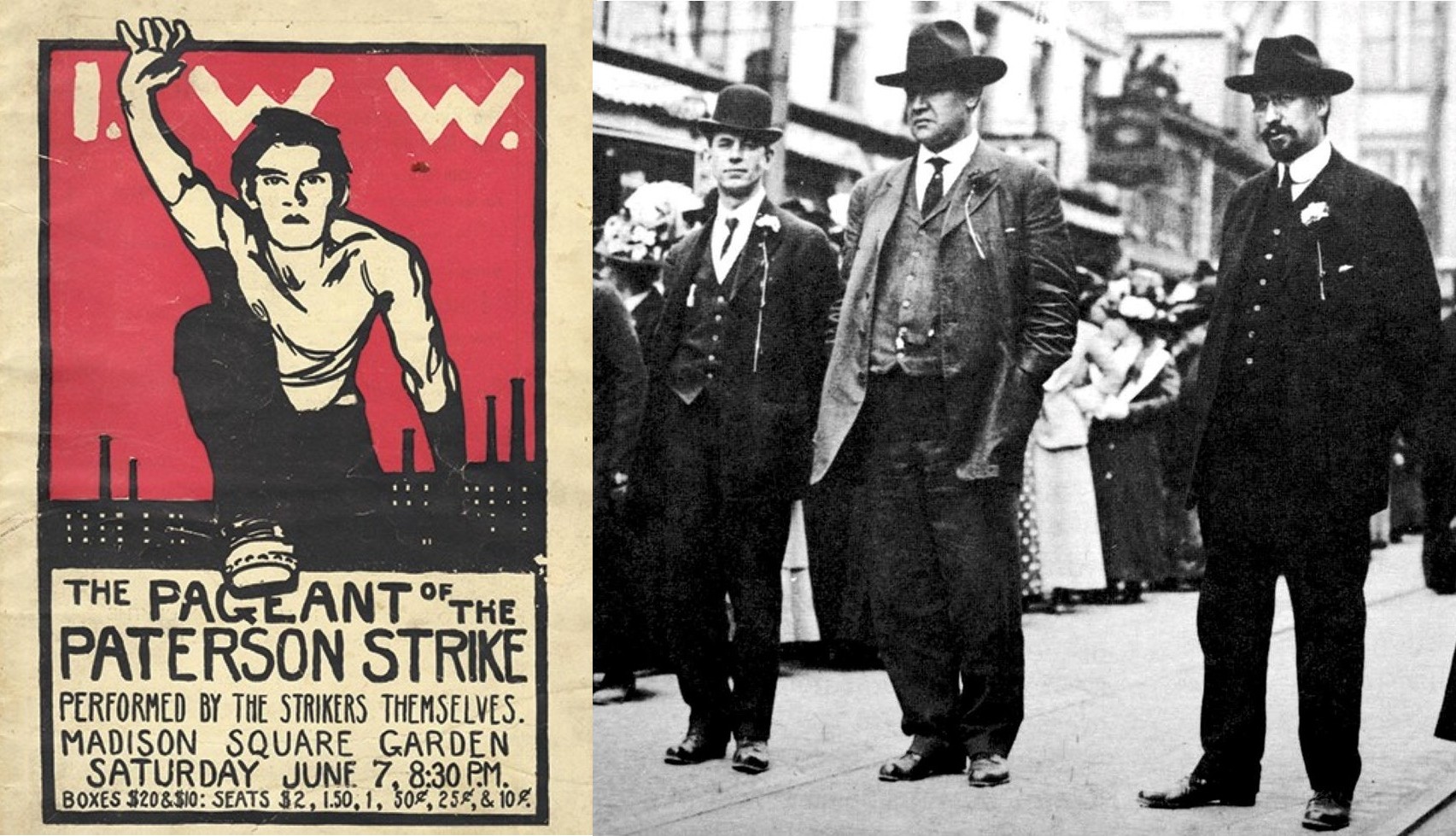
Haywood’s summary of the era-defining 1913 Paterson Silk Strike from the Madison Square Garden Pageant program.
‘Smoothing Out the Wrinkles in Silk’ by William D. Haywood from Pageant of the Paterson Strike. Success Press, New York. 1913.
When more than seventeen weeks ago the broad-silk weavers of the Henry Doherty mill went on strike, they had no idea that it would grow until the silk industry would be paralyzed. This is the situation at present,
The strike has spread until every branch of the industry in Pennsylvania, New York, Connecticut, Virginia, as well as New Jersey, is involved.
The strike of the silk workers is unique in as much as it more nearly represents a general strike than anything that has ever occurred in any industry in this country. There are approximately 50,000 men, women and children who are affected directly as strikers, or are locked out, due to the fact that the dye houses, which are one of the preliminary processes and the keystone of the silk industry, are tied up.
Organization Beforehand
Paterson, N.J., is at this hour the storm center of this remarkable strike. The silk workers are fortunate in having Local No. 152 as a nucleus around which to form their organization. This Local was largely composed of seasoned veterans in the labor movement, many of them charter members since 1906. When they realized the necessity of a general strike to protect the workers of Doherty’s mill and themselves, the strike call came from Local 152. It met a general response, and the necessary committees for carrying on the preliminary work of what have grown to be matters of great importance were formed almost automatically and have since developed and been added to, so that from nearly every standpoint the working machinery of the strike is in excellent shape.
From the beginning the Executive Committee began throwing their outposts into the adjoining states where silk was produced, and through the efforts of these committees the aims and purposes of the strike were made known, so that now, in all localities, the silk workers are standing for the same demands as Paterson.
Police Help Strike
It was in the very beginning of the strike that we received our first assistance from the police force. Elizabeth Gurley Flynn and Carlo Tresca came from New York to work in the interests of the strike. They were almost immediately arrested and thrown into jail. This action on the part of the police so thoroughly aroused the working class of Paterson, and especially that part of it that had heard the speakers at different meetings deliver the message of the I.W.W. and make their appeal for solidarity, that it resulted in bringing about an amalgamation that would otherwise have required much hard work and a longer period to accomplish.
Since then the police have continued in their bungling methods, each time adding to the indignation of the striking workers, as well as arousing the hostility of the public, which is usually against the workers.
The city and county authorities and politicians generally have assumed the same arrogant attitude that we have always to contend with, while, on the other hand, the workers in this particular strike have been tolerant and patient in face of all opposition. Hundreds of them have been thrown into jail, arrested without warrant and held without charge, with the evident purpose of breaking their spirit. They have been crowded into noisome cells, in some instances seven or eight being compelled to occupy a space intended for one, and kept there more than twenty-four hours without food or water.
This brutal treatment, instead of weakening the spirit of the picketers, has made it stronger, as is shown by the fact that some of them have been arrested four and five times, only to come out of jail, report their experiences at the mass meeting, and go on to the picket line again in defiance of the police.
Demands of Strikers
The chief demand of the strikers is for the shorter work day. The dye house workers, who are employed at the most unhealthful and meanest work connected with the silk industry, are demanding an eight-hour day and a minimum wage of $12. Already some of the dye house proprietors have offered to reduce the 12-hour day to 9 and give $13 a week. But the workers have learned to think in terms of eight hours and are not willing to make any concessions.
So strong is the desire for eight hours among the workers that this is the time when the capping stone is to be put in place. They have sworn to themselves that no matter what the outcome of the strike or what the result of any settlement, under no circumstances will they work longer than eight hours. This determined stand has been taken in mass meetings of the women as well as of the men and children.
The ribbon weavers are demanding that the two-loom system be abolished, the eight-hour day established and the 1894 price list reinstated.
The principal demand of the broad-silk weavers is to abolish the nerve-racking and death-dealing three and four loom system.
These are the principal demands that have held 25,000 workers in a solid phalanx against the manufacturers’ association for now eight weeks.
The manufacturers, with their sordid and selfish plea, claim that they cannot grant the workers’ demands and make any profit out of their goods; this, notwithstanding that they are receiving a 60 per cent. tariff protection against foreign importation, which has enabled them to receive the bulk of the wealth represented in the silk industry, which now represents $200,000,000. The workers have invited the manufacturers to raise the price of the goods, as this is one of the commodities not used by the working class, and perhaps for this reason the price has not increased during the past ten or fifteen years, while bread and meat have gone up 100 per cent.
The manufacturers likewise claim that they have competitors in the field, which in itself is a palpable lie, as 80 per cent. of all the ribbon manufactured in America is made in Paterson, which likewise is true of the finer grades of silk.
Cheaper grades are made in Pennsylvania, where wages are less and where 91 per cent, of the workers employed in silk mills are women and children. These mills, in many instances, are only the annex of Paterson concerns, which have built up their business in mining camps, where the wives and children of the miners have been induced to become the slaves of the silk barons.
I.W.W. a Nightmare to Bosses
Before the startled eyes of the silk manufacturers the I.W.W. looms up like a nightmare. They have found no one in executive capacity with whom they can deal in star chamber sessions in methods usually adopted with the John Golden type, who, by the way, was responsible for the introduction of the four-loom system through one of his compromise “settlements” some years ago in Paterson.

As in Lawrence, so also in Paterson, the mask has been torn from Golden, and here he will be unable to make any success as a strike-breaker. He is discounted and despised by the workers, who know him for what he is, a medium and tool for the bosses. The employers would indeed like to “settle” with Mr. Golden, but the Paterson strike will not be settled by outsiders, but by the workers themselves who have the strike in their own hands and are learning to jealously guard their interests.
Nearly 10,000 of these men, women and children, who are battling for a better standard of living, are now members in good standing of the I.W.W., while thousands of others have been enrolled and will be card members as soon as the strike is settled.
An indication of the way the bosses feel toward the I.W.W. is plainly shown by the following statement of the manufacturers’ association just issued:
“The manufacturers can give no more wages and they cannot shorten hours and still continue in business. They cannot change their position in the very least particular. They refuse to recognize the strikers as a body because they are dominated by the I.W.W.”
Paterson “Press” Howls
The following shriek from the Paterson “Press” will give the readers of “Solidarity” an idea of how the I.W.W. is regarded by this mouthpiece of the silk mill owners:
“The ‘Press’ is against the I.W.W. The ‘Press’ hates to see the working men and women of Paterson fooled by the I.W.W. The ‘Press’ wants to make it as plain to the mill workers of Paterson as the English language permits that the I.W.W. would go out of existence if there were no strikes. In other words, the I.W.W. is kept alive by fights between employers and employees. That being true, it is the sole business of the I.W.W. to create trouble between capital and labor, and by so doing to keep the organization in existence and keep pouring money into the pockets of the paid agitators of this un-American organization. Cannot the mill workers of Paterson see that they are being made a tool for the professional trouble makers who head the I.W.W.? The I.W.W. agitators are the only ones who have been benefited by this strike. Figure it out for yourself, you mill workers of Paterson, just how much this gang has cleaned up in this city during the past six weeks. How much did they clean up in the Lawrence strike? How much did they make out of the Akron strike and in others in which they have operated? Is it not true that they would like to continue the Paterson strike for at least another two weeks, so as to capture the second month’s assessment, which you, who have foolishly joined the I.W.W., must pay to be in good standing in this revolutionary organization?
“The I.W.W. never won a strike, and so long as American manhood and American principles prevail it never will. The so-called strike leaders, who are feeding like vultures upon the misery of their dupes, go from city to city, and, as in Paterson, when they have squeezed all they can from their victims, depart to some other field, where they go through the same diabolical program of arraying the working class against the employing class, preaching hatred, violence and treason, and in the meantime chuckling in glee over their devilish creations, while they pocket all the coin in sight.
“I.W.W. Disgrace to America”
“The ‘Press’ begs the mill workers of Paterson to repudiate the I.W.W. for two reasons: First, because it is a disgrace to America; and second, because it carries with it the very characteristics that will bring defeat to any strike that it engineers. The I.W.W. is a hoodoo organization simply because it is a bad organization, and the ‘Press’ tells the mill workers of Paterson that better conditions will never be brought about through its agency. The I.W.W., instead of the friend, is the enemy of the working man, because it promises him what it cannot perform. And not only is the I.W.W. the real enemy of the working man, whom it professes to love, but it is the enemy of the best country on earth; it stands for the destruction of the government of America, the country that is a haven of refuge for the downtrodden people of Europe. And so in advocating methods that if carried out would destroy this country, it is the enemy of the unfortunate peoples of other climes who come here to enjoy the benefits of the higher civilization and the improved working and living conditions that have made America the peer of the whole world.
“The ‘Press’ is the real friend of the working people of Paterson, because it warns them against their worst enemy. Every day that the I.W.W. stays in Paterson the city is polluted and disgraced. The city officials seem unable by any foundation of legal procedure to get them out. It is therefore up to the working people of Paterson to do the job. They can accomplish what the Mayor, the Chief of Police, the Public Prosecutor, the Sheriff and the city’s entire legal department cannot bring about.
“Will the mill workers of Paterson force the I.W.W. out of town, go back to the mills, and then organize themselves into a decent, dignified American organization to work for better shop conditions? The ‘Press’ promises that if they will do this, the manufacturers, who have justly refused to recognize the I.W.W., will be forced to listen to them. If the workers will repudiate the I.W.W. the ‘Press’ renews its promise to support them vigorously in their undertaking, as will every other good influence in Paterson.”
Similar to Lawrence
Again we have a situation similar to Lawrence in the many different nationalities to bring together. Here are twenty, chief among them the Italians, and in order Jews, German, American, Polish, and workers from many other countries. An insidious effort has been made by press, pulpit and politician to divide the ranks of the workers, appealing to the spirit of patriotism of the Americans, all of which have been devoid of results, as will be seen by the following letter:
“Whereas, the Morning Call, the Paterson Press and Guardian, newspapers published in the city of Paterson, have repeatedly published in their columns that the American or English speaking men and women wanted to go back to work, being satisfied with conditions in the silk industry as they existed before the present strike, and that they were intimidated and afraid to go back to work on account of the fear that they would be branded scabs by the foreign-speaking men and women; and
“Whereas, such statements published by the above newspapers are an insult to the English-speaking men and women who are on strike for better conditions, and whose demands have been presented to the manufacturers by their respective shop committees and said shop committees upon presenting said demands have not always been shown the courtesy due them as American men and women;
“Resolved, That we, the English-speaking employes of the Frank & Dugan (both Railroad avenue and Marget street) mills in shop meeting assembled do hereby protest against the aforesaid newspapers in trying to inject race prejudice into our ranks in order to divide the working men and women who have for the past six weeks put up such an orderly and splendid fight for better conditions, in order to live a better, longer and happier life, so that the city of Paterson may become a model city for the whole world to look up to.

“The Employes of the Frank & Dugan Shops, per the Committee on Resolutions.”
The Mills Are Dead
The workers of all nationalities realize that this strike is the crucial test of the silk industry. Each and all of them are conserving their strength and making every cent count. During all these long weeks the writer has never seen a drunken man among the strikers of Paterson. They are not spending what little money they may have for anything but the actual necessities of life, but they are willing to fight until bitter starvation drives them back, and even then will still fight and make the bosses pay for their folly.
The spirit of enthusiasm among the workers is unflagging. Great mass meetings are held every day in the forenoon in Turn and Helvetia halls, while the afternoons and evenings are given to shop committees of the various branches in the industry. Among the most notable of the meetings that have been held have been those of women and of children.
The workers are active in their own interests. The mills are dead, standing like sepulchres, rusting for lack of the magic touch of the wealth producers.
PDF of original program: https://archive.org/compress/pageantofpaterso00unse/formats=TEXT%20PDF,JPEG-COMPRESSED%20PDF&file=/pageantofpaterso00unse.zip
 Revolution's Newsstand