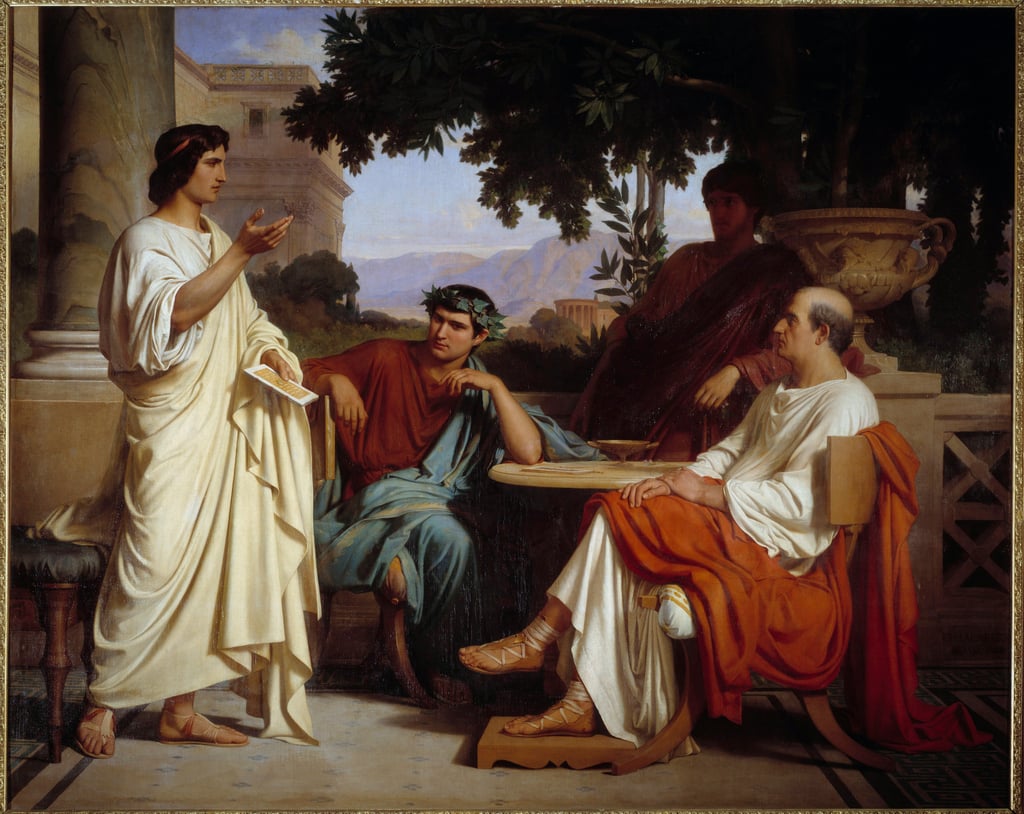
Radical classicist Rolfe Humpries on the the place of the Roman poet in history and literature.
‘Two Thousand Years of Years of Horace’ by Rolfe Humphries from New Masses. Vol. 22 No. 6. February 2, 1937.
A much-misunderstood Roman poet is seen against the class background of his time
THE Roman poet Horace was born two thousand years ago. It is a rather sinister commentary on this ancestor of ours that his bi-millennial anniversary has to be celebrated almost exclusively by academicians, and is scarcely noticed by our bards and critics. No modern poet could be expected to have the devotion to assemble for the occasion a complete collection of translations of his 120 Odes and forty-two longer poems, so perhaps it is ungrateful to fault Professor Kraemer’s work on the ground that he is not a poet. In the edition prepared by him, there is more verse than doggerel, but more doggerel than poetry: there are pompous and pedestrian versions of Horace, as well as arch and cute improvements on him; the hacks and dubs are here, along with Ben Jonson, Samuel Johnson, Calverly, and Conington. If the best of translations is not always found, nor the best of translators always put to happy use, nevertheless thanks are due Professor Kraemer for performing an act of piety; and among the welter of undistinguished items, the prose translations made from the Satires by Hubert Wetmore Wells deserve praise for their direct and unsqueamish reproduction of a salty toughness in the Horatian idiom. This quality is too often obscured by persons who have an interest in making Horace appear a mellow and genial sot, the columnists’ delight, or a propagandist for imperialism after the fashion of the late Kipling.
The searching felicity of Horace, as Professor Kraemer’s unpretentious introduction agrees, puts him, to our loss, beyond reach of translators. Nevertheless, a study of his life and work is rich in interesting and profitable instruction. “He writes to us,” says Dr. Kraemer, “from a stirring age when old systems had collapsed and a new order was rising hesitantly from the ashes. The reign of Augustus was the culmination of a century of heart-breaking civil war, of tumultuous political struggles which left men exhausted and crying for peace. The spirit of the age Horace feels so intimately and interprets so faithfully that we have in him not merely poetry but a historical document. In the pages which follow, one can pick up all the threads of a tangled web: the disorder, the corruption, and the moral decay of an impotent political system; the dark threats of watchful enemies on the frontier; a New Deal with a slogan of peace and prosperity; the valiant struggle for the creation of a new morale based upon internal reform and harking back to the great old day, the criticism of problems yet unsolved, like the ostentatious rage for wealth and the irrational lure of the city.”
This, to be sure, puts it somewhat naïvely, and offers misleading analogies, but if we come to our study of Horace equipped with even a rudimentary dialectic apparatus, we can see more clearly not only how his work reflects, but also how he was himself conditioned by, the class struggle of his time. Marx saw that struggle in ancient Rome in terms of a duel between debtors and creditors, with slavery the former’s eventual fate; before the birth of Horace, his father had been by turns free, then slave, then free again. To appreciate Horace, it is necessary to survey the economic history which culminated in a century of heart-breaking civil war and tumultuous political struggle.
THE LAST CENTURY of the Roman republic coincided with the rise of the business men; the collapse of republican institutions was more than coincidence. The economic antagonisms were becoming too strong to be held in check by the old machinery. The exploited classes grew increasingly restless: there were proposals for the restoration of the old peasant state, and wild rumors of an alliance between the slaves and the free proletariat of the city. In the end, an alliance between the bourgeoisie of all Italy and the proletariat, headed by ambitious politicians and military leaders, brought about the overthrow of the old feudal land-owning classes, and of their tool, the republican state. To establish a new instrument for the new interest required the introduction of dictatorship, a principle by no means received with lavish enthusiasm. As Rostovtzev points out, the intellectuals were inclined to take a stand against tyranny, and fought on the side of Brutus and Cassius against Cæsar. This was the losing side; but the victory of Octavian Augustus was not secure until Actium, and was in large measure the consequence of his having persuaded the proletariat to fight, for once, not in defense of its own material interest, but on behalf of a slogan “to save the world for Roman ideals against oriental barbarism and slavery.” The victory of Augustus was a victory for the Roman middle class. The victor realized that the benevolent dictatorship he was permitted to exercise must never transcend conservative functions. Recovery, to his notion, took precedence over reform. In the competition between individual business men, neither the leader nor the state machinery he organized was permitted to interfere. The ranks of the great capitalists who had dominated the republic were joined by newcomers from all classes, including former slaves, but the dominance of capitalism was encouraged. The economic policy was completely laissez-faire. It was a pity the father of Horace could not have lived to enjoy this state of affairs, though he might have fought against its consummation. By this time, the son had outgrown the primary phases of schooling, the father had scraped together enough to take the son to the city for a modest education; he seems to have determined that his son should not repeat the error of trying to buck Rome. The atmosphere there at Rome was by no means serenely academic; the period was one of increasing violence climaxed by the outbreak of overt hostilities between Cæsar and Pompey.
Athens was a better place to study, but the poet’s reading of the Greek poets in the Academy was interrupted by a call to action. Brutus, the tyrannicide, was making his headquarters there, and Horace was among the intellectuals persuaded by him to accept commissions in the republican army. Horace soldiered with some success, but fled the field with the losers at Phillippi, and made his way home to find most of the family’s Venusian holdings confiscated by the bonus demands of the victorious soldiery. He salvaged enough to take him to Rome and buy a clerkship in the treasury department. Thus he managed to live, and find enough marginal time to stroll around, have a little fun, and put in some time on his scribbling.
Horace was not an æsthete. Any tendency to dilettantism had been knocked out of his head by tough schooling he had received. He had never been infected by the atmosphere of literary cults and coteries, common as they were at Rome, nor was he inclined to think that poetry could be compounded out of obscure perversity and neurotic conceits. He began with a kind of writing which he considered none too far from prose. His Satires, or Conversation Pieces, afford autobiographical and critical commentary in defense of his position and practice; other items are scarcely more than anecdotes, wise-cracks, or risqué argument of the sort that particularly amuses the commercial mind. Not high art, they are, in general readable and entertaining, particularly as they reflect a quite unliterary, un-Roman interest in business men and affairs. As to their morality, Horace explicitly tells us that between right and wrong Nature can draw no such distinction as between things gainful and harmful. Sinfulness, whether in fiscal or sexual matters, consists only in going to extremes.
Horace published a second collection of Satires, less incisive than the first, and on the strength of these successes added a collection of early pieces which our present editor classifies as Refrains. Meanwhile, his literary security had been greatly advanced by his meeting with Virgil, who presented Horace to the man who had put him on his feet again after the evictions at Cremona, a rich young business man, well educated, personal confidant and adviser of Augustus. Mæcenas believed that an artistic renaissance would promote as well as advertise the glories of the Augustan regime; Horace realized that the institution of patronage was a necessity for the aspiring writer. Mæcenas probably had his doubts about accepting Horace, for the tone of the Satires had been pugnaciously republican, but Mæcenas was truly liberal, and time fought on his side, proposing to republicans the choice between Antony and Augustus, and not sensible person could have any doubt as to which was the lesser evil. It was not, with Horace, a question of acquiring economic independence at a cost of political subservience. As for the farm Mæcenas gave him, Horace felt that he properly had it coming to him after the robbery at Venusia. There is no doubt that the direction of his work was thereby changed, but there is no evidence that the change was in the direction Mæcenas and Augustus would have preferred.
The official policy tended to promulgate nationalistic feeling, to revive the old Latin classics, to reestablish in the minds of men devotion to the primitive Italian agrarianism out of which, it was felt, the greatness of the state had arisen, only to be corrupted by the degenerate practices of the mercantile age. Against the official policy, Horace was prepared to argue that what Rome needed for cultural enlightenment was not less but more of the Greek spirit, not less but greater urbanization of the mind.
This is not to say that the Odes reflect an arty, romantic, ivory-tower, escapist theory of art; on the contrary. Plenty of that kind of verse was being written in Rome, some of it even within the circle of Mæcenas, but it was a kind of verse with which Horace had no patience whatever. The Odes are loud with a sense of civic obligation and individual responsibility; moreover, they are informed with a realistic observation. Like the Satires, the Odes persist in the mention of rebels against tyranny; the final important poem of the first book, an intensely patriotic outburst in commemoration of Actium, culminates, without a trace of chauvinism, in a splendid tribute to the beaten Cleopatra. With all the urge of Roman pride and loyalty, Horace yet faces the fact that he has to go back to the equivalent of our colonial times to find men worthy of his praise. The Regulus poem is a terrific denunciation of the vulgarity, corruptions, and decadence of a degenerating plutocracy; Regulus goes with dignity to death among his Carthaginian foes rather than face prolonged existence in such a state. Frank says of his twenty-fourth ode that “not even in the period of his own distress did he so nearly approach a complete condemnation of capitalism and all its consequences.”
The two books of letters in verse, reverting in form somewhat to the manner of the Satires, and written during the poet’s later forties, show signs of weariness. The poet seems to have been discouraged by the reception of the Odes, as well as saddened by the death of Virgil. With the latter gone, Horace had to be acknowledged as Rome’s poetic leader, and Augustus called on him to compose the Secular Hymn for the ceremonial games ostensibly in honor of Apollo. A revolutionary situation was in the making throughout the western provinces, and Augustus projected a big religious show to serve the disguised pretext of booming the political regime. To this period also belongs the fourth book of Odes, a rather scanty collection organized around poems in praise of military victories on the northern frontier, and supported by material not quite good enough for former books, patched up and worked over. The evidence is perhaps insufficient to prove that Horace could stand adversity better than prosperity.
Finally, in his latest and longest single work, a verse essay on the art of poetry, Horace documents for us the case history of one type of artist in a society whose culture varies according to the class character of the population. In the light of his experience we are shown how the impulse to classicism and classical unity is the inevitable dialectical product of an essentially individualistic and romantic time. The very attempt of the individual to escape from romanticism is itself fatally romantic; the classicism of Horace, like that of T.S. Eliot in our own day, is really only romanticism’s double negative. Horace records for us other phenomena familiar to such a time. He tells us, for instance, of conceited dilettantes whose self-confidence was the equivalent of criticism, and of long-haired bohemians whose reputation was in direct proportion to the unkemptness of their appearance; he mentions æsthetic phonies with a predilection for the archaic, and the self-subsidized newly-rich throwing parties to promote flattering notice of their otherwise intolerable works. For all such gentry Horace had an abiding scorn. He thought that literature, like athletics, was something for which men had to train, and lolling around salons a vicious practice. If a man was to write well, he had to begin by knowing something, and academic information was not enough. To get the right thing said at the right moment required tenfold scrutiny, patience, and immunization of the mind against the itch for publication. Mediocrity in art was anathema. “Neither gods, nor men, nor even booksellers, can stand for pretty good poets.”
The essay shows that Horace had some shrewd intimations as to how the degeneracy of art forms was effected by material conditions. In talking about the history of Greek drama, for instance, he observes that “with the growth of wealth and luxury in the state, and the consequent deterioration in the taste and character of the audience, the music became more florid and sensational, the diction more artificial, and the sentiments more obscure and oracular.” He recognizes the difficulty in which an artist who aims at classical unity is involved by virtue of the fact that the class character of the audience is divided: the upper classes, he says, are often offended by lines which the proletariat approves. And when it comes right down to contemporary fundamentals, he attributes the imperfect state of Roman poetry to the fact that education conditions the reflexes of Roman youth along other lines:
Our Roman boys, by puzzling days and nights,
Bring down a shilling to a hundred mites.
Come, young Albinus, tell us, if you take
A penny from a sixpence, what ’twill make?
Fivepence. Good boy! you’ll come to wealth one day.
Now add a penny. Sevenpence, he will say.
O, when this cankering rust, this greed of gain,
Has touched the soul and wrought into its grain,
What hope that poets will produce such lines
As cedar-oil embalms and cypress shrines?
“This love of gain,” observes an earlier editor of Horace, “hath been uniformly assigned, by the wisdom of ancient times, as the specific bane of arts and letters. Longinus and Quinctilian account, from hence, for the decay of eloquence, Galen of physic, Petronius of painting, and Pliny of the whole circle of the liberal arts. For being, as Longinus calls it, Nosema mikropoion, a disease which narrows and contracts the soul, it must of course restrain the generous efforts and expansions of genius; cramp the free powers and energies of the mind, and render it unapt to open itself to wide views, and to the projection of great, extensive designs. It is so in its consequences. For, as one says elegantly, when the passion of avarice grows general in a country, the temples of honor are soon pulled down, and all men’s sacrifices are made to fortune.”
 Revolution's Newsstand