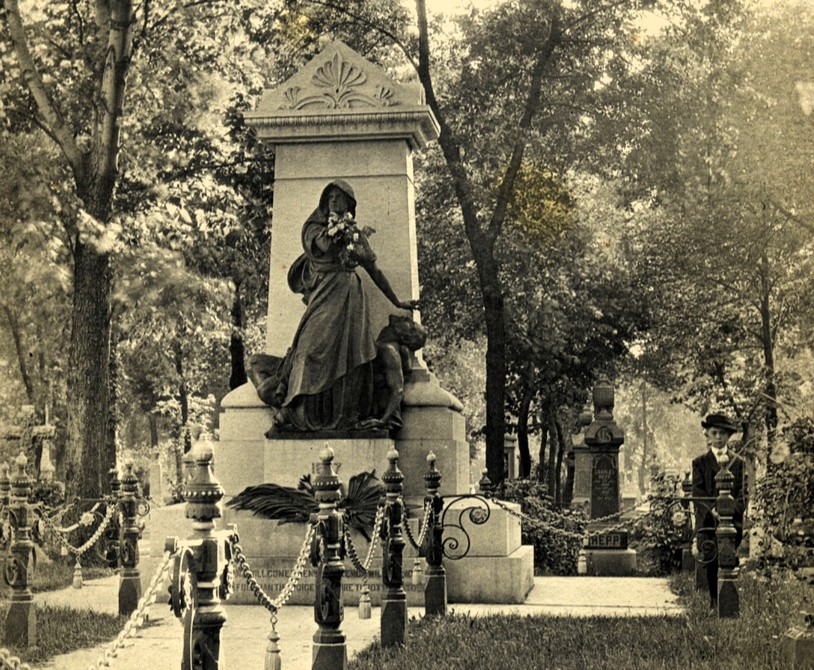
A solemn manifestation at the graves of the Haymarket martyrs by thousands of their comrades, friends, and families on the first anniversary of their execution.
‘At the Martyrs’ Graves’ from The Alarm. (new) Vol 1. No. 36. November 17, 1888.
Labor Assembly No. 1 held an interesting meeting last Wednesday night, out of which grew what at one time threatened to be a sensation. After the regular lecture of the evening (a humorous and able essay on “Poetry” by William Furey) chairman Holmes reminded the assembly of the near approach of the anniversary of the judicial murder of a year ago, and requested the secretary to read the following resolutions, which were unanimously adopted:
“Whereas: On the 11th November 1887 certain labor reformers were barbarously put to death by the constituted authorities after a trial notorious for its unfairness—the victims of a shameful conspiracy by the money power; and
“Whereas, We recognize that these men were our brothers, the true friends of labor and radical reform, and worthy our deepest respect and emulation; therefore
“Resolved, that the members of Labor Assembly No 1, in order to show our respect for these dead heroes, agree to take part in any public demonstration that may take place, whether in the city or at the graves in Waldheim cemetery, on the 11th of November.”
The question once started evoked considerable enthusiasm, and it was finally decided that the assembly would march in a body from their hall to the depot on Sunday morning. A committee was also appointed to wait upon Mayor Roche for the purpose of ascertaining the terms of the ordinance against parades and outdoor demonstrations.
Messrs. Oliver and Shannon, a majority of the committee saw the mayor on Friday morning and had a very stormy interview with “Hizzoner.” He attempted to bully and cowe them, but he evidently had got hold of the wrong customers. Before they left him the committee impressed this modern Caesar with the fact that they knew their rights and dared maintain them.
That same evening and the next morning the papers announced that the committee had approached the mayor bowing and scraping, and after listening to his denunciations of anarchism had sneaked out of his presence. Mr. Oliver sent a manly letter of protest and denial explaining the real facts to the News, but that paper of course refused to print it.
On Sunday morning the weather, which for three days had been wet and disagreeable, was bright and cold; nature smiling on us, her favored children, with her accustomed benignancy. Owing to an unfortunate misunderstanding as to the time for assembling at the hall, several of the members arrived late. The early comers, after waiting nearly an hour, proceeded, to the depot bearing a large circular bank of white and yellow flowers, with a red star in the center and the words “Albert R. Parsons’ Assembly” in red flowers around the rim. Shortly afterward about forty more of the members reached the hall and also marched to the depot in a compact body. Thus the assembly, composed largely of native born Americans, fully carried out their programme, nor were they molested in doing so.
Two special trains conveyed about 3000 people to Waldheim, and other trains, arriving later, brought additional crowds to this future Mecca of all good socialists. Besides this, the villages and small towns in the vicinity were well represented.
The scene from the speaker’s platform in the cemetery was an imposing one. On all sides was a perfect sea of upturned, eager, earnest faces. It was not a very demonstrative gathering, but during the reading of the letter of our comrade Parsons to his children many of the upturned faces were bathed with fast flowing tears. Geo. A. Schilling called the multitude to order and introduced Robert Reitzel of Detroit who spoke at some length in German.
About one hundred pupils of the socialistic Sunday-schools of the city sang an ode composed by Dr. Edward Kleinodt and set to music for the occasion by Professor Oscar Schmoll. It was entitled: “Für Freiheit und Recht” (for freedom and right), and the first verse of it was, in literal translation, as follows:
O Freedom, thou hidest in dismay thy face,
I hear around me naught but dirges sounding.
For that which none had deemed possible.
It was done, and done to thy truest sons.
E’en now a more enlightened public knows
That your watchword was: Freedom and Right.
This chorus of young voices (little ones ranging from 7 to 12 years old) was an interesting and significant feature of the occasion. These are the children whom the capitalistic press declared should be torn from their homes because they were learning principles destructive of “law and order.”
George Schilling then read the letter which comrade Parsons left for his children with the request that it should not be opened and read until the eleventh of November 1888. The letter is as follows:
“Dungeon No. 7. Cook County Jail. Chicago, Ill., November 9, 1887.
“To my darling, precious little children, Albert R. Parsons, jr., and his sister, Lula Eda Parsons–As I write this blot your names with a tear. We never meet again. O, my children, how deeply, dearly your papa loves you. We show our love by living for our loved ones. We also prove our love by dying when necessary for them. Of my life and the cause of my unnatural and cruel death you will learn from others.
“Your father is a self-offered sacrifice on the altar of liberty and happiness. To you I leave the legacy of an honest name and duty done. Preserve it, emulate it. Be true to yourselves, and you cannot be false to others. Be industrious, sober and cheerful. Your mother; as she is the grandest, noblest of women! Love, honor and obey her, my children.
“My precious ones, I request you to read this parting message on each anniversary of my death in remembrance of him who died not alone, for you, but for the children yet unborn.
“Bless you, my darlings. Farewell. Your father,
Albert R. Parsons.”
The German Maennerchor, 300 strong, followed with the beautiful dirge, “Under the trees is rest,” composed and set in music by Professor Otto W, Richter. It was sung in excellent style and the words of it were as follows (in translation):
Sleep sweetly, dear brethren.
Best now in the silent tomb!
To your honor sound these songs;
Since your duty you fulfilled:
Fearless, true, for human rights,
Without expecting any gain.
Fighting against cruel power,
Yielded you your lives.
But the seed will put forth shoots,
Trees which no storm may blow down;
Freedom will cease to be a mere word,
And the lie will destroy itself!
Sleep sweetly, then, dear brethren, etc…
The singing societies, which rendered this hymn were the following: Socialistic Maennerchor of the Southwest Side, Social M.C. of the North Side, International M.C., Harugari M.C., Hermannssoehne M.C., Schleswig-Holstein Saengerbund, Liedertafel Vorwaerts, Herwegh M.C., Singing Section Columbia, Singing Section Aurora.
Chairman Schilling then announced that Joseph Labadie, of Detroit, who had been engaged as a speaker in the English language, was unable, on account of sickness in his family, to be present, and introduced in his stead William Holmes who had been requested by the committee at the last moment to address the assemblage. Comrade Holmes then made a short speech eulogizing the dead heroes. He began by declaring that this was the proudest moment of his life, but he felt his unworthiness to attempt to carry on the grand fight in which our noble comrades had laid down their lives. Pointing to the five graves near at hand, he said the bodies interred there had been the noblest, the truest and altogether the grandest men the centuries had ever known. They were ever ready to sacrifice time, money, their liberty and their lives for the great principle of human emancipation, and he urged his bearers to continue in the grand fight until labor’s wrongs were righted and their rights guaranteed for all time. The lying capitalistic press and a prejudiced public had hurled denunciation upon the heads of the devoted men and denied that they were the true representatives of labor. In refutation of this vice slander he referred to the work of the men in the coal fields of Ohio, Pennsylvania, their frequent trips of agitation throughout the country, and the tens of thousands of workers they had addressed at home and abroad.
The speaker then said a few words for the men who are enduring a living death in Joliet, and declared there were men yet in the ranks deserving our warmest praise and our united support. Many of them
—toil in penury and grief,
Alone if not maligned
Forlorn, forlorn, bearing the scorn
Of the meanest of mankind
But the sunshine aye
Shall light the sky
As round and round we run
And the right shall yet come uppermost
And justice’s shall be done.
As surely as yonder sun lights the sky, our time will come. We have waited long, and bitter has been our disappointment at times, but the day of the proletariat has already begun to dawn and we must prepare for the inevitable day of reckoning.
Paul Grottkau was the last speaker and spoke in German with his accustomed eloquence.
It may come in peace if the right men lead
It will sweep in storm if it be denied.
Law to bring justice should be decreed
And on every hand are the warning’s cried.
Beware with your classes! Men are men,
And a cry in the night is a fearful teacher.
When it reaches the hearts of the masses, then
It needs not a sword for a judge or a preacher.
Take heed, for your juggernaut pushes hard,
Man holds the doom that its day completes.
It will down like a fire when the track is barred
By a barricade in the city streets.
The band then rendered some appropriate selections and the gathering silently dispersed.
The Alarm was an extremely important paper at a momentous moment in the history of the US and international workers’ movement. The Alarm was the paper of the International Working People’s Association produced weekly in Chicago and edited by Albert Parsons. The IWPA was formed by anarchists and social revolutionists who left the Socialist Labor Party in 1883 led by Johann Most who had recently arrived in the States. The SLP was then dominated by German-speaking Lassalleans focused on electoral work, and a smaller group of Marxists largely focused on craft unions. In the immigrant slums of proletarian Chicago, neither were as appealing as the city’s Lehr-und-Wehr Vereine (Education and Defense Societies) which armed and trained themselves for the class war. With 5000 members by the mid-1880s, the IWPA quickly far outgrew the SLP, and signified the larger dominance of anarchism on radical thought in that decade. The Alarm first appeared on October 4, 1884, one of eight IWPA papers that formed, but the only one in English. Parsons was formerly the assistant-editor of the SLP’s ‘People’ newspaper and a pioneer member of the American Typographical Union. By early 1886 Alarm claimed a run of 3000, while the other Chicago IWPA papers, the daily German Arbeiter-Zeitung (Workers’ Newspaper) edited by August Spies and weeklies Der Vorbote (The Harbinger) had between 7-8000 each, while the weekly Der Fackel (The Torch) ran 12000 copies an issue. A Czech-language weekly Budoucnost (The Future) was also produced. Parsons, assisted by Lizzie Holmes and his wife Lucy Parsons, issued a militant working-class paper. The Alarm was incendiary in its language, literally. Along with openly advocating the use of force, The Alarm published bomb-making instructions. Suppressed immediately after May 4, 1886, the last issue edited by Parson was April 24. On November 5, 1887, one week before Parson’s execution, The Alarm was relaunched by Dyer Lum but only lasted half a year. Restarted again in 1888, The Alarm finally ended in February 1889. The Alarm is a crucial resource to understanding the rise of anarchism in the US and the world of Haymarket and one of the most radical eras in US working class history.
PDF of full issue: https://dds.crl.edu/item/54023
 Revolution's Newsstand