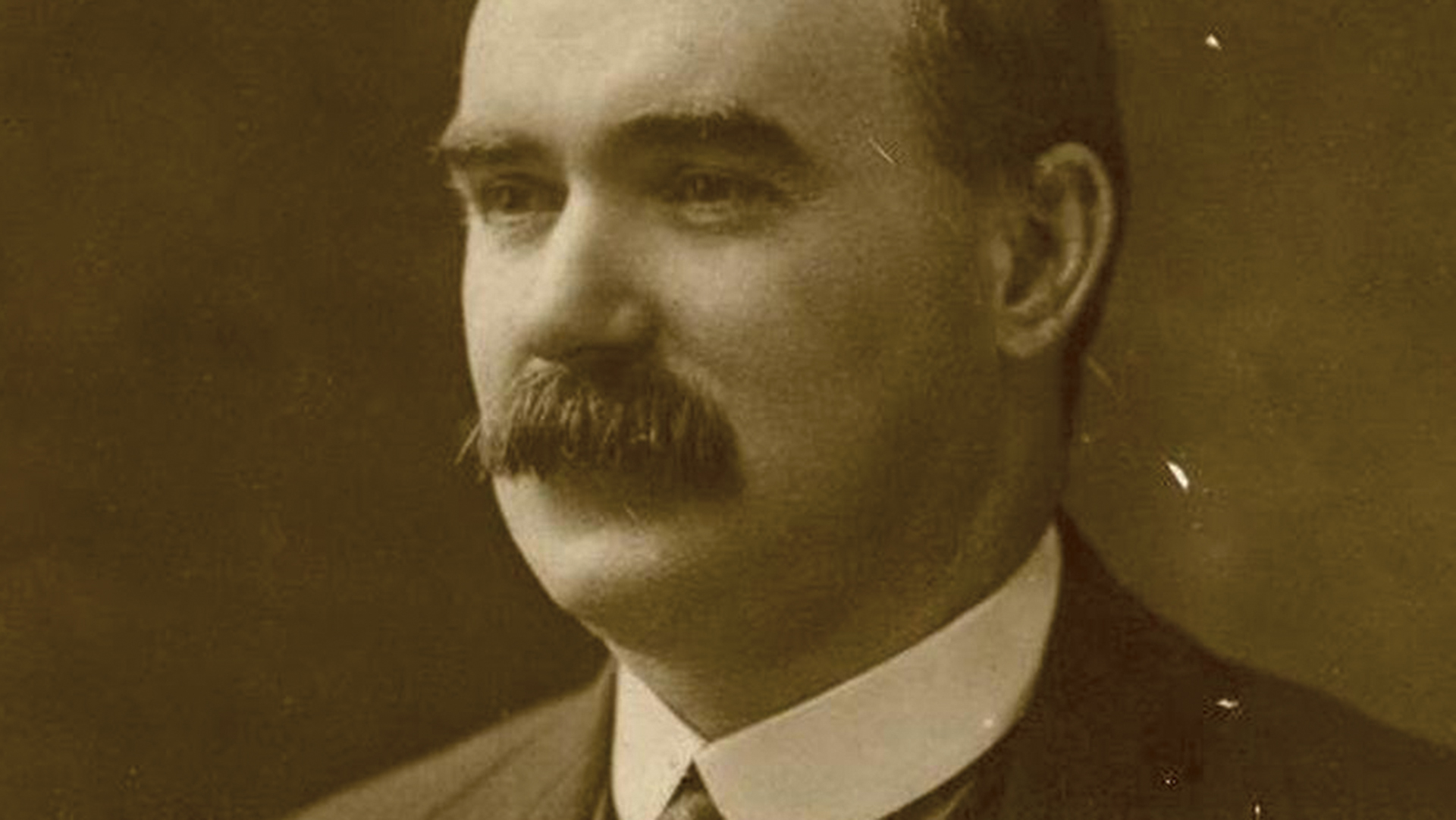
Writing from Salt Lake City during his 1902 tour of the United States, Connolly answers the question asked by many of his Socialist Labor Party comrades, what do you think of the States? His reply below.
‘On America’ by James Connolly from The Weekly People. Vol. 12 No. 34. November 22, 1911.
THE S.L.P. “BEING DEAD YET SPEAKETH.”
Salt Lake City, Utah, Nov. 10. Doubtless my comrades of the S.L.P. would be interested in learning what are the impressions of America I have acquired so far, as the result of my trip in this country. At least when I consider that every Socialist Labor Party member whom I have yet met, as soon as he had got through the necessary preliminary process of shaking my hand, immediately inquired: “What do you think of America?” I am emboldened to believe that my opinion may at least be interesting to the comradeship. So I am venturing to set down here some of my opinions.
When it was arranged between the I.S.R.P. in Ireland and the S.L.P. of America that I should honor this country by my presence, an acquaintance suggested to me that I had better hurry up or there would be no S.L.P. left in the United States when I got there. Now, that was the common belief of all those who depended for their knowledge of American affairs upon the Socialist papers of Great Britain, whose “foreign correspondents” retail for the information (sic) of British and Irish readers every slander against the S.L.P. the malevolence of its enemies can suggest.
Personally, although I took no stock in such slanders, it would be untrue to say that I was entirely uninfluenced by the constantly reported tales of secessions and resignations. I believed that when I got to America I would find the S.L.P. in a pretty bad state; that did not deter me from coming, of course; to me it was sufficient that the S.L.P. was following in America the same line of action which we in Ireland had mapped out for ourselves before we came in touch with S.L.P. literature, that although Ireland and Bulgaria were the only countries which at the International Congress had voted solid against the Kautsky resolution, yet the S.L.P. had followed the lead of France, Poland and Italy, and had backed us up by one vote, and that as long as their cause was just it did not matter whether the S.L.P. vote was 34,000 or the million which the S.D.P. did not poll in 1900. I believe firmly that the revolutionary Socialist movement will always be numerically weak, until the hour of revolution arrives, and then it will be as easy to get adherents by the thousands as it is now to get single individuals.
This then was the mood in which I reached American shores, and I can scarcely convey to the comrades how much the real state of affairs in the sections exceeded far greater all my fondest anticipations. I expected to find the sections disheartened and disorganized; I found them active, energetic, sanguine, radiant with confidence. I thought I would hear all sorts of expressions of regret at certain well known and respected men having left the party; I did hear such, expressions but they were expressions of regret and sorrow for the sake of the men who had left, and thus put themselves out of the movement, not for the party which pursued the even tenor of its way undisturbed by their defections. In short, I found a real revolutionary movement–a movement of fighters who in the eager rush forward to the conflict, have no time to waste a thought on the timid camp followers whom the whirl of the struggle had for a moment thrown out of their natural position and into the van of the fight.
I met the tyrant De Leon whom a Kangaroo at Salt Lake City told me the other day “had driven hundreds of thousands of men out of the party,” and was surprised to find that he struck me as, a somewhat chirpy old gentleman, with an inordinately developed bump of family affection-a new sort of “Socialist of the Chair,” who stated a politico-sociological proposition, which scalps a traitor or reveals a corruption, with as little personal feeling as moves a mathematician or a surgeon in the dissecting room.
Permit me also to say that in one respect the S.L.P. is thoroughly American; it has its full share of the American national disease—Swellhead. When the average S.L.P. man asks me now what I think of America I have got into the habit of replying that I don’t think much of it, and it does me good to watch the dazed, mystified expression that creeps across his face. Then after a while his face clears up and I know then that he has said to himself: “Well, Connolly is only an Irishman after all, and of course he knows no better.”
I was once engaged in an agitation in Dublin against an increase of 12 cents per week in the rents of some cottage property in Bark street, and one of the speakers told the tenants that “the twenty millions of the Irish race in America, the Irish under the Southern Cross of Australia, and away upon the lonely veldt of South Africa,” were watching them–watching to see if we would pay that 12 cents extra per week, and I thought to myself that that kind of heroics which makes one imagine that he and his are the center of the universe was confined to Ireland, but I do not think so now. America has robbed us of that, as she has robbed us of Tammany Hall, saloon controlled politics, slave-driving politicians and other Irish products now acclimatized in America.
One thing that I have noticed in America is that despite all we Irish have done for the country, there are very few monuments to Irishmen in the United States. I was inclined to grumble at this until I came to Salt Lake City, when I found that here, at least, was one city that had repaired the omission. On the topmast spire of the Morman Temple there is a life-size figure of an Irishman named Morany, blowing a trumpet. Of course, they call him an angel and spell his name Morani, but that is only their ignorance. Possibly, they put this distinguished countryman of mine in this exalted position because Irish Mormons were and are as rare as honest politicians.
I am not grumbling at this egotistical feeling on the part of the S.L.P. It is, of course, highly natural towards any other nationality except the Irish; towards us it is only ridiculous. In course of time we will, no doubt, succeed in making you realize that fact; until then we will tolerate you as “an amoosin cuss” as Artemus Ward said of his kangaroo.
I have to thank the comrades for the all they have given me in securing subscriptions to the Worker’s Republic. I got most subscriptions in Boston, Mass., and Duluth, Minn., and least in New York city and Minneapolis, Minn.
James Connolly.
New York Labor News Company was the publishing house of the Socialist Labor Party and their paper The People. The People was the official paper of the Socialist Labor Party of America (SLP), established in New York City in 1891 as a weekly. The New York SLP, and The People, were dominated Daniel De Leon and his supporters, the dominant ideological leader of the SLP from the 1890s until the time of his death. The People became a daily in 1900. It’s first editor was the French socialist Lucien Sanial who was quickly replaced by De Leon who held the position until his death in 1914. Morris Hillquit and Henry Slobodin, future leaders of the Socialist Party of America were writers before their split from the SLP in 1899. For a while there were two SLPs and two Peoples, requiring a legal case to determine ownership. Eventual the anti-De Leonist produced what would become the New York Call and became the Social Democratic, later Socialist, Party. The De Leonist The People continued publishing until 2008.
PDF of full issue: https://www.marxists.org/history/usa/pubs/the-people-slp/021122-weeklypeople-v12n34.pdf
 Revolution's Newsstand