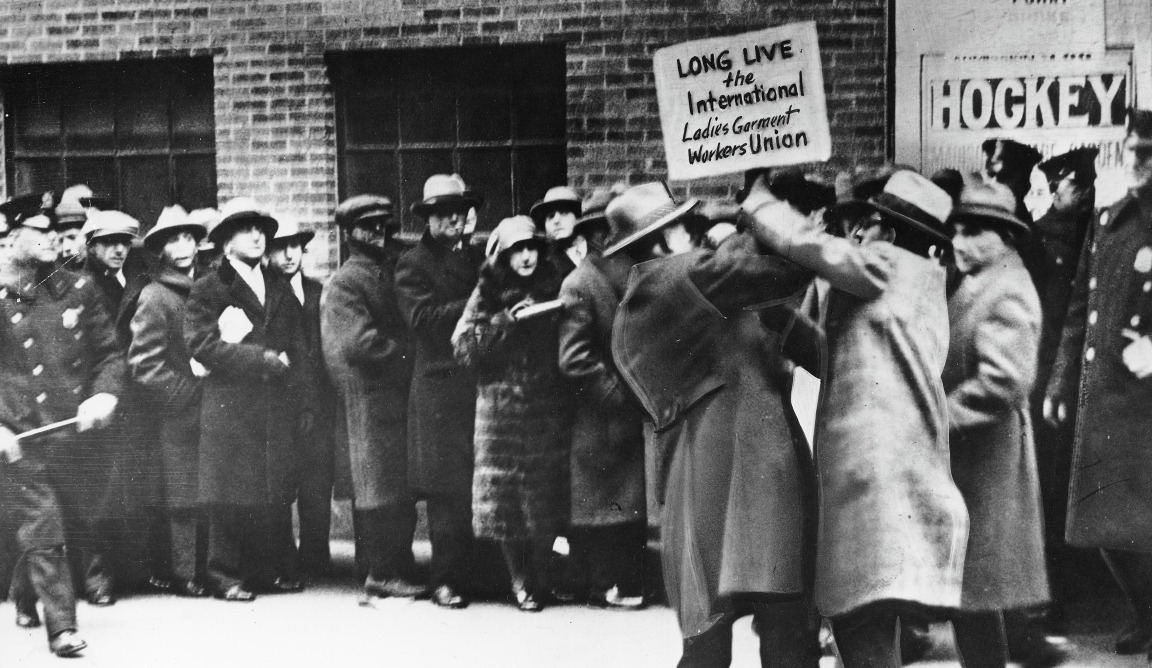
Much to ponder on for today’s labor activists in this article. The I.L.G.W.U. had, perhaps, the largest concentration of organized left wing workers of any large union in the country. That, and many more reason, made the union a site of intense, often successful, radical organizing. Leading C.P. trade unionist William F. Dunne on the importance of the fight and a critique of the strategy and tactics of the I.L.G.W.U. left-wing facing the new ‘Socialist’ leadership of Morris Sigman.
‘The Left Wing at the I.L.G.W.U. Convention’ by William F. Dunne from Workers Monthly. Vol. 5 No. 4. November, 1926.
Two conventions, those of the International Ladies’ Garment Workers and the Fur Workers, the first held in Philadelphia, the second in Boston, in the closing months of 1925, showed the left wing in these unions supported by a majority of the membership.
At both these conventions the left wing wrestled with the question of taking control of the union—a question which finds a place on the order of business of the left wing as an immediate practical problem for the first time in the history of left wing struggles since it has appeared as a definite section of the American labor movement with a program of its own opposed at all points to the class peace and class surrender policy of the A.F. of L. bureaucracy.
The Advanced Position of the Needle Trade Unions.
It is not surprising that the problem of whether to take power and the methods by which it was to be secured, should arise first for the left wing in the needle trades. The needle trades unions are the most advanced section of the American labor movement from the standpoint of political understanding. To prove this contention it is only necessary to cite the fact that even the needle trades bureaucracy mouths glibly the phrases of the social revolution, that in words it acknowledges the class struggle, that at all needle trades conventions the flag-waving 100 per cent Americanism which is the hallmark of the rest of the labor movement, is entirely absent. The rank and file, the most active elements with a large mass following at least, have had anarchist and socialist training. There are of course exceptions to the above but it is idle to compare the needle trades membership with even the most advanced sections of other A.F. of L. unions such as the International Association of Machinists. Such a comparison only serves to disclose that the difference between the needle trades and other unions is the difference between the American and European labor movements.
The Great Importance of the I.L.G.W.U. Convention.
Of the two conventions that of the I.L.G.W.U. was by far the most important for several reasons:
1. Size of the Union.
First, because of the size of the union—it is exceeded in this respect, according to A.F. of L. figures for 1924, only by the United Mine Workers of America, the unions of Carpenters, Painters, Street Railwaymen, Railway Carmen and Electrical Workers. It paid per capita to the A.F. of L. in that year for 91,000 members. The figures for the Electrical Workers and Railway Carmen are padded for convention purposes so that the I.L.G.W.U. even with the decrease in membership caused by the Sigman policy, is actually one of the five largest unions in the A.F. of L.
The Fur Workers have approximately 10,000 members.
2. Strength of the Left Wing.
Second, because of the numerical strength of the left wing and its defeat of the Sigman machine in the pre-convention struggle in New York—the largest center of the ladies’ garment industry. In the convention the left cast 110 votes representing two-thirds of the membership against 154 for the machine.
3. Character of the I.L.G.W.U. Bureaucracy.
Third, because of the social-democratic character of the I.L.G.W.U. bureaucracy, its previous training in the class struggle school enabling it to fight and maneuver far more skillfully against the left wing than the cruder bureaucrats of the other A.F. of L. unions.
Sigman’s Maneuvers in the Gitlow Case.
As an instance of this let us take the action of the Sigman bureaucracy in the case of Benjamin Gitlow.
On the first day of the convention a machine delegate moved that a protest against the imprisonment of Gitlow be sent to the authorities. The motion was carried unanimously. Then the “impartial chairman” of the governor’s commission for regulating wages and working conditions in the ladies’ garment industry in New York proceeded to Albany, where he conferred with Governor Smith. By long distance telephone he informed President Sigman that Gitlow’s pardon had been obtained.
Sigman, who hates Gitlow and the Communist Party to which Gitlow belongs with an undying hatred, made the announcement of Gitlow’s release to the convention.
Loud cheers from the left wing delegates.
Still louder cheers from the right wing deleates.
A motion to invite Gitlow to address the convention was passed unanimously. Gitlow spoke. A right wing delegate moved that his speech be made part of the minutes. This was passed without a dissenting vote.
The why of the above is as follows:
The demand for the release of Gitlow was a good left wing issue. The left wing was going to demand endorsement of his release from the convention. Gitlow is a needle trades worker and known to every needle trades worker as a fearless fighter. A Hutcheson, a Berry or a John L. Lewis could have, because of the lower level of class consciousness among their union membership, and would have, because it is their method, fought against Gitlow’s release to the bitter end.
Gitlow’s release was expected during the holidays so the Sigman machine very cleverly maneuvered to appear as the deus ex machina and thereby increase its prestige as against that of the left wing. Incidentally, the governor’s “impartial” commission would profit also.
Actually, it was the mass pressure of the membership behind the left wing that forced Gitlow’s release.
The Sigman machine made no fight on such issues as a labor party, amalgamation or recognition of Soviet Russia, altho true to its socialist training it dragged in the issue of “political prisoners” in Russia. It agreed to resolutions denouncing the Ku Klux Klan and the Fascisti. It accepted a resolution providing for a trade union delegation to the Soviet Union with the provision that a member of the executive board should accompany it. It agreed formally to abandon the expulsion policy which precipitated the crisis in the union following the Boston convention.
In other words the I.L.G.W.U. bureaucracy made concessions to the left wing which the left wings in other unions can visualise only in dreams of the distant future.
4. Size of the Communist Fraction.
Fourth, the I.L.G.W.U. convention is important because of the size of the Communist convention fraction. The strength or weakness of the left wing in Philadelphia was the strength or weakness of the Communist fraction and therefore a test of the correctness of understanding of the policy and tactics of our party in this field.
The Strategy of the Sigman Machine.
The Sigman machine disclosed a carefully worked out two-sided strategy:
First, by concessions, liberal gestures and “unity” maneuvers, accompanied by a vituperative denunciation of the Communist Party, with the purpose of convicting it and its members as disrupters of the union, to split the broad left wing from the Communists and demoralize it.
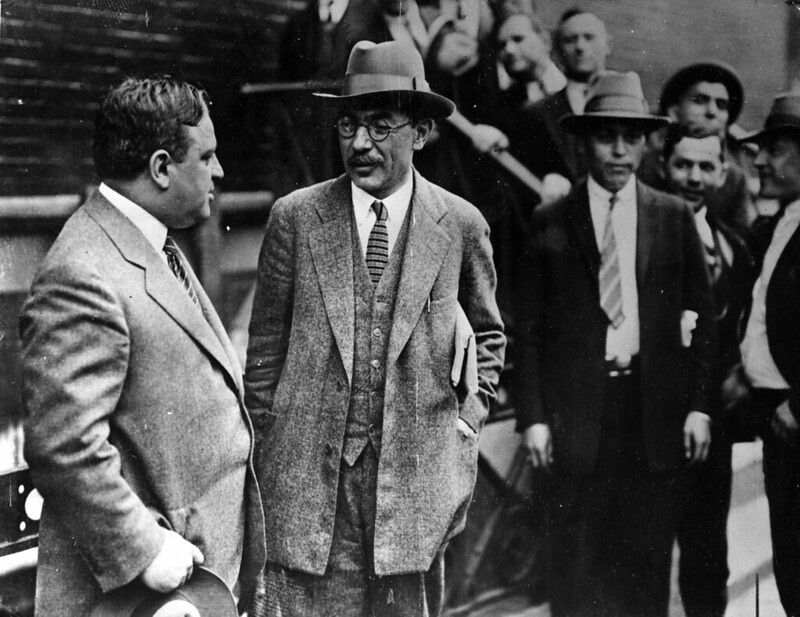
Second, failing in this, to provoke a split for which the left wing, and particularly the Communists, could be blamed.
The Strategy of the Left Wing.
The obvious strategy for the left wing in this situation was to expose the Sigman machine as the advocate of cooperation with the bosses, as the disorganizers of the union and show the convention and the membership at large that the left wing stood for unity on the basis of the class struggle, that by this program alone could the class interests of the membership be protected.
The Strategy of the Communists.
The Communist strategy was:
To firmly consolidate the left wing on the basis of their left wing program, to turn the convention discussion into an ideological campaign to convince the progressives and win them for that program.
The Deviations of the Left Wing and the Communist Fraction from Their Line of Strategy.
In actual practice both the left wing and the Communist fraction departed considerably from their strategic line and the net results of the convention are therefore less for the left wing than might have been obtained.
For this the Communist fraction must take the responsibility.
Its convention actions were a weird mixture of leftism and opportunism—leftism in that it followed an objectively splitting policy until the last day of the convention, opportunism in that this splitting policy was based on the naive belief that the Sigman machine was sincere enough in its unity maneuvers to make substantial concessions to the left wing in order to avoid a split in the union.
This complete misunderstanding of the role of the bureaucracy in the present period, that of disrupters of the unions and agents of the capitalists in the union, is responsible also for a desire, and even attempts, which manifested themselves from time to time during the convention to share control of the union with sections of the Sigman machine.
Not only was the objectively splitting policy and tactics based on lingering remains of confidence in the Sigmanites as “honest trade unionists.” It had the additional and extremely dangerous defect of being based on a wrong estimation of the relationship of forces in the needle trades industry, to say nothing about its not taking into account at all the relationship of forces in the whole American labor movement.
Our party in its work in the trade unions does not “make a fetish of unity” but it has a right to insist that when an objectively secessionist policy is followed by a Communist fraction in a needle trades union affiliated with the A.F. of L. that some consideration be given to the fact that in the powerful Amalgamated Clothing Workers union the left wing is almost non-existent.
Our party also had to take into consideration the fact that the left wing in the I.L.G.W.U. had been built up largely as a result of the struggle against the expulsion policy of the machine and that what jurists call “a reasonable doubt” exists as to whether workers who fought for the right of militants to stay in the union would follow them out with the same loyalty into a secessionist movement.
There is in addition the one decisive fact that a left wing which appears in this period of the development of the American labor movement as the advocate of unity of the American labor movement and of the world trade union movement, and whose whole prestige is based on this fact, cannot carry out a secessionist policy in this stage of the struggle without bringing disaster on itself and on the entire left wing.
Neither can it afford, in the absence of a center group in the convention, to enter into election compromises with the bureaucrats.
Both of these dangers confronted the left wing in the I.L.G.W.U. convention. That these tendencies were overcome, that the left wing did not deal itself a blow from which it would not easily recover, is a tribute to its working class character, consciousness and militancy.
From the first day of the convention it was evident that the question of control of the union, partial or complete, was uppermost in the minds of the left wing—including the Communist fraction. Controlling New York, the largest center of the union, the left wing resented the manipulation which gave the machine a convention majority to which it was not entitled. Without any clear and open formulation of its purpose, the left wing really intended to club the machine into giving substantial concessions or else to secede. It did not at first see that the Sigman machine was ready and willing to provoke a split if the left wing could be made to carry the blame for it.
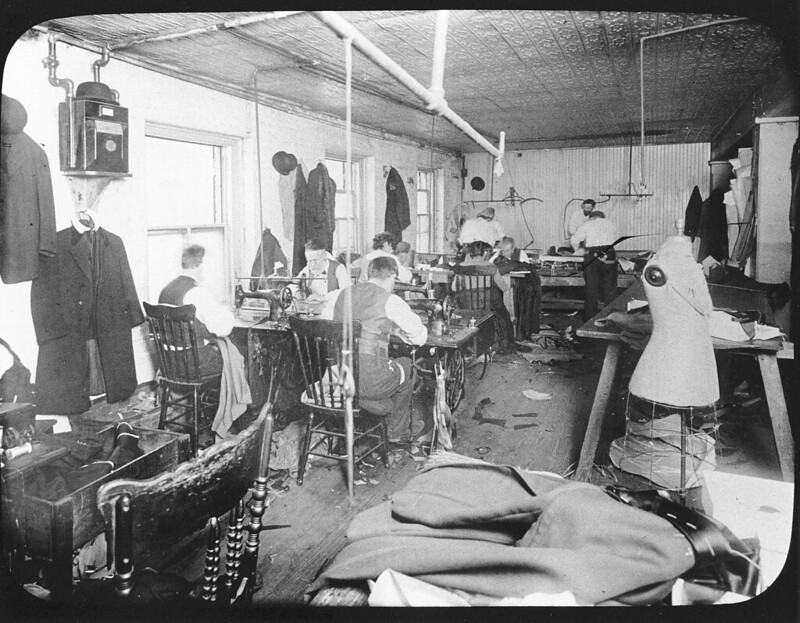
Sharp challenges amounting to ultimatums to the Sigmanites were made by left wing speakers right at the beginning of the convention. No objection could be made to these evidences of militancy had they been accompanied by clear explanations of the position of the left as the defenders and unifiers of the organisation. But this was not done. In addition to this the early fight of the left was on the question of credentials and other organizational matters, dragged out for days, laying the left wing open to the charge of obstructing the work of the convention.
Then came the decision of the left wing to stay away from the official banquet—where Green or Lewis was to speak—not to extend the fight against the machine at the banquet itself but to hold an affair of its own. The excuse given by left wing leaders for this action was that they could not explain to the rank and file their reasons for attending the official banquet—proof in itself that the rank and file had not been sufficiently informed as to objectives and methods, Communist observers at the convention interpreted this action correctly as the second open sign of an objectively splitting policy. They were correct and in a very short time their judgement was confirmed by the refusal of the left wing to serve on the convention committees. The reason given for this was that the appointments of left wingers had been handled by the machine so as to keep the most able off the most important committees—such as those on the report of the general executive board, organization, and appeals.
Subsequently the left wing formally agreed to appear before the committees but to the best of my knowledge this policy was not carried out. If it was it was in a very half-hearted manner.
The refusal to serve on the convention committees had been announced with the belief that the machine would yield to pressure and revise the committee appointments.
The Provocation Policy of the Machine.
Not only did it not do this but it began a policy of deliberate provocation obviously intended to enrage the left wing still further and provoke a further tendency towards secession. Continual insulting speeches by Sigman were used to increase the tension.
Only during the first part of the debate on the report of the general executive board which had been divided into three parts—industrial conditions and future policy, the New York situation and the morale of the organization—did this policy of provocation relax.
The reason for this was that the machine hoped to administer a moral and political defeat Lo the left wing by showing a superior knowledge of the industry and the history of the union. Much to the surprise of the bureaucracy and, I think, to some extent of the left wing itself, the left wing showed at least an equal knowledge of the special conditions of the industry and by its superior understanding of capitalist development in the United States, coupled with its fight for a program based on the class struggle, was able to defeat the machine in the debate on this question.
Needing a smashing victory over the left wing on the first part of the officers report in order to break even on the whole report—for it could make no plausible defense of its policies in the debate on the New York situation and on the morale of the union—the Sigmanites became desperate and abandoned all unity maneuvers. They renewed the provocation by such methods as the provocateur speech of Yanofsky—discredited and deposed editor of Justice, the union’s official organ—by threats to use police to clear the hall of the rank and file members attending the convention and culminating in the driving from the convention hall of delegates and visitors by a squad of bluecoats.
When the bureaucracy believed that the left wing could stand no more, it brazenly refused to abide by the provisions of the “peace agreement” concluded after the struggle in New York with the rank and file committee of action and which stipulated among other things that certain important questions be submitted to referendum and that the representation to joint boards be on a proportional basis.
The Walkout of the Left Wing.
The left wing delegation promptly left the convention without even making a statement.
The threatened split became an actual fact.
But the left wing leaders stubbornly insisted that they had no intention of seceding and no amount of argument seemed to convince them that one does not need to deliberately plan a split to have a policy which produces one.
In spite of the protestations of the left wing it is my belief that the leaders had no intention of returning to the convention unless the Sigman machine made certain concessions. If they did not intend to secede they have the difficult task of explaining why they staked everything on the possibility of the machine making concessions and prepared no way for a retreat with their forces intact.
As a matter of fact the machine did make some minor organizational concessions and the left wing returned to the convention. The concessions made seem to have confirmed some of the left wing in the belief that its dangerous maneuver, which for a few hours threatened the whole left wing in the American labor movement with disaster, was a very brilliant performance. The exact opposite is the case.
The Dangers of the Walkout Maneuver.
In the first place the walkout was based on the idea that the Sigmanites, in spite of their deliberate provocation of a split, would yield rather than see the union divided.
In the second place, had not concessions been made which allowed the left wing to save its face, the left would either have had to actually secede, having led the membership to this point, or to have gone back into the convention defeated and demoralized.

The fact that the machine yielded cannot be taken as evidence of the correctness of the left wing’s action or the manner in which it was carried out. The truth is that the Sigman machine had been carried away by its hatred of the left wing and the Communists and had blindly chosen an issue on which to provoke a split for which it could not rally all of its own forces. Hence it made concessions. The effect of these concessions upon the future attitude of the left wing in the convention brings to mind the warning against Greeks bearing gifts.
The machine agreed to proportional representation for the New York joint board and to submit certain questions to referendum—not earlier than six months and not later than one year from the adjournment of the convention.”
The Left Wing Sways to the Other Extreme.
From a split position the day before, the left wing now swayed to the other extreme as a result of this new evidence of the desire for “unity” on the part of the bureaucracy. So overcome was it with what might be termed the “peace on earth, good will to men” feeling that it made no fight for proportional representation for joint boards in garment centers outside of New York—a failure which under slightly different circumstances might have created serious dissension in the left wing—allowed First Vice-President Ninfo to be elected without nominating a candidate against him, and in nominating its own candidates for other offices failed to take the opportunity to state that the left wing supported these candidates because they in turn stood on the left wing platform.
So much for the mistakes of the left wing—mistakes for which I repeat, the Communist fraction must stand responsible. This is obvious when we know that out of 110 left wing delegates 52 were Communists.
The Causes of the Mistakes of the Left Wing.
These mistakes were due to the inflated importance attached to the issue of union control and to a certain provincialism which fails to see the left wing struggle as a whole, over-estimating the importance of the needle trades in the American labor movement, and finally to a lack of ideological preparation for the masses of left wing followers.
The Essential Strength and Vitality of the Left Wing.
Such mistakes are not fatal if corrected and the fact that the left wing went thru three weeks of arduous convention struggle without losing a single delegate, that in New York the workers showed their intense interest in the convention and support of the left wing by huge mass meetings, that in Philadelphia, a thousand needle workers met, listened to and endorsed the left wing program during the convention, proves that the left wing is essentially sound with vitality enough to overcome any wrong tendencies.
The Problems facing the Left Wing in the I.L.G.W.U.
The left wing in the needle trades faces tremendous problems. It is now officially responsible for the interests of the union in the city of New York. It has the unscrupulous tactics and bitter enmity of the Sigman machine, the A.F. of L. bureaucracy, the bosses and the Hillman machine of the Amalgamated Clothing Workers to contend with.
The Sigman machine left the New York organization penniless and hundreds of thousands of dollars in debt.
A general strike will probably be necessary in the entire New York ladies’ garment industry this spring. A half-million dollars are needed for this alone. There is but one way of meeting and solving these difficulties. It is by firmly consolidating the forces now following the left wing and at the same time drawing more masses into their ranks by winning the thousands of Italian workers who are still deceived by Ninfo and Antonini, and who form now the chief strength of the Sigman machine.
In addition to this, the closest relations must be established and maintained between the I.L.G.W.U. left wing and the left wings in the Fur Workers and the Amalgamated. In the Amalgamated the left wing must be stimulated and broadened by systematic exposure of the Hillman machine and an energetic struggle against its class surrender policy. Relentless war on the bureaucrats is the only way to victory over the bosses.
The strength of the left wing lies not in offices but in the masses. With the loyal support of thousands of conscious workers, with the economic struggle fought militantly and efficiently, the question of power in the union solves itself.
The splendid left wing of serried thousands in the I.L.G.W.U., steeled now in a two-year struggle, is the most hopeful sign on the horizon of the American labor movement today.
The Workers Monthly began publishing in 1924 as a merger of the ‘Liberator’, the Trade Union Educational League magazine ‘Labor Herald’, and Friends of Soviet Russia’s monthly ‘Soviet Russia Pictorial’ as an explicitly Party publication. In 1927 Workers Monthly ceased and the Communist Party began publishing The Communist as its theoretical magazine. Editors included Earl Browder and Max Bedacht as the magazine continued the Liberator’s use of graphics and art.
PDF of full issue: https://www.marxists.org/history/usa/culture/pubs/wm/1926/v5n04-feb-1926-1B-WM.pdf
 Revolution's Newsstand