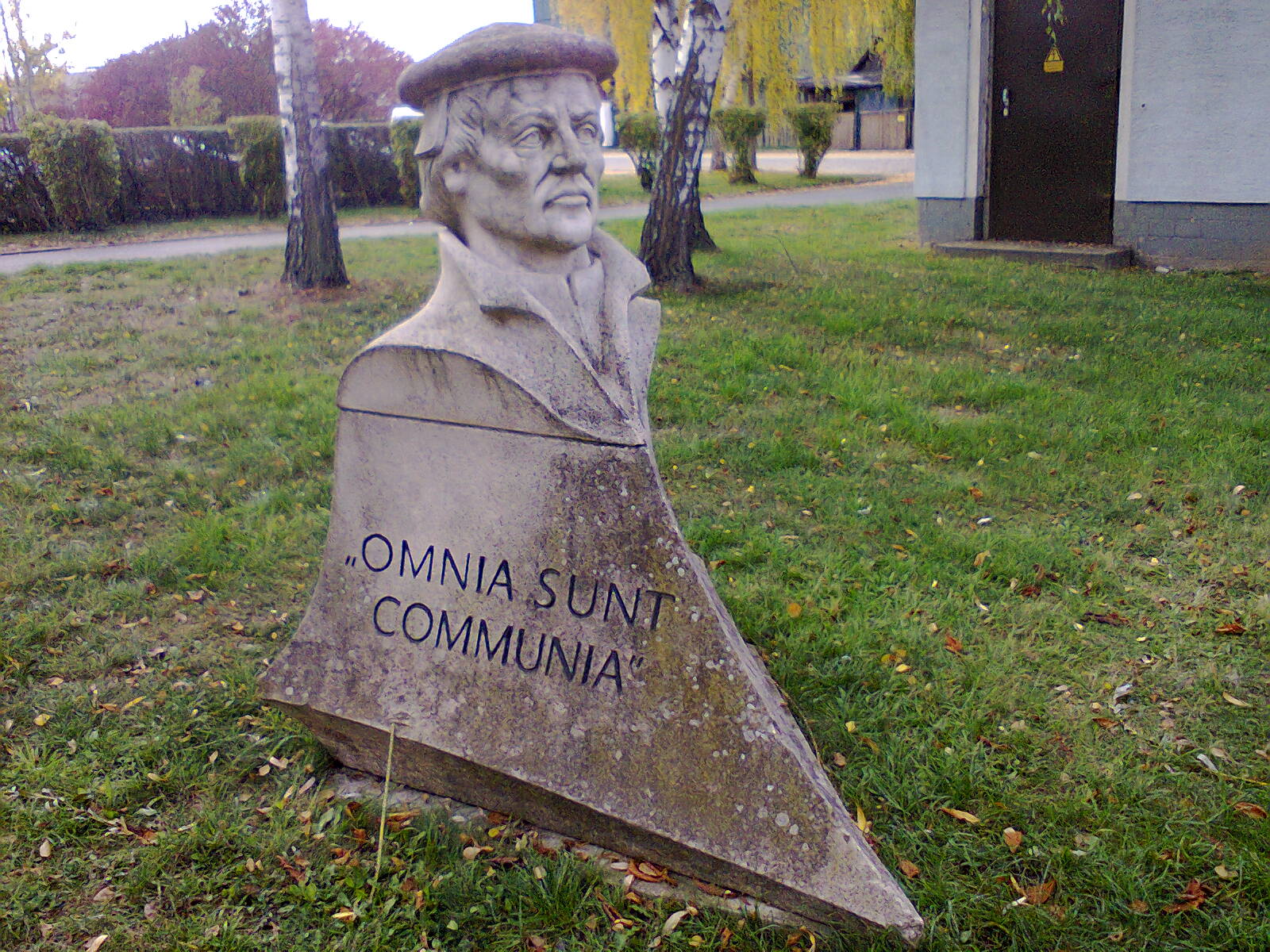
Written in the immediate aftermath of 1848, below is a central chapter from Engels’ 1850 book, made possible by the creation of the Marx-Engels Institute and the work of David Riazanov, who also provides the full explanatory notes. One of the first books published by the Communist Party’s new International Publishers, formed for the purpose of translating and disseminating international Marxist texts and headed by Alexander Trachtenberg. This text was translated from the German by Moissaye J. Olgin.
‘Luther and Muenzer’ (1850) by Friedrich Engels from The Peasant War in Germany. Translated by Moissaye J. Olgin with an Introduction by David Riazanov. International Publishers, New York, 1926.
The grouping of the numerous and variegated groups into bigger units was at that time made impossible by decentralisation, by local and provincial independence, by industrial and commercial isolation of the provinces from each other, and by poor means of communication. This grouping develops only with the general spread of revolutionary, religious and political ideas, in the course of the Reformation. The various groups of the population which either accept or oppose those ideas, concentrate the nation, very slowly and only approximately indeed, into three large camps, the reactionary or Catholic, the reformist middle-class or Lutheran, and the revolutionary elements. If we discover little logic even in this great division of the nation, if the first two camps include partly the same elements, it is due to the fact that most of the official groupings brought over from the Middle Ages had begun to dissolve and to become decentralised, which circumstance gave to the same groups in different localities a momentary opposing orientation. In the last years we have so often met with similar facts in Germany that we will not be surprised at this apparent mixture of groups and classes under the much more complicated conditions of the Sixteenth Century.
The German ideology of to-day sees in the struggles to which the Middle Ages had succumbed nothing but violent theological bickerings, this notwithstanding our modern experiences. Had the people of that time only been able to reach an understanding concerning the celestial things, say our patriotic historians and wise statesmen, there would have been no ground whatever for struggle over earthly affairs. These ideologists were gullible enough to accept on their face value all the illusions which an epoch maintains about itself, or which the ideologists of a certain period maintained about that period. This class of people, which saw in the revolution of 1789 nothing but a heated debate over the advantages of a constitutional monarchy as compared with absolutism, would see in the July Revolution a practical controversy over the untenability of the empire by the grace of God, and in the February Revolution, an attempt at solving the problem of a republic or monarchy, etc. Of the class struggles which were being fought out in these convulsions, and whose mere expression is being every time written as a political slogan on the banner of these class struggles, our ideologists have no conception even at the present time, although manifestations of them are audible enough not only abroad, but also from the grumbling and the resentment of many thousands of home proletarians.
In the so-called religious wars of the Sixteenth Century, very positive material class-interests were at play, and those wars were class wars just as were the later collisions in England and France. If the class struggles of that time appear to bear religious earmarks, if the interests, requirements and demands of the various classes hid themselves behind a religious screen, it little changes the actual situation, and is to be explained by conditions of the time.
The Middle Ages had developed out of raw primitiveness. It had done away with old civilisation, old philosophy, politics and jurisprudence, in order to begin anew in every respect. The only thing which it had retained from the old shattered world was Christianity and a number of half-ruined cities deprived of their civilisation. As a consequence, the clergy retained a monopoly of intellectual education, a phenomenon to be found in every primitive stage of development, and education itself had acquired a predominantly theological nature.
In the hands of the clergy, politics and jurisprudence, as well as other sciences, remained branches of theology, and were treated according to the principles prevailing in the latter. The dogmas of the church were at the same time political axioms, and Bible quotations had the validity of law in every court. Even after the formation of a special class of jurists, jurisprudence long remained under the tutelage of theology. This supremacy of theology in the realm of intellectual activities was at the same time a logical consequence of the situation of the church as the most general force coordinating and sanctioning existing feudal domination.
It is obvious that under such conditions, all general and overt attacks on feudalism, in the first place attacks on the church, all revolutionary, social and political doctrines, necessarily became theological heresies. In order to be attacked, existing social conditions had to be stripped of their aureole of sanctity.
The revolutionary opposition to feudalism was alive throughout all the Middle Ages. According to conditions of the time, it appeared either in the form of mysticism, as open heresy, or of armed insurrection. As mysticism, it is well known how indispensable it was for the reformers of the Sixteenth Century. Muenzer himself was largely indebted to it. The heresies were partly an expression of the reaction of the patriarchal Alpine shepherds against the encroachments of feudalism in their realm (Waldenses1), partly an opposition to feudalism of the cities that had out-grown it (The Albigenses, Arnold of Brescia, etc.), and partly direct insurrections of peasants (John Ball, the master from Hungary in Picardy, etc.). We can omit, in this connection, the patriarchal heresy of the Waldenses, as well as the insurrection of the Swiss, which by form and contents, was a reactionary attempt at stemming the tide of historic development, and of a purely local importance. In the other two forms of mediaeval heresy, we find as early as the Twelfth Century the precursors of the great division between the middle-class and the peasant-plebeian opposition which caused the collapse of the peasant war. This division is manifest throughout the later Middle Ages.
The heresy of the cities, which is the actual official heresy of the Middle Ages, directed itself primarily against the clergy, whose riches and political importance it attacked. In the very same manner as the bourgeoisie at present demands a “gouvernement à bon marché” (cheap government), so the middle-class of mediaeval times demanded first of all an “église à bon marché” (cheap church). Reactionary in form, as is every heresy which sees in the further development of church and dogma, only a degeneration, the middle-class heresy demanded the restoration of the ancient simple church constitution and the abolition of an exclusive class of priests. This cheap arrangement would eliminate the monks, the prelates, the Roman court, in brief, everything which was expensive for the church. In their attack against papacy, the cities, themselves republics although under the protection of monarchs, expressed for the first time in a general form the idea that the normal form of government for the bourgeoisie was the republic. Their hostility towards many a dogma and church law is partly explained by the foregoing and partly by their conditions. Why they were so bitter against celibacy, no one has given a better explanation than Boccaccio. Arnold of Brescia2 in Italy and Germany, the Albigenses3 in south France, John Wycliffe4 in England, Huss5 and the Calixtines6 in Bohemia, were the chief representatives of this opposition. That the opposition against feudalism should appear here only as an opposition against religious feudalism, is easily understood when one remembers that, at that time, the cities were already a recognised estate sufficiently capable of fighting lay feudalism with its privileges either by force of arms or in the city assemblies.
Here, as in south France, in England and Bohemia, we find the lower nobility joining hands with the cities in their struggle against the clergy and in their heresies, a phenomenon due to the dependence of the lower nobility upon the cities and to the community of interests of both groups as against the princes and the prelates. The same phenomenon is found in the peasant war.
A totally different character was assumed by that heresy which was a direct expression of the peasant and plebeian demands, and which was almost always connected with an insurrection. This heresy, sharing all the demands of middle-class heresy relative to the clergy, the papacy, and the restoration of the ancient Christian church organisation, went far beyond them. It demanded the restoration of ancient Christian equality among the members of the community, this to be recognised as a rule for the middle-class world as well. From the equality of the children of God it made the implication as to civil equality, and partly also as to equality of property. To make the nobility equal to the peasant, the patricians and the privileged middle-class equal to the plebeians, to abolish serfdom, ground rents, taxes, privileges, and at least the most flagrant differences of property – these were demands put forth with more or less definiteness and regarded as naturally emanating from the ancient Christian doctrine. This peasant-plebeian heresy, in the fullness of feudalism, e.g., among the Albigenses, hardly distinguishable from the middle-class opposition, grew in the course of the Fourteenth and Fifteenth Centuries to be a strongly defined party opinion appearing independently alongside the heresy of the middle-class. This is the case with John Ball, preacher of the Wat Tyler insurrection in England alongside the Wycliffe movement. This is also the case with the Taborites alongside the Calixtines in Bohemia. The Taborites showed even a republican tendency under theocratic colouring, a view later developed by the representatives of the plebeians in Germany in the Fifteenth and at the beginning of the Sixteenth Century.
This form of heresy was joined in by the dream visions of the mystic sects, such as the Scourging Friars,7 the Lollards,8 etc., which in times of suppression continued the revolutionary tradition.
The plebeians of that time were the only class outside of the existing official society. It was outside the feudal, as well as outside the middle-class organisation. It had neither privileges nor property; it was deprived even of the possessions owned by peasant or petty bourgeois, burdened with crushing duties as much as they might be; it was deprived of property and rights in every respect; it lived in such a manner that it did not even come into direct contact with the existing institutions, which ignored it completely. It was a living symptom of the dissolution of the feudal and guild middle-class societies, and it was at the same time the first precursor of modern bourgeois society.
This position of the plebeians is sufficient explanation as to why the plebeian opposition of that time could not be satisfied with fighting feudalism and the privileged middle-class alone; why, in fantasy, at least, it reached beyond modern bourgeois society then only in its inception; why, being an absolutely propertyless faction, it questioned institutions, views and conceptions common to every society based on division of classes. The chiliastic dream-visions9 of ancient Christianity offered in this respect a very serviceable starting-point. On the other hand, this reaching out beyond not only the present but also the future, could not help being violently fantastic. At the first practical application, it naturally fell back into narrow limits set by prevailing conditions. The attack on private property, the demand for community of possession had to solve itself into a crude organisation of charity; vague Christian equality could result in nothing but civic equality before the law; abolition of all officialdom transformed itself finally in the organisation of republican governments elected by the people. Anticipation of communism by human fantasy was in reality anticipation of modern bourgeois conditions.
This anticipation of coming stages of historic development, forced in itself, but a natural outcome of the life conditions of the plebeian group, is first to be noted in Germany, in the teachings of Thomas Muenzer and his party. Already the Taborites showed a kind of chiliastic community of property, but this was a purely military measure. Only in the teachings of Muenzer did these communist notions find expression as the desires of a vital section of society. Through him they were formulated with a certain definiteness, and were afterwards found in every great convulsion of the people, until gradually they merged with the modern proletarian movement. Something similar we observe in the Middle Ages, where the struggles of the free peasants against increasing feudal domination merged with the struggles of the serfs and bondsmen for the complete abolition of the feudal system.
While the first of the three large camps, the conservative Catholics, embraced all the elements interested in maintaining the existing imperial power, the ecclesiastical and a section of the lay princes, the richer nobility, the prelates and the city patricians – the middle-class moderate Lutheran reform gathered under its banner all the propertied elements of the opposition, the mass of the lower nobility, the middle-class and even a portion of the lay princes who hoped to enrich themselves through the confiscation of the church estates and to seize the opportunity for establishing greater independence from the empire. As to the peasants and plebeians, they grouped themselves around the revolutionary party whose demands and doctrines found their boldest expression in Muenzer.
Luther10 and Muenzer, in their doctrines, in their characters, in their actions, accurately embodied the tenets of their separate parties.
Between 1517 and 1525, Luther had gone through the same transformations as the German constitutionalists between 1846 and 1849. This has been the case with every middle-class party which, having marched for a while at the head of the movement, has been overwhelmed by the plebeian-proletarian party pressing from the rear.
When in 1517 opposition against the dogmas and the organisation of the Catholic church was first raised by Luther, it still had no definite character. Not exceeding the demands of the earlier middle-class heresy, it did not exclude any trend of opinion which went further. It could not do so because the first moment of the struggle demanded that all opposing elements be united, the most aggressive revolutionary energy be utilised and the totality of the existing heresies fighting the Catholic orthodoxy be represented. In a similar fashion, our liberal bourgeoisie of 1847 were still revolutionary. They called themselves socialists and communists, and they discussed emancipation of the working class. Luther’s sturdy peasant nature asserted itself in the stormiest fashion in the first period of his activities. “If the raging madness [of the Roman churchmen] were to continue, it seems to me no better counsel and remedy could be found against it than that kings and princes apply force, arm themselves, attack those evil people who have poisoned the entire world, and once and for all make an end to this game, with arms, not with words. If thieves are being punished with swords, murderers with ropes, and heretics with fire, why do we not seize, with arms in hand, all those evil teachers of perdition, those popes, bishops, cardinals, and the entire crew of Roman Sodom? Why do we not wash our hands in their blood?”
This revolutionary ardour did not last long. The lightning thrust by Luther caused a conflagration. A movement started among the entire German people. In his appeals against the clergy, in his preaching of Christian freedom, peasants and plebeians perceived the signal for insurrection. Likewise, the moderate middle-class and a large section of the lower nobility joined him, and even princes were drawn into the torrent. While the former believed the day had come in which to wreak vengeance upon all their oppressors, the latter only wished to break the power of the clergy, the dependence upon Rome, the Catholic hierarchy, and to enrich themselves through the confiscation of church property. The parties became separated from each other, and each found a different spokesman. Luther had to choose between the two. Luther, the protégé of the Elector of Saxony, the respected professor of Wittenberg who had become powerful and famous overnight, the great man who was surrounded by a coterie of servile creatures and flatterers, did not hesitate a moment. He dropped the popular elements of the movement, and joined the train of the middle-class, the nobility and the princes. Appeals to war of extermination against Rome were heard no more. Luther was now preaching peaceful progress and passive resistance. (Cf. To the nobility of the German nation, 1520, etc.) Invited by Hutten to visit him and Sickingen in the castle of Ebern, the centre of the noble conspiracy against clergy and princes, Luther replied: “I should not like to see the Gospel defended by force and bloodshed. The world was conquered by the Word, the Church has maintained itself by the Word, the Church will come into its own again through the Word, and as Antichrist gained ascendancy without violence, so without violence he will fall.”
Out of this turn of mind, or, to be more exact, out of this definite delineation of Luther’s policy, sprang that policy of bartering and haggling over institutions and dogmas to be retained or reformed, that ugly diplomatising, conceding, intriguing and compromising, the result of which was the Augsburg Confession, the final draft of the constitution of the reformed middle-class church. It was the same petty trading which, in the political field, repeated itself ad nauseam in the recent German national assemblies, unity gatherings, chambers of revision, and in the parliaments of Erfurt. The Philistine middle-class character of the official reformation appeared in these negotiations most clearly.
There were valid reasons why Luther, now the recognised representative of middle-class reform, chose to preach lawful progress. The mass of the cities had joined the cause of moderate reform; the lower nobility became more and more devoted to it; one section of the princes joined it, another vacillated. Success was almost certain at least in a large portion of Germany. Under continued peaceful development the other regions could not in the long run withstand the pressure of moderate opposition. Violent convulsions, on the other hand, were bound to result in a conflict between the moderates and the extreme plebeian and peasant party, thus to alienate the princes, the nobility, and a number of cities from the movement and to leave open the alternative of either the middle-class party being overshadowed by the peasants and plebeians, or the entire movement being crushed by Catholic restoration. How middle-class parties, having achieved the slightest victory, attempt to steer their way between the Scylla of revolution and the Charybdis of restoration by means of lawful progress, we have had occasions enough to observe in the events of recent times.
It was in the nature of the then prevailing social and political conditions that the results of every change were advantageous to the princes, increasing their power. Thus it came about that the middle-class reform, having parted ways with the plebeian and peasant elements, fell more and more under the control of the reform princes. Luther’s subservience to them increased, and the people knew very well what they were doing when they accused him of having become a slave of the princes as were all the others, and when they pursued him with stones in Orlamuende.
When the peasant war broke out, becoming more predominant in regions with Catholic nobility and princes, Luther strove to maintain a conciliatory position. He resolutely attacked the governments. He said it was due to their oppression that the revolts had started, that not the peasants alone were against them, but God as well. On the other hand, he also said that the revolt was ungodly and against the Gospel. He advised both parties to yield, to reach a peaceful understanding.
Notwithstanding these sincere attempts at conciliation, however, the revolt spread rapidly over large areas, including such sections as were dominated by Protestant Lutheran princes, nobles and cities, and rapidly outgrew the middle-class “circumspect” reform. The most determined faction of the insurgents under Muenzer opened their headquarters in Luther’s very proximity, in Thuringia. A few more successes, and Germany would have been one big conflagration, Luther would have been surrounded, perhaps piked as a traitor, and middle-class reform would have been swept away by the tides of a peasant-plebeian revolution. There was no more time for circumspection. In the face of the revolution, all old animosities were forgotten. Compared with the hordes of peasants, the servants of the Roman Sodom were innocent lambs, sweet-tempered children of God. Burgher and prince, noble and clergyman, Luther and the pope united “against the murderous and plundering hordes of the peasants.” “They should be knocked to pieces, strangled and stabbed, secretly and openly, by everybody who can do it, just as one must kill a mad dog!” Luther cried. “Therefore, dear gentlemen, hearken here, save there, stab, knock, strangle them at will, and if thou diest, thou art blessed; no better death canst thou ever attain.” No false mercy was to be practised in relation to the peasants. “Whoever hath pity on those whom God pities not, whom He wishes punished and destroyed, shall be classed among the rebellious himself.” Later, he said, the peasants would learn to thank God when they had to give away one cow in order that they might enjoy the other in peace. Through the revolution, he said, the princes would learn the spirit of the mob which could reign by force only. “The wise man says: ‘Cibus, onus et virgam asino.’ The heads of the peasants are full of chaff. They do not hearken to the Word, and they are senseless, so they must hearken to the virga and the gun, and this is only just. We must pray for them that they obey. Where they do not, there should not be much mercy. Let the guns roar among them, or else they will make it a thousand times worse.”
It is the same language that was used by our late socialist and philanthropic bourgeoisie, when, after the March days the proletariat also demanded its share in the fruits of victory.
Luther had given the plebeian movement a powerful weapon – a translation of the Bible. Through the Bible, he contrasted feudal Christianity of his time with moderate Christianity of the first century. In opposition to decaying feudal society, he held up the picture of another society which knew nothing of the ramified and artificial feudal hierarchy. The peasants had made extensive use of this weapon against the forces of the princes, the nobility, and the clergy. Now Luther turned the same weapon against the peasants, extracting from the Bible a veritable hymn to the authorities ordained by God – a feat hardly exceeded by any lackey of absolute monarchy. Princedom by the grace of God, passive resistance, even serfdom, were being sanctioned by the Bible. Thus Luther repudiated not only the peasant insurrection but even his own revolt against religious and lay authority. He not only betrayed the popular movement to the princes, but the middle-class movement as well.
Need we mention other bourgeois who recently gave us examples of repudiating their own past?
Let us now compare the plebeian revolutionary, Muenzer, with the middle-class reformist, Luther.
Thomas Muenzer was born in Stolberg, in the Harz, in 1498. It is said that his father died on the scaffold, a victim of the wilfulness of the Count of Stolberg. In his fifteenth year, Muenzer organised at the Halle school a secret union against the Archbishop of Magdeburg and the Roman Church in general. His scholarly attainments in the theology of his time brought him early the doctor’s degree and the position of chaplain in a Halle nunnery. Here he began to treat the dogmas and rites of the church with the greatest contempt. At mass he omitted the words of the transubstantiation, and ate, as Luther said, the almighty gods unconsecrated. Mediaeval mystics, especially the chiliastic works of Joachim of Calabria,11 were the main subject of his studies. It seemed to Muenzer that the millennium and the Day of Judgment over the degenerated church and the corrupted world, as announced and pictured by that mystic, had come in the form of the Reformation and the general restlessness of his time. He preached in his neighbourhood with great success. In 1520 he went to Zwickau as the first evangelist preacher. There he found one of those dreamy chiliastic sects which continued their existence in many localities, hiding behind an appearance of humility and detachment, the rankly growing opposition of the lower strata of society against existing conditions, and with the growth of agitation, beginning to press to the foreground more boldly and with more endurance. It was the sect of the Anabaptists headed by Nicolas Storch.12 The Anabaptists preached the approach of the Day of Judgment and of the millennium; they had “visions, convulsions, and the spirit of prophecy.” They soon came into conflict with the council of Zwickau. Muenzer defended them, though he had never joined them unconditionally, and had rather brought them under his own influence. The council took decisive steps against them, they were compelled to leave the city, and Muenzer departed with them. This was at the end of 1521.
He then went to Prague and, in order to gain ground, attempted to join the remnants of the Hussite movement. His proclamations, however, made it necessary for him to flee Bohemia also. In 1522, he became preacher at Allstedt in Thuringia. Here he started with reforming the cult. Before even Luther dared to go so far, he entirely abolished the Latin language, and ordered the entire Bible, not only the prescribed Sunday Gospels and epistles, to be read to the people. At the same time, he organised propaganda in his locality. People flocked to him from all directions, and soon Allstedt became the centre of the popular anti-priest movement of entire Thuringia.
Muenzer at that time was still theologian before everything else. He directed his attacks almost exclusively against the priests. He did not, however, preach quiet debate and peaceful progress, as Luther had begun to do at that time, but he continued the early violent preachments of Luther, appealing to the princes of Saxony and the people to rise in arms against the Roman priests. “Is it not Christ who said: ‘I have come to bring, not peace, but the sword’? What can you [the princes of Saxony] do with that sword? You can do only one thing: If you wish to be the servants of God, you must drive out and destroy the evil ones who stand in the way of the Gospel. Christ ordered very earnestly (Luke, 19, 27): ‘But these mine enemies, that would not that I should reign over them, bring hither, and slay them before me.’ Do not resort to empty assertions that the power of God could do it without aid of our sword, since then it would have to rust in its sheath. We must destroy those who stand in the way of God’s revelation, we must do it mercilessly, as Hezekiah, Cyrus, Josiah, Daniel and Elias destroyed the priests of Baal, else the Christian Church will never come back to its origins. We must uproot the weeds in God’s vineyard at the time when the crops are ripe. God said in the Fifth Book of Moses, 7, ‘Thou shalt not show mercy unto the idolators, but ye shall break down their altars, dash in pieces their graven images and burn them with fire that I shall not be wroth at you.’” But these appeals to the princes were of no avail, whereas the revolutionary agitation among the people grew day by day. Muenzer, whose ideas became more definitely shaped and more courageous, now definitely relinquished the middle-class reformation, and at the same time appeared as a direct political agitator.
His theologic-philosophic doctrine attacked all the main points not only of Catholicism but of Christianity as such. Under the cloak of Christian forms, he preached a kind of pantheism, which curiously resembles the modern speculative mode of contemplation, and at times even taught open atheism. He repudiated the assertion that the Bible was the only infallible revelation. The only living revelation, he said, was reason, a revelation which existed among all peoples at all times. To contrast the Bible with reason, he maintained, was to kill the spirit by the latter, for the Holy Spirit of which the Bible spoke was not a thing outside of us; the Holy Spirit was our reason. Faith, he said, was nothing else but reason become alive in man, therefore, he said, pagans could also have faith. Through this faith, through reason come to life, man became godlike and blessed, he said. Heaven was to be sought in this life, not beyond, and it was, according to Muenzer, the task of the believers to establish Heaven, the kingdom of God, here on earth. As there is no Heaven in the beyond, so there is no Hell in the beyond, and no damnation, and there are no devils but the evil desires and cravings of man. Christ, he said, was a man, as we are, a prophet and a teacher, and his “Lord’s Supper” is nothing but a plain meal of commemoration wherein bread and wine are being consumed with mystic additions.
Muenzer preached these doctrines mostly in a covert fashion, under the cloak of Christian phraseology which the new philosophy was compelled to utilise for some time. The fundamental heretic idea, however, is easily discernible in all his writings, and it is obvious that the biblical cloak was for him of much less importance than it was for many a disciple of Hegel in modern times. Still, there is a distance of three hundred years between Muenzer and modern philosophy.
Muenzer’s political doctrine followed his revolutionary religious conceptions very closely, and as his theology reached far beyond the current conceptions of his time, so his political doctrine went beyond existing social and political conditions. As Muenzer’s philosophy of religion touched upon atheism, so his political programme touched upon communism, and there is more than one communist sect of modern times which, on the eve of the February Revolution, did not possess a theoretical equipment as rich as that of Muenzer of the Sixteenth Century. His programme, less a compilation of the demands of the then existing plebeians than a genius’s anticipation of the conditions for the emancipation of the proletarian element that had just begun to develop among the plebeians, demanded the immediate establishment of the kingdom of God, of the prophesied millennium on earth. This was to be accomplished by the return of the church to its origins and the abolition of all institutions that were in conflict with what Muenzer conceived as original Christianity, which, in fact, was the idea of a very modern church. By the kingdom of God, Muenzer understood nothing else than a state of society without class differences, without private property, and without superimposed state powers opposed to the members of society. All existing authorities, as far as they did not submit and join the revolution, he taught, must be overthrown, all work and all property must be shared in common, and complete equality must be introduced. In his conception, a union of the people was to be organised to realise this programme, not only throughout Germany, but throughout entire Christendom. Princes and nobles were to be invited to join, and should they refuse, the union was to overthrow or kill them, with arms in hand, at the first opportunity.
Muenzer immediately set to work to organise the union. His preachings assumed a still more militant character. He attacked, not only the clergy, but with equal passion the princes, the nobility and the patricians. He pictured in burning colours the existing oppression, and contrasted it with the vision of the millennium of social republican equality which he created out of his imagination. He published one revolutionary pamphlet after another, sending emissaries in all directions, while he personally organised the union in Allstedt and its vicinity.
The first fruit of this propaganda was the destruction St. Mary’s Chapel in Mellerbach near Allstedt, according to the command of the Bible (Deut. 7, 5): “Ye shall break down their altars, and dash in pieces their pillars, and hew down their Asherim, and burn their graven images with fire.” The princes of Saxony came in person to Allstedt to quell the upheaval, and they called Muenzer to the castle. There he delivered a sermon, which they had never heard from Luther, “that easy living flesh of Wittenberg,” Muenzer called him. He insisted that the ungodly rulers, especially the priests and monks who treated the Gospel as heresy, must be killed; for confirmation he referred to the New Testament. The ungodly have no right to live, he said, save by the mercy of the chosen ones. If the princes would not exterminate the ungodly, he asserted, God would take their sword from them because the right to wield the sword belongs to the community. The source of the evil of usury, thievery and robbery, he said, were the princes and the masters who had taken all creatures into their private possession – the fishes in the water, the birds in the air, the plants in the soil. And the usurpers, he said, still preached to the poor the commandment, “Thou shalt not steal,” while they grabbed everything, and robbed and crushed the peasant and the artisan. “When, however, one of the latter commits the slightest transgression,” he said, “he has to hang, and Dr. Liar says to all this: Amen.” The masters themselves created a situation, he argued, in which the poor man was forced to become their enemy. If they did not remove the causes of the upheaval, how could things improve in times to come? he asked. “Oh, my dear gentlemen, how the Lord will smite with an iron rod all these old pots! When I say so, I am considered rebellious. So be it!” (Cf. Zimmermann’s Peasant War, II, p. 75.)
Muenzer had the sermon printed. His Allstedt printer was punished by Duke Johann of Saxony with banishment. His own writings were to be henceforth subjected to the censorship of the ducal government in Weimar. But he paid no heed to this order. He immediately published a very inciting paper in the imperial city of Muehlhausen, wherein he admonished the people “to widen the hole so that all the world may see and comprehend who our fools are who have blasphemously turned our Lord into a painted mannikin.” He concluded with the following words: “All the world must suffer a big jolt. The game will be such that the ungodly will be thrown off their seats and the downtrodden will rise.” As a motto, Thomas Muenzer, “the man with the hammer,” wrote the following on the title page: “Beware, I have put my words into thy mouth; I have lifted thee above the people and above the empires that thou mayest uproot, destroy, scatter and overthrow, and that thou mayest build and plant. A wall of iron against the kings, princes, priests, and for the people hath been erected. Let them fight, for victory is wondrous, and the strong and godless tyrants will perish.”
The breach between Muenzer and Luther with his party had taken place long before that. Luther himself was compelled to accept some church reforms which were introduced by Muenzer without consulting him. Luther watched Muenzer’s activities with the nettled distrust of a moderate reformer towards an energetic far-aiming radical. Already in the spring of 1524, in a letter to Melanchthon, that model of a hectic stay-at-home Philistine, Muenzer wrote that he and Luther did not understand the movement at all. They were seeking, he said, to choke it by adherence to the letter of the Bible, and their doctrine was worm-eaten. “Dear brethren,” he wrote, “stop your delaying and hesitating. The time has come, the summer is knocking at our doors. Do not keep friendship with the ungodly who prevent the Word from exercising its full force. Do not flatter your princes in order that you may not perish with them. Ye tender, bookish scholars, do not be wroth, for I cannot do otherwise.”
Luther had more than once invited Muenzer to an open debate. The latter, however, being always ready to accept battle in the presence of the people, did not have the slightest desire to plunge into a theological squabble before the partisan public of the Wittenberg University. He had no desire “to bring the testimony of the spirit before the high school of learning exclusively.” If Luther was sincere, he wrote, let him use his influence to stop the chicaneries against his, Muenzer’s, printers, and to lift the censorship in order that their controversy might be freely fought out in the press.
When the above-mentioned revolutionary brochure appeared, Luther openly denounced Muenzer. In his “Letter to the Princes of Saxony Against the Rebellious Spirit,” he declared Muenzer to be an instrument of Satan, and demanded of the princes to intervene, and drive the instigators of the upheaval out of the country, since, he said, they did not confine themselves to preaching their evil doctrine, but incited to insurrection, to violent lawless action against the authorities.
On August 1st, Muenzer was compelled to appear before the princes in the castle of Weimar, to defend himself against the accusation of incendiary machinations. There were highly compromising facts quoted against him; his secret union had been traced; his hand was discovered in the organisation of the pitmen and the peasants. He was being threatened with banishment. Upon returning to Allstedt, he learned Duke Georg of Saxony demanded his extradition. Union letters in his handwriting had been intercepted, wherein he called Georg’s subjects to armed resistance against the enemies of the Gospel. The council would have extradited him had he not left the city.
In the meantime, the rising agitation among the peasants and the plebeians had enormously lightened Muenzer’s task of propaganda. In the person of the Anabaptists he found invaluable agents. This sect, having no definite dogmas, held together by common opposition against all ruling classes and by the common symbol of second baptism, ascetic in their mode of living, untiring, fanatic and intrepid in propaganda, had grouped itself more closely around Muenzer. Made homeless by constant persecutions, its members wandered over the length and breadth of Germany, announcing everywhere the new gospel wherein Muenzer had made clear to them their own demands and wishes. Numberless Anabaptists were put on the rack, burned or otherwise executed. But the courage and endurance of these emissaries were unshaken, and the success of their activities amidst the rapidly rising agitation of the people was enormous. That was one of the reasons why, on his flight from Thuringia, Muenzer found the ground prepared wherever he turned.
In Nuernberg, a peasant revolt had been nipped in the bud a month previous. Here Muenzer conducted his propaganda under cover. Soon there appeared persons who defended his most audacious theological doctrines of the non-obligatory power of the Bible and the meaninglessness of sacraments, declaring Christ to have been a mere man, and the power of lay authorities to be ungodly. “We see there Satan stalking, the spirit of Allstedt!” Luther exclaimed. In Nuernberg, Muenzer printed his reply to Luther. He accused him of flattering the princes and supporting the reactionary party by his moderate position. “The people will free themselves in spite of everything,” he wrote, “and then the fate of Dr. Luther will be that of a captive fox.” The city council ordered the paper confiscated, and Muenzer was compelled to leave the city. From there he went through Suabia to Alsace, then to Switzerland, and then back to the Upper Black Forest where the insurrection had started several months before, precipitated largely by the Anabaptist emissaries. There is no doubt that this propaganda trip of Muenzer’s added much to the organisation of the people’s party, to a clear formulation of its demands and to the final general outbreak of the insurrection in April, 1525. It was through this trip that the dual nature of Muenzer’s activities became more and more pronounced – on the one hand, his propaganda among the people whom he approached in the only language then comprehensible to the masses, that of religious prophecy; on the other hand, his contact with the initiated, to whom he could disclose his ultimate aims. Even previous to this journey he had grouped around himself in Thuringia a circle of the most determined persons, not only from among the people, but also from among the lower clergy, a circle whom he had put at the head of the secret organisation. Now he became the centre of the entire revolutionary movement of southwest Germany, organising connections between Saxony and Thuringia through Franconia and Suabia up to Alsace and the Swiss frontier and counting among his disciples and the heads of the organisation such men as Hubmaier of Waldshut, Conrad Grebel of Zurich, Franz Rabmann of Griessen, Schappelar of Memmingen, Jakob Wehe of Leipheim, and Dr. Mantel in Stuttgart, the most revolutionary of priests. He kept himself mostly in Griessen on the Schaffhausen frontier, undertaking journeys through the Hegau, Klettgau, etc. The bloody persecutions undertaken by the alarmed princes and masters everywhere against this new plebeian heresy, aided not a little in fanning the rebellious spirit and closing the ranks of the organisation. In this way, Muenzer passed five months in upper Germany. When the outbreak of the general movement was at hand, he returned to Thuringia, where he wished to lead the movement personally. There we will find him later.
We shall see how truly the character and the behaviour of the two party heads reflected the position of their respective parties. Luther’s indecision, his fear of the movement, assumed serious proportions; his cowardly servility towards the princes corresponded closely to the hesitating, vacillating policy of the middle-classes. The revolutionary energy and decisiveness of Muenzer, on the other hand, was seen in the most advanced faction of the plebeians and peasants. The difference was that while Luther confined himself to an expression of the ideas and wishes of a majority of his class and thereby acquired among it a very cheap popularity, Muenzer, on the contrary, went far beyond the immediate ideas and demands of the plebeians and peasants, organising out of the then existing revolutionary elements a party, which, as far as it stood on the level of his ideas and shared his energy, still represented only a small minority of the insurgent masses.
NOTES
1. Waldenses – A religious sect which sprang up in the cities of southern France in the middle of the Twelfth Century. The cities of northern Italy and southern France of that time represented very favourable ground for the development of a religious reformist movement. Commerce and industry had developed here earlier than in the west; the bourgeoisie had come into existence, the crafts flourished. But while the cities of northern Italy, which were partly interested in the exploitation of Rome, since they derived from it no small profits, began to show spiritual independence only in relation to the doctrines of the Catholic Church, the cities of southern France, which were no less developed economically but at the same time less dependent upon Rome, started the first serious upheaval against the pope’s domination.
According to the legend, the sect of the Waldenses was founded by a rich merchant of Lyons called Petrus Waldus. It is possible, however, that it existed prior to that time. Petrus Waldus decided to follow the law of the Gospel. He distributed his possessions among the poor, gathered around himself a considerable number of followers, and began preaching (1176). Soon the Waldenses combined in Lombardy with the sect of the Humiliates, who also called themselves the paupers of Lyons. The Waldenses did not confine their preachings to southern France. We find them also in Italy, Germany and Bohemia. In southern France, as elsewhere, they recruited their followers from among the artisans, particularly the weavers.
Originally, the Waldenses did not plan to secede from the church. But their free reading of the Gospel and their lay preachings, their disagreement with Catholicism in understanding the mysteries of transubstantiation, as well as their militant character, compelled the official authorities, the clergy, to start a campaign of cruel persecution against them. Pope Sixtus IV even declared a crusade against them in 1477. Those persecutions continued down to the Eighteenth Century. In 1685, French and Italian armies killed 3,000 Waldenses and captured 1,000. Only in 1848 did they attain civil rights and religious freedom in Piedmont and Savoy. Italian Waldenses are to be found even at present in the Alpine valleys, Val-Martino, Val-Angrona. The Twentieth Century finds 46 communities of Waldenses with 6,276 parishioners.
The Evangelist communism of the Waldenses in the Middle Ages was of a monklike character. For the ‘perfect’ members of their community they made communism and celibacy obligatory. The ‘disciples,’ however, were allowed to marry and to possess property. The Waldenses rejected military service and the oath. They devoted their attention to the education of the masses. In those communities of the Waldenses where the peasants and the middle-class prevailed, they turned into a bourgeois–democratic sect. Where the proletarian elements prevailed, the Waldenses became communist ‘dreamers.’
2. Arnold of Brescia – Made the first serious attempt to reform the Catholic Church as early as the middle of the Twelfth Century. Arnold of Brescia was born between 1100 and 1110 in Brescia, Italy. A disciple of the theologian and philosopher, Abélard, he adopted his critical attitude towards the religious dogmas and the teachings of the fathers. In 1136, he participated, with his native city, Brescia, in its struggle against its lord, the bishop. Arnold of Brescia strove to bring the clergy back to the real Christianity of the Gospel. He demanded that the clergy should relinquish lay authority and should hand over its possessions to the lay rulers. The clergymen who preached must content themselves with the tithe and voluntary contributions, he said. At the second Lateran church council (1139), the Bishop of Brescia accused him of heresy. Arnold of Brescia was compelled to flee to Paris. In 1146, he returned to Rome, where he participated in the struggle between the city democracy and the pope.
Rome in the middle of the Twelfth Century was a spiritual and political centre whither material wealth was flowing from all sections of the Christian world. The popes ably exploited the favourable situation of the Christian capital. Arnold of Brescia appealed to the people to depose the pope and to restore the ancient Roman republic. Pope Hadrian IV, however, succeeded in expelling him from the city. He was taken prisoner by Emperor Frederick Barbarossa and extradited to the authorities of Rome. He was hanged as a rabid heretic, and his body was burned (1155).
3. The Albigenses – A religious sect of southern France, were widespread in the Eleventh and Twelfth Centuries. Their name was derived from the city of Albi in Languedoc, one of the most important centres of the movement. The Albigenses preached apostolic Christianity and simple life according to the Gospel. They were called the ‘good men.’ The pope and the councils of the church claimed that they denied the Trinity doctrine, the Holy Communion and marriage, as well as the doctrine of the death and resurrection of Jesus Christ. At the council of Toulouse (1119), Pope Calixtus II, and subsequently in 1139 Pope Innocent II, excommunicated them. Finally, in 1209, Pope Innocent III organised a crusade against them. The war covered twenty years.
The stubbornness of the bloody fight against the Albigenses is explained partly by the fact that the Albigenses were aided in their war against the pope by the local feudal lords of southern France. When a papal legate and inquisitor was killed on the territory of Count Raymond VI of Toulouse, Pope Innocent III decided to use this occurrence as the occasion for taking away the lands from Count Raymond, who maintained a tolerant attitude towards the heretics. A struggle ensued between the lords of southern France and the pope, who was supported by the lords of the north. Northern France was in conflict with the south, which being economically more developed, was, therefore, a menace to it. The northern armies were headed by Count Simon de Montfort and papal legates. When the armies of the north took the city of Béziers, they killed 20,000 Albigenses. In the course of the ensuing struggle hundreds of thousands fell. The provinces of Provence and Languedoc were devastated. Peace was concluded only as late as 1229. In consequence of the wars against the Albigenses the wealthy south was destroyed and the territories of the French crown were expanded.
4. John Wycliffe (Born October 1320, died 1384) – An English reformer. One of those ideologists who, even prior to the Reformation (Fifteenth and Sixteenth Centuries), drew an outline of the coming reforms. John Wycliffe was a professor of Oxford University. Prior to his appearance on the social and political arena, he devoted himself entirely to research work in the fields of physics, logic and philosophy. The Fourteenth Century was an epoch of stubborn fighting between the royal power of England and the pope. The pope exploited England cruelly. In the Thirteenth Century, the English kingdom paid to the pope a yearly tribute of 1,000 pounds of silver. Under Edward III (Fourteenth Century), Parliament complained that the country was paying the pope a sum five times the amount of the taxes paid to the king. The development of industry and commerce increased the resisting power of England. The struggle between Rome and England was deepened by the Hundred Years’ War between England and France (1339–1456). This war affected the interests of all classes of the English people. The governing classes of England sought possession of the treasuries of Netherland, and they also looked with a covetous eye on the riches of the French nobility. The middle-class saw in this war a means of enrichment. The burden of the war fell primarily upon the peasantry. It is not surprising, therefore, that the pope, having become an ally of France, aroused universal hatred in England. In 1336, Parliament abolished the tribute to the pope. Heresies persecuted in Italy and France now spread to England. Wycliffe’s preachings were popular among all the strata of the people. He taught that in case of necessity the State had a right to deprive the Church of its possessions, that power was based upon service, and that consequently only service could justify the levying of taxes and duties by the clergy. In 1374, in disputes with the representatives of the Roman court, Wycliffe disclosed also the abuses of the Roman Church in appointing candidates to ecclesiastical posts in England. He was severely persecuted by the clergy, and only the interference of the court, and the intervention of the university and the cities, saved him.
In his doctrines, Wycliffe never overstepped the boundaries laid down by the ruling classes. He preached poverty and equality in Christ, but only for the clergy. He proposed that their lands should be expropriated; but this was entirely in the interests of the landowners and the king. The relations between man and God, Wycliffe pictured in the image of the feudal relations of his time. Man holds all his possessions, he said, from God. God’s mercy is the condition of this vassalage. Mortal sin deprives man, he preached, of his right to hold possessions by the mercy of God. Therefore, he said, the clergy should have common property, and should submit to civil jurisdiction. The supreme judge of the human conscience, he said, was not the pope, but God.
After the peasant insurrection of 1381, a general sympathy for Wycliffe in his struggle against the pope changed into a hatred on the part of the propertied classes. Oxford University condemned his Twelve Articles, which rejected the doctrine of transubstantiation. Wycliffe died in peace, but his doctrines were cruelly persecuted.
In 1415, the church council at Constance decided to burn his remains.
5. With the name of John Huss is connected the struggle against the Catholic Church in Bohemia, the so-called Hussite movement of the Fifteenth Century. During the Fourteenth and Fifteenth Centuries, the Roman Catholic Church had lost its authority among the masses of the people. The Roman pope was, in the eyes of all peoples, an exploiter who deprived them of earthly goods in the name of God and heavenly life. In England, France and Spain, the Church was assuming a national character, severing its relations with Rome. The exception was Germany, which became the object of the avaricious appetite of the pope. If the other countries were in a more favourable condition, if they were earlier in a position to free themselves from under the papal yoke, it is to be explained only by the development of capitalism, the growth of wealth, and the power of the middle-class and the princes. Of all Germany, only Bohemia was, in this respect, in an exceptional situation. Bohemia developed economically in the Fourteenth Century with incredible rapidity because of its silver mines. The Church and the king with his court, as well as the merchants and the artisans, received enormous profits. The pope and the emperor were keenly watching Bohemia lest it free itself from their dependence. Dissatisfaction had begun to gather in the country. The lower nobility, the peasantry and the middle-class were dissatisfied. A price revolution, due to the abundance of silver, caused a general dearth. Besides, the masses of the people in Bohemia were Czechs, while the exploiting upper layer, the lay and ecclesiastical authorities, were Germans. Therefore the class struggle here assumed the character of a religious and national struggle of the Bohemians against the Germans and the pope. In this revolutionary medium, the ideas of the English reformist, Wycliffe, penetrated into Bohemia. Jan Huss was the literary defender and propounder of Wycliffe’s ideas.
Huss was born in 1369, in a well-to-do peasant family. He was professor, and at one time rector, in the then famous Prague University, and also preacher in the Chapel of Bethlehem, where services were held in the Czech language. When the Prague University took a stand against the forty-five theses of Wycliffe, Huss came to their defence (1409). In 1412, Pope John XXIII, being in need of money, organised the sale of indulgences in Prague. Huss came forth with a heated sermon against the corruption of the Church, and demanded the termination of the traffic. He also opposed ‘miracles.’ In a special treatise, Huss proved that true Christians needed no miracles, and that true faith was contained only in the Holy Scriptures. Huss asserted that the Church was only an assembly of the faithful destined for Heaven, whereby he provoked the hatred of the ruling clique, who saw in the Church the dominance of the higher clergy.
On June 6, 1410, the books of Huss were burned, and he was excommunicated. In 1414, the Church council at Constance accused him of heresy, and though Huss declared that he wished to receive guidance and instruction from the princes of the Church as to wherein his opinions differed from the Word of God, he was turned over to the authorities and burned at the stake (June 6, 1415). His ashes were thrown into the Rhine.
6. Hussites (Taborites and Calixtines). The execution of Jan Huss set a revolution afoot in Bohemia. All the classes of the Bohemian people arrayed themselves against the power of the pope – for a church reform, and against the Germans – for national independence. In this nationalist religious struggle the masses of the people revealed their social hatred for the propertied classes. At the beginning, however, all classes of Bohemia acted in unison. The slogan of the struggle was the demand for communion under two forms. The rites of the Catholic Church gave to the layman in communion bread alone, and to the priests bread and wine. The masses rising against the privileges of the Church demanded equality in communion. ‘A chalice for the layman!’ – that was the slogan of the movement. The nobility which joined the movement used this struggle to annex the lands of the Church; and the clergy held no less than one-quarter of the kingdom’s territory. The rich bourgeoisie saw in the Hussite war also a means of gaining more riches from the clergy and the possessions of the German Catholic cities (Kuttenberg, with its famous silver mines was the most desirable of all). The nobility and the rich Bohemian bourgeoisie that joined the Hussite movement formed the moderate party of the Calixtines or Utraquists. Their centre was the city of Prague. Side by side with this moderate movement, however, there existed also a democratic one. Its bulk was formed by the peasants who wished to be free owners of the land, especially after the nobility had appropriated the land of the clergy. The lower middle-class of the cities and the proletarians were with the peasants. They were concentrated in the smaller cities of Bohemia. The democratic elements later began to call themselves Taborites after the name of their military and political centre, the communist city of Tabor. The Hussite movement was now headed by a group of communists.
In 1414, the people drove King Wenceslaus out of Prague, after which heretics began to flow into Bohemia from all parts of Europe.
The Beghards and the Waldenses found in Bohemia a refuge from persecution. The communists fortified themselves in Tabor where they started their propaganda. They declared that the Millennium of Christ had come, that there would be no more servants and masters, and that the people would return to the state of pristine innocence. In various cities, particularly in Tabor, the insurgents began to organise communist centres. Tabor was located in the vicinity of gold mines. Commerce and industry flourished there. When the communists became strong in Tabor they attracted large masses of the people. It is said that one gathering numbered 42,000 (July 22, 1419). The inhabitants of Tabor called each other brother and sister, and recognised no difference between ‘thine’ and ‘mine.’ The Taborites taught that ‘there should be no kings, no masters, no subjects on earth, and that taxes and duties should be abolished.’ According to their doctrine there was to be no coercion, everything was to belong to all, and therefore, they said, he who possesses property commits a mortal sin. This communism, however, was of a Christian nature. It was a communism of consumption, not production. Every family worked for itself, contributing its surplus to the general treasury. There were among the Taborites the most extreme communists, who allowed no concessions, and denied the family. Those ‘brothers and sisters of the free spirit’ called themselves Adamites. The majority of the inhabitants of Tabor and the knights, under the leadership of Zizka, launched a struggle against the Adamites.
The communist community of Tabor was surprisingly well organised. As a military community it alarmed the German princes for a long while. The Taborites represented the first regular army, and they were the first to use artillery in battle. That the Taborites could hold their own for almost a generation is explained by their attention to education, by the order and discipline in their community. Tabor fell, due, mainly, to a split among the Hussites. The moderate Calixtines, having appropriated the land of the clergy, did not wish to recognise the supremacy of Tabor. The war of the Taborites against the king, the pope, and all of Europe, was not in the interests of the nobility. After the victory of the Taborites at Tauss (1431), it seemed that there was no enemy capable of coping with them. But the Calixtines started negotiations with the enemy. They decided to call to a Diet all barons, knights, and representatives of the cities, to discuss a plan for a state organization. Tabor itself was divided. The lower middle-class and the peasantry were indifferent to the communist programme. They wanted peace. Tabor’s communism was not stable. It had not the foundation of communist production, therefore equality of the means of subsistence soon disappeared. There were both rich and poor in Tabor.
The army of Tabor was being overcrowded by ‘crooks and riff-raff of all nations.’ As soon as the nobility began to recruit soldiers for a war against Tabor, offering better conditions than the communist community, treason crept into the ranks of the Taborite army, and wholesale desertion began. This explains the fall of Tabor. On May 30, 1434, the Taborites suffered a crushing defeat near Czeski Brod. Out of 18,000 Taborite soldiers, 13,000 were killed. In 1437, they were compelled to conclude a treaty with Sigismund, who guaranteed them the independence of Tabor. But in spite of this the communist community of Tabor soon disappeared.
7. Scourging Friars (Flagellants) – A sect of people who whip themselves. It appeared in Europe as early as the Eleventh Century, and became widespread in the Thirteenth, Fourteenth and Fifteenth Centuries. From Italy, the movement spread through southern France, Netherlands, Alsace and Lorraine. The Flagellants taught that it was possible to obtain absolution from sin by inflicting sufferings on one’s body. One of the first ecclesiastical theorists of this sect, George VII, taught that in this way the faithful emulated Christ, laboured to obtain a martyr’s crown, deadened and castigated their flesh, and expiated their sins. This doctrine was in line with the prevailing asceticism of the Middle Ages, which demanded of the faithful to harden and torture their bodies by fasting, poor clothing, etc., in the name of Christ. The Flagellant movement, however, assumed the character of an epidemic, of a mass psychosis. Thus, in the Thirteenth Century, bands of people marched through the cities of Italy, whipping themselves with straps and lashes, and praying for absolution. After the devastating epidemic of the ‘Black Death,’ the movement assumed a dangerous character. In many localities of Germany, France and Flanders, Flagellants in mortal terror, imagining that Christ was about to destroy the world for the sins of mankind, inflicted cruel punishment upon themselves. In German cities, Flagellant communities began to come into existence. ‘Those desirous of partaking of self-castigation had to pay a small fee, and this was all demanded of proselytes.’ In the Fifteenth Century, the movement weakened, but it did not disappear. The Flagellants of the Fifteenth Century spoke evil of the monks and demanded a series of church reforms. The Roman Church, which at the beginning had not opposed the movement since, in Italy, it was anti-imperial and therefore a means of strengthening the Church, began to persecute the Flagellants. In the Sixteenth and Seventeenth Centuries, the movement became fashionable at court. Sex elements began to dominate in it. Traces of this sect can be found even in the Nineteenth Century.
8. The Lollards – A religious sect widespread among the working populations of England in the Fourteenth and Fifteenth Centuries. The heresies of those times found favourable ground not only among the master classes. As a matter of fact, every class formulated its demands through the reform movement. Thus, among the poorest weavers of England the sect of Beghards, or, as they were commonly called in England, Lollards, came into existence. (The Lollards were funeral chanters.) The Beghards first appeared in the Netherlands (Flanders and Brabant), in a country where commerce and industry had progressed earlier than in the rest of Europe and where sheep-breeding and the woollen industry were highly developed. The sect of Beghards was in most cases a fraternity of weavers. Unmarried artisans belonging to the sect lived in common houses, where they kept a communist household. The movement started in England when the weavers of Flanders migrated into that country. Norfolk, the centre of the woollen industry, became also the centre of the movement of the English Beghards, the Lollards. The Lollard propagandists, called ‘poor brothers,’ spread the new doctrine over the country. Errant ‘poor ministers’ preached to the people that lay and ecclesiastical possessions should be common property. They urged the people to pay neither dues nor tithes to the clergy, and appealed to the servants to refuse to work for the masters. In 1395, the Lollards petitioned Parliament, demanding a reform of the Anglican Church, abolition of its worldly possessions and celibacy. The petition was rejected.
The most outstanding representative of the Lollards was John Ball, the mad minister of Kent. Coming from the ranks of the Franciscan monks who sympathised with the Lollard movement, he became one of the leaders of the peasant uprising of 1381 in England. Beginning with 1356, John Ball preached mainly in Essex and in Norfolk, delivering his sermons in city squares and cemeteries. They became very popular. He preached common property, and urged the people to exterminate the nobility. Only then, he said, would people be equal, and the masters would be no higher than the rest. All men originated from Adam and Eve, he said. ‘When Adam dolf and Eve span, who was then the gentleman?’ he queried. He was killed during the suppression of the revolt in 1381.
The Lollard movement gained in importance when it became connected with the peasant uprising and with the opposition movement of the middle-class in the cities, After 1381, the Lollards found themselves in a precarious situation. Every Lollard was considered a criminal and treated accordingly. Terrorist acts against the sect continued for a long while, but it did not disappear from the lower strata of the working population, as is proven by pamphlets appearing even at the end of the Fourteenth and the beginning of the Fifteenth Century: The Ploughman’s Prayer and The Lanthorne of Light. The Lollards spread among the people a knowledge of the Bible in the English language.
9. Chiliastic dreams, Chiliasm – The doctrine of the second coming of Christ and the Millennium on earth. This Millennium was pictured as one thousand years of joy and happiness. All sufferings and privations, the adherents of this doctrine said, would disappear, and perfect harmony between mankind and rejuvenated nature would be re-established. The dreams of a Millennium became widespread in the Middle Ages, in years of elemental sufferings and socio-political cataclysms; in more quiet epochs, Chiliasm was the doctrine of small insignificant sects. Large masses of people were fired with Chiliastic dreams during the persecutions of the Christians in the Tenth Century, because the end of the world was expected to come in the year of Christ 1000. More widespread, however, were the Chiliastic dreams in the Fourteenth and Fifteenth Centuries, in the Reformation period. A back-to-the-Gospel movement, religious unrest, coupled with an increasing exploitation of the working population, were fertile soil for Chiliastic visions. Thomas Muenzer, the Anabaptists, and the Taborites, all paid tribute to the mystic doctrine of the Millennium.
Social conditions prevailing in the Middle Ages created an atmosphere favourable for mysticism. The ignorance of the masses nurtured it. Besides, Chiliasm, belief in miracles, and mystic visions were an outlet at a time when the masses saw no way of improving their condition by their own efforts. Only a miracle could, in their opinion, overthrow all oppressors and exploiters. The masses were driven to believe in the miracle of the second coming of Christ, in order that they should not sink into despair.
10. With the name of Martin Luther is connected the history of the religious and socio-political transformation of the Germany of the Sixteenth Century, the history of the so-called Reformation. Luther was not the initiator of that movement. His activities and doctrines by no means cover the social history of the Reformation. In the revolutionary movement of the Sixteenth Century, he was the representative of the coalition of the middle-class and the nobility.
From the Fourteenth to the Sixteenth Century, trade capital transformed the old natural economy of the European peoples, and rendered superfluous the political system of feudalism. The victory of absolutism became an economic necessity. On the other hand, development of commercial capital induced the masters to increase the exploitation of the peasants. Freeing the peasants from the feudal yoke, the masters increased their burdens, substituting cash payments for manual labour and payments in kind. The peasants were being driven off the land, and thus the nucleus of the future proletarian class was formed. This incipient proletariat was utilised by the army commanders and the merchants, by the former as material for the armies, by the latter as workers in their manufactories. In a period of economic revolution, feudal nobility became a hindrance to historic development. The lower nobility, the knights, took an intermediary position between the peasantry and the high nobility. The knighthood attempted to halt its own imminent ruin. In Germany, the struggle of these two class groupings was complicated by the peculiarities of German economic development. At the beginning of the Sixteenth Century, Germany, because of its mines and commerce, was still a powerful country economically. But the economic centre of Europe soon moved from the Mediterranean basin to the coast of the Atlantic. The development of Germany, as of all Eastern Europe, became stagnant. Under these circumstances well-established social and political conditions were either breaking down or changing radically. For a century Europe was shaken by terrific wars and revolutions. The exploitation on the part of the Roman Church was most keenly felt in Germany. The monasteries and the princes of the Church exploited the peasantry and the cities to the point of ruin. The middle-classes protested against the aid that the monasteries gave to the poor, because it limited them in their exploitation of the masses.
The Roman Church found a lucrative source of income in the sale of church offices and especially in the sale of the so-called indulgences – absolution for cash. The princes of the Church exploited the people in their own realm, as did the feudal land owners and the capitalist merchants in theirs. A struggle against the Roman Church became inevitable. But while England and France, economically more advanced than Germany, soon succeeded in freeing themselves from papal rule, Germany required a long and stubborn struggle.
In Germany, all classes of the population suffered gravely under papal exploitation, but each formulated its own programme. Luther’s propaganda was the centre which originally united, first, the knighthood struggling against the princes, second, the lower clergy and the peasantry struggling against the princes of the Church and the feudal barons, and, third, the city middle-class chafing under the rule of the city aristocracy, the patricians.
Luther was born November 10, 1483, in a peasant family. His father worked in the mines. In 1501, he entered Erfurt University, where he led a very gay life in the circles of the Humanists, those advocates of radical ideas. In 1505, he entered a monastery, and, as every good Catholic, went to see the pope. In 1509, Luther gave a course of lectures in the Wittenberg University. In 1517, when Tetzel, the representative of Pope Leo X, opened a sale of indulgences in Saxony, Luther hung out on the doors of the Wittenberg chapel, his ninety-five theses against indulgences. His first protest against the Roman Church was very timid. Luther protested against corruption. Thesis 21 read: ‘Advocates of indulgences are mistaken when they say that through papal absolution a man is freed of all punishment.’ Thesis 27: ‘It is nonsense to preach that as soon as the penny jingles in the box, the soul leaves purgatory.’ Luther was surprised at the effect of his theses. He gave impetus to a movement which had started before him, and it engulfed all classes of Germany. Three groups became engaged in the struggle: the Catholic conservatives, the middle-class reformists, and the plebeian revolutionists. As a leader of the middle-class reformist movement, Luther at first appealed to violence, to the use of fire and iron for the extermination of the cancer that, he said, was destroying the world. He called for a decisive struggle against the lay and clerical princes. Between 1517 and 1522, Luther was ready to enter an alliance with the democratic factions. Between 1522 and 1525, however, he betrayed his allies, the peasantry and the lower clergy. His change was due to the Anabaptists in Zwickau and the peasant movement. He was also influenced by the uprising of the knighthood (Autumn, 1522).
At the head of the uprising of the knighthood were Franz von Sickingen and Ulrich von Hutten. The former was the commander, and the latter the ideologist of the movement. Their hatred for the pope and the princes and their striving for the reconstruction of a united Germany made them, by the middle of the Sixteenth Century, the heroes of the German bourgeoisie. In substance, however, the movement of united knighthood in a society where capitalism had begun to develop, was reactionary. Sickingen and Hutten dreamed of a renewed mediaeval state where power was in the hands of the nobles and the emperor was their subject. They never aimed at freeing the cities or the peasantry, though they were compelled to appeal to them for aid. In the summer of 1522, Franz von Sickingen led troops against the ‘priestly nest’ of Trier. But the armies of the united Rhenish and Suabian princes dealt him a decisive blow. Many castles were destroyed and many knights perished. Luther did not support that movement, but condemned it as well as that of the peasants.
In his first works, where he called the princes ‘the greatest fools on earth and the most heinous scoundrels,’ and in his first appeals relative to the Peasant War, Luther defended the insurgents. He wrote, for instance, ‘It is not the peasants who arose against you masters, but God himself, who wishes to punish you for your evil doings.’ Luther hoped to find in the peasant movement a support for his struggle against Rome. But when, in April and May, the peasantry revolted all over the country, burning and destroying castles, the movement assuming a communist character, Luther defended the princes against the insurgent peasants. He attributed the movement to the peasants’ easy life. He urged the princes to ‘strangle them as you would mad dogs.’ When the insurrection was quelled, he bragged that he ‘had killed the peasants because he had given the orders to kill.’ ‘All their blood is upon me,’ he said.
An alliance was established between Luther and the princes, who were well satisfied with the acquisition of the church estates. The Reformation was profitable both to them and to the insurgents of the big cities. In 1526, at a Diet session in Speyer, it was for the first time decreed that the subject must follow the faith of his master. This saved the princes, who openly joined Luther. It is true that in 1529 Catholic services were reinstated and the confiscation of the lands of the clergy was halted in the provinces of the Lutheran princes, but the Lutheran minority protested against this decision – hence the name Protestants. In 1530, at a Diet session in Augsburg, the Protestant princes submitted to Emperor Charles V the so-called Augsburg Confession of the Lutherans. It consisted of two parts, the first giving an exposition of the new faith, and the second condemning the corruption of the Roman Church and outlining the necessary reforms.
‘We reject those,’ says the Augsburg Confession, ‘who preach that absolution can be reached, not by faith, but by good deeds.’ Man can find favour in the eyes of God, says the document, only by the word of God and by the guidance of the Holy Spirit. We must not, it says, confuse the authority of the State with the authority of the pope; the Church has the power to preach the Gospel and to perform rites, but it should not participate in the affairs of the State.
The publication of the Augsburg Confession was not the end of the struggle. In September, 1555, at the Augsburg Diet, the so-called Augsburg Religious Peace confirmed the decision of 1526 relative to the obligation of the subjects to follow the faith of their masters. This decision made it obvious that Germany was to remain dismembered, under the rule of the princes.
Lutherism became the religion of the economically backward countries. It spread in northern and western Germany, Denmark and Sweden, where the princes, the bishops and the landlords became the protectors of the Lutheran Church. But even this partial reform could succeed only as a result of the revolutionary movement of the peasantry, the cities and the knighthood.
11. Joachim of Floris (of Calabria) – An Italian mystic of the Twelfth Century. His doctrine of the eternal gospel is known under the name of Joachimism. In his conception, the Apocalypse teaches us that the world passes through three ages, the age of the Law, or of the Father, the age of the Gospel, or of the Son, and the age of the Spirit, which will bring the ages to an end. The first age, he said, corresponds to the Old Testament, the rule of lay authority, of external law and the preponderance of the flesh. The second age marks the predominance of the clergy, and the combination of spiritual and material interests. This, he said, was the age he lived in. The third age, he prophesied, would soon come and would be marked by a dominance of the spirit over the flesh, the monks becoming the ruling power, and the eternal gospel being the law of the world. Joachim denied that humanity was saved by Christ.
Joachim was of an urban family. Stricken by the horrors of the plague epidemic, he became a monk and founded the monastery of San Giovanni in Fiore. He wrote two books: The Concordance Between the New and the Old Testaments and Commentary on the Apocalypse. Several decades later (1260), the Joachimites were cursed by the pope and severely persecuted.
12. Nicolas Storch – A cloth-maker in Zwickau, where he became famous by preaching religious communism. Thomas Muenzer was under his influence and asserted that he knew the Bible better than all priests combined. In a short time, a whole community, which counted twelve apostles in its midst, gathered around Storch. His disciples believed that the truth was given to him in holy revelations. On May 16, 1521, the community of Zwickau invited a new preacher, Nicolas Hausmann of Schneeberg, a devoted friend of Luther’s, and thus Storch’s activities met with a stubborn opposition. He was expelled from the city, and went to the city of Wittenberg, where the ‘Zwickau prophets’ hoped to find support in Carlstadt, a former co-worker of Luther. But they were compelled to flee to southern Germany where Storch dreamed of establishing the kingdom of God on earth. A holy revelation, he said, made clear to him the true paths of social reformation. In 1522, Storch settled in Thuringia, where he became one of the initiators and leaders of the Peasant War. In collaboration with Muenzer, Pfeifer and others, he composed a programme of demands, which declared property to belong to all alike, since God had created all men equally bare and had given to them everything on the land, in the water and under the sky. All officers, lay and ecclesiastical alike, the programme said, must be removed from their offices, or killed. Every man could freely preach the law of God, as every one had a free will and was able to accept the good and reject the evil. Storch died in Munich in 1525.
The Peasant War in Germany by Friedrich Engels. Translated by Moissaye J. Olgin with an Introduction by David Riazanov. International Publishers, New York, 1926.
Contents: Introduction by David Riazanov, Author’s Preface to the Second Edition (1870), Author’s Addendum to the Preface (1874), The Economic Situation and Classes in Germany, The Main Opposition Groups and their Programmes; Luther and Muenzer, Precursors: Peasant Uprisings, 1476–1517, Uprising of the Nobility, The Peasant War in Suabia and Franconis, The Peasant War in Thuringia Alsace and Austria, Significance of the Peasant War, The Twelve Articles of the Peasants, Notes. 185 pages.
International Publishers was formed in 1923 for the purpose of translating and disseminating international Marxist texts and headed by Alexander Trachtenberg. It quickly outgrew that mission to be the main book publisher, while Workers Library continued to be the pamphlet publisher of the Communist Party.
PDF of 1926 edition: https://www.marxists.org/archive/marx/works/download/pdf/peasant-war-germany.pdf
 Revolution's Newsstand