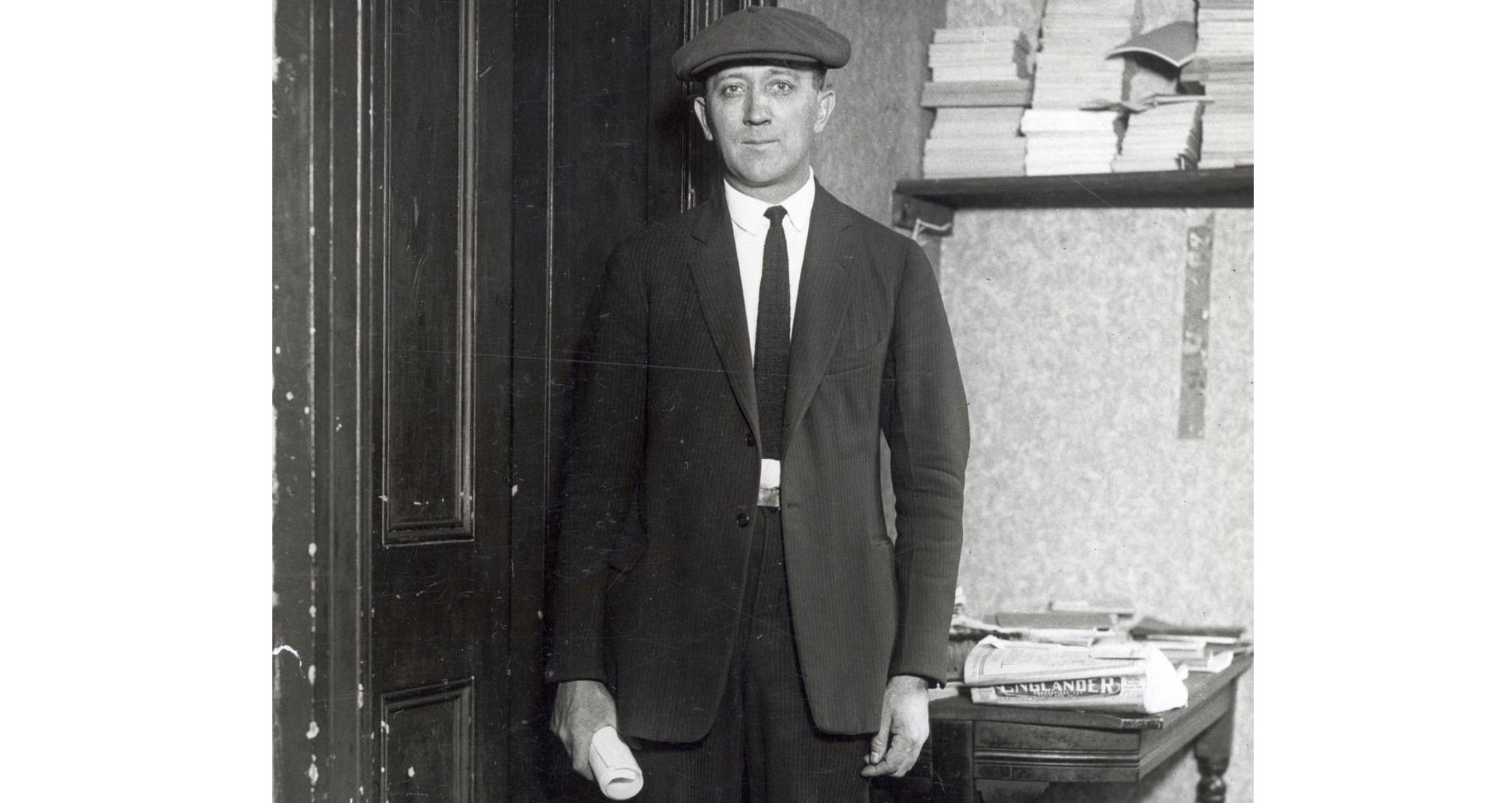
The first half of Foster’s most significant literary intervention into the I..W.W. In 1912, Foster was already a veteran activist, a 30-year-old recent convert to syndicalism after his trip to Europe, where he had been a correspondent for the I.W.W, press, particularly by the work of the C.G.T. of France and the Unione Sindacale Italiana. After failing to win many adherents to his position at the 1911 I.W.W. Congress, Foster left to form the Syndicalist League of North America, of which this may be seen as a defining text.
‘Revolutionary Tactics I-III’ by William Z. Foster from The Agitator. Vol. 2 Nos. 11-13. April 15-May 15, 1912.
I.
The gathering of Socialist labor leaders and politicians, who founded the I.W.W. and outlined its policies and structure, unconsciously pursued a curious though not unnatural method of reasoning by analogy in their undertaking.
Previously, when establishing their political party, following the universal custom of Socialists, they had scathingly criticised and condemned all existing political parties as being by nature non-revolutionary, and organized their party entirely independent of and opposed to all others. When they felt the necessity for an economic “wing” to their movement they instinctively pursued the same course of reasoning and tactics. They violently criticised and utterly condemned the existing conservative labor unions and established the I.W.W. as an independent labor movement.
They reasoned, in effect, though perhaps without realizing it, as follows:
“The corrupt old parties don’t represent the interests of the Working Class on the political field. We organized a new party and it is succeeding. The rotten craft unions don’t represent the interests of the Working Class on the economic field. Therefore, let’s organize a new revolutionary union to replace them. It also will succeed.”
The result of this sub-conscious analogic lumping together of labor union and political party organization problems was that the special problems ever present in the organization of dual labor unions were entirely neglected and the I.W.W. organized “willy nilly” on the gratuitous assumption that if a dual political party can be made a success so can a dual labor union.
But as time has gone on the political party has had a continued growth while the I.W.W., in spite of a large and growing revolutionary sentiment, has vegetated, struggling with problems and difficulties, entirely absent in the political party’s experience. It is, therefore, high time that the problems facing the I.W.W. be given a long needed and more thorough examination than the haphazard one accorded them at the outset, when they were all “settled” without even being considered.
To contribute to this long delayed investigation will be the purpose of this series of articles.
A Dual Program
In its attempt to organize the American proletariat on a revolutionary basis, the I.W.W. is performing two distinct and separate functions with the one organization. It has a double program: First, it is serving as a propaganda league to propagate the ideas of industrial unionism; second, it is functioning as a labor union wherever possible and trying to build up an entirely new labor movement.
We have been so accustomed to see these two programs associated together, that we have not heretofore even remarked them as being two different entities. Proof of their individuality is seen however, in that in many countries syndicalist propaganda leagues exist which do not function as labor unions. The syndicalist propaganda league of England is an example. On the other hand, innumerable labor organizations exist, which are not functioning as propaganda leagues.
In France, where the labor movement is controlled by direct action revolutionists, this duality of functions is also clearly seen. The direct actionists have established magazines and papers (one of them a daily) to propagate their ideas, especially anti-parliamentarism, it being recognized that neither the labor unions nor their official papers can be used for this purpose, if disastrous internal dissensions are to be avoided. Violations of this principle always provoke violent quarrels between the direct actionists and politicians in the unions.
In the I.W.W. these two functions of labor organization and propaganda league are combined–thanks to the farseeing (sic) judgment of the politician founders of the I.W.W. They thought that if a political party could be built around a principle, so could a labor union and they constructed the I.W.W. accordingly.
Since then the I.W.W. has presented its two programs of industrial unionism and dual labor unionism to the working class. The responses to these programs have been, or rather should be, instructive. They have certainly been very different. In fact, one program has been welcomed and the other repudiated. The one is a success and the other a failure.
The Successful Program
The propagation during the past seven years of the industrial union idea–in the sense at least of the necessity for much broader forms and more militant types of labor organizations than those now existing, if not in the exact sense of the I.W.W. charted anti-political One Big Union with an all powerful G.E.B. at the top and an obedient rank and file at the bottom–may be fairly said to have been a success. Workers everywhere are imbued with it. Only the most reactionary or ignorant workers are opposed to it. Insistent demands are being made on all sides in all kinds of unions for the remodeling of the labor movement, more in accord with industrial union principles.
The I.W.W., for some time after its founding, had a monopoly in this propagation of industrial unionism. Indeed, to say “Industrial Unionism” was to say “I.W.W.” But in the course of time the I.W.W. has lost this monopoly. (This has been caused principally by its universal dual organization and anti-political attitude.) Today it is perhaps only a minor factor in the propagation of industrial unionism. At first sight this statement may seem exaggerated, but when one considers that the whole radical wing of the Socialist party (represented by the International Socialist Review, Revolt, etc.); have taken the propaganda as their own and are carrying it on independent of the I.W.W.; that dozens of other Socialist and trades union papers are doing the same; that at its last convention, the U.M.W. of A. endorsed industrial unionism and instructed its officers to attend as many trade union conventions as possible in order to spread the industrial union propaganda; that numerous papers, such as The Coal Digger, The 3-Hour Day, Toledo Union Leader, controlled by direct actionists, are carrying on an active industrial unionism campaign outside of the I.W.W. and the other multiple signs of widespread non-I.W.W. propagation of industrial unionism, the statement takes on at least an appearance of strong probability.
The important fact is, however, that the propaganda program of the I.W.W. IN ITS BROAD outlines at least has been success, so much so, in fact, that it has very largely ran away from the I.W.W.
The Unsuccessful Program
But let us turn to the other program of the I.W.W viz.: the building of a new labor movement, and see how it has fared. The answer is readily apparent. It is a failure. In spite of the great and rapidly growing sentiment in favor of industrial unionism, the I.W.W. has less members now than at its inception seven years ago.
Very many superficial reasons are urged in explanation of this condition and many rosy prophecies of the future made. But they don’t do away with the all-important fact that the workers have failed to respond to the I.W.W.’s dual organization program.
And this is true in spite of the I.W.W.’s recent large increase of membership in the textile industry. These new members were gained as a result of the great Lawrence strike, but, this by no means signifies that the new membership is a permanent one. We have time and again in the past had large groups of workers organized, only to have them desert the organization as the W.F. of M., or disintegrate, as the McKee’s Rocks organization, in response to influences still at work in the I.W.W.
The failure of the dual labor organization program of the I.W.W. means the failure of the I.W.W. itself, as above all it aims to be the labor movement, its propaganda program being only incidental to this end.
In the next article of this series, some of the causes of this failure will be pointed out.
II.
In this article will be considered some of the chief causes of the failure of the I.W.W. dual organization program.
First. The universal and indiscriminate condemnation of non-I.W.W. labor unions as worthless and incapable of evolution.
The I.W.W. was organized, and still organizes, on the theory that all American non-I.W.W. labor unions, A.F. of L. and independent alike, are not labor unions at all nor even capable of becoming such. It is asserted that they are capitalist institutions and must be supplanted by a new and revolutionary organization—which the I.W.W. claims to be. Having been kindly given a monopoly on the labor movement by a bunch of theorists at the first I.W.W. convention—most of whom unquestionably didn’t know even the names of half of the labor unions they were so sweepingly condemning,—the I.W.W. claims jurisdiction over the whole working class, and i3 organizing unions indiscriminately in all industries regardless of the existence of older unions in these industries.
It claims to be the whole labor movement. All other unions are interlopers and must disappear as rivals. The I.W.W., alone for some mysterious reasons, of all American unions, possessing the magic quality of being revolutionary.
What a wonderful and original theory, and how absurd and egotistic it is.
This wholesale condemnation of non-I.W.W. into the position of the sole and only possible labor union is the foundation theory upon which the whole I.W.W. dual organization program rests.
And it is a purely arbitrary one as even the slightest investigation shows. Its justification can he found in neither American nor foreign labor movements. On the contrary, it is being given the lie everywhere in labor movements, both here and abroad. In the United States many of the condemned non-I.W.W. unions are making progress—even though we refuse to see it; and in the labor movements of foreign countries, notably England, one of the great facts being demonstrated is that the course of evolution of labor movements is gradually from the conservative to the revolutionary. Everywhere, where ready-made revolutionary labor organization, a la I.W.W., have been established (German, Sweden, England, etc.) they have proven failures, while revolutionary movements aiming to gradually revolutionize the old conservative labor unions (England, France, Italy, Spain) are all achieving great success.
Many of the unions becoming revolutionary in these various movements have been as conservative as many American unions now under the ban of the I.W.W. These non-I.W.W. unions, and there are many of them, there being 115 in the A. F. of L. alone—are of all types—good, bad and indifferent—and in all stages of growth and decay. Some, like the “Boot and Shoe Workers” and textile Workers,” are decadent, scabby, yellow unions and apparently doomed to extinction. Others, such as the U.M.W. of A., W.F. of M., etc., are unquestionably unions of much higher types and susceptible to progress. For the I.W.W. to sweepingly assert, as it is doing, that none of these unions can become revolutionary—unless it affiliates with the I.W.W. and so gets permission, is ridiculous. There is absolutely no justification for such a conclusion unless it can be proven that the I.W.W. is endowed with the absolute gift of prophecy.
A New Brand of Patriotism.
Nevertheless the theory still prevails and serves as the fountain from which all the difficulties of the I.W.W. dual organization program flow. It has long since become a sort of official dogma and woe unto the heretic who calls it in question. Logically, because of it, we have erected the I.W.W. into a sort of labor union deity that can do no wrong and without which there can be no good.
We have become I.W.W. patriots; and this patriotism is natural, nay compulsory, for having founded our organization on the theory that all non-I.W.W. unions cannot evolve and that the I.W.W. is the only possible bona fide labor organization, we cannot admit that these unions can evolve ever so little; for if we do we must admit that they can evolve to any extent, an admission which would do away with our justification for the I.W.W.’s existence as a labor union. Consequently we don’t admit such evolution on their part even though it be patent to all observers.
The American labor movement hasn’t yet accepted the I.W.W. theory, and is everywhere exhibiting signs of progress, which we as good patriots must explain away. The recently organized system federations gave us a fine opportunity for such “explanations.” We proved it to ourselves, if not to others, that the System Federations—which anybody but a bigot can see are a higher type of unionism—are a step backward for the unions composing them.
The Recalcitrant W. F. of M.
A typical illustration of this. I.W.W. patriotism is exhibited in our attitude towards the W.F. of M. Formerly we considered the W.F. of M. a progressive labor union and part of the structure of the future society which the I.W.W. has the exclusive contract to build. This was when the W.F. of M. was affiliated with the I.W.W. But now this is all changed. To us the W.F. of M. is no longer even a labor union, much less a progressive one. It has had its sub-contract to build the mining department of the future society revoked. It has lost jurisdiction over even its own members and like all other non-I.W.W. unions is a target for our condemnation and dual organization tactics. Many of us would rejoice to see it wiped out of existence.
This great change of attitude has been brought about simply because the W.F. of M. has withdrawn from the I.W.W. and affiliated with the A.F. of L. Its membership and form have remained the same and to an unsophisticated observer, it is as much a labor union as ever. But to us I.W.W. patriots consideration of form or membership don’t necessarily enter into the determination of whether or not an organization is a labor union. The determining factor is whether or not it is affiliated with the I.W.W. Those organizations affiliated are labor unions, the unaffiliated ones are not. The affiliated organizations are parts of the structure of the new society and not to be dualized. The unaffiliated ones are not parts of the new society and are to be dualized. Very simple—and patriotic. We are applying this gauge to the W.F. of M.
This patriotic attitude on our part will last as long as we maintain our ridiculous theory that the I.W.W. had a monopoly on the labor movement and the revolutionary—as long as we continue trying to build up a name rather than the thing. And if we persist much longer in this patriotic attitude, we may easily suffer the fate of the English I.W.W., which has been swept aside into “innocuous desuetude” by the rapidly evolving English labor movement that refused to conform to cut-and-dried I.W.W. theories. Indeed, the I.W.W. and the labor movement in general as will be shown later, has already suffered from it. All the failure of the dual organization program in the last analysis is due to It. Other causes for this failure are of secondary nature, springing from this original cause.
Second. The I.W.W. lays itself open to scabbery on the part of rival unions.
Another cause for the I.W.W. dual organization program not being a success is that time and again, as in Goldfield, Bonner, Brooklyn, etc., the I.W.W. has been scabbed out of existence by A. F. of L. unions. And there is small promise that the I.W.W. will ever be able to build up a strong membership against these scabbing tactics before which the K. of L., A.R.U. and other unions went down. Being a revolutionary union, the I.W.W. cannot reply in kind, and this seems to be the only method of defence or retaliation.
True, by seizing control of the situation at Lawrence, while the discredited and decrepit old “United Textile Workers” union was asleep, the I.W.W. acquired such prestige that the usual scabbing tactics couldn’t prevent its winning the great strike. But this was the result of very fortunate circumstances. Ordinarily such easy victories over A.F. of L. unions cannot be expected.
The A.F. of L. machine is thoroly stirred by this I.W.W. victory and v unless all signs fail, are going to wage a bitter war with the I.W.W. for the mastery of the textile industry; and, as usual, the advantages are on the side of the A.F. of L. In addition to the usual scabbing tactics, it can depend on the large Socialist element in the I.W.W. textile union for assistance.
This is because the I.W.W. Is a direct action organization and so intolerant of Socialists,—that it is only a matter of time until this Socialist element, however large, is forced out of the I.W.W. The A.F. of L. will be the natural haven for it to go to, more especially as it is rapidly falling under the control of the Socialists.
And when the A.F. of L. is finally captured by the Socialists, the I.W.W.’s chances of breaking it up will go glimmering. The Socialists will give the A.F. of L. a new lease of life, not by making it revolutionary, perhaps, but by at least modifying it so greatly that it will be next to impossible to destroy it as we propose.
This warfare between the I.W.W. and rival unions is the inevitable result of our dual organization program. These non-I.W.W. unions won’t accept our ambitious scheme of organization, and they have no other choice left but to fight. And the blame for this fight rests with us, as we are precipitating it needlessly, simply because we are obsessed with the belief that the I.W.W. has a monopoly on the labor movement.
For years we have scathingly criticized the futility, harm of and absurd causes of the jurisdictional quarrels continually raging amongst A.F. of L. unions; and yet with naive inconsistency, on the strength of the above trivial pretense, we are trying to provoke an internecine war in the labor movement beside which all such heretofore would pale into insignificance. It is to be hoped that the I.W.W. will now see the folly of continuing this useless warfare in which we can hope to gain nothing and in which we are dissipating our scanty strength.
In the next article of this series, more causes of the failures of the I.W.W. dual organization will be reviewed.
III.
The four chief causes to which I have attributed the failure of the I.W.W.’s dual organization program are: First, The wholesale condemnation of all non-I.W.W. unions; second, The I.W.W. lays itself open to and encourages scabbing on the part of these unions; third, The I.W.W. places itself in the unsavory position of a disruptive organization; fourth, The I.W.W. violates the principle of the militant minority. It will be seen they all four arise from the warlike relation of the I.W.W. toward the non-I.W.W. unions in general. These unions present the I.W.W.’s most serious problem. Were they but out of existence, the I.W.W. would have comparatively plain sailing. But they refuse to go out of existence and wherever the I.W.W. tries to organize it comes in conflict with them and wastes its strength in fruitless combat. They (ensemble) as well as the I.W.W., claim jurisdiction over the whole working class and don’t tamely submit to competition.
The seriousness of the problem presented by these unions is generally, if vaguely, recognized in the I.W.W. and many and varied are the solutions offered for it. Just a few typical ones held by prominent I.W.W.; Haywood, St. John—ignore the A. F. of L., and organize the unskilled—the “Let Gompers have his million we’ll take the rest throng—Troutman, Williams, Ettor, break up the A.F. of L.—Williams says, ‘We must bore the A.F. of L. all to pieces;” Ettor has stated it Is the duty of every revolutionist to use all his energies to destroy the A.F. of L., because while it .exists a revolutionary movement is impossible in the United States; Walker C. Smith says we must “bore from within” and “build from without”—a combination build-it-up and bust-it-up theory; Rossini would have I.W.W. members work in the old unions, yet preserve an organization on the outside to serve as a sort of haven for those workers discouraged in the A.F. of L.; Hall, in whose brain the idea of the I.W.W. was conceived, would, as I understand him, have the I.W.W. a sort of propaganda organization, consisting solely of rebels, yet taking the form of a dual labor organization; Thompson says we should encourage the industrial union idea wherever possible, get into the old unions, capture them, and swing them into the I.W.W. He says he has often deterred I.W.W. coal miners from forming I.W.W. unions, advising them to stick in the U.M.W.A. And so it goes, about every second member having a different theory—their violently contradictory theories running gamut of every possible line of tactics.
The best comment on these theories—none of which touch the root of the evil— is to be found in that none of their holders, so far as can be seen, are making any efforts to have the I.W.W. adopt them. They are leaving the organization peacefully go along in its planless, haphazard, wasteful method of organizing a member or local wherever possible. They themselves don’t believe their theories are “worth a damn.” Belief in their proposition explains the present activities (obnoxious) of the members advocating “boring from within” tactics for the I.W.W. These proposed new tactics are briefly as follows:
New Tactics for the I.W.W.
The I.W.W., as an organization, shall give up its present unsuccessful and patriotic attempt to build up a completely new labor movement and shall limits itself to propaganda work. We must give up our unsuccessful program—dual organization—and prosecute our successful program—propagation of industrial unionism. We must separate the church from the state, as it were, dissociate the propagation of industrial unionism from dual organization and concentrate our efforts on the former, leaving the latter to take care of itself—as will be indicated later. We must cease trying to be the labor movement and must develop our organization into an effective propaganda league.
We would thus be but adapting the tactics being used in all effective Syndicalist movements and those which would unquestionably have been originally adopted by the I.W.W. had it been formed by Syndicalists, who would have given the question serious study, instead of by a bunch of politicians, who, believing that if a new political party could be made a success, so can a new labor movement.
National Propaganda Organizations
The English, Italian and French movements present types of national Syndicalist propaganda organizations. The English Syndicalist propaganda league, of which Tom Mann is the head, and which has played such a prominent part in the recent series of great uprisings in the English labor movement, is a national dues paying organization. It Is not trying to build up a new labor movement, but to revolutionize the old one. To which end it is turning out vast quantities of literature and everywhere “butting in” on the labor movement, spreading its revolutionary doctrines.
The national organization of the Italian Syndicalists is the “Committee of Direct Action,” in Parma. It is composed of delegates from all Italian unions controlled by Syndicalists—be they independent or affiliated with the conservative Confederation of Labor. It carries on propaganda activities similar to the English Syndicalist organization and is not a dual labor organization. It serves simply as the medium through which the Syndicalists secure more concerted action in propagation and realization of their doctrines in the Italian labor movement in general. It is a power in the Italian movement.
In France the Syndicalists, being in control of the national labor movement, haven’t the need for such a strongly developed national propaganda organization as the weaker Italian and English Syndicalist movements. They secure the necessary concerted action in their eternal fight against the Socialist politicians through their national unofficial papers and magazines owned and sustained by rebels.
Of these three types of organizations the English Outline of New National Organization for I.W.W. undoubtedly is the best fitted for American conditions. The I.W.W. naturally could easily be changed into such an organization. The greatest change necessary would be that it change its aim. It would have to cease trying to build up a new labor movement and instead devote itself to the propagation of industrial unionism. This change of aim would, of course, involve the discarding of its present constitution and the adoption of a new one.
The national headquarters would be maintained then—as now—by dues. As the organizations in the industries would have full autonomy, as will be explained later, the national officers would be few and their duties of a clerical and propaganda nature.
National Organ.
A national paper (or papers) would be indispensable to such an organization. This paper would differ from the rest of the organization papers, in that it would not specialize in any particular industry, but would occupy itself with the whole labor movement. It would be the national organ and the medium through which the whole movement clarified itself and shaped its general policies.
The French equivalent to this paper is “La Bataille Syndicaliste,” a daily. It is not an official organ of the C.G.T., nor any union, but may be called the official organ of the impromptu national syndicalist propaganda league, it being founded and supported by direct action rebels, to propagate their doctrines and fight the politicians.
Corps of Organizers.
A national corps of organizers would also probably be necessary. (These might be later replaced by representatives of the various unions controlled by the Syndicalists who would serve as organizers, etc., similar to the members of the Italian Committee of Direct Action.) These organizers, in addition to their other propaganda activities, would have as their special function to take part in every important labor war, asked or unasked, by the conservative unions engaged.
During strikes workers readily accept revolutionary ideas and, if given the slightest encouragement and organization, repudiate their misleaders and act together in a revolutionary manner. Consequently, it would be the best and most natural policy of the national organization to concentrate its force as much as possible on great strikes—which occur with sufficient frequency to keep it thoroughly employed. The strike districts would be flooded with organizers and literature, pointing out the fallacy and futility of craft unionism and the advantages of industrial unionism, etc., and generally educating and stimulating the workers to revolutionary action.
The great value of this propaganda would be that it would be disinterested and taken at its face value by workers. At present the I.W.W. is excluded from this rich field of work. First, it has no interest in aiding old unions to win strikes; indeed, it would much rather see them lose, so they would go out of existence the quicker; and, second, even if it does send organizers into strike districts, they are inevitably and justly considered disrupters and their propaganda practically neglected. As a result, while rich situations like that presented by the great Harriman strike lies unexploited, all over the country one can find able I.W.W. organizers on “soap boxes in fevered competition with the Salvation Army, warming chairs,” etc.
This national corps of organizers, acting in conjunction with the organized militant minorities in the unions involved, would be a powerful force. The mere fear of its activities would undoubtedly force labor fakers to give up many of their demoralizing practices. It would be a potent means to the revolution of the American labor movement.
Though this form of national organization would be effective—if we may judge by its results wherever tried—it would be but a minor feature of propaganda organization. The most important features would be the organizations in the various industries. These organizations will be treated of in the next article of this series.
The Syndicalist began as The Agitator by Earl Ford, JW Johnstone, and William Z Foster in 1911. Inspired by the revolutionary syndicalism of the French CGT, they felt they were political competitors to the IWW and in early 1912, Foster and others created the Syndicalist Militant Minority Leagues in Chicago with chapters soon forming in Kansas City, Omaha, Minneapolis, St. Louis, Denver, Seattle, Tacoma, Vancouver, San Francisco, and Los Angeles. They renamed The Agitator The Syndicalist as the paper of the Syndicalist League of North America with Jay Fox as editor. The group then focused on the AFL. The Syndicalist ceased publication in September 1913 with some going on to form the International Trade Union Educational League in January 1915. While only briefly an organization, the SLNA had a host of future important leaders of the Communist movement. Like Foster, Tom Mooney and Earl Browder who were also members.
PDF of full issue: https://www.marxists.org/history/usa/pubs/agitator/v2n11-w35-apr-15-1912-agitator.pdf
PDF of issue 2: https://www.marxists.org/history/usa/pubs/agitator/v2n12-w36-may-01-1912-agitator.pdf
PDF of issue 3: https://www.marxists.org/history/usa/pubs/agitator/v2n13-w37-may-15-1912-agitator.pdf
 Revolution's Newsstand