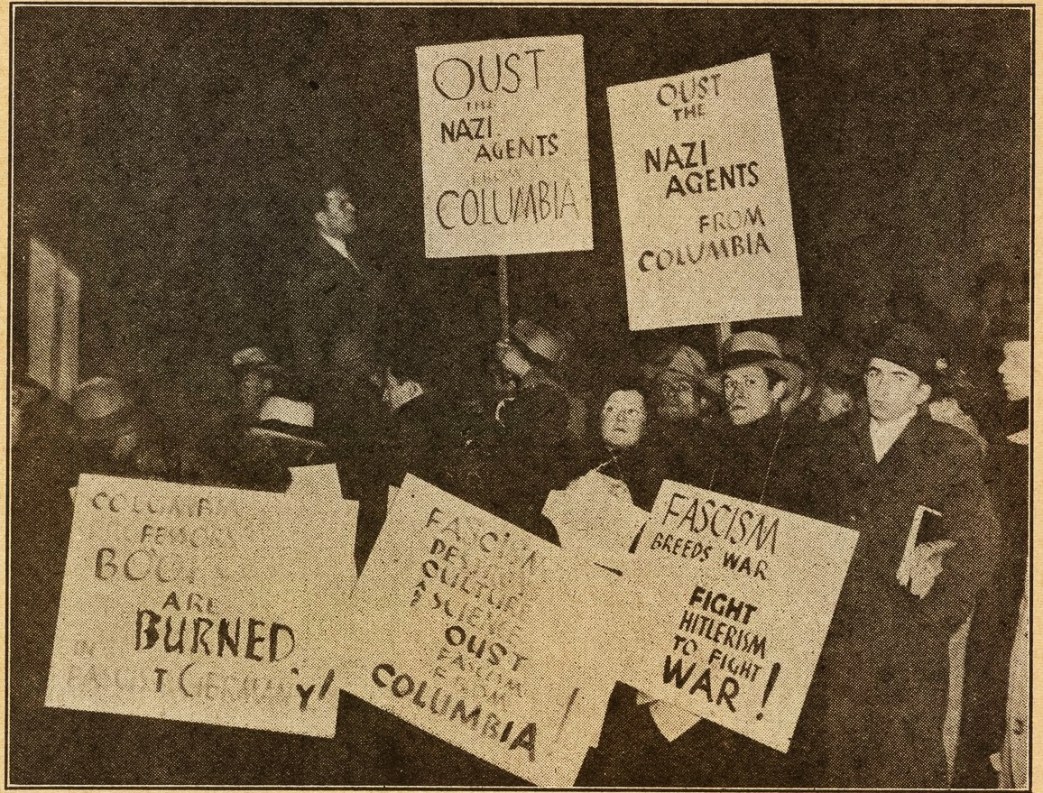
While firing radical teachers and suspending anti-war students, on Dec. 12, 1933, Columbia University’s president invited Hans Luther, Nazi Ambassador to the U.S, to deliver a speech on the new regime. Protests and arrests followed. Columbia economics professor Addison Cutler on the rise of fascism on college campuses.
‘Campus Fascism’ by Dr. Addison T. Cutler from The Fight Against War and Fascism. Vol. 1 No. 3. January, 1934.
What are American college students and teachers going to do about Fascism? This very important question was sharply posed by the affair at Columbia. An invitation, with honors, to the Nazi ambassador to use Columbia University as a national platform was met by a protest campaign culminating in a vigorous demonstration which challenged the Fascists both inside and outside the hall provided by the University.
Ambassador Luther received one more public repudiation to report back to Hitler. The University community learned something in the process, and the authorities of the University were forced to retreat at least to the extent of abandoning the proposed reception for Luther and moving the “lecture” to a hall more obscure and less official than the one originally planned.
The effectiveness of the protest was largely due to the efforts of such organizations as the National Student League, the Columbia Committee Against War and other sympathetic groups. The undergraduate students of Columbia College were in the main indifferent or even hostile to the anti-Nazi campaign. This is something for us to study.
Fertile Soil
The student body of Columbia College, like that of most American colleges, is made up chiefly of middle-class boys aspiring to professional and small-business careers. What they want is simple–a home, a family, a good job, security. Few aspire to be business Napoleons. But they are beginning to see that the prospects of achieving even these modest hopes is bleak in the extreme. Hence they are the potential prey of Fascists who seek to dupe them by false promises into the perpetuation by violence of a crumbling capitalist regime all in the name of a “new” order which will offer them God-knows-what. Here in the United States, the repetition of the Italian and German tragedies is already being prepared. It is our job to stop it.
According to my observations there is a widespread, increasingly typical notion forming in the minds of Columbia College undergraduates, something like this: “The N.R.A. is failing. There go our prospects. The next thing is Socialism or Communism or Fascism. Fascism offers more to fellows like us.” This notion is not yet fully crystallized. But it is rapidly becoming so. I find it on exam papers, essays, and in conversations. Many of my colleagues tell me they find the same.
But this is not all. These ideas find expression in local affairs. First we may recall the egg-throwers and strong-arm boys who, in a blind defense of constituted authority, attacked the supporters of Reed Harris, expelled student editor, and of Donald Henderson, dismissed radical instructor. In the latter case, we were treated to an open display of anti-Semitism and pro-Hitler sentiments aimed against some of Henderson’s supporters. This year we hear new rumblings. It is proposed publicly that “all red-blooded Americans on the campus rise against the menace of the Social Problems Club.” Bits of talk about the possibility of forming a “Young Hitler League” reach our ears. One of my own students presents me, anonymously, with a caricature of myself strung up in a lynching party (all in the spirit of good clean fun, I trust). These are all straws in the wind. I think they mean something. Perhaps the uniforms are not so far off.
Our Task
Now this is not submitted in the spirit of defeatism. It is rather to emphasize our problem. We must show these students clearly what Fascism is. They can, I think, be made to see that, if they do the dirty work for big capital, it will result in nothing for themselves but perversion and betrayal, and nothing but incalculable harm for all the progressive forces in society. They must be made to see that Fascism is not a new order, but rather the ultimate in horror of the old order. I wish they would all be compelled to read Strachey’s Menace of Fascism. Obviously we cannot rely on college curricula. We are compelled to resort to wider spheres of thought and action, reaching far beyond the confines of a class-room, which is all to rarely penetrated by the burning issue of the outside world. But our mass demonstrations can hardly be successful enough in carrying their striking messages unless we accompany them with a patient campaign in the realm of ideas. I refer to the need for more pamphlets, leaflets, lectures, symposia, debates on the meaning of Fascism–Italian, German, and American brands. And on the alternative to Fascism, let us make the college undergraduates see that there is a place for them in an alliance with workers, who in struggling against War and Fascism are really taking the road to a new society–one where the man with technical ability is offered both security and creative work.
University Liberals
How about the faculty members? A fair sample at Columbia showed the trend of opinion to be as follows: “We oppose the Nazis’ burning of books, imprisonment of professors, etc. We welcome on the campus the exiled German professors. But we are not opposed to the invitation and reception to the Nazi ambassador.” Among those who sprang to the defense of the Nazi Luther in the name of “free speech” were many who last year failed to see any violation of academic freedom in the dismissal of Henderson, who was guilty of carrying into practice those forward-looking ideas which Columbia had been liberal enough to allow him to teach. This is clearly liberalism gone reactionary. But among the Columbia faculty there is also a type of liberalism which suffers mainly from timidity and a mistaken view of “tactics.” Can we make these people, who should be with us, see that “laughing off Hitler” and “laughing off Luther” is suicidal for liberals, pacifists, Socialists, and Communists–in fact suicidal for science, culture, and civilization itself? The lessons of Germany have not yet been driven home, when we hear at Columbia that “if we give the Fascists enough rope, they will hang themselves.” On the contrary, they will hang us. Tolerance for all, including the destroyers, is the negation of tolerance, freedom, and peace. Some professors see it and we can make others see it.
Fight Fascism
And so, to combat embryonic Fascism in America, we have a lot to do to win over the potential Storm Troopers as well as to buck up the flagging liberals. I might mention here. the case of a Columbia professor who told me that he was so much opposed to the Fascists that he was ready to be shot fighting them, but that he was unwilling to risk his job now in protesting the welcoming of the Nazis to the campus! But later he was willing to die. That imperialist War and Fascism are two sides of the same metal, was recognized by the permanent Columbia Committee Against War when it joined the anti-Luther protest. But this recognition is, of course, far from general. For instance the magazine “Fight Against War and Fascism,” while it is popular in many quarters of the Columbia campus, meets resistance in some quarters on the plea: “Why, I am against war but not against Fascism. Fascism is a political question, and I’m not ready to take sides.” Clearly there remains a huge task before us. We have only begun.
FIGHT Against War and Fascism was the monthly newspaper of the broad-based, but Communist-inspired, American League Against War and Fascism formed in 1933 as Nazism came to power in Germany. The paper and the League attracted fairly wide support and hosted many events in the 1930s. In 1937, reflecting the Popular Front turn, the name of the group was changed to the American League for Peace and Democracy and the journal to The Fight for Peace and Democracy. Both the paper and the organization closed in the wake of 1939’s Molotov–Ribbentrop Pact.
PDF of full issue: https://www.marxists.org/history/usa/pubs/fight/v1n03-jan-1934.pdf
 Revolution's Newsstand