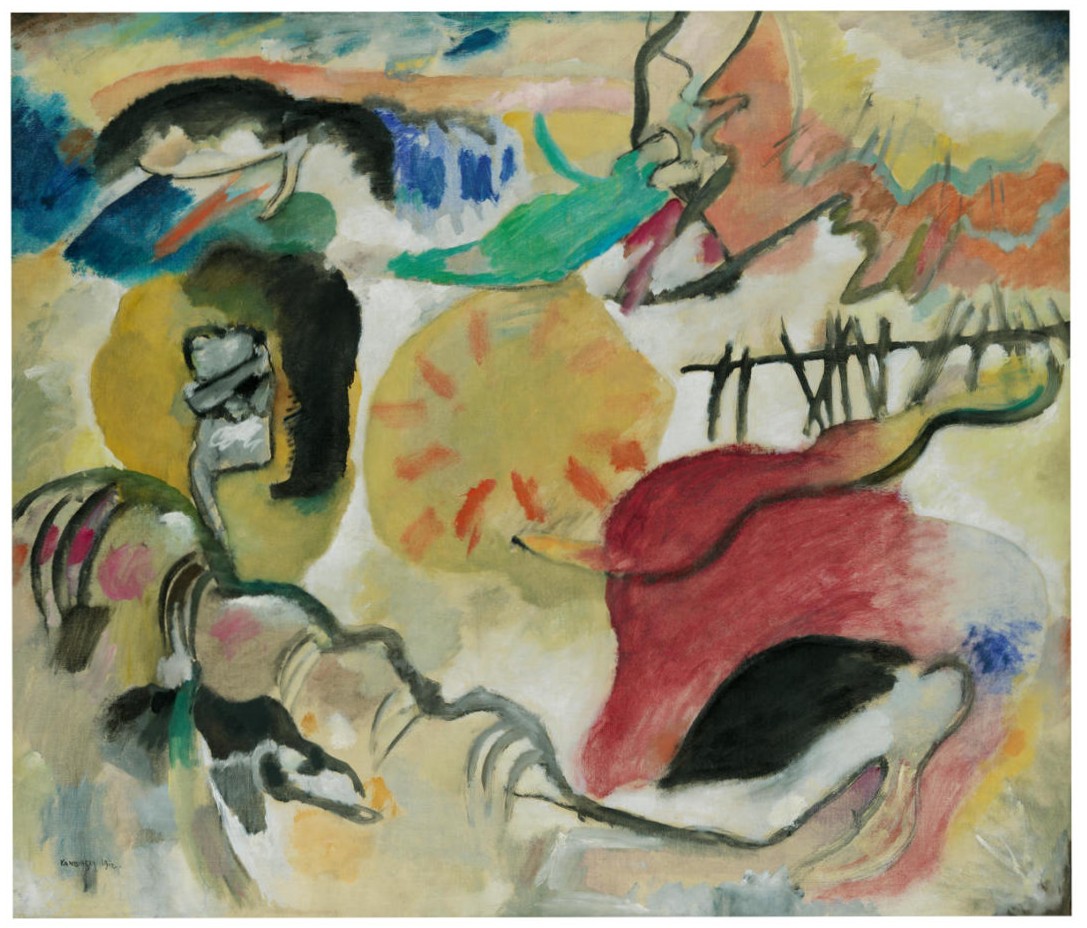
Andre Tridon reflects on Wassily Kandinsky’s first painting exhibited in the U.S., “Improvisation 27” (“Garden of Love II”), at New York’s 1913 Armory Show. Tridon was a French-born translator, syndicalist-cum-communist, ‘Masses and ‘New Review’ editor, arts critic, and pioneering psychoanalyst (he translated Freud and Alfred Adler into English).
‘Wassily Kandinsky’s ‘Improvisation” by Andre Tridon from New Review. Vol. 1 No. 15. April 12, 1913.
A “Wild Man” Explains Himself
There was at the exhibition of the Independents a canvass signed Wassily Kandinsky, which more than any Cubist or Futurist work distressed the visitor. It represents nothing in particular. Daubs of color, green, grey, pink. Something in the center of the painting had a remote likeness to either an umbrella’s frame or a watermelon. And it was entitled “Improvisation.” Fortunately Kandinsky is not only a painter but a forceful, lucid writer, and his book, “Das Geistige in der Kunst,” gives us a key to the recondite meaning of his pictorial work.
If the viewing of “Improvisation” justified the hasty in doubting Kandinsky’s good faith, the perusal of his book on the intellectual element in art suffices to reveal one of the most painstaking, conscientious estheticians of the present day.
This generation is not likely to understand, or rather to feel, Kandinsky’s canvasses, for he has forged too far ahead of us. He realizes the fact and begs us to be patient. I cited in a previous article the pitiful case of Bellini doubting Wagner’s sanity and honesty. Kandinsky reminds us in a foot note of Weber’s unfortunate attitude to Beethoven. To the author of Der Freischiitz, the Master’s Seventh Symphony was proof of his dementia. “Beethoven is now ripe for the madhouse,” he wrote.
If I insist on examples drawn from the musical art it is because music has advanced further than painting, though in the same direction. There was a time when almost every composition affected the form of a dance tune. Italian operas (remember II Trovatore) were built on polkas, waltzes, mazurkas, etc. The French school introduced the plain melodic phrase; Wagner, his leitmotifs and their symphonic combinations; the modern school, Debussy, Reger, Strauss have discarded dance tunes, melodies and leitmotifs. These composers express nothing but successions of moods through sound combinations as seemingly unrelated and fleeting as moods are. Their only principle is a blind obedience to what Kandinsky calls “die innere Notwendigkeit,” the inner urge. The musical composition of to-day is designated nowadays, owing to our insufficient vocabulary, as a tone poem, we say it is full of color, certain phrases have a clear relief or are clean cut. The terminology of poetry, painting, sculpture, engraving is drawn upon; a clear symptom that the arts can hardly ever be separated. In fact, we have no definite word to designate a modern musical composition.
Kandinsky now proposes that painters discard all the traditional forms and the traditional technique of painting, even as musicians have discarded the traditional types of composition and traditional harmony. They must obey “the inner urge,” whatever its promptings may be, and only transfer to the canvas the colors and color schemes they feel, regardless of what the result is to be.
After all, isn’t this the origin of every powerful painting, from the “Night Watch” to Matisse’s “Red Panel”? The artist remembers primarily a striking combination of colors and nuances, and to communicate his feeling to the layman plays off those colors on some scene, full of human figures and action in the case of an older painter, indicated by sober, simple lines in the case of a modern. As progress in all arts has made for the elimination of detail (we no longer write Iliads but note subtle moods in twenty lines, we no longer write Pamelas in seven volumes but sketches of life in ten pages), can we not foresee the day when suggestion will be all in painting, as it is now. in music, as it almost is in poetry?
What we appreciate most in a work of art is powerful self-expression, personality. Kandinsky’s theory offers to the pictorial ego a free field. Will not the artist’s personality, expressed through such a medium, remain a closed book to the beholder?
By no means! No concert-goer could mistake a Debussy motive for a Strauss motive. One element in painting is eternal: the intrinsic significance of colors. Yellow will always remain the warm, luminous, earthy color; blue the restful color which in its deeper shades may express a superhuman woe, in its lighter, indifference and coldness; red the irritating violent color, etc. We shall also have the lines of motion, centripetal and centrifugal, color contrasts as between white and black, yellow and blue, evident to all in their primary meaning.
Have we ever pondered over what constitutes the beauty of a sunset, especially after the sun has sunk under the horizon?
If the sky be cloudless and the landscape between us and the horizon unobstructed by any natural objects, what have we to behold but a series of color layers running from red to green and grey above the horizon, from red to brown and grey below the horizon.
For thousands of years the world has been admiring the kind of painting Kandinsky wishes us to produce. Only Nature painted it, and we have grown so abnormal that we cannot even recognize in man’s handiwork the beauty which stares at us from everywhere in the physical world.
The New Review: A Critical Survey of International Socialism was a New York-based, explicitly Marxist, sometimes weekly/sometimes monthly theoretical journal begun in 1913 and was an important vehicle for left discussion in the period before World War One. Bases in New York it declared in its aim the first issue: “The intellectual achievements of Marx and his successors have become the guiding star of the awakened, self-conscious proletariat on the toilsome road that leads to its emancipation. And it will be one of the principal tasks of The NEW REVIEW to make known these achievements,to the Socialists of America, so that we may attain to that fundamental unity of thought without which unity of action is impossible.” In the world of the East Coast Socialist Party, it included Max Eastman, Floyd Dell, Herman Simpson, Louis Boudin, William English Walling, Moses Oppenheimer, Robert Rives La Monte, Walter Lippmann, William Bohn, Frank Bohn, John Spargo, Austin Lewis, WEB DuBois, Arturo Giovannitti, Harry W. Laidler, Austin Lewis, and Isaac Hourwich as editors. Louis Fraina played an increasing role from 1914 and lead the journal in a leftward direction as New Review addressed many of the leading international questions facing Marxists. International writers in New Review included Rosa Luxemburg, James Connolly, Karl Kautsky, Anton Pannekoek, Lajpat Rai, Alexandra Kollontai, Tom Quelch, S.J. Rutgers, Edward Bernstein, and H.M. Hyndman, The journal folded in June, 1916 for financial reasons. Its issues are a formidable and invaluable archive of Marxist and Socialist discussion of the time.
PDF of full issue: https://www.marxists.org/history/usa/pubs/newreview/1913/v1n15-apr-12-1913.pdf
 Revolution's Newsstand