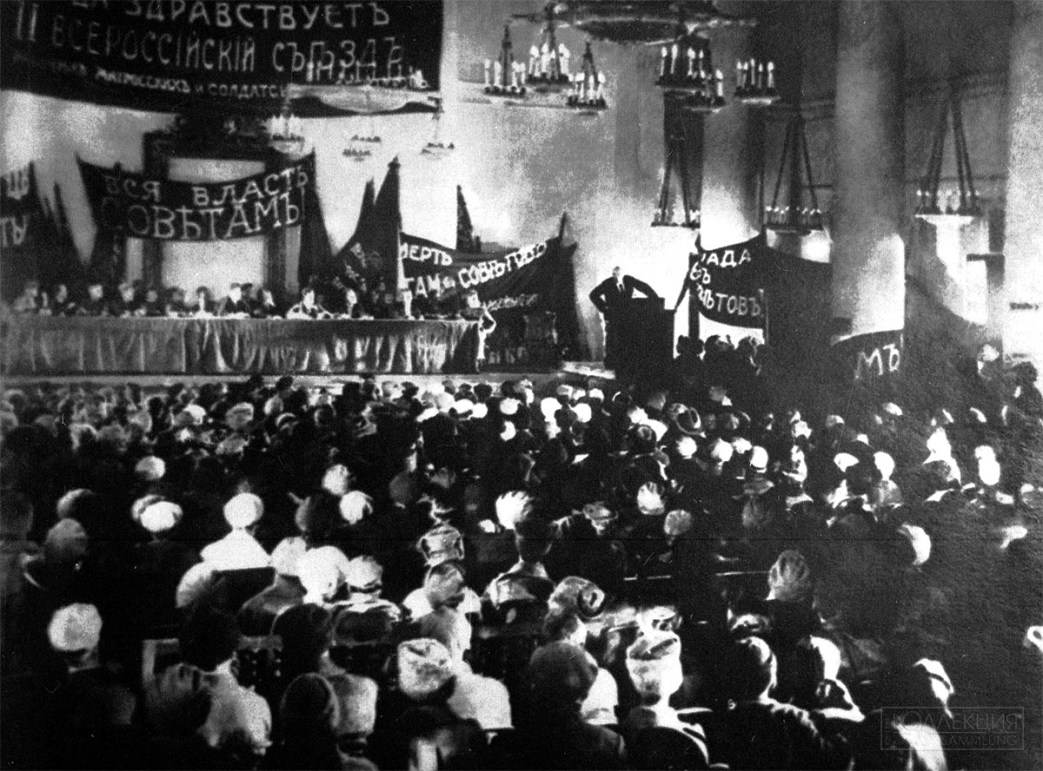
The first two decrees of the Soviets, passed within hours of assuming power, were on an immediate end to the war, and the Decree on Land, below, adopted by the All-Russian Congress of Soviets on November 8, 1917.
‘Decree on Confiscation and Nationalization of Land’ from Class Struggle. Vol. 2 No. 4. September-October, 1918.
Adopted by the All-Russian Congress of Soviets, November 8, 1917.
1. The landlord’s property in all land is herewith abolished without compensation.
2. The estates of the landlords, as well as the appanage lands and lands belonging to the monasteries, churches, with all their live and dead inventories, manor buildings, and implements, pass into the control of rural Land Committees and District Councils of Peasants’ Delegates, until the Constituent Assembly.
3. Any damage willfully caused to the confiscated property, belonging from now on to the whole people, constitutes a grave crime, punishable by the Revolutionary Tribunals. The District Councils of Peasants’ Delegates are to take all the measures required for the preservation of strict order while carrying out the confiscation of the estates of the landlords, for recording the size of the estates to be confiscated, for preparing a detailed specification of the whole confiscated property, and for the most stringent revolutionary protection of all the agricultural estates passing now into the hands of the people, with all the buildings, machinery, cattle, stores, etc., appertaining to them.
4. Until the Constituent Assembly will have finally decided the lines of the great land reform, the following instructions, embodying 242 resolutions of a meeting of peasants, and drafted by the Editorial Committee of the “Bulletins of the All-Russian Council of Peasants’ Delegates,” shall serve for the guidance of the authorities carrying out the work at present:
“The land question in its entirety can be solved only by the Constituent Assembly. The most just solution of the land question must be as follows:
“1. The right of private ownership in land is abolished forever; land can neither be sold, nor bought, nor leased, nor mortgaged, nor appropriated in any other way. The whole of the land of the State, of the appanages, of the Crown, of the monasteries, of the churches, as well as monasteries, lands in conditional possession, or endowed to persons, or concerns, privately owned land and land belonging to public bodies, and to peasants, and so on, is herewith expropriated without any compensation whatever, and it becomes the property of the whole people and is transferred for use to all who till it
“Those who have suffered from this expropriation are entitled to public relief, but only for the time which may be necessary to allow them to adapt themselves to the new conditions of existence.
“2. All the interior of the earth, ores, naphta, coal, salt, etc., as well as forests and waterways, having an all-national importance, pass into the exclusive possession of the State. Small rivers, lakes, and forests, pass into the possession of the local communities, subject to the control of the local authorities.
“3. Highly cultivated estates, orchards, plantations, nurseries, hothouses, etc., are not to be subjected to division, but are to remain as model estates, and they pass into the possession either of the State or of the local communities, in accordance with their size and importance.
“Land appertaining to manor houses, or belonging to towns, or villages, as well as orchards and market gardens appertaining to households, remain in the possession of their present owners, the size of such land and the rate of the tax to be paid by the owners for their use to be fixed by
“4. All kinds of breeding stations, of horses, cattle, poultry, etc., whether belonging to the Crown or to private persons, are confiscated and they become the property of the whole people and pass either into the exclusive possession of the State, or of the communities in accordance with their size and importance. The question of compensation to be decided by the Constituent Assembly.
“5. The whole of the inventory of the confiscated estates, both live and dead, passes into the exclusive possession of the State or the local communities, in accordance with their size or importance. The confiscation of the inventory is not extended to small peasants.
“6. All Russian citizens, irrespective of sex, willing to till the soil with their own labor, or with the assistance of their families, or in company with other peasants, are entitled to receive land for use, and for the duration of time they are able to till it. No hired labor is allowed.
“In case of any member of the village community becoming an invalid the community must come to his assistance, by cultivating his land till die time of his recovery, but not longer than during two years. Persons who, either from old age or illness, have lost the ability to till the soil, lose their right to use land and receive instead a pension from the State
“7. The possession of the land is to be equal, i.e., the land is distributed amongst the tillers, in accordance with local conditions, in equal plots, the standard share being either a plot to a man capable of working it with his own labor, or a plot required to feed himself and his family. The forms of land tenure are to be decided freely by the local community, whether individual, communal, cooperative, or any other.
“8. The whole of the land, after its expropriation, forms a National Land Reserve. The distribution of this reserve amongst the tillers is effected by the local authorities, beginning with democratically elected rural and urban municipalities and ending with the central provincial institutions. The re-allotment of the whole of the Land Reserve is carried out periodically, in accordance with the growth of the population and the rise in the productiveness of land cultivation. During the re-allotments the main portion of an original allotment must remain unchanged. The land which belonged to persons, who for one reason or another, have lost, or given up possession, reverts to the Land Reserve.
“The cost of manuring or improvements (in so far as the latter are of a fundamental nature), are to be refunded to the owner, if not fully utilized at the time of delivery of possession of the plot.
“9. In case the available Land Reserve in any given locality is not sufficient to provide for the local population, the excess population is provided for by emigration organized by the State, and the latter bears all the cost of the emigration and settlement of the new land.
“10. The contents of this instruction as representing the firm will of the great majority of the conscious peasants of the whole Russia is declared a temporary law, to be carried into effect forthwith, either in full or in part, as determined by the District Councils of Peasants’ Delegates. Land belonging to peasants and Cossacks below a certain standard size is not to be confiscated.”
The Class Struggle and The Socialist Publication Society produced some of the earliest US versions of the revolutionary texts of First World War and the upheavals that followed. A project of Louis Fraina’s, the Society also published The Class Struggle. The Class Struggle is considered the first pro-Bolshevik journal in the United States and began in the aftermath of Russia’s February Revolution. A bi-monthly published between May 1917 and November 1919 in New York City by the Socialist Publication Society, its original editors were Ludwig Lore, Louis B. Boudin, and Louis C. Fraina. The Class Struggle became the primary English-language paper of the Socialist Party’s left wing and emerging Communist movement. Its last issue was published by the Communist Labor Party of America. ‘In the two years of its existence thus far, this magazine has presented the best interpretations of world events from the pens of American and Foreign Socialists. Among those who have contributed articles to its pages are: Nikolai Lenin, Leon Trotzky, Franz Mehring, Karl Liebknecht, Rosa Luxemburg, Lunacharsky, Bukharin, Hoglund, Karl Island, Friedrich Adler, and many others. The pages of this magazine will continue to print only the best and most class-conscious socialist material, and should be read by all who wish to be in contact with the living thought of the most uncompromising section of the Socialist Party.’
PDF of full issue: https://www.marxists.org/history/usa/pubs/class-struggle/v2n4sep-oct1918.pdf
 Revolution's Newsstand