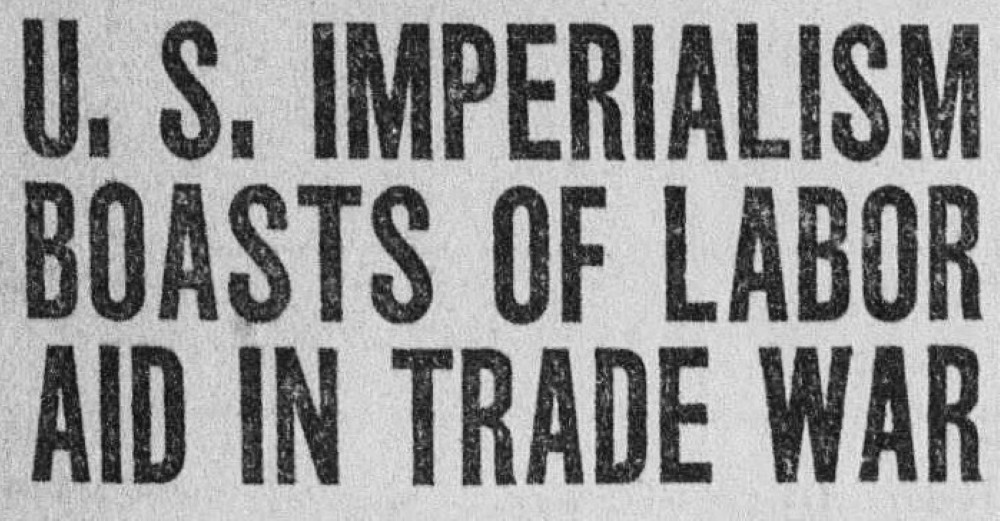
From our movement’s history, a concise statement of principle, this obviously relevant resolution from 1925’s semi-regular conference of European Communist parliamentarians. While written in the context of an emerging Soviet Union, and the post-war Dawes Plan and trade wars by which the U.S. muscled into battered European markets, it is a general statement of the proletarian position on tariffs and trade, covering the colonial and semi-colonial world as well. A working document, the resolution asks the International to further develop on its theses. A must read for today.
‘Resolution on the Policy of Protective Tariffs and Trade Agreements’ from International Press Correspondence. Vol. 5 No. 85. December 3, 1925.
1. The war has tremendously intensified the contradictions of capitalist international economy. The extension in the apparatus of production is becoming more and more disproportionate to the limited possibilities of sale. No satisfactory regulation of the question of the cost of the war and of the paying off of international debts has yet been found. The consequence is a permanent chain of crises concerning markets and currency which are constantly recurring and always becoming more severe in almost all capitalist countries (agrarian crises in America and Germany, industrial crises in England and Germany, currency crises in Germany, Poland, France etc.)
One of the means by which the bourgeoisie tries to master these international crises is its policy of high protective tariffs, of prohibition of imports, of anti-dumping laws, of concessions for imports and exports from case to case, of fixing contingents of imports (also of immigration as for instance in the United States), of granting privileges to “national” shipping and industry and of obstinately fighting against the foreign trade monopoly of the Soviet Union, as well as of attempts to strangle the native industries in the colonial and semi-colonial countries.
At the same time, the bourgeoisie is attempting in the various countries to bring about at least a temporary settlement between the contradictory interests of the various national groups of capital, by a system of commercial treaties, constructed on the basis of “fighting duties”, import contingents etc., and further by certain international agreements (for instance the proposal of an international economic conference, the slogan of “a European Customs’ Union”, the project of an agreement as to “international regime in seaports”).
2. Whereas however, in the period of early capitalism, protective duties and commercial treaties had the object of developing the internal market, now, in the period of monopolist capitalism, they are turning into an obstacle to technical progress and to the internationalisation of economics as well as into a means of ensuring the rule of the great national groups of capital, the trusts, concerns, cartels and syndicates, and further into a weapon or, as the case may be, an object of bargaining for the great groups of capital in the distribution of world markets. They are an instrument for intensified exploitation both of the broad masses of workers in the capitalist States and of the colonial and semi-colonial peoples.
The commercial treaties of the capitalist governments are, in the imperialist period, not means for bringing about “understanding between the peoples” and “peaceful competition”, but means for the embittered fight of the imperialist robbers for markets and for territories to exploit. They are also means for enforcing the “Dawesation” of the weaker capitalist States by the groups with economic and military predominance, as well as for strangling the independent and economic development of semi-colonial peoples.
The slogan of “treaty duties” is nothing but an attempt to make “customs’ war” a permanent condition among the individual imperialist robber States. Customs’ wars however not only mean the destruction of economic relations, they are not only combined with a constant increase in the cost of living and unemployment for the working masses, they involve at the same time the direct danger of fresh military encounters.
3. An essential feature of the imperialist customs’ and trade policy dictated by the great trusts, cartels etc. are the private negotiations and private agreements of large groups of capital which run parallel with the official government negotiations and in reality determine them (for instance the negotiations between German and French heavy industry). The intensified fight for markets, the growing formation of international cartels is expressed in the ever-increasing establishment of definite import and export contingents in favour of large industry combined in concerns. These measures are associated with the closing of factories and increased unemployment and serve at the same time to intensify the exploitation of the proletariat and to make the weaker industrial groups and the peasant masses dependent on the large concerns.
4. The social democratic parties of the 2nd International in no way carry on on principle a fight against the imperialist customs’ and trade policy, they do not carry on a fight which is determined by the class interests of the proletariat and of the strata and peoples who are oppressed by the imperialist bourgeoisie. It is true that at times they carry on a certain parliamentary opposition to the bourgeois policy of protection for reasons of demagogic agitation, but in practice, the social democrats of the most various countries have always proved to be helpmates of one group or other of the bourgeoisie in their country, whether they tolerated the introduction or the increase of certain industrial duties and only protested against agricultural duties “in the interest of the consumers”, or whether they themselves took a positive share in the introduction of “moderate” or “gliding” protective duties. Social democracy everywhere supports the illusion that international treaties and agreements of capitalist States or of groups of large capitalists, as the case may be, might solve or at least mitigate the existing economic and currency crises. It should be especially emphasised that social democracy has done nothing to combat the exploitation of the colonial and semi-colonial countries by the extortionate customs and trade policy of the imperialist robber States. It does however, hand in hand with the bourgeoisie, combat the commercial and economic policy of the only proletarian State in the world, the Soviet Union. Nowhere in the world does social democracy mobilise the broad masses to fight against the imperialist commercial and economic policy.
5. In contrast to this, the Communists declare that the contradictions of capitalist economy in the period of monopolist capitalism are not less, but greater, more violent and, as they affect the working masses, more devastating. The international agreements and formation of cartels of the great monopolist groups of capital are, in exactly the same way as the treaties, alliances and conferences of the imperialist governments, not instruments for preventing new economic or political crises, conflicts and catastrophes, but means of power of the strongest monopolist groups of capital and imperialist States, and thus the source of new and worse crises, conflicts and wars. The whole customs and trade policy of the capitalist imperialist States is consequently nothing but a continuation of the old war policy with other means and the preparation for new armed conflicts.
It is therefore the duty of the Communist Parties of all countries to carry on the most intensive fight against the customs and trade policy of the imperialist governments, inside and outside the Parliaments. They must in every individual case point out the reactionary effect of the protective tariffs which threaten not only the existence of the proletariat but also the existence of the broadest middle strata of the rural and urban population in the present period, and they must mobilise the masses for fight against the whole protection policy of the imperialist bourgeoisie. The Communist Party must fight to the uttermost against the social democratic conception, according to which “moderate” or “sliding” protective tariffs may be granted to industry or to certain branches of manufacturing industry, nominally in the interest of the workers. In no case do the working masses benefit by protective tariffs in the highly capitalist States. Above all, protective tariffs do not prevent the importation of capital and so do not prevent the subjugation of protected but weaker economic bodies by strong international financial groups. Further, any protection in one branch, of industry is necessarily followed by demands for protection in another branch. Anyone who agrees to industrial duties, even under the mask of “financial duties”, “treaty duties” etc., gives the large agrarians the most powerful argument for their demands for duties. Duties for “protection of the currency”, for “improving the trade balance” also only serve the purposes of the large groups of capital.
The slogans of the agrarians: “increase agricultural production”, “food from our own soil”, “protection of farming” are also only slogans for misleading the proletarian, peasant and petty bourgeois masses. In reality agrarian duties always serve the purpose of increasing profit from land and the capital profits of landed proprietors and agrarian capitalists.
6. Duties on luxury goods can only be conceded by the Communists when it is a case of products which are really only consumed by the bourgeoisie as luxuries (pearls, diamonds, expensive furs).
It is a special duty of the Communists to carry on a broad, careful work of enlightenment of the masses of the small and middle peasantry as to the part played by and the effect of, both agrarian and industrial duties. Protective duties on commercial plants, such as fruit, tobacco, vegetables and wine should also be rejected. Should however a sudden removal of the capitalist protective measures threaten the existence of broad strata of the small peasants in consequence of their being heavily taxed and exploited by the big agrarians and big industrialists, the Communists must indeed promote the rapid removal of these duties but at the same time promote the carrying through of serious measures for cheapening and increasing peasant production or for turning over to other kinds of work in certain branches of production.
Should, as a result of the protective tariffs or of certain tariffs, the broad peasant masses be exposed to ruin and to the supremacy of certain foreign trusts and concerns who wish to monopolise the home markets, the question must be asked whether the Communists, after they have made the above proposals and these proposals have been rejected, might, in the interest of maintaining the alliance between the proletariat and the peasantry, agree in Parliament to certain protective measures as a provisional modus vivendi. This question is to be made the subject of a thorough enquiry in the whole Communist International.
At the same time, it should be explained to the strata of small peasants, by energetic agitation, that the protective policy of a State developed on capitalist lines is at bottom, in it effect, against their interest, and that other measures must be taken for their protection.
7. This fight of Communism against the capitalist imperialist protection policy, by no means implies identification with the principles of bourgeois free trade. “Free trade” in the period of monopolist capitalism means in practice the dictatorship of the strongest groups of capital over the weaker ones. It does not diminish but increases the material and financial exploitation of the working masses and the concentration of all the means of production in the hands of a few gigantic international trusts, concerns and financial corporations. “Free trade” by no means leads to the economic satisfaction of the world markets but, on the contrary, to increased competition between the large international groups of capital for the final distribution of markets and territories for exploitation. The slogan of the industrial adherents of free trade as regards corn, “cheap bread”, is only a cover for their intention of lowering the wages of the workers. The unrelenting fight of the Communists against the policy of protection and the commercial treaties of the imperialist States which are based on it, must therefore be closely combined with the destruction of the illusions of the free traders.
The fight against the undercutting of the large trusts and syndicates must be carried on as a fight for equal wages and for the eight hours’ day in all countries, and therefore as a fight against the anti-dumping laws of the bourgeoisie and for international trade union unity.
The whole fight against the tariff and trade policy of the imperialist bourgeoisie must be combined with a broad and permanent propaganda demanding proletarian control of production, a workers and peasants government and an economic alliance with Soviet Russia, as the proletarian solution of the existing problems. A proletarian State, in which the working class rules, will carry out an economic policy in the interest of the working masses by means of a monopoly of foreign trade.
8. When commercial treaties are being concluded between bourgeois governments, the Communist Parties of the countries in question should get in touch with one another in good time’ and determine their attitude in the closest agreement with one another. The consent to or rejection of a commercial treaty must in each individual case be determined, not according to the reformist point of view by an “understanding with the powerful capitalists and their governments” but according to the point of view of an understanding with the working masses. The character of the commercial treaties as instruments of the large groups of capital which rule in the imperialist States, must be sharply outlined in the propaganda and agitation. Our attitude in this connection must not be determined by the momentary advantage of the working class of a single country, but must be governed by the permanent interest of the workers of all countries, including the oppressed colonial and semi-colonial peoples. The consent to a special commercial treaty is only permissible when it is a case of making use of existing contradictions between the individual groups of capital in the interest of the working masses. Consent in Parliament must therefore in each case be combined with an explanation of the motives.
9. The question of protection and trade policy must on principle be answered differently in a country with a proletarian dictatorship such as Soviet Russia, and in capitalist States. In the former, foreign trade is exclusively in the hands of the workers and peasants. In proletarian States, the monopoly of foreign trade serves exclusively to keep off imperialist attempts at exploitation and to promote the development of socialist industry and of cooperative farming. The Communist Parties in the capitalist States must therefore fight with all their force to secure the recognition of the foreign trade monopoly of Soviet Russia by the imperialist governments, to persuade them to grant in each case the “most favoured nation terms” to Soviet Russia and to conclude a close economic alliance with this first proletarian State.
10. As regards the colonial and semi-colonial countries, the Communists must fight to the bitter end:
a) against the demands of the imperialist robbers that the income from tariffs should be pledged.
b) against the claims of the imperialist States, for partial or complete tariff unity in the semi-colonial countries.
c) for the complete independence and autonomy of the semi-colonial peoples in their customs and trade policy.
d) for the complete economic and political autonomy of the colonies and dominions.
e) for the removal of colonial undercutting, by granting to the native proletariat the unrestricted right to form Unions and to strike, with the object of obtaining equal wages and the eight hour day throughout the world.
International Press Correspondence, widely known as”Inprecorr” was published by the Executive Committee of the Communist International (ECCI) regularly in German and English, occasionally in many other languages, beginning in 1921 and lasting in English until 1938. Inprecorr’s role was to supply translated articles to the English-speaking press of the International from the Comintern’s different sections, as well as news and statements from the ECCI. Many ‘Daily Worker’ and ‘Communist’ articles originated in Inprecorr, and it also published articles by American comrades for use in other countries. It was published at least weekly, and often thrice weekly. Inprecorr is an invaluable English-language source on the history of the Communist International and its sections.
PDF of full issue: https://www.marxists.org/history/international/comintern/inprecor/1925/v05n85-dec-03-1925-inprecor.pdf
 Revolution's Newsstand