
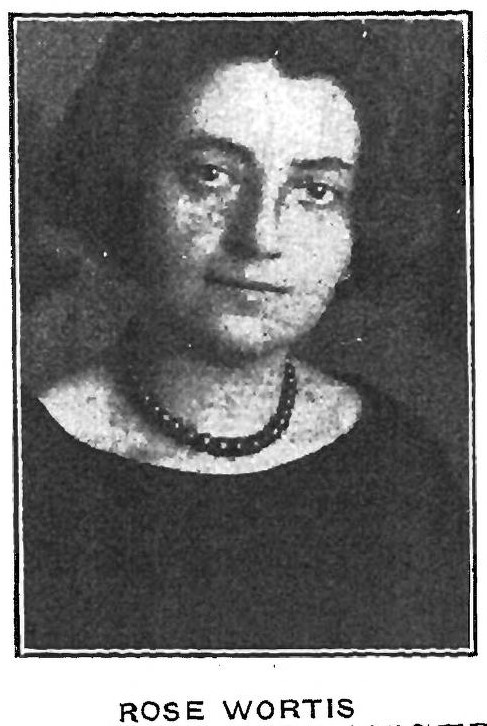
Rose Wortis, a factory-floor Communist working in the needle trades who became a leader of the International Ladies Garment Workers Union left wing, dispels the received wisdom that women were a conservative force in the labor movement; on the contrary women-dominated unions were among the most militant and progressive in the country.
‘Women as a Factor in the Trade Union Movement’ by Rose Wortis from The Daily Worker. Vol. 4 No. 46 March 8, 1927.
IT is but a comparatively short time since the general opinion prevailed that “women’s place is in the home” and if she did enter the field of industry it was but a temporary state until she secured a man to provide for her. Therefore the problem of organizing women workers was considered a hopeless task and was totally neglected by the labor movement.
The extension of industry, the improvement of machinery and the simplification of the methods of production, however, forced an even greater number of women into industrial occupations and sooner or later the attention of the labor movement had to be turned to the question of organizing women.
The 1909 Strike.
The strike of waist and dressmakers of 1909 was the first open mass revolt, the first successful organized attempt on the part of women in New York to assert their rights as workers, and sounded the signal for the organization of women not only in the needle trades but in the general labor movement.
The strike of the waist and dressmakers completely shattered the false idea of the impossibility of organizing women. It was a brilliant manifestation of class-consciousness and marked the beginning of women as a factor in the trade union movement.
Without an organization or organizational experience, without any funds at their disposal, thousands of girls (but strangers in this country) came out in open revolt against the unbearable sweat shop conditions in the waist and dress industry. For over three months the waistmakers gave battle to their employers, the police and hired thugs. Innumerable were the sacrifices, unsurmountable were the difficulties under which the waistmakers conducted their strike.
With shoes and clothing in shreds these pioneers in the cause of labor spent night and day on the picket line in the bitter cold fighting for their rights to organize a union that would raise them from the status of slaves to that of human beings. These sacrifices were not in vain. After weeks of the most bitter and determined struggle, which aroused the admiration of the entire labor movement and will remain a testimonial to the fighting spirit of women workers, the waist and dress makers emerged victorious.
Union Born in Struggle.
The union was born in struggle and during the eighteen years of its existence retained its militancy and remained true to its traditions. The strike of the waistmakers was an event of great importance to the labor movement not only because it marked the beginning of the organization of the needle trade workers and broke down the prejudice against women, but mainly because it revealed what a constructive force women could be in the labor movement and the great contribution they would make to the growth and development of the movement.
Contrary to the generally accepted theory about the conservatism of women, the waist and dressmakers’ union, of which the majority are women, was always in the front ranks of the progressive labor movement, the first to lend ear to new ideas and organizational reforms. The waistmakers’ union was the first to extend its activities beyond the narrow limits of the struggle for immediate economic improvements. It introduced the ideal of labor education under the supervision of trade unions and was the first to begin the propaganda for the shop delegate system of rank and file control, and for that reason it has been the target for attack on the part of the reactionary forces in the American labor movement.
Women Revolt Against Corruption.
True to its militant traditions the waist and dressmakers’ union was the first to raise the banner of revolt against the corrupt leadership in the needle trade unions when the latter abandoned the policy of militant struggle in favor of a policy of “hearty cooperation with the employers”.
The dressmakers played a leading role in the internal struggle of the I.L.G.W.U. in 1925 when for a period of four months they kept, vigil at their headquarters day and night, under most difficult circumstances, in order to prevent these headquarters from being captured by the Sigman machine, then at war with the membership.
The dressmakers distinguished themselves by offering the most stubborn resistance both against the employers as well as the reactionary officials, and are today playing a prominent role in the present struggle going on in their union. By the admission of Sigman himself the dressmakers are a hard nut to crack. The women have braved all dangers in order to save their union from the domination of the Sigman clique which has made common cause with the bosses to destroy the union built thru struggle and sacrifice.
Women In Other Industries.
What is true of the women dressmakers is equally true of the millinery workers. For years the reactionary officials of that union maintained that the women could not be organized; but thru the patient efforts of a few energetic women a splendid local has been organized in New York and another local is in the process of being organized in Chicago.
The role of the women in the textile strikes and particularly in the recent strike of Passaic has completely dispelled the old idea that women’s role in society and has demonstrated women’s ability as a fighter in the cause of labor. It was the simple, unpolished women, mothers of families, who gave battle to the textile barons of Passaic and forced some of them for the first time in the history of the textile industry to recognize the right of workers to organize themselves into trade unions. It was these horny daughters of toil that roused the attention of the entire country to the shameful conditions prevailing in the mills of Passaic. With their babes in arms, they braved the cossacks with their gas bombs on the picket line. Misery and starvation had brought these women together and taught them the lesson of class solidarity.
The heroic deeds of the women in the mining districts in support of their men strikers are a great tribute to the courage and spirit of defiance of these women, to no lesser degree than the Passaic women.
Need For Militant Women.
The activities of the women in the recent boxmakers’ strike in New York and the strike of the laundry workers are additional proof that women have become a prominent factor in industry and, as such, are beginning to assume their proper place in the trade union movement. They have demonstrated that not only are they able to fight on the picket line but they have also shown ability along the lines of administrative work. The labor movement of America today, which has been dragged into the mire of petty politics and is under the domination of a corrupt and self-seeking leadership more closely allied to and concerned about the employing class and its interests than the interests of the workers whom they are supposed to represent, is in great need of the active participation of women. It is in need of the sincerity, devotion, fearlessness and spirit of self-sacrifice which is so characteristic of working class women and women active in the trade union movement in particular.
The trade union movement offers a broad field for social activity for women which will be of great advantage to them and to the labor movement in general. Every women worker who has the opportunity to assert. herself as a factor in the trade union movement should not fail to take advantage of it.
The Daily Worker began in 1924 and was published in New York City by the Communist Party US and its predecessor organizations. Among the most long-lasting and important left publications in US history, it had a circulation of 35,000 at its peak. The Daily Worker came from The Ohio Socialist, published by the Left Wing-dominated Socialist Party of Ohio in Cleveland from 1917 to November 1919, when it became became The Toiler, paper of the Communist Labor Party. In December 1921 the above-ground Workers Party of America merged the Toiler with the paper Workers Council to found The Worker, which became The Daily Worker beginning January 13, 1924.
PDF of full issue: https://www.marxists.org/history/usa/pubs/dailyworker/1927/1927-ny/v04-n046-NY-mar-08-1927-DW-LOC.pdf
 Revolution's Newsstand