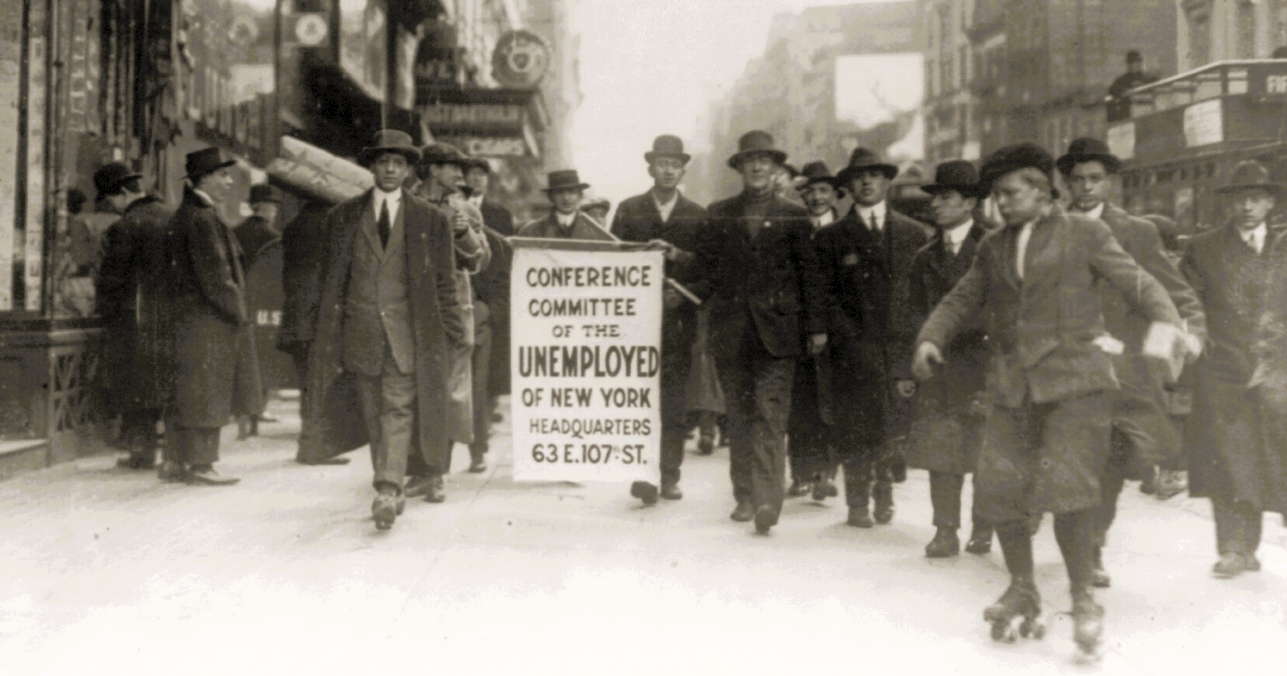
‘New York Police Riot Against Unemployed on Union Square’ from Solidarity. Vol. 5 No. 222. April 11, 1914.
Cops Deliberately Charge Crowd That Is Trying To Leave Meeting Peaceably–O’Carroll And Others Badly Beaten Up
PROGRAM TO SUPPRESS UNEMPLOYED AGITATION
(Special to Solidarity) New York, April 5. The police here are intent on the forcible suppression of the I.W.W., regardless of any legality in the matter. Ever since the Tannenbaum episode they have arrested and clubbed the unemployed and I.W.W. without even a pretext for so doing. The climax of their infamy was reached last night, when they started unwarranted and evidently premeditated riots, as the following report from The Tribune of this morning will convince the careful reader.
Two riots, during which mounted police charged the crowds, while their comrades on foot made nine arrests and badly beat up one of the leaders, marked an I.W.W. gathering of unemployed in Union Square yesterday afternoon.
A mass meeting announced for 3 o’clock was called off when it was discovered that the Central Federated Union had obtained a prior permit. A crowd had assembled, however, and when “Wild Joe” O’Carroll undertook to lead them away, at about 4 o’clock, the most serious trouble occurred.
Joseph Cannon, of the Western Federation of Miners, was addressing the crowd on the striking copper workers in Michigan when O’Carroll, “Becky” Adelson and Carlo Tresca started through the park and down Fourth avenue, followed by several hundred.
Police Charge the Crowd
Red cards announcing the postponement of the meeting to next Saturday had been distributed by Alexander Berkman, “Kid” Griffo, a one-time pugilist, and others. These cards O’Carroll ordered his followers to stick in their hats.
Detectives Gildea and Gegan and a score of policemen trailed after the men. As the crowd neared 14th street it grew rapidly in size, and Lieutenant Gildea ordered the police to close in on it.
Then the police charged and the crowd fled pell-mell. The mounted men rode their horses into the gathering. The footmen. waded in with drawn clubs and used them.
O’Carroll was arrested by Detectives Dawson and McGannon. They looked for Tresca, but he had slipped away. As O’Carroll was being arrested Miss Adelson fought the police and tried to drag O’Carroll away, crying “Don’t you arrest him!”
The crowd retreated up Fourth avenue. Dawson and McGan non turned O’Carroll over to two policemen, who started up Fourth avenue with him. At 15th street the crowd surged in on the policemen, some crying “Kill the tools of the capitalists!” or “Kill the cops!”
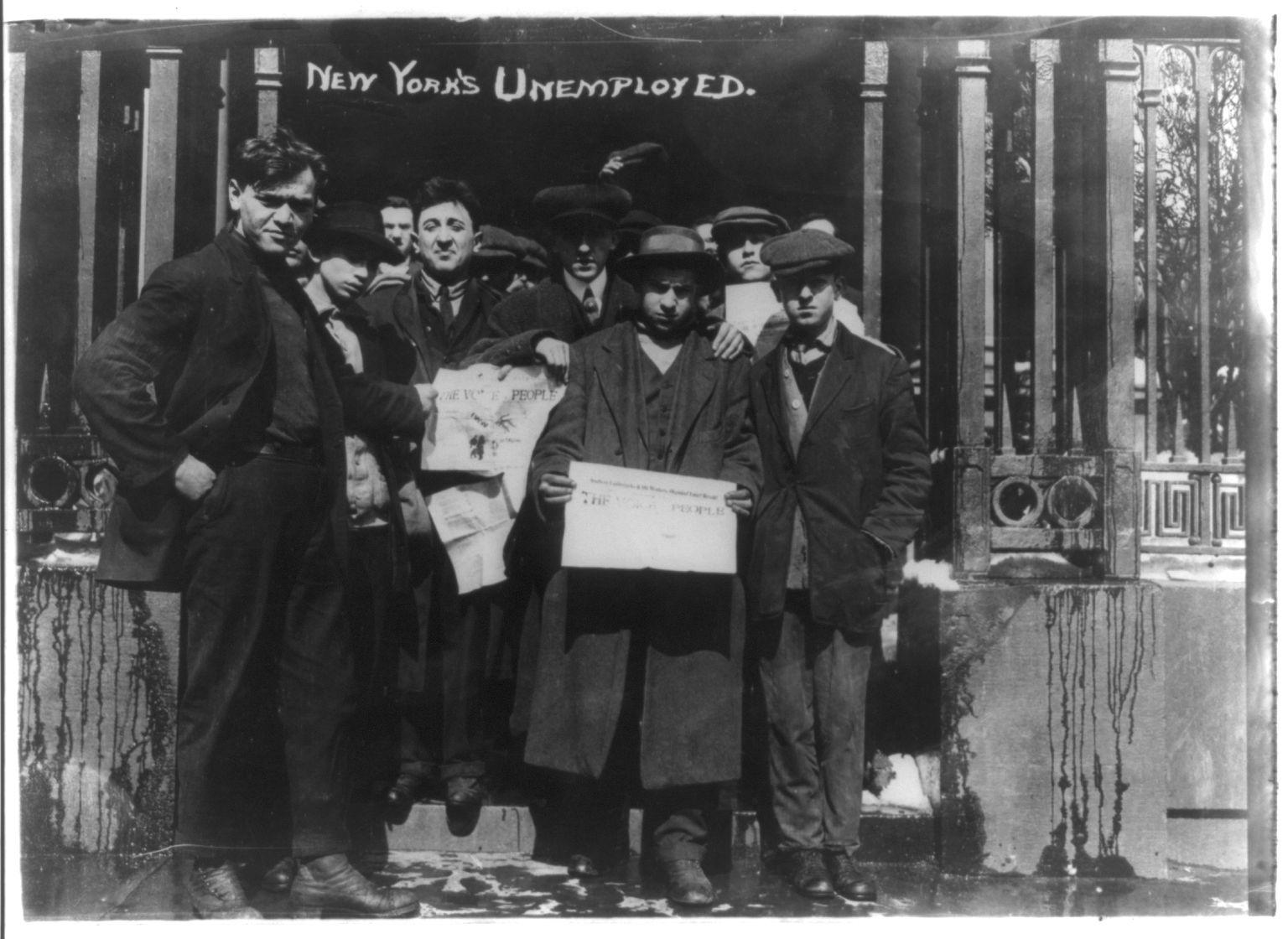
The mounted police went to their rescue and in the battle which ensued O’Carroll received a terrible beating. Blood poured from his head, saturating his clothing. In this encounter five more men were arrested. All were more or less beaten up, one, Arthur, Caron, receiving a blow that raised a large welt under his righteye.
Grifenhagen to the Rescue
The police turned into 16th street with their prisoners, and at Irving Place encountered Sheriff Grifenhagen with eight deputies. O’Carroll and Caron, who were in need of medical attention, were rushed to the East 22d street station in Grifenhagen’s automobile, the others following on foot. At the station house O’Carroll was attended by Dr. Meyers, of Bellevue Hospital, who took five stitches in his head. Caron refused medical attention.
O’Carroll was charged with leading a parade without a permit. He was released from prison last Tuesday, having tried two weeks ago to break up a Socialist meeting in Cooper Union. As he was being booked he turned to the reporters and said: “Treat me fair, boys. I was only trying to leave the meeting peaceably.”
The charge against Caron was interfering with an officer in the performance of his duty. He said he was an engineer and had no home. Adolf Wolff, who was arrested and charged with threatening two detectives, has been prominent in the Industrial Workers of the World movement from the start. He is a native of Belgium, lives at No. 1931 Broadway and says he is a sculptor. He is an anarchist and the author of a book of poems entitled “Songs, Sighs and Curses.”
Philip Novik, a merchant of No. 16 East 105th street, was arrested at 18th street and Fourth avenue on a charge of interfering with a policeman. Joseph La Ricia, a shoemaker of No. 58 Kenmare street, and Vincenzo Minnella, of No. 190 Christie street, were charged with disorderly conduct.
First Outbreak Sensational
The first of the outbreaks, which occurred at 3 o’clock, was wilder and more spectacular than the second, although only two arrests were made. Albert Turner and John J. Gans Industrial Workers of the World workers appeared, carrying two huge red banners, one bearing the words, “Tannenbaum Must Be Freed,” and the other, “Unemployed Union, Local No. 1.”At about 3 o’clock Alexander Berkman arrived and began distributing cards bearing a black flag with the word “Hunger” on it. The cards were red or yellow, and read thus:
“Extra! Because of our solidarity with the labor unions who have arranged a demonstration at Union Squire for April 4, the mass meeting of the unemployed, advertised for the same day, has been postponed till Saturday, April 11, 2 p.m., at Union Square.
Executive Committee, Conference of the Unemployed.”
Seventeenth street, between Broadway and Fourth avenue, at that time held about 5,000 persons, including those who came to attend the Central Federated Union meeting. Turner and Gans shouldered their banners and pushed through the crowd. The banners were conspicuous, and about 1,000 men followed them. At Broadway Sergeant James J. Gegan held up the procession and said to Turner:
“Where are you going?”
“We are going to parade down Broadway,” Turned replied.
“Nothing doing,” said Gegan. “You haven’t got a permit.”
“I don’t care. We’re going to do it, anyhow,” answered Turner. Detective Gegan seized the Tannenbaum sign, which came down with a crash on Turner’s head. Patrolman John Flynn grabbed the other sign and Gans at the same time. A half dozen mounted and other policemen plunged into the crowd, and there were loud yells as the policemen’s clubs came down and the horses’ heels reared up.
At least two men were trampled by the horses, but they escaped before their names or the extent of their injuries could be learned. In the confusion Turner broke away, but Gans was arrested.
Garibaldi La Polla, a teacher in DeWitt Clinton High School, was arrested during this demonstration. He gave his age as 26 and his address as No. 29 West 129th street. Both La Polla and Gans were charged with parading without a permit.
After, the arrests of these men the mounted police rode through 17th street and succeeded in clearing the street. Alexander Berkman then asked permission to address the gathering and announce the postponement of the meeting, but this was refused until Lincoln Steffens explained the circumstances. Berkman then announced the postponement of the meeting and incidentally paid his compliments to the capitalists. He was wildly cheered.
“We planned our meeting two weeks ago,” said Berkman, “but now we find that the American Federation of Labor, represented by the Central Federated Union, is here ahead of us. We will post-pone our meeting, because we want the people of New York and of the country to see our solidarity with labor, whether organized or unorganized.”
The Central Federated Union meeting was without other incident, although a young girl climbed to the stand and tried to harangue the crowd about the arrest of O’Carroll. She was suppressed.
The ninth arrest occurred at the close of the meeting, when Samuel Rapport, of No. 159 Stanton Street, was taken into custody for using threatening language to a policeman.
Three hundred policemen in uniform were on hand and 120 in plain clothes mingled with the crowd. They were in charge of Inspector Cornelius F. Cohalane. Police Commissioner McKay was present at the first riot, and Sheriff Griffenhagen during the latter part of the afternoon.
The most widely read of I.W.W. newspapers, Solidarity was published by the Industrial Workers of the World from 1909 until 1917. First produced in New Castle, Pennsylvania, and born during the McKees Rocks strike, Solidarity later moved to Cleveland, Ohio until 1917 then spent its last months in Chicago. With a circulation of around 12,000 and a readership many times that, Solidarity was instrumental in defining the Wobbly world-view at the height of their influence in the working class. It was edited over its life by A.M. Stirton, H.A. Goff, Ben H. Williams, Ralph Chaplin who also provided much of the paper’s color, and others. Like nearly all the left press it fell victim to federal repression in 1917.
PDF of full issue: https://www.marxists.org/history/usa/pubs/solidarity-iww/1914/v05-w222-apr-11-1914-solidarity.pdf
 Revolution's Newsstand