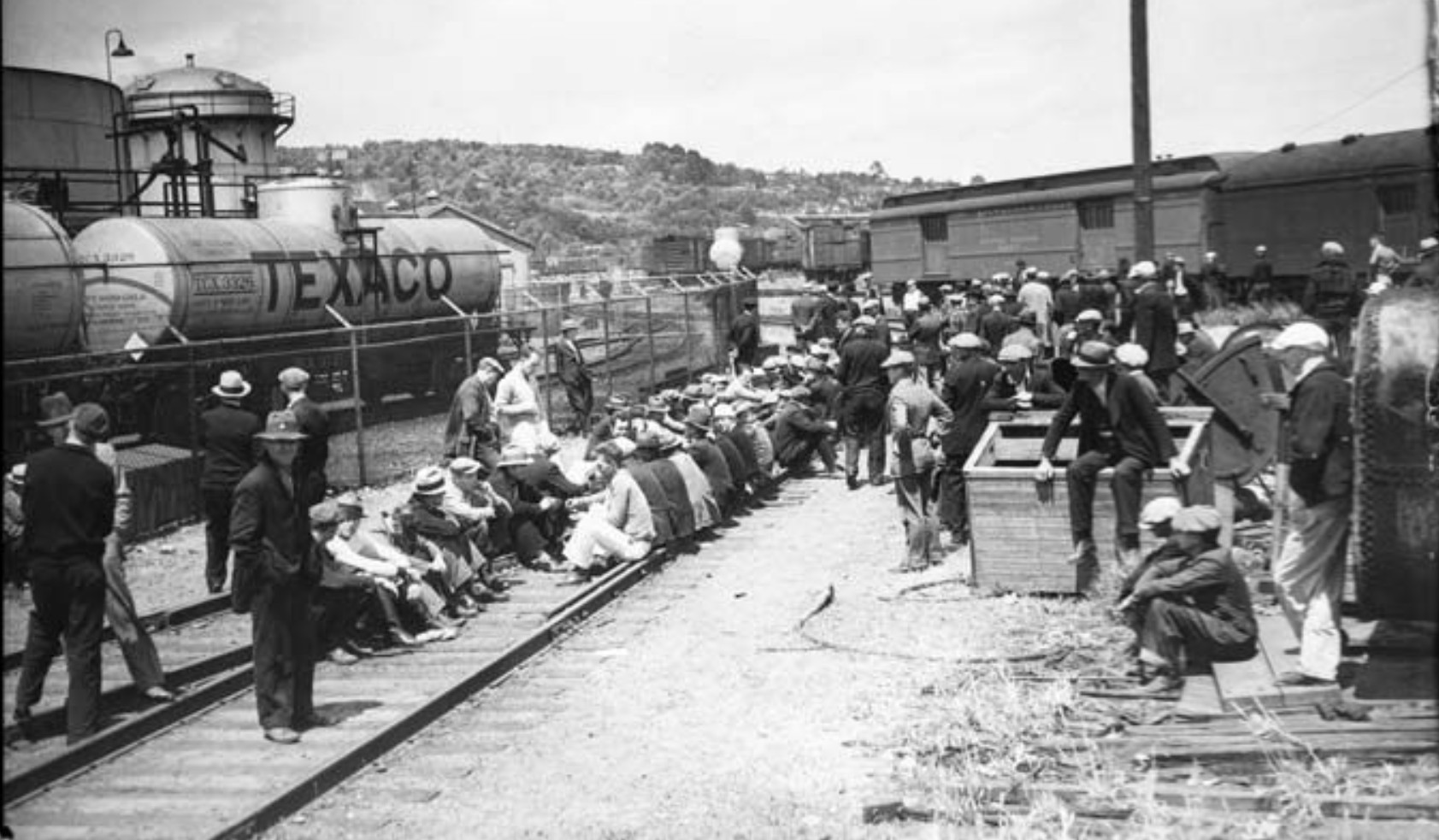
A longshore worker on the terrible state of work in the early Great Depression and the utter incapacity of the I.L.A., with its gangsterism, bureaucracy, and conservatism, to face the crisis. Less than two years after this, the waterfronts would explode in rank-and-file actions and mass strikes.
“All Quiet on the Water Front” by De Profundis from Labor Age. Vol. 21 No. 9. September, 1932.
If any further conclusive proof is needed of the blaring, but cruelly misleading, announcements coming from the Hoover prosperity howlers that “we have turned the corner,” and that signs are multiplying everywhere, that the country is emerging from the depression and well on the road to another Hoover (synthetic) prosperity, one only needs to make a casual visit to the waterfront, where steamships are loading and discharging, or rather, used to load and discharge high cargoes of all kinds of merchandise and commodities.
The gloom and quiet of almost complete stagnation has settled upon the docks and piers, the scene, formerly, of never ending hustle and bustle of moving freight by strong-armed longshoremen. Yes,—“all is quiet on the water front.” Not only has foreign commerce come to an almost complete standstill, but also the coastal and inter-coastal freight movement has dwindled to insignificant proportions. The blaringly heralded prosperity of the Hoover psychological type, has not reached the water front as yet. On the contrary, there the stagnation has been, and still is deepening, especially during the past few months.
As an instance: This is supposed to be the busy season for the shipment of dried and preserved fruit from Pacific Coast ports. In former years extra ships had to be put into the service on the route through the Panama Canal in order to transport the huge shipments to the Atlantic ports, mostly for reshipment to Europe and other parts of the world. The volume of freight of this kind coming this season is negligible, and not one half of the cargo space of the regular liners is taken up with it. The same, or worse, conditions prevail in other lines of ocean freight transportation. If, as the big newspapers continue to report, car loadings are increasing, the increase has not been noticeable on the water front. There, the loadings and unloadings are still decreasing.
Steamships that used to come in with 8,000 or 10,000 tons of freight consisting of all kinds of merchandise, the unloading of which would always give several hundred longshoremen employment for three or four days, with a few night hours thrown in for good measure, and which used to take a similar huge cargo out again, now arrive with a couple of hundred tons at the most, and leave again in the same condition. It is not unusual that a big combination passenger and freight carrier arrives and leaves again, without a pound of freight in her holds, carrying only passengers and mail.
That the lot of the longshoremen, who depend for a livelihood upon the hard and taxing work of loading and unloading these ships, boats, lighters and vessels of all kinds, is not a happy one under such conditions may readily be seen. Even the earnings of the few who still have the better run of the work have dwindled to very low figures. Many call themselves lucky when they catch one or two days’ work a week, but thousands of others tramp the water front day after day, from one pier to another, in a vain search for a few hours casual employment.
Even in so-called prosperous times, longshore work, being casual labor, offers the men following this kind of work but a very insecure and undependable livelihood. Earnings of the longshoremen are influenced by a number of unforeseen factors, from the temper and the goodwill of the hiring stevedore to the conditions of wind and weather and the stand of the ocean tides. Besides, it is listed by casualty insurance companies as.one of the most hazardous occupations.
In spite of these disadvantages, or possibly, because of them, the longshoremen have always maintained a very noticeable spirit of independence, although much of this carefree spirit has been lost as a result of the terrible unemployment. Occasionally this rebellious spirit broke out on rather slight provocation, and often resulted in so-called unauthorized strikes and tie-ups, which often gave the officials of the union considerable trouble to straighten matters out again. Since the Union got control of the work and annual agreements were concluded between the employers and workers, not only a uniform rate of hourly wages, but also certain working rules are set up, which must be observed by the stevedores. This recognition of the union by the employers, the steamship companies and the contracting stevedores, has improved the conditions of the longshoremen considerably. But it has also given into the hands of the leaders of the union, the president, the business agents and others, a most powerful weapon, not so much against dishonest and unreliable employers, as against rebellious or recalcitrant members of the union.
Much has been exposed lately of racketeering and gangsterism in the trade unions. Labor leaders use their position and the power gained, for selfish purposes, for their own enrichment and aggrandizement, often at a terrible cost to the membership of their unions. To say that this is nonexistent in the organizations of the waterfront workers, is to make a statement that is far from the truth. The longshoremen can sing a song of graft and corruption within their union, of gangsterism, favoritism, dishonesty and abuse of dictatorial powers and undisguised treachery. If these have not been exposed as much as in some of the other trade unions, it is because of the prevailing lack of interest in organization matters among longshoremen generally. Their lack of interest in their union is shown by the small attendance at the union meetings. Except on very rare occasions, the meetings of local unions show an average attendance of 12 or 15 members out of a membership of between 500 to 1,000.
But it is not alone a lack of interest, that keeps the members away from the meetings. Questionable tactics and sometimes systematically applied terror methods, create a feeling of disgust, in some instances even of fear in the membership. Some of the officials intentionally foster this feeling of disgust in the members, to keep them away from the meetings, so that they and their immediate following can have things all their own way. Matters in the union of the longshoremen have developed to such a state, that the average longshoreman looks upon the union as something outside of and hostile to him, something to which he has to pay tribute in return for a meagre chance at very uncertain employment.
Under such a state of affairs, together with the terrible unemployment prevailing, it is with grave misgivings that those among them who are still showing a little active interest in the affairs of the organization look upon the future of the organization and especially on the coming wage negotiations. A new agreement has to be concluded by the first of October when the present one expires. Although President Ryan of the International Longshoremen’s Association is reported to have expressed himself as determinedly opposed to any wage cut, the shipowners have made no attempt to hide their hankering for lower wage standards. Already last winter, they demanded a voluntary wage cut, which was voted down unanimously by the members. Shortly after they forced a wage cut on the coastwise longshoremen, who had, unwisely, allowed their union to deteriorate and disintegrate.
It is up to the still active members of the union to arouse new interest for the union and its problems among their fellow workers, to make them feel again that after all it is their union and the only bulwark against encroachments upon their living standards by greedy employers, and that, if they wish to hold their own, they cannot afford to leave everything, their most vital interests, in the hands of a few leaders. This is certainly an appropriate time to begin regaining the members’ interest in their union. The forward looking members must at once get in contact with each other in order to work systematically, not for the weakening or the destruction of the union, but for its strengthening and upbuilding and, above all, the regaining of the control of the union by the membership and the wiping out of all dictatorial powers within the organization.
Labor Age was a left-labor monthly magazine with origins in Socialist Review, journal of the Intercollegiate Socialist Society. Published by the Labor Publication Society from 1921-1933 aligned with the League for Industrial Democracy of left-wing trade unionists across industries. During 1929-33 the magazine was affiliated with the Conference for Progressive Labor Action (CPLA) led by A. J. Muste. James Maurer, Harry W. Laidler, and Louis Budenz were also writers. The orientation of the magazine was industrial unionism, planning, nationalization, and was illustrated with photos and cartoons. With its stress on worker education, social unionism and rank and file activism, it is one of the essential journals of the radical US labor socialist movement of its time.
PDF of full issue: https://www.marxists.org/history/usa/pubs/laborage/v21n09-sep-1932-labor-age.pdf
 Revolution's Newsstand