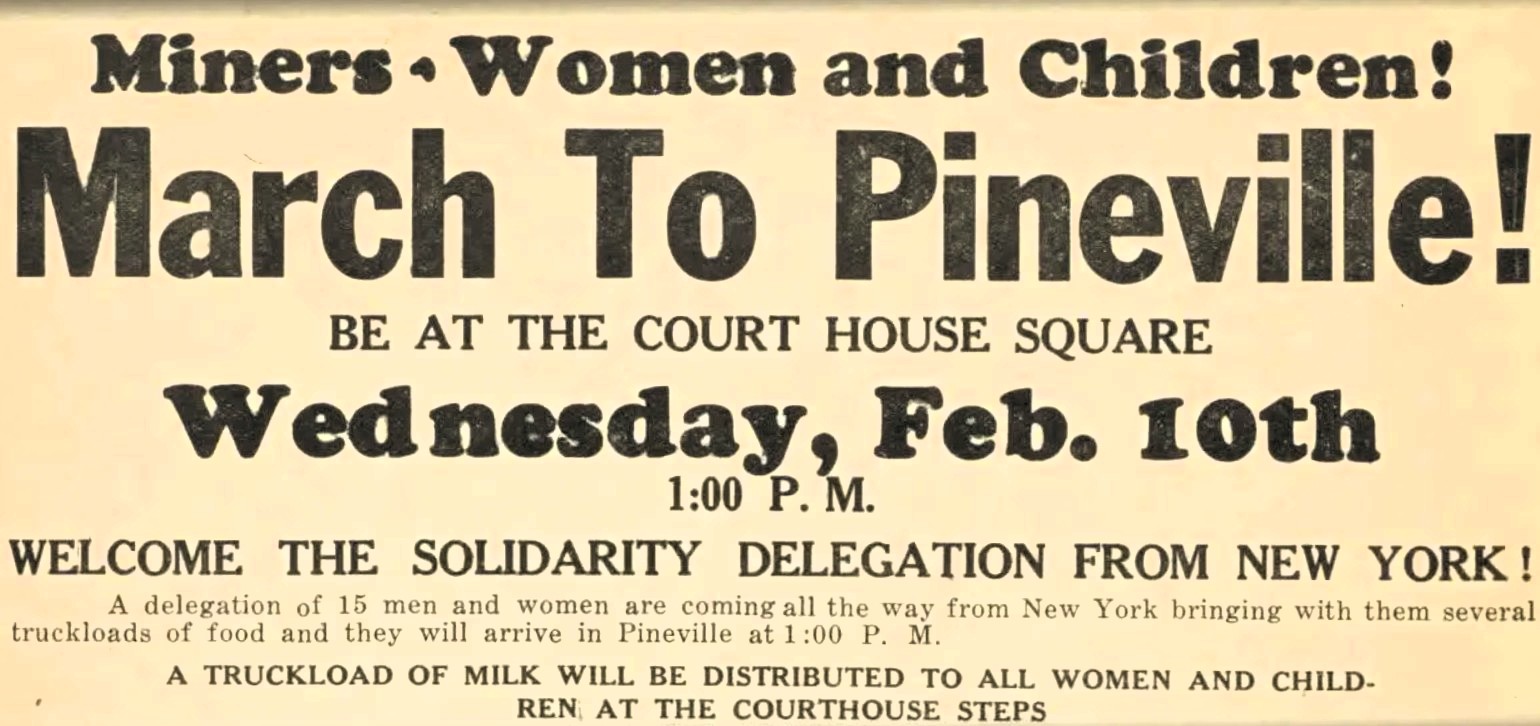
“Bloody Harlan,” a truly desperate struggle in isolated Eastern Kentucky with the only aid coming from a persecuted left.
‘Civil War in Harlan County Kentucky’ by Thomas Bunker from Class Struggle (C.L.S.). Vol. 1 No. 2. June, 1931.
Since March 1st this year, the black spectre of starvation, arson, and violent death has stalked Harlan county situated in the mountainous southeast corner of Kentucky.
Civil was has broken out. Already 3 have been killed. On the one hand the Harlan County Coal Operators Association, dominant politically, and strongly entrenched with Sheriff John Henry Blair, high priest of thuggery, and the state guard. Against them are starving workers and their families, grim, bitter, and determined to fight to the last ditch. Already there has been the rattle of machine gun fire, the crack of high powered rifles in the hands of mountaineers perched on ridges, dynamiting, looting of stores, wholesale burning of miners’ homes and shootings in which brother has actually killed brother.
On my first visit to Harlan in 1924 as an employee of the Louisville and Nashville R.R. conditions were much different from the present. Then the Ku-Klux-Klan ruled. On alighting from the train I was approached by a stocky individual who held his arm in a slightly bent manner peculiar to gunmen of the south, and asked in a drawling manner the “natur” of my business.
I soon learned that this curious procedure was characteristic of the sections in which the coal operators were a law unto themselves. In the town itself, a general air of prosperity seemed to pervade. Coal orders were heavy, coal prices were at their post-war peak, and even the drab shacks of the miners in their prison-like monotonous formation, seemed to reflect the sunshine of plenty. Hooded sheet parades, and fiery crosses on the mountainsides, signalized the “movement” to oust the Pope and “keep the ‘nigger’ in his place.” This latter is of particular interest when we observe events that occurred later.
The miners were lulled into a false sense of economic security, had their union neatly sabotaged by the mine operators and everything was “Jake.” Came the depression and the lowest wages ever paid in these coal fields. When the operators again slashed wages during the month of February this year, the miners found themselves working from ten to twelve hours a day to obtain a daily wage ranging from two to four dollars. The miners soon recognized their paramount need and began to organize a union locally, making Evarts the headquarters.
Union Workers Fired
As fast as the miners enrolled they were systematically fired from their jobs. Over 10,500 were organized but none of the organized were allowed to work. The operators set out to rush an injunction thru the Federal court at Richmond, Ky., the Black Mountain Coal Corp., and the P.V. & K. Corp. staging a gun fight to give impetus to their plea in court. Sixteen houses were fired by the thugs at Cawood and as a result the miners were able to obtain warrants against two undeputized guards, charging arson.
Last month some of Sheriff Blair’s deputies drove to the Black Mountain Camp and arrested a Negro worker on a warrant charging “banding and confederating.” Whilst the Negro worker was in the custody of the deputies, shooting broke out and one of them was killed. The deputies in turn shot and wounded Will Burnett a white worker who lies in the hospital under guard charged with murder. This incident in itself is significant proof of the solidarity of the white and Negro worker in the south when faced with actual warfare in the class struggle. It is not strange to Communists; that even in a section of the south that only recently was Klan ridden, white fights white in the defense of a Negro. The inanity of the K.K.K. becomes obvious to the workers, who gravitate toward each other regardless of race, and fight shoulder to shoulder against the common enemy.
Dynamite Shook Harlan
A heavy blast of dynamite shook Harlan and “Bloody” Blair complains the blast was a ruse to divert his thugs so the miners could form a party to snatch the Negro from jail. The A. & P. store at Evarts was broken into by a hungry group of workers and cleaned out of everything even taking chicken feed. The next day the store was restocked and once more promptly looted. A pitched battle between deputies armed with machine guns and workers, armed with rifles and pistols ended with four killed and some three or four wounded. Blair could not account for the fact that although the deputies outnumbered miners two to one and were superior in armament the deputies suffered the heaviest losses. The deputies has been sent to shoot up the town of Evarts so that women and children were compelled to leave the camp.

A Condescending Savior in the shape of the United Mine Workers of America appeared on the scene with the usual A. F. of L. policy. Bill Turnblazer of Jellico, Tennessee, the U.M.W. district president, immediately appealed to Gov. Stampson of Kentucky for troops. Turnblazer informed Gov. Stampson that the U.M.W. were not at fault but that outsiders from other states were to blame. The Governor stated that it had been a fertile field for Communists, and reds, blah! blah! blah! The soldiers arrived on schedule under the command of Dan Carrell of Louisville. To greet them the U.M.W. fakers rallied as many as possible at the railroad station but more than a thousand miners, for the most part armed, stood pat at Evarts. The miners who fought against overwhelming odds and never gave ground, now, thanks to the A. F. of L., find themselves facing the business end of guns projecting from tanks, backed up with infantry and a squadron of cavalry.
The A.F. of L. Policy
Listen to the union organizer give them some good old A.F. of L. fighting tactics. “You men that are on Black Mountain property—get out. You men that are on P.V. & K. property—get out. This doesn’t mean maybe. Whatever you do, don’t violate the injunction. There isn’t anything left for you to do but get out. You’ve just one excuse, if your wife is pregnant, you have 21 days … Keep within the law and win.” Ten days ago Turnblazer and Dwyer of the A.F. of L. signed an agreement with the personal representatives of the governor in which they pledged to “co-operate in every way to bring about a settlement of conditions at the earliest possible moment.” Before me as I write, lies a copy of the semi-monthly pay slip No. 780-127, issued to C. H. Jones by the Black Mountain Corp., for the first half of March this year. Fifteen days work at machine mining and entry, nets this miner a total of $33.32. Deductions are as follows: Miners supplies $1.10; Smithing 31 cents; Check weighman 98c; Hospital 50 cents; School 40 cents; Doctor 90 cents; Burial Fund 50 cents; Rent $3.50; Coal 95 cents; Scrip $13.00; Life insurance $2.50; Miscellaneous 25 cents. Total deductions $24.89. Amount due payday, $8.43. The miners are forced to trade at the company stores where the prices are boosted. The Black Mountain Corp. not only boost prices at the commissary but compel the miners to spend a certain percentage of their wages there. Witness the following: condensed milk 15 cents a can at Black Mountain; 3 cans for 21 cents at Evarts. Flour $1.50 a bag at Black Mountain, 61 cents a bag at Evarts. Oleomargarine 45 cents a pound at Black Mountain, 10 cents or 3 for 25 cents at Evarts, etc., etc. The miner whose pay slip we read states: “I bought a bill of goods at Evarts (independent store) for $14.90. I priced the same goods at Black Mountain and it came to $51.95.” The miners repudiate the charge that they fired on the Black Mountain Mine. They are good shots, they say, and can hit at 1000 yds. “If we had been doing it we would have hit someone.” The war in Harlan is only another proof of the potential radicalization of the workers, and their growing hatred for the capitalist state and its minions the politicians. The failure of the A.F. of L. to keep these mines organized (The U.M.W. held sway in this area prior to the Klan entering the field), shows plainly the disintegrating of the United Mine Workers Union. Lesson after lesson appears in the Harlan situation, and forefront of all is the acute necessity for the Communists with a correct policy to mobilize the masses for this and coming struggles. The Lovestones, the Fosters and the Cannons have blunderingly failed to see the potentialities for immediate radicalization of the workers. Do they, like the socialists, require a “barometer”—If so, let them give Harlan a place on their barometric chart.
The Communist League of Struggle was formed in March, 1931 by C.P. veterans Albert Weisbord, Vera Buch, Sam Fisher and co-thinkers after briefly being members of the Communist League of America led by James P. Cannon. In addition to leaflets and pamphlets, the C.L.S. had a mostly monthly magazine, Class Struggle, and issued a shipyard workers shop paper,The Red Dreadnaught. Always a small organization, the C.L.S. did not grow in the 1930s and disbanded in 1937.
 Revolution's Newsstand