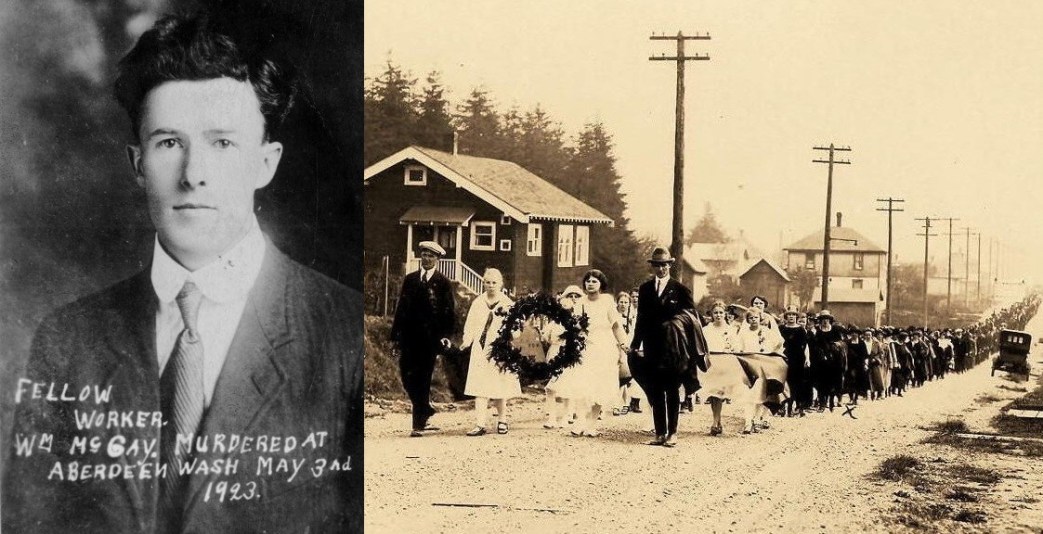
Irish-born, veteran wobbly, the 40-year-old William McCay was shot in the back of the head running from a company gunman after a picket-line confrontation during a strike against the Bay City Lumber Co. as part of a general logging strike on May 3, 1923.
‘Gunman Murders I.W.W.’ from Industrial Worker. (New) Vol. 5 No. 19. May 9, 1923.
A. F. of L. Unions Uneasy; Construction Jobs Strike
ABERDEEN, Wash. This town seems to be taking the front rank as a scene of counter strike activity. The two delegates who left here to visit Simpson’s camp and try to draw out the loggers on strike have not returned. Searching parties organized in Seattle and Aberdeen are at- tempting to discover whether they were murdered by company gunmen or their friends, or whether they were locked up in some city jail and held incommunicado.
The entire Northwest is shocked by the shooting to death of Fellow Worker William McKaye, on the morning of May 3, by a watchman at the Bay City Lumber mill in South Aberdeen.
There are twenty-five pickets who witnessed the murder. McKay, who is a logger, forty years of age, had been trying to speak to some of the strike-breaking mill hands, when the watchman, Green, attempted to interfere. The men were not on company property and McKay was walking away, when Green, losing his temper, drew his gun and fired twice, both bullets striking McKay in the back of the head and one of them penetrating the base of the brain.
Feeling among the townspeople is favorable to the I.W.W. Green did not escape, but was lodged in the city jail. Everyone is much disturbed.
The Aberdeen-Grays Habor district is amongst the most important lumber sections of all the Northwest, and the organization has been most difficult there.
It was expected that the lumber capitalists would put up a hard fight, but no one was prepared for such a cynical disregard of law, and deliberate killing as has resulted in this strike.
The Bay City Mill was closed, after all, and the logging camps continue to come out. The territory is fairly well struck. Logging has nearly stopped and little success has been had obtaining scabs.
The logging camps are out as follows: The five Saginaw Timber Company camps are out solid, except 12 scabs in camp 11. All the five Clemons Log Company camps are completely tied up. The two Greenwood Log Company camps are out solid. Wyonotche Log Company camps are all pretty well out except a few strikebreakers. All the Humptulips camps are shut down by the strike. Anderson and Middleton camp is out solid. Balch is out. River Log Company is out solid. Lydle Log Company at Elks River out nearly solid. Carlisle and Aloha are out 80 per cent. Shafers Log Company is out about 40 per cent, and more will come down on May 1, as they are waiting for their bonus. Polson and Donivan and Corkrey are about the only outfits that amount to anything that are running on the harbor at the present time. Men are leaving both outfits daily.
The bootlegging industry is tied up 90 per cent and the committee hopes to have it tied up 98 per cent by the end of next week. It is a peculiar sight to see a bunch of old habitual dehorns with their tongues hanging out, huffing up and down the street trying to find a bootlegging joint. Several boot-legging joints that still sold moonshine after the strike was called were picketed and closed by the bootlegging committee of the I.W.W. Very few drunks are seen on the street since the strike started.
Gambling is at a complete standstill in Aberdeen. Not a poker chip moved after the strike was called.
The waterfront is out 90 per cent, including the sailors, firemen and longshoremen, and there are only a few bosses humping lumber with the office crews of the Stevedoring Company.
All the night shifts in Grays Harbor mills have been discontinued. The mills are running 50 per cent normal with more men quitting every day. Also the log supply is getting shorter.
There is a large shortage of rooms in Grays Harbor and the trains and stages are loaded every day with strikers leaving for Seattle, Portland and other points.
The daily press has many long winded write-ups; say that the strike is a joke, that everything is running full blast and that hundreds of men are going back to work. The strike committee expects to see many such wild and woolly tales told to hurt the strike before it is won. Sorry to say for the press, the sentiment of the conservative public usually is, “O, yes, that is what they say, but you can’t believe much you see in the papers now days.”
Blankets and sheets were furnished and many improvements were made in the camps when the bosses saw the strike coming.
The sentiment for the strike is fine. Many workers are discussing the six affidavits of “not guilty” the jury signed in the Centralia case and the verdict of the labor jury in that case. Also many other union men who are serving long terms in prison solely on account of their activity in the eight-hour strike in 1917 and the battle against the copper trust for better conditions that was on at that time.
We have seen smoke here and there from old slashings which were put to fire just before the strike, and if the strike last any time they may blame us for it, so we would like to have all pickets be careful with fire.
The Industrial Union Bulletin, and the Industrial Worker were newspapers published by the Industrial Workers of the World (IWW) from 1907 until 1913. First printed in Joliet, Illinois, IUB incorporated The Voice of Labor, the newspaper of the American Labor Union which had joined the IWW, and another IWW affiliate, International Metal Worker.The Trautmann-DeLeon faction issued its weekly from March 1907. Soon after, De Leon would be expelled and Trautmann would continue IUB until March 1909. It was edited by A. S. Edwards. 1909, production moved to Spokane, Washington and became The Industrial Worker, “the voice of revolutionary industrial unionism.”
PDF of full issue: http://iw.applefritter.com/Industrial%20Worker/1923/1923%205%2019%20Industrial%20Worker.pdf
 Revolution's Newsstand