
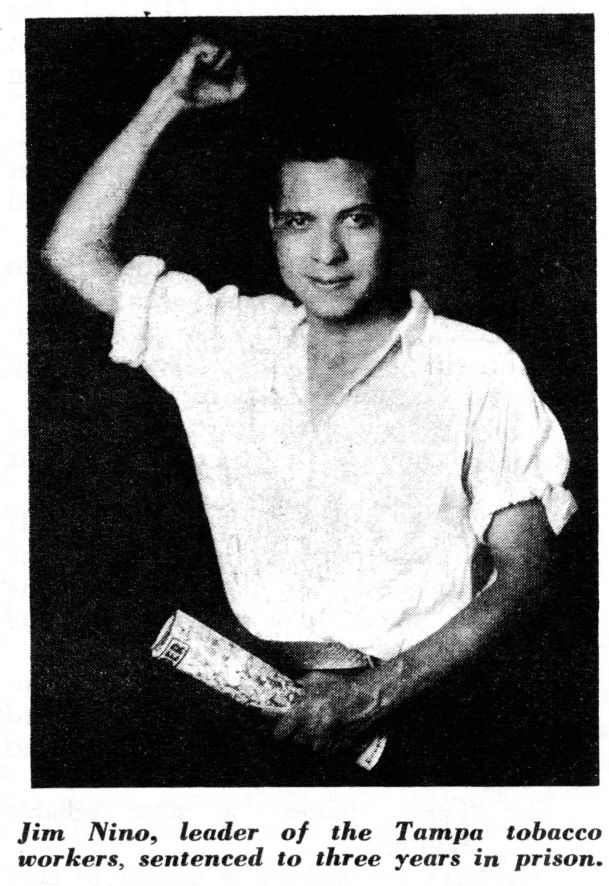
Tampa, Florida has one of the richest labor histories of any Southern city, and has since the days of José Martí thanks to the many Cuban workers employed in the massive tobacco industry there. For generations the mixed workforce of Cuban, Italian, Black, Caribbean, Spanish, Slavic, and a few Anglos, had a rich culture of unions and self-organization. By the early 30s there were 12,000 members of the T.U.U.L.-affiliated The Tobacco Workers’ Industrial Union in the area. On November 7, 1931 a planned celebration of the Russian Revolution at the Labor Temple was prevented by police, causing a confrontation in which the police shot a worker–and charged dozens of union members with attempted murder and other charges. Long a tradition brought from Cuba, ‘readers’ in the factories read to the cigar rollers as they worked. When the bosses stopped the practice to prevent the reading of the Daily Worker about the cases, the workers went on a 3-day strike to protest the sentences, followed by a lockout and a blacklisting. William Simons urges comrades to make this their struggle, as because of geography, but also because of race and ethnicity, has not been the focus of attention it demanded.
‘Fifty-three Years in Jail’ by William Simons from The Daily Worker. Vol. 9 No. 32. February 6, 1932.
FIFTY-THREE years in jail! Fourteen Tampa workers have begun to serve terms, totaling 53 years. They have been refused a new trial. Seven others are held by the Immigration authorities, awaiting a deportation hearing.
One of the outstanding cases in the country of capitalist terror against the workers. Especially important, because it is an attack on workers of colonial origin, from Cuba, Porto Rico, and other countries of Latin America. The sentence of the fourteen was aimed to crush the Tobacco Workers’ Industrial Union, to compel the militant tobacco workers to accept the bosses’ wage-cutting campaign, and to stamp out the growing influence of the Communist Party. Like Gastonia, like Imperial Valley, like Kentucky, the Tampa case is intimately tied up with the workers’ struggles; it is an outgrowth of struggles already begun.
A Vicious Injunction Issued.
Tampa not only presents the defense angle, but also the attempt of the Tobacco Manufacturers to crush the Tobacco Workers’ Industrial Union through an injunction, which is the most inclusive since the Daugherty Injunction in the 1922 railroad strike. The motion for making permanent the preliminary injunction granted in December comes before the court on Feb. 15th. This injunction included 140 of the best fighters for the union, and also specifies “others,” permitting them to add as many as they please. It includes also the only two newspapers in Spanish issued in Tampa at that time, Traduccion and Gaceta, forbidding them to publish news about the 72-hour strike.

Extreme terror is raging in Tampa today. During the 72-hour strike of the tobacco workers of Tampa, many were arrested on the picket line, and were put to work on the streets in the barbarous chain gang. The American Legion threatened with arrest and torture those who were collecting funds for the defense of the Tampa workers. The city authorities have forbidden any collections in the factories or in the houses. There is a united front of the Mayor, the Tobacco Manufacturers and the Citizen’s Committee against the tobacco workers.
Organizing Against Wage Cots.
The tobacco manufacturers are cutting wages. This has happened recently in the shops of Thompson Bros., Morgan Bros., and some others. The packers, organized independently in the Tampa Packers’ Union, have been cut $3 per thousand in some shops. The packers stood shoulder to shoulder with the Tobacco Workers’ Industrial Union during the 72-hour strike. These wage cuts follow the 10 per cent general wage cut in December, 1930, and the additional cut of 20 per cent brought about since then through being compelled to do higher grade work at a low grade price. Of the 14,000 tobacco workers, less than half are now working, for an average wage, under piece work, of $10 to $12 for an average work-week of 56 hours. The attack on the Tampa workers came Just after the tobacco workers began to organize the Tobacco Workers’ Industrial Union, affiliated with the revolutionary Trade Union Unity League The tobacco workers turned to the Trade Union Unity League after 20 years of experience with the reactionary leadership of the Cigarmakers’ International Union and the American Federation of Labor, and after an attempt in 1930 to organize a local movement of tobacco workers, independent of the revolutionary unions throughout the country. In spite of the wholesale terror by the authorities, the Tobacco Workers’ Industrial Union is alive and giving out books to the new members. In 1931, the union had 12,000 members on its books, those working being paid up. The Tobacco Workers’ Industrial Union in Tampa deserves the support of every militant trade unionist, In its struggle for existence.
What was thee 72-hour strike? It was planned to protest against the jailing of the 15 workers on November 7th, and was precipitated by the bosses’ elimination of the “readers” from the tobacco factories. The system of “readers” began among the tobacco workers in Cuba forty years ago, whereby the workers pay a “reader” to read to them from newspapers, pamphlets and books while the workers are at work in the factory. The “readers” read for 3 hours a day, in six periods of one-half hour each. Just after the November 7th arrests, the tobacco workers called for the reading of more items from the Daily Worker, not only connected with the Tampa case, but with the revolutionary movement throughout the world. It was to stop this growing interest of the tobacco workers in the revolutionary movement that the manufacturers decided to abolish this 40-year-old custom of “readers.” Thereupon, the workers immediately and spontaneously left the shops in their 72-hour strike. The manufacturers secured their temporary injunction. After the 72-hour strike, the manufacturers declared a lockout, and later opened their factories, but blacklisted a large number of workers.
School Children Show Solidarity.
The school children of the Tampa tobacco workers showed a splendid spirit of solidarity. About 700 school children from West Tampa, the Latin-American section, went on strike, and marched to the Labor Temple, where they held a meeting. In one of the school classes attended by an American Legion representative, he called on all who were 100 per cent Americans to rise. Instead, one boy shouted: “Viva el Comunismo!” Thereupon the entire class arose and sang the International. The boy who started it was later arrested.
The Tampa Tobacco Workers are a vital part of the revolutionary trade union movement of the United States; they are conscious of their duty toward the revolutionary struggles in the rest of the United States and in Cuba. For many years, they have collected money regularly and systematically for strikes; for every week for six months, they collected $120 a week for the miners’ strike. Surely, they deserve the support of every class conscious worker In the United States. When the November 7th case took place, they immediately took collections in the factories, raising money for the case, without any financial support from the outside. But they are forbidden to collect! They need support! Collectors were fired from their jobs, and strikes took place. They need support!
November 7th! And as yet, not a single successful mass meetings held in the United States! In Harlem, the meeting held six weeks ago did not receive the support of the International Labor Defense or of the Trade Union Unity Council. We have left the support of Tampa to the Latin American tobacco workers of New York City. This neglect must be overcome. The series of mass meetings decided upon by the New York District of the International Labor Defense must secure the support of the membership of the Trade Union Unity League and of the Communist Party. Similar mass meetings with a campaign of protest resolutions should be arranged throughout the country. Despite definite Instructions from the National Committee of the International Labor Defense on Tampa a month ago, yet nothing is heard from the various districts of that organization. Despite an appeal from the I.L.D. on Tampa which appeared in the Daily Worker a month ago, there is no evidence of any campaign. The Tampa workers are being left to shift for themselves.
Link Tampa With Other Struggles.
The Tampa Defense must be a vital part of every defense campaign. It must be linked up with Kentucky, with Harlan, with Tom Mooney, with Imperial Valley. Every defense meeting, every meeting with a defense resolution, should take up Tampa. The Trade Union Unity Councils and the revolutionary unions should pass a resolution on Tampa, carry on agitation about the case and the conditions in Tampa, and especially support the fight of the tobacco workers against the injunction. Every important demonstration should raise the issue of Tampa.
The Tampa case proves that we still do not react quickly to problems that occur at points far away from New York City; that as yet, we react very slowly to problems affecting the Latin Americans in this country. At a time when the masses of workers and peasants in Latin America are engaging in broader and more revolutionary struggles (El Salvador, Cuba, Chile), it becomes absolutely necessary to strengthen our support to their struggles through the organization of the Latin American workers in this country. Real support to Tampa now, when it is needed, will do more to win the Latin Americans for the revolutionary trade unions and for the Communist Party than abstract propaganda. It will convince them that the Party and the Trade Union Unity League in practice as well as in words make no distinction between native born workers and workers of colonial origin.
We must convince them through action! We must do our revolutionary duty! Let us begin now! We are already late! The trial in Tampa was over before any mass campaign was carried on. Let us begin that campaign now! Tampa is our problem. It is the problem of every class conscious worker in the country. Take this question into your meetings, this week, tonight, have your organization act—pass a resolution of protest. Send it to the Mayor of Tampa, Florida. Raise funds for the fight to release the 14 Jailed comrades. Help the struggle against the injunctino! Fight against the deportations! Send funds and resolutions to the International Labor defense, 799 Broadway, Room 410. Let each class conscious worker play his part in this Tampa Campaign.
The Daily Worker began in 1924 and was published in New York City by the Communist Party US and its predecessor organizations. Among the most long-lasting and important left publications in US history, it had a circulation of 35,000 at its peak. The Daily Worker came from The Ohio Socialist, published by the Left Wing-dominated Socialist Party of Ohio in Cleveland from 1917 to November 1919, when it became became The Toiler, paper of the Communist Labor Party. In December 1921 the above-ground Workers Party of America merged the Toiler with the paper Workers Council to found The Worker, which became The Daily Worker beginning January 13, 1924.
PDF of full issue: https://www.marxists.org/history/usa/pubs/dailyworker/1932/v09-n032-NY-feb-06-1932-DW-LOC.pdf
 Revolution's Newsstand