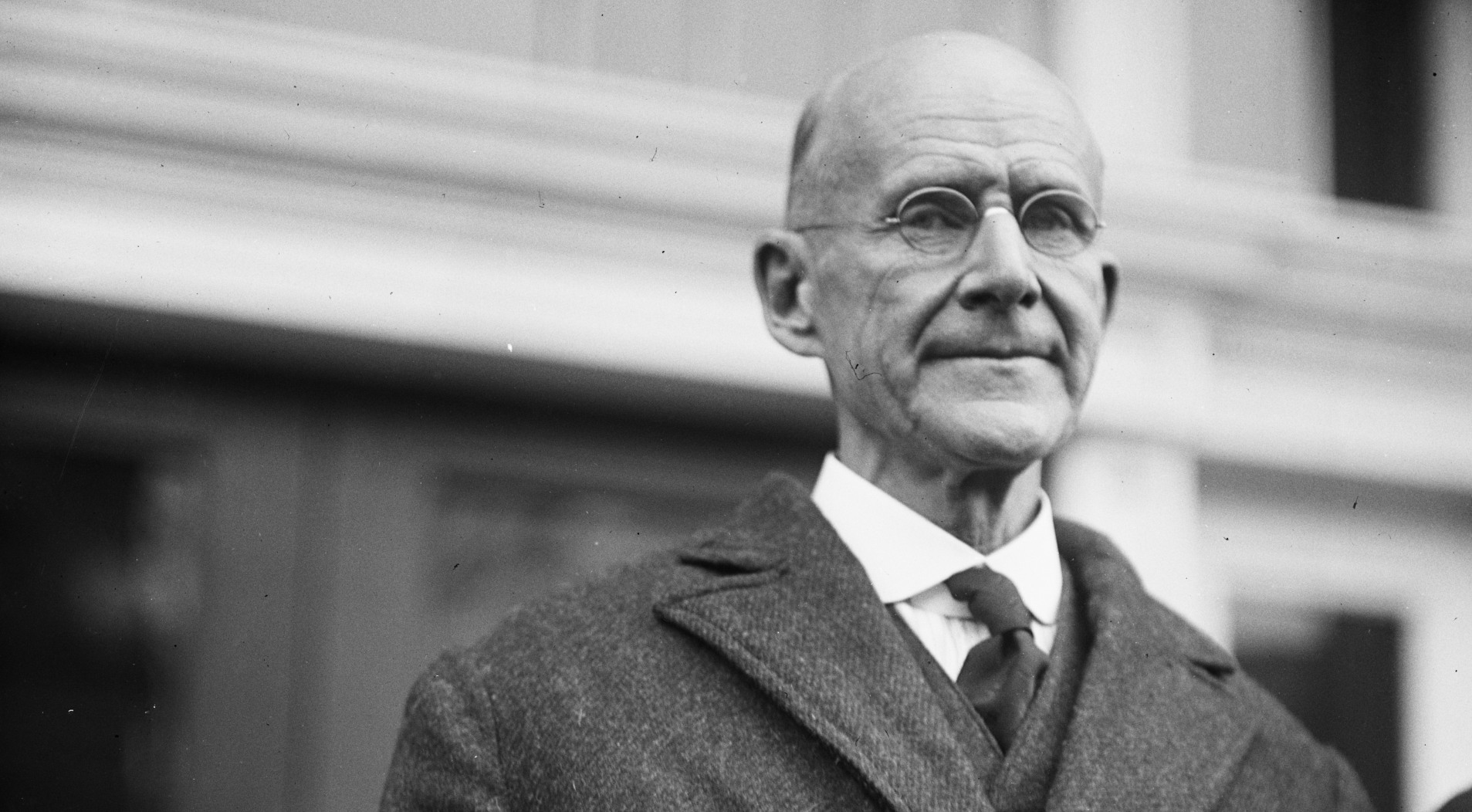
Debs was a magnificent writer, as in this howl against the Boise trial, an indictment of capitalist “law and order” calling on workers to assume the responsibility of John Brown in confronting wage slavery.
‘The Coming Climax in the Irrepressible Struggle for Emancipation’ by Eugene V. Debs from Appeal to Reason. No. 598. May 18, 1907.
There’s a divinity that shapes our ends, rough hew them how we will.
The prosecution in the pending trial is doing its utmost to have it appear that it is simply the trial of three men charged with killing another—an ordinary case of murder. It insists that there is no other issue involved, and flouts the idea that the case has anything to do with the struggle between labor and capital.
The capitalist press has uniformly taken the same position, declaring that an “atrocious murder” has been committed and that no question of a class struggle should be raised in connection with the prosecution of those charged with the crime.
How many people seriously believe that Moyer, Haywood, and Pettibone would be on trial today if they had not been leaders of labor in battles between labor and capital in the Rocky Mountains during the last fifteen years?
Ignorance or Design?
How many believe that there would be any such trial at all but for this war of the classes?
To speak of the trial, therefore, as an “ordinary murder case” betrays either deplorable ignorance or sinister design.
What is the object of this extreme concern in having a case that has aroused the whole nation and achieved international notoriety regarded as a “simple murder trial?” The answer is ready. The prosecution and the capitalist “interests” behind it fear that the working class, the “dumb-driven cattle,” may comprehend its true significance and awaken to their economic class interests, and this would mean the speedy end of capitalist exploitation and wage slavery.
Capitalist class rule is based upon working class fools. Ignorance is the title deed of the capitalist to his wage-slaves.
Hence the prosecution in this case with the aid and collusion of the capitalist newspapers and magazines must allay any suspicion of the working class that its loyal leaders are to be put to death for faithfully serving it, but that instead they are common criminals, guilty of ordinary murder, and that the wage-slaves will be all the better off for being rid of such vicious reprobates.
“Law and Order”
But fortunately this is not their first experience with corporate capital in the virtuous role of “punishing crime for the protection of society.” A few of them have observed that the so-called criminal is always a workingman and that the self-appointed guardians of society are themselves the plotters of crime and the enemies of the people. They have observed, moreover, that it is the very ones who declaim so unceasingly about “law and order” who are themselves the corrupters of the nation’s morals, the buyers of its legislatures, the polluters of its courts, the defilers of its electorate, the stealers of its public domain, and the heartless vampires that suck the lifeblood of the people.
A few of them having made these observations are now seeking to impress them upon the whole working class and it has been the agitation incident to this process that has invested the Moyer-Haywood-Pettibone prosecution with worldwide interest in spite of the persistent contention of the capitalist press that it is “only a case of ordinary murder.”
In the course of history and the sweep of events great crises develop on the eve of great social changes and in every such crisis great characters, born of the revolution and expressing its spirit, appear upon the stage of action, take the heroic parts assigned to them, and write their names in imperishable deeds in the history of humanity.
Such men are Haywood, Moyer, and Pettibone.
In the impending industrial crisis these men, developed in the travail of society, have been called to play important parts.
Patrick Henry, Sam Adams, and John Hancock served in similar roles a century and a half ago and Elijah Lovejoy, Wendell Phillips, and John Brown a century later. These men were all loathed, hated, denounced, and persecuted in the name of “law and order” and “the peace of society,” of which they were supposed to be the relentless enemies.
Haywood and Moyer and Pettibone are not more reviled today than were their revolutionary and anti-slavery prototypes of the last two centuries.
Patrick Henry was denounced by King George and William Haywood by President Theodore. Both Henry and Haywood incarnated the subject class, exposed its cause, voiced its protest, and defied the ruling class, and this has always been denounced as “treason,” and never more fiercely than today.
But Haywood is charged with murder. So was John Brown; and he never denied it. John Brown was the sworn enemy of the slaveholders. He spat upon their “morals” and held their laws in contempt. He not only advocated violence and incited bloodshed, but led in both, and yet many of the best men and women living today regard this “monster of depravity” as the greatest man, the loftiest soul, the sublimest hero that ever walked the earth.
At Harper’s Ferry
Think of John Brown in the engine house at Harper’s Ferry, his cocked rifle in one hand and the pulse of his wounded and dying boy in the other—the grizzled old warrior facing death in the holy cause of freedom with godlike serenity. Think of that sublime spectacle in the presence of which the spirit rises to exaltation and then recall the hideous shrieks of “treason” from the throat of slavery in the name of “law and order” to mock the solemn majesty of that supreme hour!
Treason to despotism is devotion to freedom. “Law and order” is a phrase mouthed by hypocrites to command the obedience of cowards.
The capitalist class buys law, as it does labor, using the one to fleece the other, and what it means by “law and order” is cringing submission to slavery.
“Law and order” is the wand of the imposter, the mask of the robber.
Beware of him who ceaselessly gabbles about the sanctity of the law.
Every ward-heeling politician, grafter, boodler, vote-buyer, labor exploiter, ballot box stuffer, franchise robber, timber thief, jury-briber, thimble-rigger, and kidnapper is the vaunted patron of “law and order.” Every one of them. That is their chief stock in trade.
Buchtel, the savage, now governor of Colorado by the grace of the mine and smelter trust and other thieves; Buchtel, the flint-faced, heartless priest who is going about telling the people Moyer, Haywood, and Pettibone are guilty of countless crimes for fear they will not be murdered; Buchtel, for whom the red-light districts turned out en masse on election day at the behest of the corporation “bosses;” Buchtel, the chancellor who has changed offices and functions with the hangman, is a shining specimen of the capitalist apostle of “law and order.”
Peace Based on Justice
Let no capitalist hireling charge that we favor violence and bloodshed. It is false and malicious. We are not opposed to law and order. We are opposed to the shams and hypocrisies; the frauds and crimes that resist threatened exposure as an attack upon “law and order.”
“Law and order” based upon industrial robbery and social crime have an insecure foundation and all the armed forces of the world cannot prevent such a foul fabric from going down.
There are not three men in America who by nature and habit are more peaceable and order-loving than William Haywood, Charles Moyer, and George Pettibone; not three men anywhere less inclined to incite strife or more responsive to the harmony and goodwill of human fellowship. They are all men of family, with loved and loving wives, devoted children, and pure, ideal homes. There is not a blemish upon the character of one of them as citizen or man.
Had you visited their homes before they were despoiled, as I have done, you would have been charmed by these types of splendid manhood, graced by the affections of their loved ones as great oaks are caressed by tender vines. Had you asked their neighbors you would have been told that they were sober, honest, manly men, who walked upright before their fellows, and even the children would have eagerly added their testimony of affectionate regard.
There is not a man who knows “Bill” Haywood who does not believe him square as a die; truthful, honest, generous to a fault. In his massive frame he carries the tender, loving heart of a child. He does not know what guile is; and to duplicity he is a total stranger. I would freely stake my life on his unsupported word. There is no scar upon his integrity; no shadow upon his honor.
Aroused, this Rocky Mountain miner has the strength of a giant and the courage of a Spartan. But no man I have ever known is calmer, serener, or has more perfect self-control. This is real strength, true courage, perfect manhood. It was this that extorted from the lips of Wendell Phillips as he stood beside the cold and pulseless form of John Brown, the soul-inspired exclamation: “Marvelous old man!”
History Again Culminating
History is again approaching its culmination. Industrial freedom is today the shibboleth of the working class. No conceivable artifice no possible sophistication can more than temporarily retard the movement toward emancipation.
The settlement of one grievance of the working class becomes the basis for the next; one concession begets another, while the defeated strike and the harrowing blacklist are the recruiting agencies of the proletarian army of revolt.
The working millions were never as class-conscious, active, and determined as they are today. Hundreds of publications devoted to their interests are springing up, thousands of speakers and agitators are leaping from their own ranks to arouse the masses, and millions of tracts, leaflets, and pamphlets proclaiming the new gospel of industrial freedom are being scattered broadcast among the people.
The working class is ceasing to blindly follow the political tools of its exploiting masters; taking counsel of its own sad experience and developing a solidarity—industrial and political—that is already shaking the foundations of capitalist society over all the civilized world.
Bitter Lessons
Many bitter lessons have workingmen been compelled to learn, but not one has been in vain. the very misery ignorance has inflicted upon them has been the means of their education and thousands who have suffered together in the depths are now keeping in step together towards the heights.
But the one supreme lesson the working class in part has already mastered—the lesson taught it by the duplicity and deceit of its rulers wee in league with the devil and infamous enough to attack “the sacred rights of property.” Elijah Lovejoy, one of the pioneers, was murdered in cold blood. Garrison narrowly escaped lynching; Wendell Phillips was repeatedly threatened with assassination.
How vividly I remember the evening thirty years ago I spent with Phillips and how he fired my boyish imagination by his recital of the thrilling scenes of the abolition conflict. An agitator was Wendell Phillips, every inch of him; an apostle of freedom, one of the grandest souls that ever glorified this planet and yet the foul minions of the slave owners hunted him as relentlessly as the Pinkerton detectives of the mine owners are hunting Haywood, Moyer, and Pettibone today.
John Brown, another of the elect of God, was a fiend incarnate in the eyes of men who trafficked in human souls in the name of “law and order.” Victor Hugo hailed him deliverer, but the American people, degraded by the brutal domination of the slave lash, murdered him by law to vindicate its sordid supremacy.
“Monster of iniquity” was the verdict of the slave owner and his “civilization,” but the verdict of one age becomes the mockery of the next. The mills of the gods grind on. John Brown has ceased to be a monster. His name has been rescued from the cruel aspersions of the slaveholder long ago. The slaveholder himself is now forgotten, but his despised victim is lovingly remembered by all the race.
John Brown, were he living today and saw the slaves in the pits and mills and their babes in the sweatshops, would again don the panoply of battle and swear death to wage-slavery. Were he living today he would be hated and persecuted as fiercely as he was by the chattel slave aristocracy half a century ago. But he is dead. And the ruling class against which he rebelled, the ruling class which put him to death and which he cannot now resist, seizes him as one of its own heroes and insults his memory by enrolling his name in its calendar of saints.
It is only because he is dead that the capitalist class pays tribute to Brown. He needs no ruling class laurels to keep his memory green. He belongs to the agitators and the liberators and not the enslavers of humanity.
Nearly 50 years ago John Brown was hanged as a felon for being a man, while the felons who took his life wee honored as men. Today the vice-president of the United States journeys to Osawatomie in pomp and circumstance to do honor to his memory while a grand monument is erected where he trampled on the “law” and incited violence and bloodshed in the cause of human freedom.
Wage-Slavery and Proletarian Patriots
Chattel slavery has disappeared. Wage-slavery has yet to be conquered. The struggle has already begun. There can be no compromise and no retreat. Again are the leaders stepping from the ranks and taking their places at the heads of the advancing columns. Defiance is on their lips and the spirit of the revolution in their souls. Like their prototypes of the past they are marked for ostracism, hated, contumely—some of them for death. But they falter not, they are the royal sons of destiny. Upon their eager faces falls the dawning of the coming day.
The voice of Freedom has called them to her standard and when they have sealed their devotion to her cause their names will shine in living letters on the scroll of the immortals.
William Haywood, Charles Moyer, and George Pettibone have fought the good fight. They have never betrayed their cause, nor ever sounded a retreat.
For serving the working class with matchless valor and unwavering devotion these proletarian patriots have been seized by the enemy and it now becomes the solemn duty of the working class of all the nation to rally to their rescue.
They are men, not murderers. Were they less than men they would not now be on trial for their lives. The aristocracy of capital that rules today does not object to murder. Thousands of the children of toil are murdered every day whose lives could and would be saved if they were of greater value than the material means required to save them.
The capitalist power rules by corruption. Where that fails it employs persecution and death.
The disclosures made in the recent exposé of the Pinkerton Detective Agency show clearly by what villainous methods labor unions are invaded by those assassins and how crime is instigated and committed by them to discredit the unions. The bills for all such treacherous services are paid by the mine owners and other capitalists who profit by the disruption of organized labor in the unrestrained exploitation of its product.
The war that has been raging in the Rocky Mountains these many years is a class war. Upon the one side are the mine owners and upon the other the mine workers. Between these two classes there can be no peace. The clash of material interests forbids it. The idle owners, by the mere fact of ownership, get most of what the miners produce. The workers have submitted to this exploitation long and patiently, but the limit has about been reached. Why should they have to deliver up to others the wealth they produce? Why not themselves enjoy the fruit of their own labor?
These are the questions being asked by more and more workingmen and with steadily increasing emphasis.
The wage system has only slavery for the working class and oft-times even that is denied them. It has served its time and purpose and must soon be abolished. The workers do not need masters; they can and must be their own.
Class Organization
To abolish wage-slavery requires the organization of the working class, both economic and political, and this work is now under way as never before. The economic organization of the workers on a revolutionary basis enables them to act together aggressively and effectively in the protection and promotion of their common interests.
Political organization has already been carried forward to such an extent that many thousands of workers now understand that their economic interests as a class are opposed to the economic interests of the class that exploits them, and that these opposing interests must express themselves in opposing parties and that, therefore, the working class must have a political party of its own and that this party, to be true to its historic mission, must demand the overthrow of the capitalist system that the cooperative commonwealth may be established and industrial freedom proclaimed.
The Socialist Party has already taken its place as the party of the working class. It is based upon the class struggle and demands the unconditional abolition of the capitalist system. All the workers of the land and all their sympathizers may here united upon revolutionary political ground.
Approaching the Crisis
The trials now in progress in Idaho are culminating scenes of fierce engagements in the class struggle. They are of vital and far-reaching interest to the whole working class. The lives of trusted leaders and issues of supreme importance are at stake. All the resources of the working class should be freely available in this crisis.
What the outcome of the trials may be no one knows, but of one thing we feel absolutely certain, and that is, if the trials are fairly conducting and the verdicts honestly rendered, Moyer, Haywood, and Pettibone will walk forth free men.
But regardless of the outcome of the trials, the issue involving the life and freedom of the whole working class has to be fought out. There can be no retreat, nor even a cessation of the struggle.
The kidnapping of Moyer, Haywood, and Pettibone, the representatives of the working class, and their heartless persecution in the name of “law and order,” has opened the eyes of many thousands to the real issue involved, and they are now ready to join their class in the political battlefield.
Should the courts of Idaho fail to do our comrades justice we will appeal their cases to the working class of the nation.
Next year, 1908, is a presidential year. The kidnapping trial in Idaho is a fitting prelude to the national campaign. We welcome the issue and the contest. Working class sentiment is rapidly crystalizing and in another year the hosts of labor will be ready for the greatest political campaign since 1860. The issue then was chattel slavery; today it is wage-slavery.
Again the bugle blasts of the “irrepressible conflict”6 are heard in the land and the toiling millions are rallying to the standard of their class.
The Idaho trial is the signal for the revolutionary alignment on both the industrial and political fields and for the opening of the national campaign in which that stalwart champion of labor, William D. Haywood, now persecuted by the capitalist class, shall be the candidate of the working class for president of the United States.
The capitalist class has flung down the gauntlet in the name of the Standard Oil Company, the mine and smelter trust, and other combines of brigandage and boodle, and we pick it up in the name of all the millions in the fetters of wage-slavery.
With William D. Haywood as the standard bearer and industrial freedom as the shibboleth the campaign of 1908 will shake the nation from its center to its circumference.
Our Candidate
No words of eulogy are required in presenting William D. Haywood to the working class of America. He is a sturdy type of the twentieth century wage-slave. His strength of mind and body are of the lower class from which he sprang. Brave, resolute, and incorruptible, he has fought the battles of his enslaved fellow men. The character of his friends and his enemies are equally eloquent of the purity and strength of his own.
The highest ambition of this proletarian leader is to serve the class that shares his fetters in honest toil. For that class he has stood as staunchly as any general ever stood on a field of battle and freely sacrificed all he had except his sacred honor.
For fifteen months William D. Haywood, in Ada County Jail, ready to die for the working class, has proved himself worthy to live for his class in the White House of the Republic.
The Appeal to Reason was among the most important and widely read left papers in the United States. With a weekly run of over 550,000 copies by 1910, it remains the largest socialist paper in US history. Founded by utopian socialist and Ruskin Colony leader Julius Wayland it was published privately in Girard, Kansas from 1895 until 1922. The paper came from the Midwestern populist tradition to become the leading national voice in support of the Socialist Party of America in 1901. A ‘popular’ paper, the Appeal was Eugene Debs main literary outlet and saw writings by Upton Sinclair, Jack London, Mary “Mother” Jones, Helen Keller and many others.
PDF of full issue: https://www.marxists.org/history/usa/pubs/appeal-to-reason/070518-appealtoreason-w598.pdf
 Revolution's Newsstand