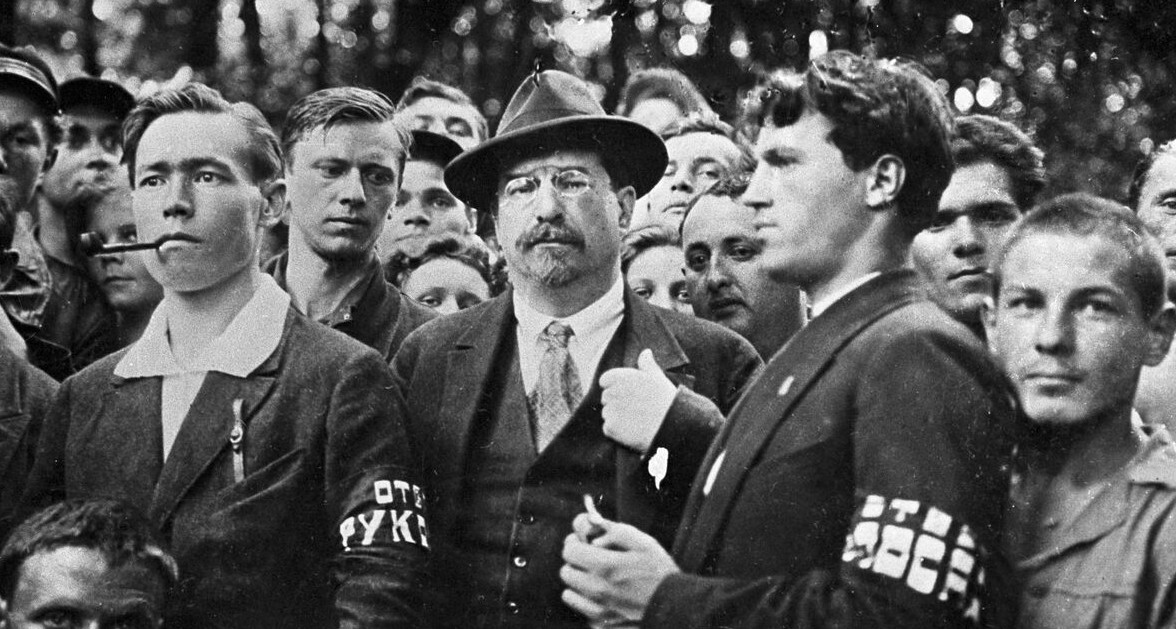
The day after taking power, the Soviets established a Commissariat of Education with Anatoly Lunacharsky leading it, a position he would hold until 1929. A unique figure among the Bolsheviks, Lunacharsky’s impact on the new Soviet culture was incalculable, but he had very little political authority within the Party, never serving on its leadership bodies. Ambitious, incredibly learned, and visionary, Lunacharsky’s transformation of education was among the Revolution’s great achievements. Below he reports to the Congress of Soviets on the Commissariat’s first year of work, where the most pressing issue was a conflict over the changes with the old teachers’ unions, and plans for the immediate future.
‘Education Under the Bolsheviks’ by Anatoly Lunacharsky from The Liberator. Vol. 2 No. 5. May, 1919.
A Translation of the Annual Report of A. V. Lunacharsky, Commissar of Education in the Soviet Government, for the Year Ending November 7, 1918
IN a country kept artificially in ignorance, the task of education could not find full development on the day following the people’s revolution, which transferred the power to the toiling masses. It is evident, however, that neither the conquest of political power nor the attainment of the position of economic master of the country, could be lasting, if the people should not also attain knowledge.
Only a high level of public education could make possible a conscious governing-by-the-people, which should embrace large masses. During the interval an important role had to be played by the intelligentsia, which had enjoyed the odious privilege of exclusive erudition, and was considered in Russia to be in sympathy with the people. In the time of the 1905-6 revolution, Kautsky pointed out with hope the fact that in Russia the task of the working class would be made easier by its sincere ally, the revolutionary intelligentsia. Kautsky did not foresee at that time that at the moment of the concrete realization of his dreams, at the hour of the social revolution, even he himself would turn enemy to the proletarian vanguard.
However, there is no evil without its accompanying good. The abominable sabotage on the part of the majority of the Russian intelligentsia, and in particular of the so-called Socialist intelligentsia, proved an excellent lesson for the proletariat, laying stress upon the unalterable necessity for the proletarian to acquire real knowledge immediately–for himself so far as possible and in full measure for his children. The leadership in this important task has fallen to the Commissariat for Public Instruction.
Sabotage by Teachers
It was extremely hard to fulfill it, for one of the most relentless detachments in the camp of the sabotagers was the gentlemen-teachers, urged along by the All-Russian Union of Teachers. The officials sabotaged also, destroying the central apparatus of the former Ministry of Public Instruction. We found ourselves among ruins, without guides, without actual connection with the schools, without connection with the provinces, and with our pedagogical forces limited to an unbelievable extent.
Still other impediments arose along our road during the year. Suffice it to mention only one–the transfer of the Commissariat to Moscow at the time of the German invasion, before the Brest treaty, a necessity which destroyed a full half of the work that we had step by step put in order.
Nevertheless, the central apparatus, and in a great measure also the local, is at the present time working harmoniously; the greater part of the body of the teachers (the lower ranks) are sincerely working with us, the remaining part are willy-nilly creeping along.
Let us say here a few words in regard to the apparatus by which we have supplanted the old ministry and its local organs. At the head of the Commissariat stands the People’s Commissar and his assistant, and the staff, consisting at present of seven persons, which decides all current affairs that are outside the competence of the branch superintendents. Basic problems are solved by a state Board of Public Education, which, besides the members of the staff and the branch superintendents, includes also representatives from the centres of the Soviet Government, from the labor unions and the workers’ cultural organizations, and from that part of the body of the teachers which is taking a stand of loyal co-operation with the Soviet power.
Finally, problems of especial importance, for instance, regarding a general school reform, are considered at the All-Russian Conventions, the first of which, well attended, harmonious and imbued with communistic ideals, took place in Moscow in the month of August.
In the provinces the work of public education is being directed by the Departments of Public Instruction attached to the provincial (“gubernia “), county (ouyezd), city, and lastly, the “volost,” Executive Committees. The provincial, county, and city departments, corresponding to the Central staff, have attached to them Councils of Public Instruction corresponding in the provinces to the State Board.
It is self-evident that the main care of the Commissariat for Public Instruction was the elaboration of the basic principles for a radical reform system to replace the school apparatus inherited by us from the czarist regime.
Class Education Abolished
In place of schools of all varieties and kinds–which formerly were sharply divided into a lower school for the plain people, and the middle school for the privileged classes and the well-to-do people, and divided further into schools for boys and those for girls, into technical and classical secondary schools, general and special school institutions–the Commissariat has introduced the Unified Workers’ School (covering the entire length of the course of instruction).
The unity of this school should be understood in two ways: first, that the class divisions are abolished and the school adopts a continuous grade system. In principle, every child of the Russian republic enters a school of an identical type and has the same chances as every other to complete its higher education. Second, that up to the age of 16, all specialization is omitted. It is self-understood that this does not hinder the adoption of the principle of individual attention, and of the greatest possible variety of forms inside each school. But specialization in the full meaning of the word is permitted only after attaining the age of 16, and upon the foundation of a general and polytechnical education acquired already. The school is declared an absolutely lay institution; diplomas, in their character of certificates granting special rights, are abolished; the classical languages are declared non-obligatory.
This school, unified in principle, is divided into two grades: the first of five years’ duration, and the second of four years. This nine years’ course is declared to be in principle obligatory.
Our school will be in fact accessible to all. To attain this end, not only are all tuition fees abolished, but the children are provided with gratuitous hot food, and the poorest children with shoes and clothing. It goes without saying that all school manuals are offered to the children free of charge by the school.
The Commissariat understands fully how immense are the difficulties which it will meet with on its road. The country is ruined and famished, there is a lack of manuals even for the needs of the old school, and still more for the immensely enlarged new school. The Commissariat, however, supported by the whole Soviet government, will undertake the overcoming of this difficulty, and hopes to master it if not at once at least in the near future.
Declaring the nine years’ course to be obligatory in principle, the Commissariat intrusts all councils with registering all children of school age, with placing all those whom it is physically possible to include in the schools among various educational institutions; with giving to the rest certificates showing that they are outside the school not by omission or reluctance of the parents. After finding out the number of children of school age in each locality, the Commissariat will immediately undertake the building of a school system. It is proposed for the next year to open 10,000 primary, and 1,000 secondary schools.
Work as the Basis of Education
The labor character of the school consists in the fact that labor, pedagogical as well as, in particular, productive labor, will be made a basis of teaching.
In the primary schools it will be mostly work within the walls of the school: in the kitchen, in the garden, in special workshops, etc. The labor must be of a productive character–in this way in particular, that the children serve the needs of the school community so far as their strength will permit them. It bears, at this grade, mostly the character of domestic and artisan labor; in the city, naturally, approaching more the type of a workshop, in the village the type of a farm. It is proposed, however, to transfer in the summer time all city school activities as far as possible to the village places.
In the secondary schools the productive and the broad social character of labor is emphasized still more sharply. We deal here with children from thirteen years up. From this age there is possible an easy but real labor outside of the school; the participation in factory or shop work, the helping in serious farm work, the co-operation in some business enterprise, the co-operation in some social or state undertaking. From this age up we are uniting the labor of the children, the participation of the child in the social struggle for existence, and its development with its education. The school, without losing sight of the youngster, protecting it from harm, turning each act of its labor to the benefit of its general physical and mental development, will lead it into the very tangle of social productive work.
This task is the most novel and the most representative. Only by the way of experience and by an attentive co-operation of the teacher with the technical staff and the workers’ administration of factories and workshops, shall we be able to feel out gradually the correct method of close relationship between the pedagogical and the industrial life.
In the meantime, we meet here with that very peculiarity which is proper only to the communistic way of solving the school problem.
Every time Marx happened to speak of education he turned to child labor, and laid stress upon the circumstance that not the prohibition of child labor, but the regulating and transforming of it into a polytechnical basis of education by way of a rational co-ordination with science, physical exercises, and aesthetic development–will create a harmonious and truly modern man. Such is, in general terms, the labor basis of our general education school. To be sure some specialization is also possible for the youth, the learning by choice of this or the other technical branch; individual schools of secondary grade may, too, in conformity with local conditions, concentrate their attention upon the local production–in such a manner, however, as to develop in the pupil through the example of the special production, all potential abilities and to acquaint him or her with the whole of culture and not confine too closely to the specialty. The actual specialization, then, the transition to the vocational preparation, is, in the opinion of the Commissariat, admissible only in the third grade, beginning with the age of sixteen, in schools which we call higher and in institutions of the extension-teaching type.
City and Country Schools
The Commissariat considers it very desirable to do away in schools of secondary grade with the involuntary but excessive division between the city and the village schools. Not only is it necessary to transform the city schools in summer time into colonies, but to bring in pupils of the village secondary schools, in winter time, into the factory and cultural centers. The realization of this great reform, which is outlined here but briefly, and which was worked out by the Commissariat with the co-operation of the first All-Russian Convention in Matters of Public Instruction in a relatively detailed manner, requires, of course, a considerable number of well-prepared teachers.
The school policies of the Commissariat were confined to the following: (1) to check as far as possible the influence of the sabotaging All-Russian Teachers’ Union; (2) to unite in a broad trade-union, particularly the lower grade teachers, upon the foundation of the so-called Union of Teachers-Internationalists; (3) to equalize as regards their rights the teachers of the primary and secondary grades, bringing the remuneration of their work also to one level; (5) to aid by all means the development and the increase of educational institutions for the preparation of teachers; (6) meanwhile to have recourse, as far as possible, to the organization of teachers’ courses.
These policies have been approved by a number of teachers’ conventions, and they have found a definite expression in their last points at the Moscow Conference devoted to the problem of preparing teachers.
The Commissariat has attained a real success on all the points indicated. The teachers’ union is disabled and is asking forgiveness. The ranks of the lower teachers are being organized successfully, and the many telegrams of greeting received from the teachers’ conventions shows a growing sympathy for the Soviet government on the part of the public school teachers.
Raising Teachers’ Salaries
On June 25th the Council of People’s Commissaires, upon the representation of the People’s Commissariat for Public Instruction, adopted measures which stand out singularly in the annals of school history not of Russia alone. The salaries of public school teachers were raised at once to more than double their previous amount, with back pay for three months, beginning with March. The corresponding budget item for public instruction, for the second half of 1918, increased almost to one billion. In proportion as the ideal of universal education is actually approached, in proportion as a system of new schools is opened, the salaries of the teachers’ personnel in these schools are still to be raised–the school workers of the future unified labor school will be, as regards remuneration, transferred to the first, that is, to the highest class. These expenditures will have to reach several billions; the yearly budget of the unified labor school when its plan is definitely outlined, with all side expenditures for equipments, structures, etc., will have to reach six billion roubles. But toiling Russia will not spare anything in order to have a school worthy of her hundred million of workers and peasants, who, the first in the world, have taken the power directly into their hands.
To lift the material level of the worker in the public school would mean, however, the completion of only half of the work, and not the most important half.
Bourgeois society not only kept the bodies of the masses in perpetual cold and hunger, but also tried continually to keep their minds in absolute darkness: the history of the sabotage perpetrated upon teachers shows graphically how farsighted was the bourgeoisie in this respect.
The new Russia does not want teachers physically incapacitated by misery and want, but teachers of a genuine culture, of high intellectual development, and of perfect physical vigor.
Educating the Teacher
The establishments of the old school, the teachers’ institutes and teachers’ seminaries, failed completely to produce the modern type of teacher. And although in the above-named institutions only experienced teachers were admitted, nevertheless, their course of training was miserably inadequate for serious pedagogues whose mission was to train the youth of the country. The conference called by the People’s Commissariat in the latter part of August of this year for the purpose of preparing a programme for teachers’ preparation, worked out new plans for teachers’ institutes as well as for seminaries. The latter will be converted into high pedagogic establishments, corresponding to the pedagogic faculty in universities. In the courses for teachers’ seminaries new subjects have been introduced, such as the history of socialism, the basis for the theory of law, etc., and matters of religious instruction have been entirely removed from the curriculum.
Here follows the sum total of the Soviet’s accomplishment in the province of teachers’ preparation. After October, 1918, the following establishments were opened anew: Teachers’ institutions, 4; teachers’ seminaries, 42; constant pedagogic courses, 10; short-timed courses for teachers, 110. Also 31 teachers’ seminaries and six constant pedagogic schools were accepted and regenerated by the Commissariat. The Commissariat also organized within the period of last year central pedagogic courses based on the new programme, which attracted more than 800 hearers, composed exclusively of male and female teachers. The courses proved to be a tremendous success, and among the lecturers were such comrades as Bucharin, Reisner, etc.
And I will add to the already mentioned achievements the fact that the same useful work is being carried on in the provinces, especially the northern provinces, where in Petrograd alone were at first organized courses for 400 teachers, and later for 2,000, and throughout the province 11 courses were organized, each of which was attended by from 200 to 500 hearers.
The Commissariat thinks it indispensable, not limiting its activities only to the development of children of school age, to pursue the following aim: To build at every school of the first children’s grade a two-year preparatory and obligatory children’s park. The pre-school branch of the Commissariat has outlined a broad programme for the founding and organizing of children’s playgrounds, clubs and colonies. Among the last especial attention must be called to the Children’s Industrial Colonies, which were organized in Tsarskoje Seloe, as here was laid down the first stone of the foundation planned by the Commissariat. It is the aim of the Commissariat to convert this wonderful place of the province of Petrograd into a gigantic Children’s Colony, where thousands of proletarian children will be sent yearly. This colony has given refuge during the past summer to 1,500 children, and within the year 1919 we hope to broaden the scope of the colony so that it will give room for 2,000 or more children. In the work of nourishing and caring for the children the Commissariat of the People’s Enlightenment co-operates with the Commissariat of Social Security. By the will of the Soviet People’s Commissariat all public schools went over to the jurisdiction of the Commissariat of National Enlightenment, and in due time all private schools will be taken over by them, too.
Coming over to the reforms inaugurated in the higher schools, I wish to show that those reforms, worked out by the Commissariat, affected all the Universities and advanced technical schools of Russia.
Advanced Education
A part of the demands of the Commissariat were accepted by the professoriate, and a part were enforced against the will of the professoriate, but with the understanding that they would have to submit to the demands of the revolutionary people. The principal basis of the instituted reforms is the following: Advanced education is accessible to all in Russia. Every citizen, male or female, reaching the age of 16, can enter any desirable advanced institution of learning. To the hearing of lectures all are admitted without distinction. To the practical experimentation and work are admitted only those who prove, after an examination, to possess a capacity for the work. Individuals not sufficiently prepared will receive this preparation along the plans and under the tutelage of the professoriate of the given institution in specially prepared courses.
The professors will take their seats on the basis of appointment at the all-Russian organized conferences to be called every 10 years by all the universities. (It is appropriate to remark here that teachers of schools are subject to election by the Soviets as well as to re-election and recall.)
Under such grounds the Advanced Schools have the advantage of a broad autonomy. However, in the self-government of the schools the teachers as well as the professors and the students participate with equitable proportion. In addition to the Educational Association, which is responsible for the successful operation of the above-outlined aims, each of the Associations is obliged to organize and develop an Enlightening Association, the purpose of which is to assist in the general educational development of the masses. The Enlightening Association will first transform itself into a sort of institution for the training of lecturers for the people’s universities, which are spreading all over Russia, and second, for the preparation of courses in subjects not attended by specialists but by people desiring to broaden their general education and mental status.
The Commissariat also planned to include in its demands to the High Institutions of Learning the necessity for them to establish within their organizations Scientific Associations, fundamentally to occupy themselves with purely scientific problems and research work. However, owing to the strange opposition of the professoriate to such a plan, the Commissariat came to realize that it was premature for the present.
The enlightening associations of former educational institutions lead us to tasks of out-of-school education which the Commissariat considers of great importance.
Libraries
While awaiting the growth of new communist enlightened workers, which the schools will give us, we must simultaneously meet the growing desire for knowledge on the part of the adults. For that reason it is essential to organize a long line of universities in provinces, cities and villages, and also the spreading of a great number of libraries, stable and circulating, for the advantage of the masses, and finally the organization of educational expeditions into the country and the sale of literature through various channels of communication and primarily through the Post-Telegraphic Department.
In order that there should be unity in the activities of the large, central libraries, they have been coordinated under the supervision of the Central Library Commission, which is occupied with the elaboration of schemes of how effectively to distribute books and reach the members of libraries. The public library of Petrograd has been granted a new and fruitful democratic constitution and considerable means for its development. We wish to remark here also, that all governmental archives have been converted and centralized and made accessible to the public.
The victorious nation has inherited wonderful Czarist, feudal and churchly property. In addition to the official museums, the Commissariat of Public Education has created new museums, using the historical and artistic and most precious palaces and castles of the czars and lords for that purpose, protecting them in the year of tragic fermentation, when the highly-precious property of the despised classes was in danger of being destroyed. Finally the Commissariat of Public Education has created a new special organ: The Commission for the Protection of Artistic Monuments and Monuments of Antiquity, which not only saved many of them from ruin, but also nationalized all the culture and art of the conquered for the democratic and universal benefit of the people at large.
Theaters
In the same way, all former imperial theatres have been protected and granted full autonomy for the actors, and despite the critical revolutionary period, the theatres are functioning in full force, the plays becoming more and more of a proletarian character, and the theatres becoming gradually the property of the working masses.
The Government theatres of Petrograd, resorting at first to sabotage politics, have finally sent in to the People’s Commissariat a touching address of thanks.
Moreover, the Commissariat supports Soviet theatres, such as the remarkable Moscow Soviet Operatic Theatre, and a number of communistic theatres of Petrograd.
The Theatrical Department is energetically working out the problems and methods of scenery to be introduced in schools, also methods of special theatrical education, children’s theatres, the history and theory of the theatre, publishing journals illuminating and discussing those subjects.
Music
In the same manner, all the choruses and orchestras of all former religious and imperial institutions have been taken over and reorganized democratically by the Commissariat. The imperial orchestra gives at the present time one concert a week of a musical and academic character, so to speak, two popular concerts in the beautiful halls of the Winter Palace, which has been converted into a National Palace of Art, and concerts in different neighborhoods periodically.
The two best choruses of the world, in all probability, the one of the chapel and the synodic one, have been converted into publicly accessible Academies of Music and Song. A true public character has been given to various musical schools under the supervisorship of military and naval departments. The conservatories have been also taken over by the Commissariat of Public Education, and in the near future a conference will be called to consider systematic and radical reforms to be introduced in those advanced musical establishments. The Musical Department is elaborating plans for courses in singing and musical education, and a plan for one Central School for earnest and aspiring students.
Art
The Department of Plastic Arts, in order to enliven the completely decrepit Academy of Arts, has radically democratized its present advanced educational establishment. It has been made accessible to the public. The professors have been chosen by the students themselves, and in this way have been reorganized the Free Governmental Artistic Workshops.
The following schools also have been instilled with a new spirit: Stroganowskaja, Schtiglica, etc.
Along with the Department of Plastic Arts there is another department, the Artistic-Industrial Department, which is occupied with the problem of elevating the artistic aspect of industry. For that purpose it operates at the present time a porcelain and grinding factory and is organizing colossal workshops. It is worth noting that the porcelain factory manufactures thousands of wares and dishes for peasants (ornamented by the new emblem of the Soviet Republic and with revolutionary slogans), the orders for which are given by the Commissariat of Supply of Provisions.
Public Statuary
On the Department of Plastic Arts fell also the duty of removing unesthetic and immoral monuments, and building new monuments of great thinkers, workers and poets of the revolution.
In most of the cases the monuments have merely a temporary character and serve as a monumental basis for the propagation of revolutionary ideas among the masses. The best of them will be made permanent. Up to date two monuments, those of Ferdinand Lassalle and Radishew, have been unveiled in Petrograd, and in Moscow the monuments of Dostoyevsky, and a very original one dedicated to Stephan Rasin, are ready among others for unveiling.
Besides monuments there are in preparation tablets of stone and metal with various revolutionary inscriptions, which, too, will serve the purpose of revolutionary and communistic propaganda.
The World’s Best Literature
In the literary field, the Commissariat has taken over the right of publishing literature, thus taking away the right of profit from private publishers. It publishes literature of the best sort in artistic editions and at nominal prices.
The Commissariat is determined to publish the best Russian classics in the near future. It has also thrown on the market thousands of sets at cheap prices, of Tolstoy, Uspenski, Nikitin, Krylov, Kolchov, Turgeniev, Chechov, etc. I enumerate here only those authors whose works have been published either in full, or of which the first volumes have appeared.
Shortly also the Department of Foreign Literature, under the supervision of Maxim Gorky, will begin to function. This department has a remarkable field before it, and under the directorship of a great man like Maxim Gorky it is bound to accomplish unprecedented results.
The Educational Department is occupied with the problem of mobilizing all the educational forces of Russia for the purpose of solving complicated problems brought into prominence by the conditions under the Soviet regime. The Academy of Sciences, the Association of Knowledge and a number of other educational societies work in co-operation with the Educational Department.
Science
Through this department as well as through the endeavors of the department of advanced educational establishments, have been opened a great array of learned and educational institutions. These are: The Physical Institute of Moscow, the Institute of Petrograd, the Institution of Photography and Phototechnique in Petrograd, universities in the cities. of Woronez, Tambov, Nizni Novgorod, the Polytechnical School of Vosnesensk. The last-named institution has cost $7,000,000, the total of which was collected by the local population. The city of Kostroma also has collected $2,000,000 for the purpose of establishing a university there. In the near future will begin to function an institution extremely important to Russia, a Smelting Institute in Moscow, devoted specifically to the aim of extracting and mining local coal.
-and Moving Pictures
In close contact with the educational department of the Commissariat of Public Education there works the newly organized scientific-technical department of the advanced Soviet of National Economy. In a near contact with the last-named department we find also the Kino-Committee, associated with the Commissariat of Public Education, in Petrograd as well as in Moscow, spreading in all provinces its activities from producing pictures to surveying and buying materials for new moving picture theatres.
Finally, there are the high establishments of socialist education in Russia, the Socialist Academies of General Sciences, forming a link in the great organization and body of the Commissariat of Public Education, and also forming one of the most learned and educational and the most effective instruments in disseminating socialist class-consciousness, and strengthening the communist ideals in our country.
From the summary above given the reader can well conjecture how colossal is the task of the Commissariat of Public Education. It has a noble program and ideal as its guiding spirit, and in spite of unfavorable circumstances, it has already succeeded in gaining successes in many an undertaking.
In addition to the present essay and the short account presented to the Soviet of People’s Commissars one and a half months ago, the National Educational Bureau is preparing a detailed account of its activities, at least on account of some specific angles of its activities, furnishing concrete figures, and presenting the full accomplishments of the central government for the end of the year 1918.
Insurmountable obstacles have obscured the work of the Commissariat. But, priding itself upon its important role in the family of friendly commissaries of Soviets, it goes on firmly with its idealistic aim, and will never falter even though some of its programs may not materialize as soon as could be desired.
The Liberator was published monthly from 1918, first established by Max Eastman and his sister Crystal Eastman continuing The Masses, was shut down by the US Government during World War One. Like The Masses, The Liberator contained some of the best radical journalism of its, or any, day. It combined political coverage with the arts, culture, and a commitment to revolutionary politics. Increasingly, The Liberator oriented to the Communist movement and by late 1922 was a de facto publication of the Party. In 1924, The Liberator merged with Labor Herald and Soviet Russia Pictorial into Workers Monthly. An essential magazine of the US left.
PDF of full issue: https://www.marxists.org/history/usa/culture/pubs/liberator/1919/05/v2n05-may-1919-liberator-hr.pdf
 Revolution's Newsstand