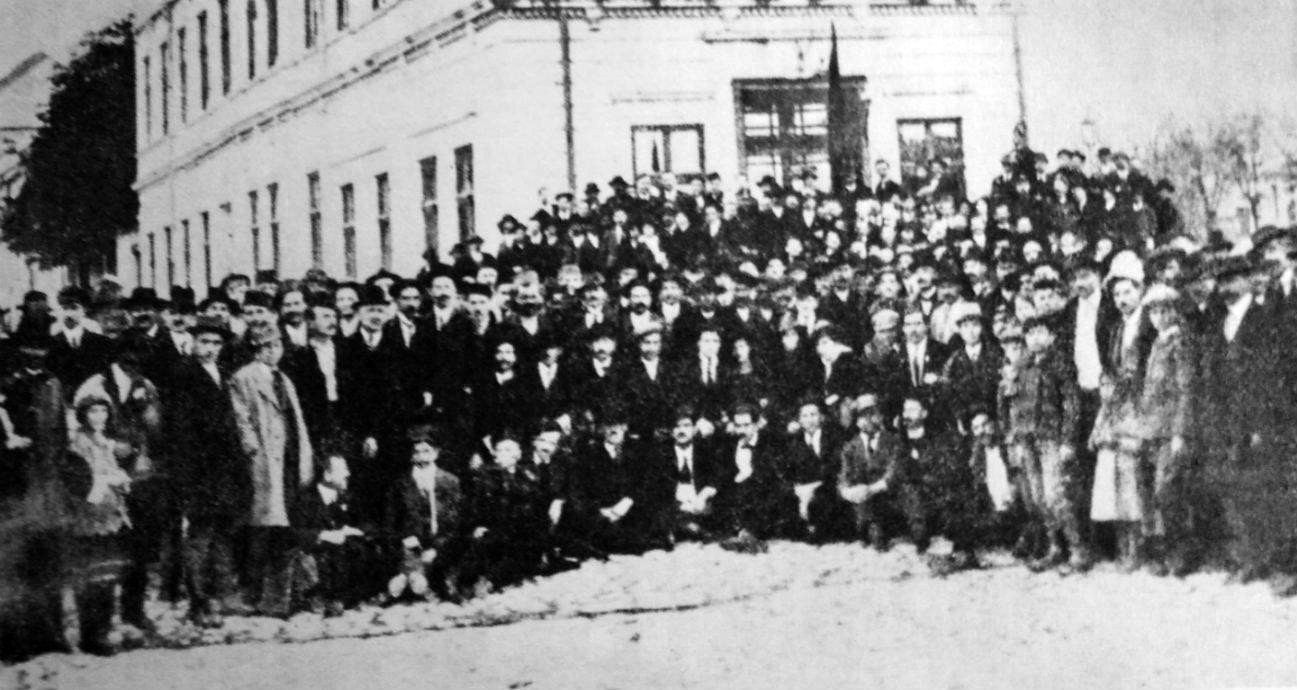
The Balkan Communist Federation began in 1910 as the Balkan Social Democratic Federation to fight against national oppression and division in the extraordinarily contested region.
‘The Fourth Balkan Communist Conference’ by Gamma from International Press Correspondence. Vol. 4 No. 56. August 7, 1924.
Towards the end of June the Fourth Balkan Communist Conference was held at Sofia. Together with the delegates of the Communist Parties of Bulgaria, Greece, Roumania and Jugoslavia as well as those of the Balkan Federation of Communist Youth which together constitute the Balkan Communist Federation, there also took part in the Conference delegates from the Communist groups of Constantinople and the Communist Party of Austria with a voice but no vote. The Executive of the Communist International was represented by Comrade Miliutin. In all 21 delegates took part in the Conference.
The words of Serrati, with which he in his time fought the Communists and the formation of a Communist Party.
After a few words of greeting from the Secretary of the Federation, Comrade Kolaroff, the Conference immediately proceeded under the chairmanship of the same comrade to the discussion of the questions on the agenda. The report on the activities of the Executive since the third conference was de. livered by Comrade Kolaroff. After a short debate a resolution was unanimously adopted expressing approval of the Executive and of the Secretariat, acknowledging the valuable assistance afforded the Secretariat by the Communist Party of Bulgaria, and also emphasizing that the Executive would not be in a position to fulfil its duties unless all sections sent permanent delegates to the Executive.
Following this, a number of detailed reports were delivered on the condition and activities of the Balkan Communist Parties, as well as the position of the Youth movement. This point on the agenda concluded with the report of Comrade Kabaktchieff upon the general political situation in the Balkans. The two Committees nominated by the Conference to deal with these reports, on which there sat delegates from all sections, drew up two resolutions dealing exhaustively with these questions: one on the general situation in the Balkans, and the other on the urgent tasks of the Communist Parties of the Balkans, both of which were unanimously adopted by the Conference. Comrade Dimitroff reported upon the trade union movement in the Balkans. The resolution moved by him was adopted with a few alterations.
The Conference in the same way decided upon a number of practical measures in connection with the organization and activity of the Executive, the publication of a Balkan Bulletin, the setting up of a Balkan Archive, the drawing up of an agrarian program, etc. After the election of the new Federation Executive and the authorization by the Conference of the same to issue a manifesto to the working masses of the Balkans, the Conference concluded with a few words by Comrade Kolaroff upon the importance of the work accomplished by it as well as on to what had been achieved by the various sections for the development and consolidation of the Balkan Communist Federation.
For the first time since the war the Communist Parties of the Balkans were able to overcome all the prevailing difficulties engendered by the Reign of Terror in the Balkan countries and to gather together at a full and representative Conference, and this in a Balkan town itself. This fact shows on the one hand that the consciousness of the necessity for building up the Balkan Communist Federation is sufficiently developed among all the Communist Parties of the Balkans, and on the other hand that the White Terror of the Balkan bourgeoisie is far from able to crush the Communist movement. The presence of the delegates from the Communist groups (Turkish and others) of Constantinople, shows that the Communist movement is making rapid headway in this important Balkan centre and that right from the beginning it feels the need of linking up with the Communist movements of the other Balkan countries. The exhaustive debates and the unanimously adopted resolutions show that the Communist Parties of the Balkans are earnestly grappling with their common tasks, that they follow with the liveliest interest the doings of the Communist Parties of the other countries, that they are prepared to be mutually helpful for the strengthening of the Communist movement and that harmony prevails between them with regard to their understanding of the general and particular tasks of the Communist Parties. All this bears testimony to the vitality and rapid growth of the young Communist Federation. The serviceable participation of the delegate from the Communist International in the work of the Conference is a guarantee that the Balkan Section of the Communist International will develop in entire accord with the latter.
Of the non-Balkan parties, the Communist Party of Austria was the only one represented at the Conference. This goes to prove that interest in the Communist Movement of the Balkans is still very slight among the brother Communist Parties of the Communist International. At the conference it was painfully evident that the Communist Parties of a number of countries which owing to the policy of their governments and their ruling classes are very closely bound up with the position in the Balkans did not consider it necessary to respond to the pressing invitation to put themselves into immediate connection with the Communist Parties of the Balkans. Particularly valuing the moral and political assistance of the Communist Parties of the Entente countries for the victory of the revolution in the Balkans, the Conference pointed out that only through the strengthening and the energetic activity of the Balkan Communist Federation would the Balkan proletariat secure for itself the support of the international proletariat which today is so necessary.
International Press Correspondence, widely known as”Inprecorr” was published by the Executive Committee of the Communist International (ECCI) regularly in German and English, occasionally in many other languages, beginning in 1921 and lasting in English until 1938. Inprecorr’s role was to supply translated articles to the English-speaking press of the International from the Comintern’s different sections, as well as news and statements from the ECCI. Many ‘Daily Worker’ and ‘Communist’ articles originated in Inprecorr, and it also published articles by American comrades for use in other countries. It was published at least weekly, and often thrice weekly. Inprecorr is an invaluable English-language source on the history of the Communist International and its sections.
PDF of full issue: https://www.marxists.org/history/international/comintern/inprecor/1924/v04n56-aug-07-1924-Inprecor-loc.pdf
 Revolution's Newsstand