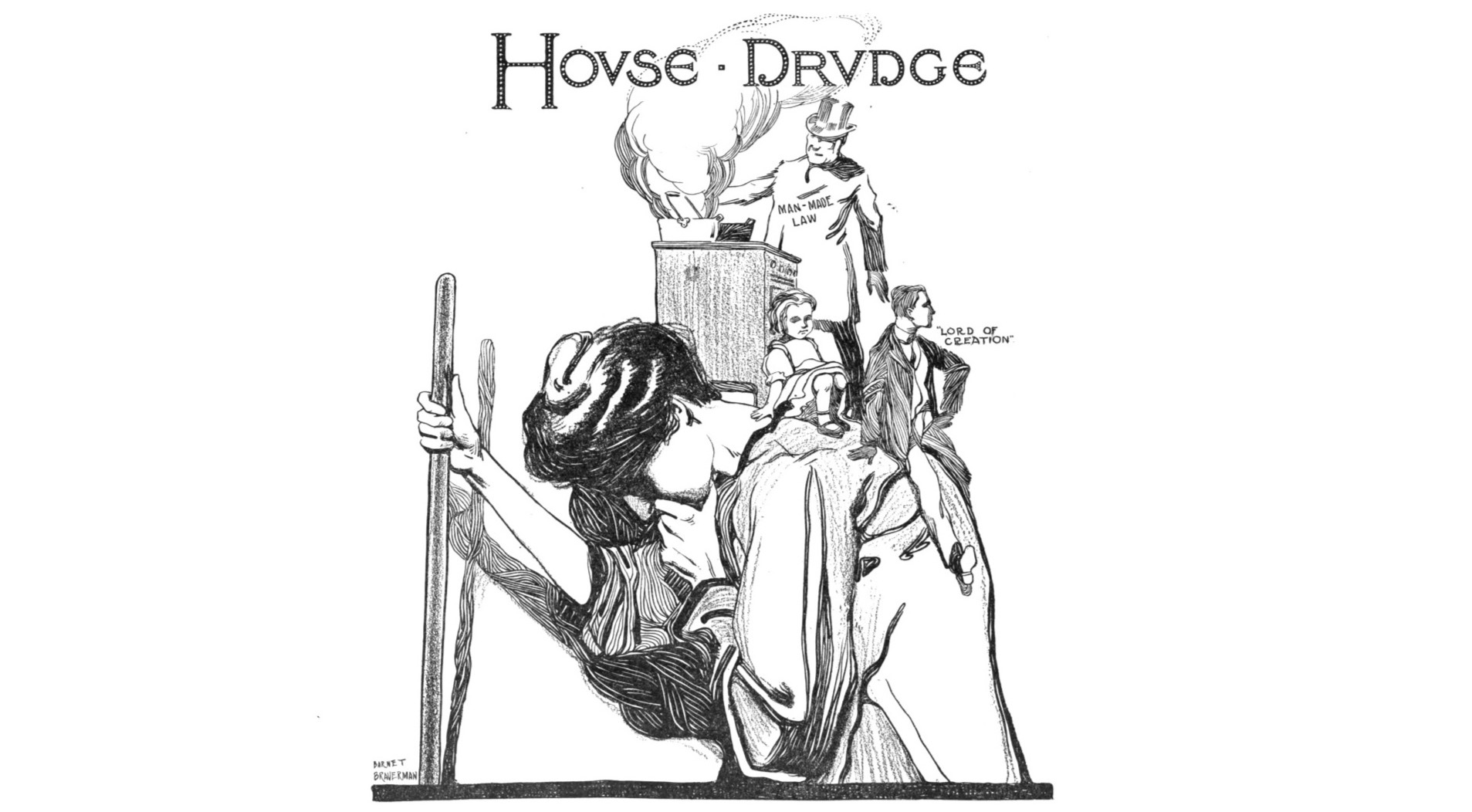
No law enacted limiting the hours doing housework, nor a labor movement demanding it.
‘The Housewife and the Eight-Hour Day’ by Theresa Malkiel from The Chicago Daily Socialist. Vol. 4 No. 189. April 30, 1910.
Over two decades have passed since the Socialists, assembled in International Congress, have first demanded the eight-hour work day. In those early days their action was a mere matter of protest, for the general working hours were, as a rule, from ten upward.
The protest was made because our conscientious comrades realized the great injustice of keeping a person chained to his daily labor the major portion of his working hours. Hence their ringing call to the working class) the world over to rebel against such slavery.
The manifesto was looked upon at first with indifference and, when the Socialists kept up their agitation for it undaunted by the enemy’s derision, the opponents of labor laughed at it as an possible chimera. But gradually, as the years are passing by, they have to swallow the bitter pill. Today many of the skilled trades enjoy the eight-hour work day. And the celebration of the 1st of May–labor’s ratification of that reform, is upheld and revered by millions of workingmen the world over.
But, amidst labor’s gradual triumphs, on the road to shorter hours, there is still left one portion of the working class that cannot celebrate past, nor hope for future victories in that line. And that portion is none other than the average house-wife, or house drudge, the most proper name for her.
Today man’s work is done long before the sun is down, but woman’s work is still never done. Her life is still one continual broom, washtub and pot, needle and tub. She is still a stranger to shorter hours and better pay. On the contrary, the rapid growth of monopolies and the increased cost of living tend to make the house-wife’s lot harder than ever. She can’t afford to buy bread nowadays, it is entirely above her means, so she must bake it. herself. Ready-made clothing costs so much that the submissive house-wife spends her evenings in making up new and, more often, in patching the old wearing apparel. Meat is being sold at the rate of gold and she is compelled to use her whole skill and ingenuity to make some other stuff palatable. And so close has her existence woven itself around these tasks that they are no longer considered labor, but part and parcel of herself.
This fact has been brought home to me very vividly the other day when I, Ike millions of other house-wives, was visited by the census man.
“Who is the head of the family?” asked the government agent.
“Well, that depends what you mean by the head of the family,” said I. “Why, of course, the party who works and supports the family,” replied the man
“But can’t there be two heads, don’t the two work?” I asked, becoming interested and anxious to find out the government’s attitude towards the hard-working, long-suffering and still obedient mule–the house-wife.
Well, yes,” “answered the census man after a minute’s thought. “Provided, the wife goes out working or earns money while being at home.”
And as his time was valuable he commenced busily to record the pedigree of our family. My husband’s name, age and occupation was recorded in full. Then my child’s name, age and her occupation at school. But when my turn comes around he was satisfied with name and age only.
“Don’t you think that I, too, do something the whole day long.” Said I indignantly.
“Well, I can’t help it.” apologized the man. “It doesn’t count unless you earn money.”
I bit my lips in mortification and returned to the house, rebelling more than ever against the present system of society, where the weak, helpless house-wife has to remain a slave of a slave. with no status either politically or economically.
But once more amidst my pots and pans I asked myself a question that has been bothering me since–is it inevitable that the house-wife should plod on her weary road of toil without relief or respite–until the Socialist millennium.
The wage-earning man and woman realize that their suffering and hardships could not be done away with under a capitalist regime, that we need a complete change of our social structure before we can hope to have justice done to the working class. But each man and woman at their trade are, as a rule, eager to buy the latest appliances in the line of tools, in order to lighten their burden. And what is more, they will not hesitate to spend the last dollar to do so. The carpenter will not take the expense into consideration when he is about to buy the new sort of chisel that is to help him in his work. The painter will seek the best brush, the cutter the sharpest knife. All with the excuse that their bread and butter depends upon it.
But the patient house-wife will never dream of buying a fireless cooker, a vacuum cleaner, an automatic washing machine, an electric dish washer or an electric attachment to her sewing machine. It never enters her mind that overtime work should by rights be shared by both husband and wife. And yet–her welfare depends upon these small things, for they would in time help her to reach some hour limit.
The more so that she is really the one in greater need of time. Man has his physical work only to perform, while to the woman is also apportioned the task of rearing and educating the children. A task which requires an unlimited amount of patience, good will calm judgment and a self-contented disposition. All qualities that are simply impossible to acquire amidst constant drudgery.
It is, therefore, only proper that the celebration of the eight-hour work day be made at the same time a universal protest against the house-wife’s double oppression, against her shameful servitude. For ought not the Socialist and the Union man who strive with all their might to gain a reduction of hours for the wage-earning population, also consider the injustice to the average house-wife, who is fairly drooping under the weight of her heavy burdens.
The Chicago Socialist, sometimes daily sometimes weekly, was published from 1902 until 1912 as the paper of the Chicago Socialist Party. The roots of the paper lie with Workers Call, published from 1899 as a Socialist Labor Party publication, becoming a voice of the Springfield Social Democratic Party after splitting with De Leon in July, 1901. It became the Chicago Socialist Party paper with the SDP’s adherence and changed its name to the Chicago Socialist in March, 1902. In 1906 it became a daily and published until 1912 by Local Cook County of the Socialist Party and was edited by A.M. Simons if the International Socialist Review. A cornucopia of historical information on the Chicago workers movements lies within its pages.
PDF of full issue: https://www.marxists.org/history/usa/pubs/chicago-daily-socialist/1910/100430-chicagodailysocialist-v04n159.pdf
 Revolution's Newsstand