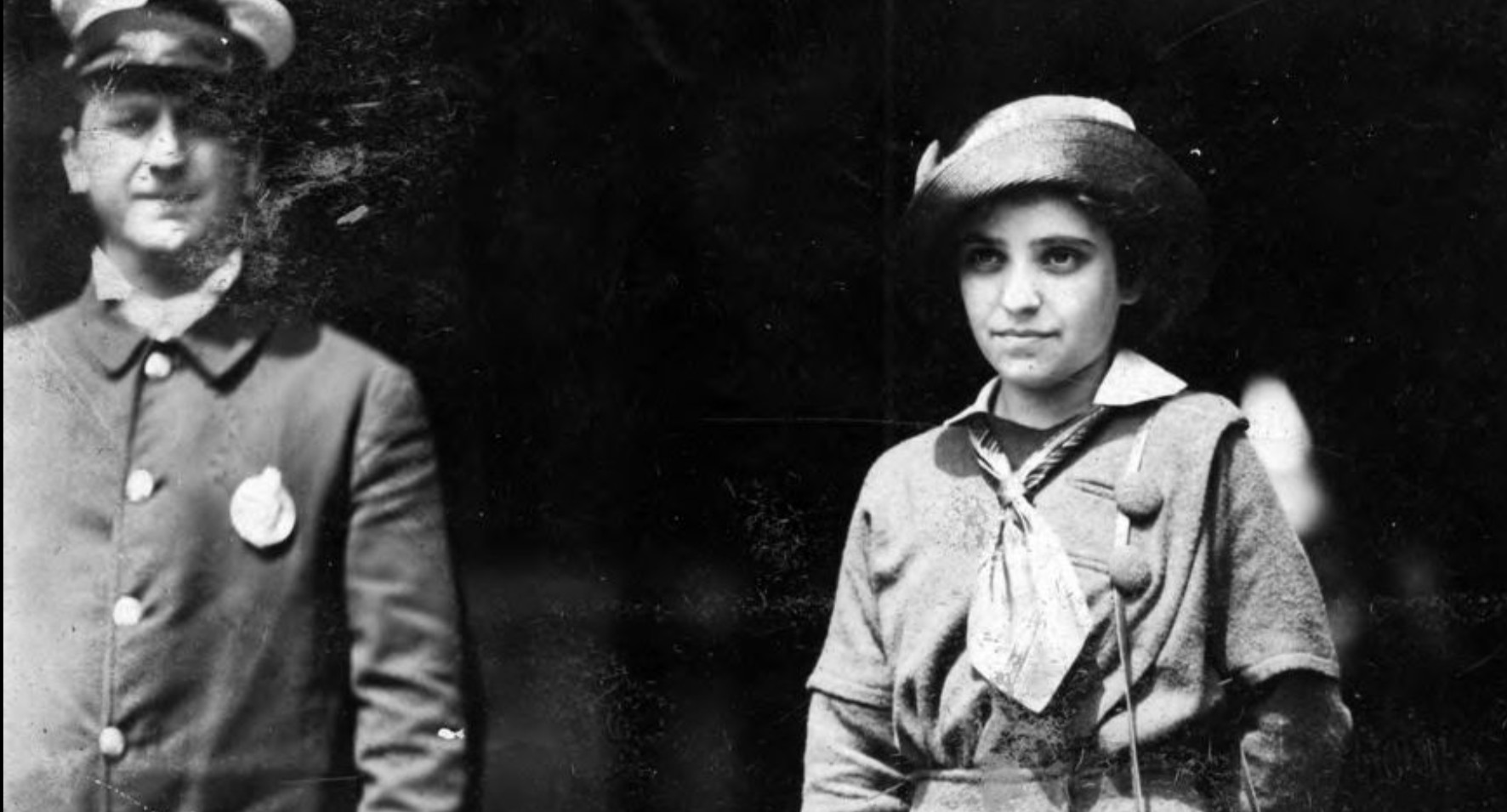
Rabinowitz on the increasing hostility of the Socialist Party toward the I.W.W. after its leadership passed the notorious Section 6, Article 2 designed to prohibit joint membership.
‘A New Antagonist’ by Matilda Rabinowitz from Solidarity. Vol. 4 No. 41. October 18, 1913.
In their mad chase after votes and “respectability” the political socialists have lost their balance, have forgotten their apparent “neutrality” and have flopped over into the reactionary camp of craft unionism.
Since the famous utterance of Samuel Gompers that the socialists want the A.F. of L. to come over to them “body, boots and breaches,” things have been nearly reversed. Sam need never fear now. Exactly the opposite is true. The Socialist Party is making efforts to get into the worn out boots and breeches of the A.F. of L.
To do this stunt successfully, it long ago, started the holy crusade against the heretics within its ranks. Following the inquisitorial Section 6, Article 2, the fathers of the S.P. have literally burned at the stake those who dared to disagree with them as to how the workers shall conduct themselves. Misconduct on the question or direct action is punished by ostracism, very often with suspension. The greater offense of whispering sabotage (not against the ballot box, but against the product controlled by the capitalist class) means banishment from the Socialist Party.
Some time has elapsed since the inauguration of that famous section at the Indianapolis convention of the S.P., and the seed is beginning to bear fruit. All over the country the socialist locals are torn up over these questions. As becomes inquisitorial mandates, inquisitorial methods are used. Charges of heresy are usually supported by the victim’s character assassination and scandal mongering. The results of such tactics are beginning to show. The recent loss of membership in the Socialist Party is stupendous.
It would have been unnecessary to point to these things, were it not the fact that the I.W.W, is made to play a very important part in this constructive work of destruction. It is an open secret now that the leading members in the S.P. charge the direct and indirect influence of the I.W.W. with this turmoil and loss of forces in the S.P.
Wherever I go among socialists I hear indictments from the more prominent members of the S.P., in their efforts to influence the general membership. Those most current are:
“The. I.W.W. used the socialists to collect money for strikes conducted by it, and for all this trouble it caused never even said thanks.”
“The I.W.W. members within the ranks of the S.P. place the importance of economic organization above political action.”
“The I.W.W. contributes nothing to the Socialist party by way of votes, money for the press, etc. The A.F. of L. does. Hence why not work for the A.F. of L.?”
The Socialist Party today is fearing and cringing before the A.F. of L. It has not even the semblance of a revolutionary organization. As it is wont to boast, having taken into its ranks some of the most prominent officials of the A.F. of L., these men are now using their influence in shaping the policies of the Socialist Party.
With very few exceptions, the socialist press is a staunch advocate for the A.F. of L. Papers and periodicals that disagree with this reactionary policy are usually suppressed and excluded from socialist locals. One of the most bitter fights the writer has participated in was fought in the socialist local at Bridgeport, Conn., between the industrialists and a gang of trade union officials, who used every means to suppress the International Socialist Review. It has finally been excluded from that local, and has since been officially put on the blacklist by the S.P. in Connecticut. One need only go over the personnel of those who fought most bitterly against the Review and its advocacy of industrial unionism to guess the motives for their antagonism. One or two officials of the C.L.U., business agents of several craft unions, a socialist councilman with a turn for the “respectable,” an aspiring newspaperman who has since become an editor of a capitalist paper, and several other disciples of Robert Hunter, made up the grand old guard.
The editorial policy of the New York Call is well known. Its stand on the I.W.W. is pronouncedly antagonistic. The Milwaukee Leader leads in advocating A.F. of L. unionism. The official organ of the national Socialist Party is continually suffering from violent attacks on the I.W.W.
Everywhere, Socialist Party members, locals, papers, are making overtures to the A.F. of L. and either by innuendo or openly are trying to discredit the I.W.W.
The most flagrant violation of every socialist principle is being encountered by the writer at present in Fitchburg, Mass. Here, in an attempt to organize the textile workers, the organizer is met by the open opposition of socialists. With a large Finnish population, the Finnish socialist paper being published here, the leaders in the socialist local take every advantage of denouncing the I.W.W. The editors in their columns are daily urging the textile workers to join John Golden’s union, pointing out the advantages of it and the A.F. of L. generally. Meetings are called and these same editors make speeches, warning the workers against the I.W.W., and distributing membership blanks for the Golden organization. One of these socialist editors told me openly that he intends to fight the I.W.W. and will use every means to do it. One of the means is the official organ of the Finnish socialist organization affiliated with the S.P.
Thus the I.W.W. organizer’s efforts in awakening the workers’ consciousness to industrial solidarity, meet the opposition of not only the capitalist class, but of an ever-increasing number of socialists,
A considerable minority has already openly allied itself with the job holders in the A.F. of L. and is doing its utmost to fight the only organization which is trying to unite the workers on the economic field, that they may emancipate themselves from wage slavery.
The most widely read of I.W.W. newspapers, Solidarity was published by the Industrial Workers of the World from 1909 until 1917. First produced in New Castle, Pennsylvania, and born during the McKees Rocks strike, Solidarity later moved to Cleveland, Ohio until 1917 then spent its last months in Chicago. With a circulation of around 12,000 and a readership many times that, Solidarity was instrumental in defining the Wobbly world-view at the height of their influence in the working class. It was edited over its life by A.M. Stirton, H.A. Goff, Ben H. Williams, Ralph Chaplin who also provided much of the paper’s color, and others. Like nearly all the left press it fell victim to federal repression in 1917.
PDF of full issue: https://www.marxists.org/history/usa/pubs/solidarity-iww/1913/v04n41-w197-oct-18-1913-solidarity.pdf
 Revolution's Newsstand