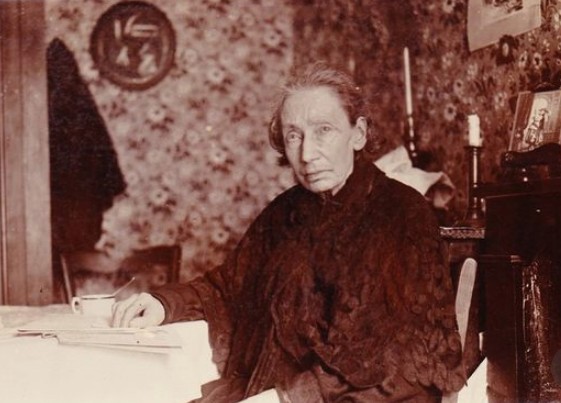
‘Louise Michel: Heroine of the Revolution’ by Max Baginski from Mother Earth. Vol. 16 No. 1. March, 1916.
IT IS a great relief to turn one’s eyes from the driven war-heroes to the free-spirited heroes of the Revolution. It deepens the sympathies that go out to the sufferers of all countries, it makes one more determined to keep up the spirit of universal brotherhood and the Internationale.
The heroes of the war may boast of their iron crosses, orders, and eagles. These rewards for efficient butchery can not remove the stigma from them, that they are fighting, like people in bondage and servitude, the battles of their own despots. Behold on the other hand, the heroes of the Revolution, agitating, fighting, dying to free humanity from, tyranny, The enthusiasm that makes their hearts beat quicker is their own enthusiasm, the convictions and ideals which inspire them are deeply rooted in their own Personalities.
The Russian revolutionists who executed Czar Alexander II. on March 13, 1881, were such heroes. Ever to be remembered are also many of the heroes of the Paris Commune of the 18th of March, 1871, butchered by the soldiers of the provisional government of May, 1871.
The head of this government was Thiers, a typical bourgeois, who was much more afraid of the rebellious Proletariat of Paris than of Bismarck, whose armies had closed in on the French capital. To disarm the uprising in Paris, to kill off as many fighters of the Commune as possible, and then to bring about an “honourable peace” with Prussia, was his most cherished desire.
At this time several leaders of the Commune were visited by a teacher whose name was Louise Michel. She told them that she was ready to kill Thiers and that she was willing to give up her own life for that purpose. She was well known as an ardent revolutionist and enthusiastic supporter of the Internationale but the men she approached persuaded her not to carry out what she Proposed.
Later Louise Michel joined the forces on the barricades, dressed like a man, fighting, shooting, doing picket duty. She was one of the communards at the cemetery Pere la Chaise, where the Commune fought its last battle.
Louise Michel managed to escape but upon hearing that her mother was arrested and held as hostage, she gave herself up to the relentless cruelty of the triumphant authorities who had commanded the soldiers thus: “You can’t kill enough of them”—meaning the workingmen of Paris. (By the way her mother had not been arrested).
With many others Louise Michel appeared before the court martial. In addressing the court she said:
“You are now the victors, but I tell you, in the end the social revolution will be stronger than you. I demand that you lawfully murder me as you have lawfully murdered Ferre and others. The lead which pierced their breasts I want to pierce my breast also. If you are not cowards kill me. Should you decide not to do it then I will preach hatred against your laws and your society as long as my life lasts and I will cry out for revenge against the murderers and executioners of the Commune.”
She was sentenced to hard labor and to be deported to New Caledonia. She remained there ten years, enduring the hardships of the exile like a stoic philosopher, nursing sick comrades, sharing her meagre provisions with the needy, encouraging the faltering and despairing. She got into friendly relations with the oppressed, unfortunate natives, collected their legends and folk lore which she published in “Légendes Canaques” and Contes Newkalédoniens.”
Meanwhile a movement for general amnesty was carried on in France, or rather, in fact, all over Europe. Louise Michel especially had many friends and even her worst enemies did not deny her absolute sincerity. It was hinted to her that she probably would be pardoned soon. In answer to such rumors she wrote a letter to the government in which she said:
“I don’t want your pardon. What I ask is a general, unlimited amnesty for all my comrades. I will not leave New Caledonia until I am sure that not one of them will be left there.”
When finally a general amnesty was granted and Louise Michel was about to board the steamer that would take her back to France, thousands of natives bade her a tearful good-bye.
In 1883 Louise Michel was sentenced to a prison term of 6 years. The court held her responsible for a raid upon a few bakeries during a demonstration of the unemployed.
Henry Rochefort was one of the witnesses at the trial. He had known her for a long time and was deported with her. His cell was near hers and he had the Opportunity to observe what type of a woman she was. She would give away the last cent she had, her shoes and stockings, the bed she slept on, she would deny herself everything if some sick or weak fellow-creature was in need.
Louise interrupted Rochefort’s testimony several times, saying: ‘I can laugh when I am scolded and calumniated, but I can not bear being praised.”
During her long imprisonment her mother whom she loved with great tenderness died.
“I had two things to live for,” she said, “my mother and the Revolution. Now only one is left me, the Revolution.”
When she left prison she had become one of the most beloved and popular characters of the French people.
The reactionaries knew that and tried to counteract her dangerous popularity by saying: “Louise is a good soul, but a little crazy.”
It seems to be true that a scheme was under way to railroad her to an insane asylum and it was on account of such designs that her friends advised her to go to England for a time, This she did, but prison life, privations, old age (she was born 1830) began to tell on her naturally very robust and healthy constitution. She had to go back to Southern France where she again took an active part in the revolutionary propaganda. In February, 1905, she went to Marseilles to speak at a meeting. She died in that city on the 21st of February.
Mother Earth was an anarchist magazine begin in 1906 and first edited by Emma Goldman in New York City. Alexander Berkman, became editor in 1907 after his release from prison until 1915.The journal has a history in the Free Society publication which had moved from San Francisco to New York City. Goldman was again editor in 1915 as the magazine was opposed to US entry into World War One and was closed down as a violator of the Espionage Act in 1917 with Goldman and Berkman, who had begun editing The Blast, being deported in 1919.
PDF of full issue: https://archive.org/compress/mother-earth/formats=TEXT%20PDF&file=/mother-earth.zip
 Revolution's Newsstand