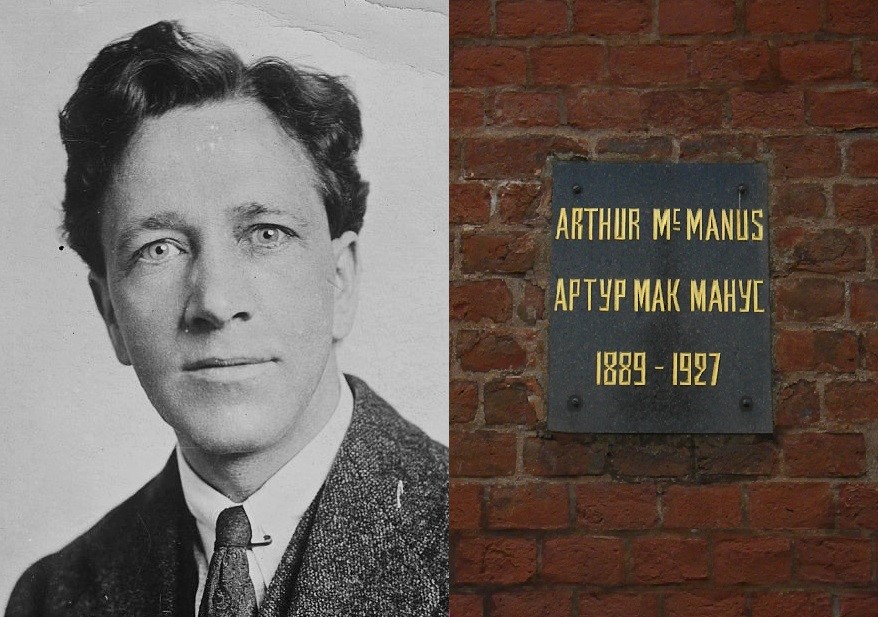
Charles Ashleigh remembers his friend and comrade. Arthur MacManus was Introduced to revolutionary activism and a life-long interest in workers’ education at Marxian Educational Classes given by the Socialist Labour Party in Glasgow during the early 1900s. A founder and central figure in the first years of British and International Communism, MacManus would also serve on of the Executive of the Communist International. MacManus died on February 27, 1927, his ashes interred in the Kremlin Wall.
‘Personal Recollections of Arthur McManus’ by Charles Ashleigh from the Daily Worker. Vol. 4 No. 54. March 17, 1927.
I first met Arthur McManus when arrived in England, in 1922, after being deported from the United States, at the expiration of a prison sentence. The annual Congress of the Communist Party of Great Britain was being held in the town hall of St. Pancras, in London, and McManus was chairman. At that time, he was also chairman of the Party–an office that was subsequently abolished. He has been a member of the Central Executive since the Party’s formation.
After thirteen years’ absence from England, including three years in an American prison, I felt a stranger in London, the city of my birth. But the welcome I received from the British revolutionists speedily dispersed any sense of strangeness. And, among those who tried so hard to make me feel that I was indeed among comrades, was McManus. He was busy and harried at the time, and not in the best of health, but he had time and inclination for the cordial extension of his friendship to the returned exile. Since those days, we have been close personal friends.
Striking Figure.
My first impression, I remember, was that of surprise at his shortness of stature. His face I knew from photographs; but I had not imagined that he was so unusually short–about five feet, two inches, I would guess. Yes, this detracted in no way from the effect of decision and mastery, when he was on a public platform. His sincerity, and the confidence born of assured knowledge, made him a striking and commanding figure, despite the deficiency in height. During the rather difficult congress of 1922–these were the earlier formative days of the British Communist Party–he showed an easy skill in directing the deliberations and preserving order.
He was “Mac” to all his friends; and he had many friends. There was at times something almost wistful about this man of young middle age–and then that wistfulness would be gone, and an elfin humour would take its place. His sensitive face reflected immediately the swift changes of mood and thought. And to this, add a certain quality of youth–a boyishness which, one knew, would always be with him, throughout the years. There was the quick emotional variation, and the readiness of repartee and wit, which perhaps were an inheritance from his Irish forebears. But this quality of elfishness–this capacity for mischievous banter and for play–in no way appeared to affect the keenness and steadiness of his political reasoning. He had a background that was invaluable: a thorough theoretical Marxist training, and practical experience of proletarian life and the working class struggle. Trained in the school of the Socialist Labor Party,–which gave its best Marxist writers and students to the Communist Party–in Glasgow, his native town, he had the advantage of graduating in what was then the best school of revolutionary economics in Britain.
In Wage Disputes Early.
As an engineer, a wage-earning machinist, in the great industrial centre of the Clyde, he early became involved in wage disputes, and won to a position of trust among his fellow trade unionists. He was prominent in the shop stewards’ movement, and, during the war, was one of those, with Gallacher and others, who organized an effective resistance to the attacks of Lloyd George. So effective, in fact, that the British government deported him and several colleagues from Glasgow.
This early experience of the industrial struggles of the workers, combined with excellent theoretical training, fitted McManus for the part he was to play in the formation of the Communist Party of Great Britain. The Russian Revolution, the triumph of the Bolsheviks, and the establishment of the Communist International, this was the insuperable logic of events which his mind–elastic, dialectic and earnest–immediately acknowledged and proclaimed.
Of his work, both in the Communist International, as a member of the Communist International and as a leader in the British Communist movement, I need not speak here. I wish merely to give some inkling of the personality of the man, whose death is such a loss to the workers of all countries.
Abounding Mental Energy.
Conspicuous in McManus was his abounding mental energy, and the versatility of his interests. Besides his political work, and his organizational labours, he had an uncommon knowledge of literature and the arts. During one of those long evenings in London, when a group of comrades and sympathisers were gathered in somebody’s apartment for supper and talk, the conversation would range widely. Perhaps the subject would be the occupation of the Ruhr, and “Mac” would devastate, with masterly ease, the arguments of some learned liberal, who had been invited to meet him. And, without effort, from this, he would turn to a consideration of modern poetry; and he would show, with copious quotation, how this or that “school” represented principally the decay–the partly conscious desire to escape from reality–of the middle-class intelligentzia of Britain. In discussing fiction, he was equally at home. And then, perhaps, a casual remark from someone would reveal that our “Mac” also possessed an unusually complete layman’s knowledge of astronomy or biology!
It was this wide acquaintance with the culture of our times which sometimes won McManus friends from those outside the Communist camp–writers, artists and others, who, while not opposed definitely to Communism, thought but little at all on political subjects. Often, these good people would try to adopt McManus as one of their own clan. “He is not like the rest of the Bolsheviks,” they would say hopefully, after the first half-hour of acquaintance, hearing him discuss a new symphony, just then being performed in London. Usually, of course, they had never met the “rest of the Bolsheviks!” But a smashing disappointment awaited them. “Mac” was just feeling around his man; and then, at some remark by the hapless intellectual, “Mac” would pounce ferociously upon him, and pin down fallacy after fallacy with the steel points of his relentless Marxist logic. And, besides dialectics, there would be bitter passion and derision in his words, if the comfortable intellectual ventured some remark anent the workers which revealed the snobbishness of the academic.
Knew Life of the Poor.
Born in one of the poorest quarters of Glasgow, McManus knew the life of the poor, the slow crucification of the proletariat on the cross of profit. And he was always conscious of this. The passion of protest and pity, which possessed him, when speaking of the children of the workers, and their limited, unfulfilled lives, was wrought from experience. His eyes had seen a thousand tragedies, and his soul was seared with suffering. In the midst of his enjoyment of a painting, a theatrical performance, or of beautiful landscape, he would remember the millions who could not enjoy; and he would point out how the enjoyment of beauty is mainly a class privilege.
Had Gift of Friendship.
“Mac’s” good nature, his gift for friendship and sympathetic observation, extended even to the least of creatures. In the corner of his room at the hotel was a small sack of flour, part of his regular ration in those earlier days, just before the “payok,” or food ration was abandoned, with the famine’s end. This naturally attracted the mice, and “Mac” liked to watch the little creatures scampering out from their burrows, and nervously attacking the flour. One of the mice, he singled out, for its courage and impudence. “It doesn’t care a damn for me,” he would relate. “It just sits up on its hind legs, in the middle of the room, curls its whiskers, and looks me straight in the eyes. I bet you it’s a shop steward of the other mice!”
An inexhaustible capacity for enthusiasm was one of McManus’s chief traits. Perhaps it would be a revolutionary play, at Meyerhold’s Theatre; or a visit to a Moscow factory; or a trip to Tver, to visit the military establishment there; or a banquet given by the metal workers of Moscow–they never forgot, and “Mac” never forgot, that he was a metal worker, and old engineer! Whatever the occasion, he would have the fresh curiosity and complete enjoyment of a boy, coupled with an understanding of the political significance of the event. He worked hard in Moscow, and, on the rare occasions of his leisure, he played hard, not sparing his frail body in the least. His health was never very good; and, all the time, his untiring energy and interests were burning this body of his–this body which would sometimes get tired, despite the flogging of his will. And so he died. The overstrained heart gave way. He died still young, with many more years to give to the workers’ cause. He died after having lived to see, and to rejoice in, the general strike, the greatest demonstration of workers’ solidarity in Britain, despite its surrender by leaders who will one day pay the price of their treachery. He lived to see the party which he loved grow, double its members in a few months and to see the great International, at whose councils he had assisted, established as the defense, leader and hope of millions of the oppressed. He died a few days after returning from the first Congress of the Oppressed Peoples, at Brussels, where he had heard, and greeted, the articulate voice of China’s rebellious masses.
His name will be honored by thousands of workers, in Britain, when the names of those who capitulated, during the general strike, are lost in obloquy and contempt. He was a soldier and leader in the class struggle, valiant and alert; and he was our dear comrade.
He lies now, sleeping. We who were inspired by his words and example, we who loved him as our comrade, shall make his name perpetual, by building it into the fabric of the British Workers’ Republic.
The Daily Worker began in 1924 and was published in New York City by the Communist Party US and its predecessor organizations. Among the most long-lasting and important left publications in US history, it had a circulation of 35,000 at its peak. The Daily Worker came from The Ohio Socialist, published by the Left Wing-dominated Socialist Party of Ohio in Cleveland from 1917 to November 1919, when it became became The Toiler, paper of the Communist Labor Party. In December 1921 the above-ground Workers Party of America merged the Toiler with the paper Workers Council to found The Worker, which became The Daily Worker beginning January 13, 1924.
PDF of full issue: https://www.marxists.org/history/usa/pubs/dailyworker/1927/1927-ny/v04-n054-NY-mar-17-1927-DW-LOC.pdf
 Revolution's Newsstand