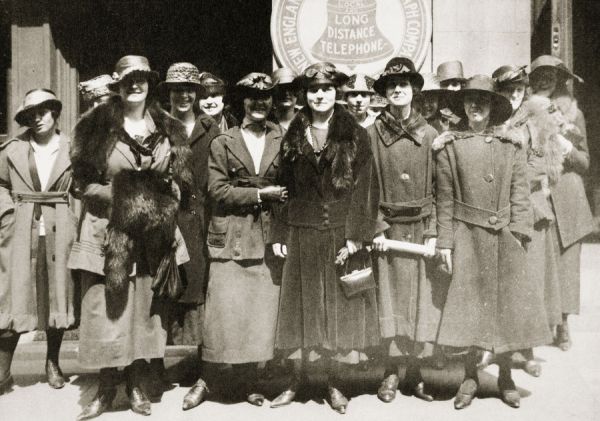
8,000 New England workers, largely young women, with a successful struggle, part of the 1919 strike wave, to win the union and better wages.
‘The Telephone Strike’ by Walter C. Hunter from One Big Union Monthly. Vol. 1 No. 6. August, 1919.
In some respects, the strike of the New England telephone operators was one of the most interesting I have noticed. On the morning of April 15th, after much futile experience with Burleson red-tape, some 8,000 girl operators of all the New England states except Connecticut, struck for higher wages and for six days, save for a little emergency police and fire device, the telephone was dead. It was one of the most completely successful tie-ups any striking organization ever accomplished. Imagine what it meant to a city the size of Boston not to able to use the phone for a week!
A day or two after the girls went out 12,000 electrical workers comprising the construction department of the telephone company also struck. The girls were obviously “American,” notwithstanding their origin, and the public was with them. But it must be admitted that Miss Julia O’Connor and her assistant ably led them. The picketing of the girls was uninterfered with and they were energetic, capable and resourceful.
For the first time in a Massachusetts labor dispute there was a slight evidence of solidarity on the workers’ part. The hotel waiters immediately announce that if strike breakers were brought to the hotels they would go out on sympathetic strike.
Efforts on the part of strike-breakers to get taxi-service were futile, as the drivers said that as union men they could not carry strike breakers. In one case several strike-breakers and their police escort boarded a Cambridge car, but the pickets informed the motorman of the nature of the passengers and he refused to run the car. The old conservative labor union began to talk sympathetic strike, and the telegraphers realizing they were essentially strike-breaking, prepared to go out. Gov. Coolidge, a stand-pat Republican, asked Burleson for permission to take over the service and run it during the emergency; all New England was beseeching Burleson to do something; the chambers of commerce were cabling Wilson and crying to Washington to settle the thing; but Wilson passed the buck to Burleson and Burleson refused to budge. Finally the mayor of Boston went to Washington and convinced Burleson that he was starting something big; so that gentleman sent his first assistant to Boston to settle the trouble.
Though the company offered $8 a day to strikebreakers, strike-breaking was practically confined to the upper classes. Different Red Cross branches jumped in to man some of the exchanges, but a yowl of protest went up and the New England manager of the Red Cross ran front page advertisement for several days in the newspapers stating that the Red Cross was not organized for strike-breaking purposes and that the Red Cross workers should remain neutral. Society women here and there were strike-breakers, the well-known anti-suffrage officer Mrs. Balch among that number. Boy scouts also were reported to have done some strikebreaking. But perhaps the larger numbers came from Smith College and from Harvard, Tech., etc. Altogether the strike-breaking was done by those naturally antipathetic to labor. At the same time it should be said that in Boston strike-breaking was done at the risk of life, as mobs surrounded the exchanges and a man-hunt commenced whenever strike-breakers, or in fact anyone else, came. out unescorted. Several men, some of whom probably had nothing to do with the strike, were brutally beaten to insensibility. Some of the best work in this respect was done by sailors.
The strike proved conclusively that everyone in New England detests Burleson and desires his removal. Big Biz was as clamorous for this as the workers. Burleson has just one friend—the man who is responsible for his appointment and for his remaining where he is—Woodrow Wilson. Perhaps Burleson will stay long enough to pull the dynasty down with him. All the evidence the girls revealed of their long dealings with the man show that he is essentially a bureaucrat, and a man of duplicity. Some revelations, such as his refusing to remove his hat when receiving the delegation of girls, are petty; others such as Congressman Gallivan’s statement that Burleson changed Tumulty’s telegram to the strikers, and Miss O’Connor’s charge that telegrams she sent to locals in the morning notifying them of a meeting were held up till night, so that the girls would get the messages too late to attend, are more serious.
Burleson asked the girls to return to work while their demands went thru a certain red-tape formula which is his idea of arbitration while they were on strike. Finally Burleson sent his man and, after more than 24 hours of discussion by all interested parties, the issue was compromised by granting 50% of the strikers demands; the minimum wage being increased from $8 to $10 and the maximum wage from $16-to $19. The electrical workers got an increase of from $3 to $4 a week. On May 1 phone rates to the public were raised to cover the increases.
Studying this strike one observed a growing sense of solidarity. On the one hand is the growing consciousness of those who work that all who labor have something in common and the acts of those who are working do help or hinder those who are on strike. They are beginning to feel that it is not right to do anything which might prevent strikers from succeeding. Something of this sense of solidarity and loyalty to one’s class was evident in this refusal of some worker’s to have anything to do with strike-breakers and in the discussion of others with regard to sympathetic strikes. On the other hand there was that almost instinctive act of the socially elect to defeat labor by strike-breaking. It was not anything pre-concerted or planned but simply an intuitive recognition of the big fundamental issue over which all men are gradually dividing. And as always where there is something vital to us at stake there was intense feeling aroused. This little strike gave evidence of growing inter-class bitterness and of the feeling that in these isolated struggles there is nothing less involved than the question of mastery of the earth.
It now becomes clear that just as long as the present owners and managers of the earth can dictate to its masters there will then remain but one logical thing for the masters to do, and that is abdicate! For where the control is there is also the power.
One Big Union Monthly was a magazine published in Chicago by the General Executive Board of the Industrial Workers of the World from 1919 until 1938, with a break from February, 1921 until September, 1926 when Industrial Pioneer was produced.
Link to PDF of full issue: https://archive.org/download/sim_one-big-union-monthly_1919-08_1_6/sim_one-big-union-monthly_1919-08_1_6.pdf
 Revolution's Newsstand