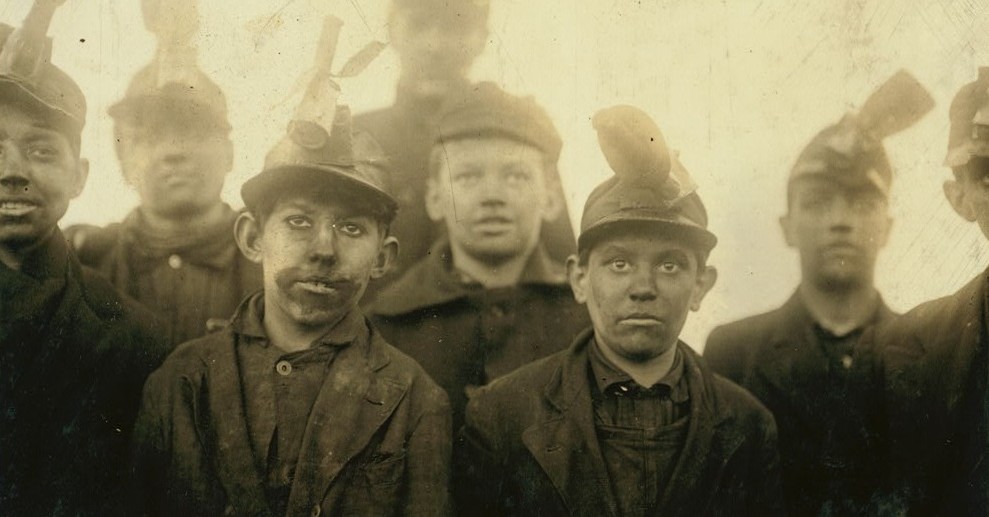
Eastern Pennsylvania miners adrift in a strike; opposed to the Lewis U.M.W.A. leadership many locals broke away in the late 1920s with more than a few being taken over by dubious elements and militants attempt to unify the opposition to the new regime.
‘Pittston Miners Strike Again’ by Jack Lee from Labor Unity. Vol. 2 No. 11. December, 1928.
After the article below was written, McGarry appeared before a mass meeting of 3,000 Pittston strikers at Browntown, Nov. 19, and openly advised them to go back to work and lose their strike. McGarry denied the floor to Anthony Minerich, National Executive Board Member of the National Miners Union, but Minerich got the floor, nevertheless by the unanimous demand of the miners there, and denounced both the Lewis union and McGarry’s misleadership, advising the strikers to stand firm. At the end of his stirring speech the strikers overwhelmingly repudiated McGarry, and declared for continuing the strike under leadership of their strike committee, organized by Minerich.—Editor.
THE militant miners of Pittston, in the anthracite region of eastern Pennsylvania, are out on strike against the contractor system. The contractor system in these fields is a plan by which certain petty bosses, hired other miners and made a profit on them. These contractors stand between the masses of the men and the companies. In the past, and still in the Lewis union, these contractors were union members, and dominate the union policy. They were the strength of the old Lewis administration in District 1, the Anthracite, that of Cappellini, they are the strength of the new Lewis administration of John Boylan, placed in power after Cappellini had completely discredited himself, and it was during the struggle of the rank and file of the miners at Pittston against the contractor system that their leaders Lillis, Campbell, Harris were assassinated by Lewis gangsters during the winter and spring of this year. Campbell was president of Pittston local of the United Mine Workers of America, elected before the formation of the new union, by the progressive forces there.
Misleaders Arise
The present form of organization of the strikers in Pittston is that of the “Anthracite Mine Workers of Pennsylvania”, a local independent union, under the domination of Frank McGarry, who is the sort oi a leader who seems to believe in frequent votes as to whether the strike should be called off, strict subservience to the dictation of the local mayor and police, incorporation of his union, high salaries for officials, and sectarianism, though many of the members of the union want to unite with their brother miners of the soft coal region in the National Miners Union.
Even with this equivocal leadership the miners oi this vicinity are fighting hard. At mass meeting held in a little village called Browntown, outside of Pittston, thousands of miners voted unanimously eight times during the same meeting, against going back to work except on their own terms, the most important of which is abolition of the contractor system.
The Pennsylvania Coal Co., whose three mines Numbers 5, 6, and 14 are the center of controversy in Pittston, is defending its contractor policy. Mayor Gillespie, of Pittston, a coal company official pure and simple, and the local judges, have combined to prohibit meetings in Pittston. The mayor issued a statement to the press, in answer to the demand made by the American Civil Liberties Union that meetings be allowed, announcing that he “accepted the challenge of the Civil Liberties and free speech or not, no strikers” meetings would be allowed in Pittston Also a flood of usual slanders against strikers.
Since this prohibition of meetings in Pittston, the miners have been meeting outside of the town. Now the state troopers are breaking up these meetings, and along with it goes a campaign of arrests and convictions…and murder.
One Day’s History
For example, here is what happened on Nov. 14. In the morning the police went up and down the streets of the town telling miners to stay in their houses, or they would be clubbed. Those who came out were clubbed. In the afternoon was the trial of Sam Licata, accused by a mine foreman of having spit in the foreman’s face. He had had a preliminary hearing before Mayor Gillespie, who refused to let more than one defense witness out of a dozen testify, on the rather unique grounds that “it is no use to hear them, they will all say the same thing anyway.” Licata was bound over on a thousand dollars bail and five hundred dollars peace bond.
The International Labor Defense got a lawyer and filed habeus corpus proceedings to force a hearing before a judge. The trial was turned into a meeting in which the judge lectured the miners on obeying the law. “If a man hits you with a blackjack”, said he “have him arrested.”
“What if the state police club me, for nothing?” said one of the miners in the audience.
“Well, you have a lawyer there who went to school with me”, said the judge, “let him advise you.
Licata’s fate was to be again remanded on a thousand dollars bond. That was in the afternoon. About 7:30 in the evening, 5,000 more walked up the road over which Campbell and Riley rode to their death and came to a little schoolhouse outside of the town to hold a meeting. The news passed around that a few minutes before the meeting opened two pickets were shot down by a Lewis-Boylan scab working in the mines. A scab called Joe “Greeny” was beating up a picket, the father of Jacob and Mike Loyack, 21 and 23 years old, respectively and they came to his assistance. Another scab in ambush nearby then shot John through the abdomen. He died a few hours later. The murderer also shot Mike in the thigh, he is in a hospital.
The McGarry leadership, neither then at the mass meeting, nor later made many attempts to rally the miners to militant defense, or effectively to protest against this latest of the many Pittston murders. At this particular meeting McGarry announced that the session must be cut short because the state police are going to break it up, and then spoke especially to the miners of No. 9, saying, “Boys, you can’t win without me, and I can’t win without you”. It is evident that the No. 9 bunch were not any too enthusiastic about McGarry leadership.
Later while Sam Licata was speaking, the state troopers, ten of them in a truck, descended upon the meeting, shouting “Break it Up!” The meeting dispersed.
Miners Solid; McGarry Hollow
It is obvious that there is good sentiment for winning this strike, and that the killings have not intimidated the miners of Pittston. But it is also certain that the McGarry misleadership, cowardice, and eagerness to collaborate with the company and the mayor will not help any in winning the strike.
For example, several days ago Anthony Minerich, National Executive Board Member of the National Miners Union, now in the Anthracite, secured a promise from the American Civil Liberties Union that they would defend the right to public assemblage and free speech in Pittston. The miners demanded of McGarry that he co-operate with Minerich in holding meetings. McGarry had a conference with the sheriff, and Minerich demanded to come in. The sheriff refused to admit him; the conference consisted of McGarry, the sheriff, and a certain Captain Rogers of the state police. After it broke up, the sheriff and the captain saw representatives of the coal company. The next morning word spread around that McGarry said the best thing to do would be to go back to work. At eleven o’clock Minerich saw McGarry coming out of the court house, where the conference with the sheriff had been held the night before. At two o’clock in the afternoon the meeting was held at Brownsville. The sheriff spoke, counseling “order” and moderation. Next Harris, McGarry’s lieutenant, opened his speech by putting the question of going back to work to a vote. It was voted down. Harris spoke a few minutes in a pessimistic vein, and again put the same vote. Again it was voted down. No less than eight separate votes on going back to work were taken, while the McGarry gang spoke to the crowd. Every time miners insisted on continuing the strike.
Minerich Speaks Up
Minerich seized the floor because of the demand among the miners that he be heard, and against McGarry ‘s will He attacked Lewis, Gillespie, and the coal companies, declared that the National Miners Union was in solidarity with the strikers, and he would have gone on, with further arguments, had not the McGarry officials cut down his time. Minerich ended, saying: “They won’t let me speak any more”, and afterwards the miners gathered in groups, saying, “What the hell’s the matter? Isn’t this just the sort of thing we wanted to hear from the soft coal miners? Why did they stop him?”

This in general is the situation. The miners will not follow Lewis. Shady leaders, with doubtful policies have created a certain local following, and are forced by the militancy of the miners to lead strikes. They lead them badly, cowardly. Thus the McGarry group never set up a strike committee in Pittston. The first thing that Minerich, representing the National Miners Union, did, when in contact with the situation, was to organise a strike committee of fifty from among the militant rank and file. The strike committee was divided into subcommittees in charge of picketing, relief, defense, etc.
Seventy-eight McGarry-Harris-Brennan local unions, that is those which sent delegates to the special convention at Scranton in May, have cut loose from his organisation, and call themselves “neutral” at present. Only two locals are still with McGarry. Lewis organizers are trying to force the check-off through in such places as Silverbrook, where they make arrangements with the companies that miners who do not carry U.M.W.A. badges will not be allowed to work. They also try to drive out the officials of independent locals through mandamus proceedings and injunctions in the courts.
In this chaos the National Miners Union comes with a clear cut program of union on a national scale, no half-hearted leadership by the McGarry’s and their sort, no truckling to the Lewis-Boylan-operator combine. The N.M.U. invites the militant miners of the Anthracite to aid in a real struggle to win organization, freedom from contractors, and improved wage rates and working conditions.
Labor Unity was the monthly journal of the Trade Union Educational League (TUEL), which sought to radically transform existing unions, and from 1929, the Trade Union Unity League which sought to challenge them with new “red unions.” The Leagues were industrial union organizations of the Communist Party of the United States (CPUSA) and the American affiliate to the Red International of Labor Unions. The TUUL was wound up with the Third Period and the beginning of the Popular Front era in 1935.
PDF of full issue: https://www.marxists.org/history/usa/pubs/labor-unity/v2n11-w30-dec-1928-TUUL-labor-unity.pdf
 Revolution's Newsstand