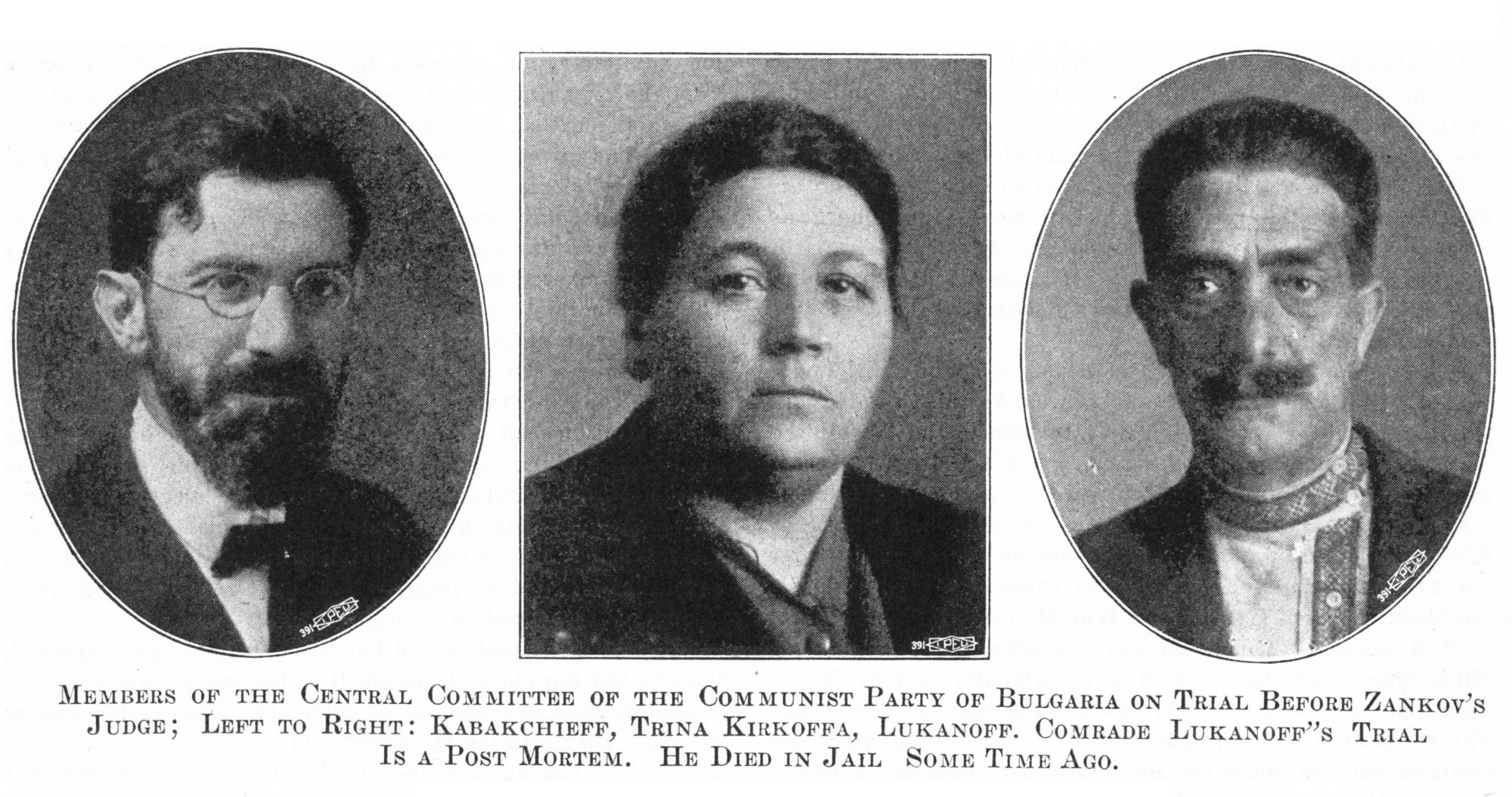
Thurber Lewis speaks to the orgy of murder engaged in by the Bulgarian ruling class against the workers movement in the aftermath of 1925’s Sofia cathedral explosion.
‘Bulgaria: The Hell of History’ by Thurber Lewis from Workers Monthly. Vol. 4 No. 11. September, 1925.
“Many persons are unable to realize the tragedy of certain contemporary events. When they are shown the actions of a government whose other face is dignified and smiling, they shrug their shoulders and say: ‘That’s impossible! Such things might have happened once, but not in our time.’ Now we must very definitely recognize this fact: never have crime, cruelty, attempts upon life and liberty been so widespread as in our time, which is truly the hell of history.” HENRY BARBUSSE.
WHEN Barbusse wrote the above, he referred directly to the white terror that has left a trail of blood and horror from the Baltic to the Black Sea. Latvia, Esthonia, Poland, Hungary, Roumania, Jugo-Slavia and Bulgaria–to the revolutionary worker these names cannot be spoken without conjuring up terrible visions of murder, torture and prison. The prize butcher of them all is the military government led by Professor Zankov, minister to King Boris, ruler of Bulgaria. The name of that black-bearded pedagogue will take its place in history next to that of Caligula and Torquemada. On his murderous head and therefore on the heads of the bankers and exploiters for whom and in whose name he kills, rests the black stigma of foul and willful mass slaughter. The dead bodies of thousands of his own countrymen, workers, peasants, women and children cry out against his infamy in the name of the revolution for which they gave their lives.
What was the prelude? An American observer, not in the least sympathetic to Communism, R.H. Markham, wrote to the “Freeman” from Sofia in November, 1922, “This (Communist) movement has swept over the whole country, capturing the whole proletariat and most of the youth. Just imagine! There are Communist clubs among army officers and a large proportion of primary teachers are Communists. At the polls, the Communists have elected the municipal governments in a large number of important cities. They represent the second strongest party in Bulgaria. They circulate far more literature than any other group. They are the most vigorous and energetic social group in the land.”
Subsequent to this awakening, on the 9th of April, 1923, the so-called “peasant” government of Stamboulisky was overthrown. The impression seems to have gotten abroad that the Stamboulisky government was friendly to the Communists. It was not. His regime was purely and simply a temporary hegemony of the petty-bourgeoisie. It came to power by grace of the old regime which, defeated in war and economically broken by the treaty of Neuilly, withdrew and turned the government over to the petty-bourgeoisie. When Bulgaria had sufficiently rehabilitated itself with the aid of international bankers, the masters decided to take the reins again. They killed Stamboulisky and many of his followers and set up a “democratic” cabinet under Zankov.
Stamboulisky was overthrown largely because he had alienated himself from the proletariat of the towns led by the Communists and could not reckon on their active support at the decisive moment. The new regime was even more unpopular than the last. Not only the workers of the towns but large sections of the peasantry flocked to the banner of Communism. Zankov knew he could never win the parliament. He dissolved it. He knew his government could not win the elections. They were not held.
But his cabinet was heading a “democratic” government. Something had to be done.
A document was forged. It declared the Communists were preparing for an armed uprising in the night of September 17, 1923. Of course they were not; they were certain of winning the elections: why at such a time should they stake their all on an insurrection? No one took the “document” (which has never been published) seriously. But on the night of September 17th all known Communist and peasant leaders were arrested in Sofia and throughout the provinces. The peasants took up arms. The military camarilla organized punitive expeditions. Whole villages were burned to the ground. In the weeks that followed no less than five thousand workers and peasants were slaughtered and fifteen thousand imprisoned. It was in this way that Zankov won the elections.
But the opposition was not broken. Thirty-five per cent of the members returned to the Sobranje were peasants and workers. The terror was increased. All trade unions and co-operatives with memberships running into hundreds of thousands were declared illegal and their funds confiscated under a “defense of the state” act. One by one, the worker and peasant members of Parliament were assassinated. At this time not one remains.
Is it any wonder in the face of this beastly terrorism that government officials, responsible for it, were murdered? Is it any wonder that a bomb was set off in a cathedral where several hundred of these brutes were assembled? No. The explosion in the cathedral was the direct result of continuous suppression and slaughter.
Using the Sveti Kral incident as a pretext the terror was enhanced. Thousands more were arrested, thousands more were shot. It is well here to point out that this fearful carnage was openly sanctioned and aided by the capitalist press of the world when it attempted to outdo in lying and false reporting the fake despatches issued by the official Bulgarian Telegraph Agency. A few days after the explosion three visiting members of the British Parliament gave out the statement: “We have used every conceivable influence in order to induce the government to restrain the militarists from carrying out a blood-bath among the men and women of their own country who have fallen into the hands of the authorities. On Monday, four days after the arrests began, we saw forty arrested persons executed by the police prefecture in the space of five minutes.” It is now established that four thousand workers and peasants were executed and thirty thousand arrested for the explosion of that bomb. And the terror has not stopped.
Reading over a partial list of murdered Communists and peasant revolutionaries with notes on the manner in which they met their fate reminds one of a report of the Spanish inquisition. Here is an old physician, a party secretary, shot from around a corner. There is a young peasant leader, tied with seventy other comrades in the square of his village to perish under machine-gun fire. A priest, Andrei Ignatov, “the red pope,” speaks to his executioner, “Hangman, dear, why are you trembling? Or is there left a shadow of conscience in your soul?” Doctor Ilyef, a party comrade, was murdered while ministering to the wounded after 120 were killed in the town of Ferdinand. Elena Gicheva hung herself in the intelligence office after terrible tortures. Haralambi Stoianov, a Communist deputy, fell fatally wounded before the very door of the parliament. So reads the grim record, on and on, thousands of brave, revered names.
The surviving members of the Central Committee of the Communist Party during 1923 are at present on trial in Sofia for their share of the “revolt” of September. It is not at all impossible that they too will have to “dance on the table” as Marco Friedman and his two comrades did after they had faced their executioners with brave, clear eyes and told them they were dying for the revolution.
The Workers Monthly began publishing in 1924 as a merger of the ‘Liberator’, the Trade Union Educational League magazine ‘Labor Herald’, and Friends of Soviet Russia’s monthly ‘Soviet Russia Pictorial’ as an explicitly Party publication. In 1927 Workers Monthly ceased and the Communist Party began publishing The Communist as its theoretical magazine. Editors included Earl Browder and Max Bedacht as the magazine continued the Liberator’s use of graphics and art.
PDF of full issue: https://www.marxists.org/history/usa/culture/pubs/wm/1925/v4n11-sep-1925.pdf
 Revolution's Newsstand