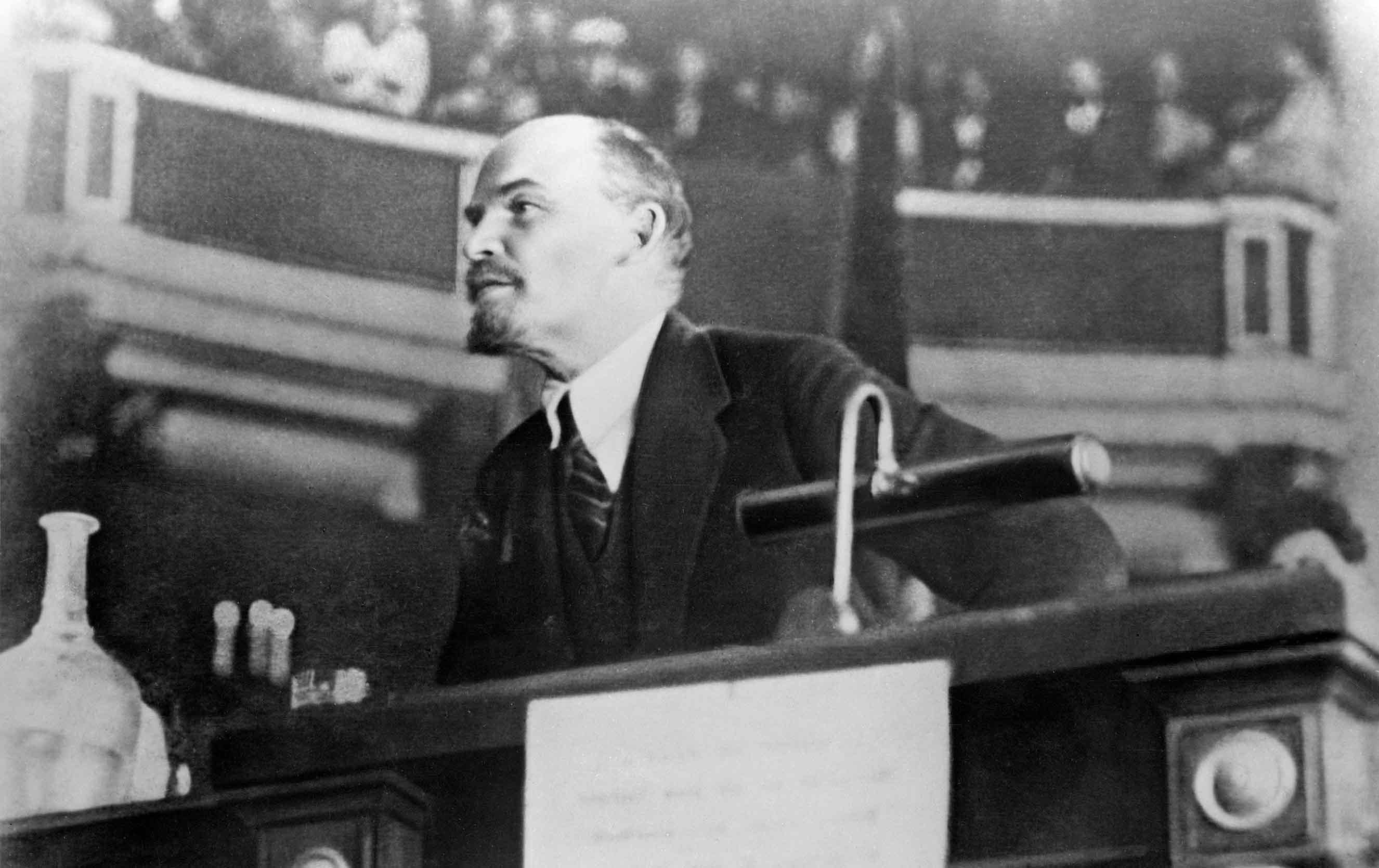
After Charles Ashleigh was released from Leavenworth Prison at the end of 1921 he was deported and found his way to Moscow for the Fourth World Congress of the Communist International in November, 1922 where he witnessed the final speech by Lenin the the International and one of his final public appearances.
‘Lenin’s Last Speech’ by Charles Ashleigh from the Daily Worker. Vol. 1 No. 388. February 13, 1924.
It was during the Fourth World Congress of the Communist International.
The Congress was held in the Nikolaevsky Palace–the Moscow residence of the Czars–in the Kremlin. It is a huge place, with great halls and corridors, with something of grandeur about them despite the glaring vulgarity of their marble, gilt and mirrored decorations.
We knew that Lenin was to speak at the Congress, and that the time for his address was nearing. We knew, too, all of us, that Vladimir Ilyitch’s health was none too good.
In the corridor outside the Congress rooms, and in the great hall–where once Court Levees were held–where we used to promenade between sessions, the question was continually being asked, “When is Lenin going to speak?” In all languages we could hear it as we surged up and down the hall, taking our brief exercise. Big blond Scandinavians, animated Italians, loose-gaited Americans, Englishmen–looking intensely and rather self-consciously English amid this motley gathering–Frenchmen, Turks, Bulgars and a score of other nationalities; revolutionists from every corner of the world, hard-bitten, class-war veterans from almost every prison in the world, they were eager, like simple children, to see and hear Lenin. It was not just curiosity however; it was not alone their respect for a man who had contributed so much new thought to revolutionary history; it was also affection.
For Lenin was loved; and loved by millions of plain simple people, as well as by revolutionaries. I have seen old peasant women, in Russian country towns, gathered round the bulletin which announced the state of Lenin’s health, listening to some one reading it aloud to them. And I have seen the tears streaming down the faces of these old women, as they crossed themselves, over and over again, crying, “God help our Vladimir Ilyitch,” “Christ restore him to health again!” They knew nothing of the theories of Communism, these simple people. but they loved Lenin, and trusted him. They loved him as one of themselves, with a sort of brotherly familiarity, entirely untouched by all.
And so we waited to hear this man who had our respect and our love. I remember that I was in the press bureau that day, in the great hall of palace where scores of typewriters were clicking out the news of the Congress, in many languages, so that the workers, the world over, might know what was taking place.
Some one came hurrying in. “The Old Man is going to speak!” It was in these familiar terms that Lenin was affectionately known to us of the English-speaking nationalities. We hurried into the Congress hall. The platform was overcrowded. At the long scarlet-covered table of the Presidium sat Zinoviev, Radek, Bucharin, and others, still and intent. Suddenly the delegates arose. A rather short, stocky man had walked briskly onto the platform. Yes, he had walked briskly enough, but there was a doctor and a nurse with him.
We stood, all of us, and we cheered, in heaven knows how many languages; and we sang the “Internationale,” and then cheered again. It was a perfectly spontaneous tribute from this World Congress of seasoned revolutionists to that man, with the keen humorous eyes, who stood quietly, absolutely without pose, waiting for us to finish.
Then he spoke. He was dealing with the question of the New Economic Policy. But, instead of going into its many details, as he intended, he could only speak to us for a couple of hours. His health would not permit the great effort he had wished to make.
Lenin’s manner was not oratorical. He spoke in a conversational tone, rather as though he were endeavoring to convince an intelligent opponent in a discussion. He was perfectly distinct; his voice carried, apparently without effort, to the farthest corners of the long and acoustically very unfavorable, hall.
He had none of the flamboyant gestures of the platform. As he approached a crucial point in his argument, he would make a sort of little lunge forward. His right hand moved constantly in short, incisive, crisp gestures, emphasizing, firming.
It was the tremendous earnestness and mastery of the man which impressed one. Thru his coolness, the unstudied carriage, the pleasant voice which he went on, reasoning, convincing, was shining, an intense fire and impeccable will. And it was not the fire, the will of an individual; it seemed as though the aspirations and determination of a class were in Lenin. It was as though he had been made the vehicle for the driving will of the awakened workers. Thru him spoke Revolution.
He had that incommunicable quality which is genius, had Lenin. He had that which we call greatness. But he was a new kind of great man. His greatness was part, not just of himself, but of a class, the workers; it was part of the revolution. He did not “give” his greatness to the people, as did the great saints, the great humanitarians, for instance. It was not his to give; it was already the people’s. He was an organic expression of the revolutionary working class; and he knew it, down to the deepest places of his consciousness, and acted instinctively always according to this knowledge. His form of greatness could never have existed in a previous historical period. He was the product of the modern proletariat, the mass become conscious. He was the Mass Man. Comrade Lenin had finished. He was tired, you could see that. As he turned away from the tribune, the doctor and nurse came anxiously forward; and he left, rather slowly, leaning on an arm.
And there were some around me, who had noted this, who were sobbing. They were men who had been imprisoned and tortured by the master class, and who, dry-eyed and grim had defied their captives. Yet now they wept. After years of exile, of poverty, of austere devotion to the cause; and after the five long years of struggle, when Socialist Russia was combating, with every sinew, the enemies within and without; and now, when more light began to shine on the way, now when the roads became easier, our Comrade Lenin was ill. We feared he might not see the glorious New Russia, which was now beginning to be built up. Those faithful, fearless eyes had seen the dawn, but they were not to see the full and beautiful effulgence of the day. Our soldier was tired, and his old wounds were bleeding, and he was not to hear the happy songs of children, crowning his victory, in a new world.
We took Lenin to our hearts that day–our comrade, loyal and unsparing of himself, who had so well fought the fight of our class. And we walked from the Congress Hall, reconsecrated, strengthened and steeled to carry on the work he loved so well, hoping only that we, too, might be fortunate enough to have the chance of giving all our strength, all our blood to the struggle which would one day, make the old earth blossom with a new and radiant life.
The Daily Worker began in 1924 and was published in New York City by the Communist Party US and its predecessor organizations. Among the most long-lasting and important left publications in US history, it had a circulation of 35,000 at its peak. The Daily Worker came from The Ohio Socialist, published by the Left Wing-dominated Socialist Party of Ohio in Cleveland from 1917 to November 1919, when it became became The Toiler, paper of the Communist Labor Party. In December 1921 the above-ground Workers Party of America merged the Toiler with the paper Workers Council to found The Worker, which became The Daily Worker beginning January 13, 1924.
PDF of full issue: https://www.marxists.org/history/usa/pubs/dailyworker/1924/v01-n338-feb-13-1924-DW-LOC.pdf
 Revolution's Newsstand