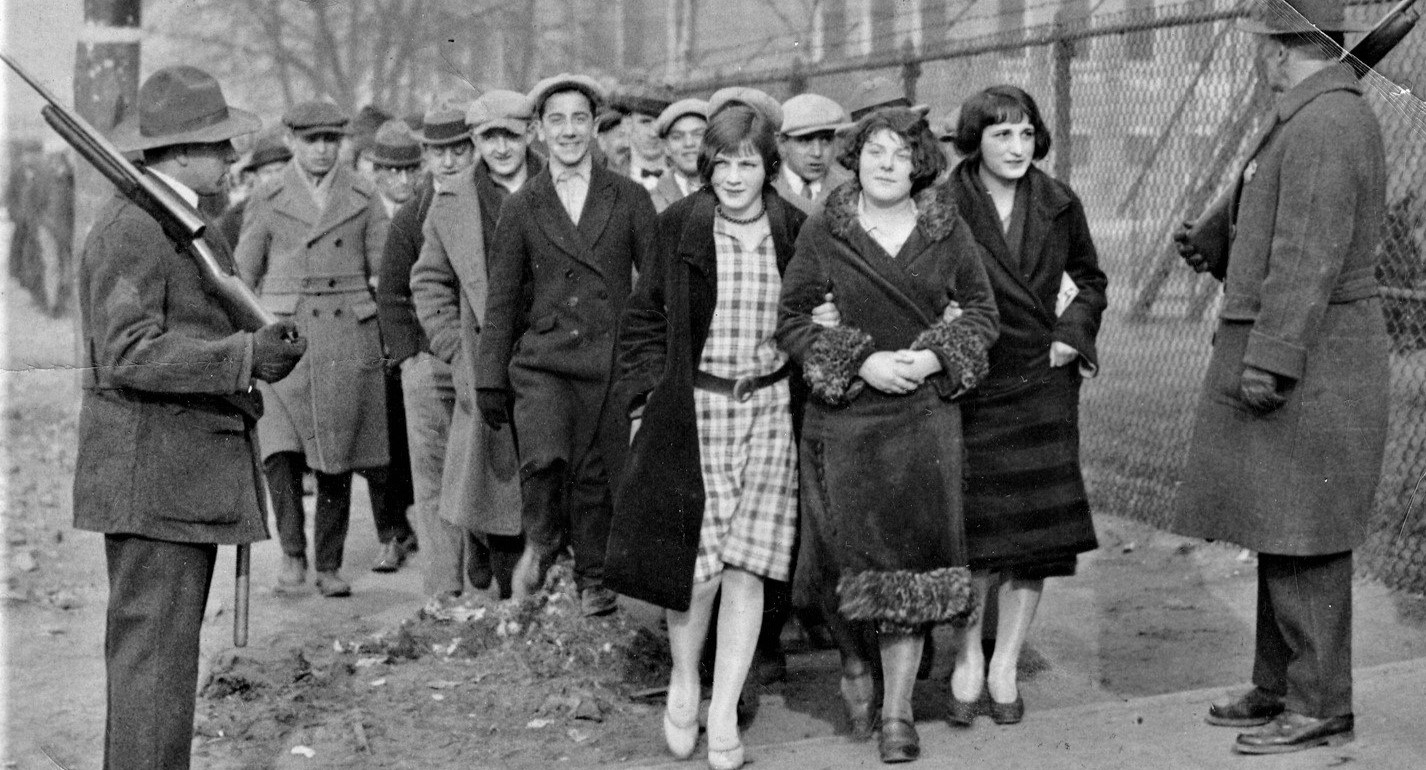
Eva Schafran was only 22 when she wrote this; a working class intellectual, Schafran was a millinery worker and union activist, who taught classes on Marxism for the Party, eventually based in Los Angeles. Here, she sees the success of the left wing in organizing women workers during the 1926 Passaic struggle, whom were largely ignored by the A.F. of L.
‘Organizing Working Women: The Task of the Left Wing’ by Eva Schafran from Labor Unity. Vol. 2 No. 4. May, 1928.
Gone are the days of “women’s place is in the home.” Dead and buried is the time when woman was considered as a toy, the “house doll,” to be taken care of by Man, the “stronger,” both physically and mentally. New days have come—the days of capitalistic industrial expansion and development which have rapidly brought women into industry and presented new burning questions of organization before the labor movement as a whole, and the left wing in particular.
The “over-night” industrial development in the United States, the need for more and cheaper laborers, the low earnings of male workers, all these added to the rapid coming of women into industry. Between 1880 and 1910, the number of women workers increased 223 per cent—twice the increase of men workers. Between 1910 and 1920, the increase was 41 per cent.
New we have 8 ½ million women “gainfully employed” in the United States, according to the 1920 Census—one woman to every five men. Two million are married women, adding eight or ten or twelve hours of work daily to their household responsibilities in order to help support their families.
Women have gone, not only into the “light” industries, as might be expected, but into the so-called “heavy” industries as well. In the automobile industry alone, the number of women workers increased, between 1880 and 1910, the tremendous amount of 1048 per cent.
Women work in almost every branch of industry in the country. Out of a total of 572 industries studied by the Women’s Bureau of the U.S. Department of Labor, only 35 do not employ women. This just shows what a factor women are increasingly becoming in industry.
Of late years there has been a great cry raised for the “freedom” and ‘equality” of women. With the upper and middle classes, this has become a sort of hobby. In their case, there is no economic reason involved. The women simply realized that the view of them as the “doll of the family” in reality meant that they were looked down on as a lower sort of being.
Which Class?
The demands in themselves are, of course, very “noble” and justified. But it all depends on who and for whose purposes they are being used. To the middle and upper class women, the right to do what they want means one thing, and to the working class women it means something else. The total disregard of the working woman’s viewpoint by her “sisters” is expressed very well by Amy Wren in an article in “Equal Rights,” official publication of the Women’s Party:
“As far as I can see, if a debutante can dance all night without injuring the chances for the future generations’ health and all that, there’s no reason why they shouldn’t work all night if they wish.”
On such “weighty” reasoning as this, Miss Wrenn and her associates would force an “Equal Rights” amendment to the Constitution, which would do away with all protective legislation for women workers.
For us workers, these arguments for “freedom” in the abstract which means in reality slavery don’t mean very much. We understand that not only are women oppressed under capitalism, but all those who have to slave under the yoke of capitalism to earn their daily bread are exploited. Nevertheless, there are certain problems peculiar to women in industry. These 8 1/2 million women now in industry work under very bad conditions—long hours, poor surroundings, and wages much lower than those of men and these are some of the problems that we should consider.
The figures of the Women’s Bureau show that the average wage for women in the various states in 1920 ranged from $16.85 per week in Rhode Island to $8.60 per week in Missouri. The average weekly earnings for men workers in Illinois in 1925 was $32.29 and for women $18.83. In New York the average earnings in 1925 for men were $30.75 per week; for women, $15.14. It is a fact well known to rail workers that women doing the same work as men are frequently paid much less.
Long Hours
The hours of work for women range from 48 to 60 and over per week, the majority of them working 9, 10, and even 11 hours a day. In the southern textile mills, the 12 hour day and 14 hour night are common. It should also be noted that long hours usually run simultaneously with low wages, according to the figures and studies of the Women’s Bureau. Many employers thoughtfully arrange for women with families to work night so they can look after their children and do the washing and cooking in the day time. When do they sleep? Ah, well, that’s not the employer’s concern.
Marriage No Escape
“Discriminatory legislation” for women has been necessary for several reasons. In the first place, they y the women, are so poorly paid that they dare not fight for better conditions for fear of starvation if they are discharged. In the second place, many have regarded their employment as temporary and have so endured the terrible conditions until they could get out—although statistics show that women who leave industry to marry are returning to it more and more frequently after marriage.
The chief reason, however, for the lack of activity by women to gain improvement for themselves has been that the trade unions have fought their admission for fear they might bring wages down or throw men out of jobs, or (incredible as it may seem) from the old belief that “women’s place is in the home/’ and that she is a creature without sense, responsibility, or endurance. The fact that less than three per cent of the working women are organized, although, as Manry Anderson says, four million out of the 8 million now working could belong to trade unions already affiliated with the A. F. of L., is a terrific indictment of the American trade unions.
That female labor is cheaper and more satisfactory to the profit interests of the employers, and that therefore, women will keep on pouring into industry—there can be no two opinions on this. Nor can there be any dispute but that women can be used in industry either to lower the wages and working conditions of the men or to help the men, by fighting with them against their common enemy—the employer. Past experience has taught us that where women are ignored or discriminated against by the men, they were a menace to the movement, and both men and women lost. Where women were taken into the unions and given a place, they were of great help to the union. We saw it in the great steel strike and in other great struggles of the workers in the past and present.
So what shall we do?
The only answer to this question is: Organize the women workers, help them raise their standards of living, and make them a valuable asset to the struggle of the working class instead of a menace.
Social legislation for women? We are for it But social legislation alone will not serve the purpose, particularly where it depends upon “goodwill” for its enactment and capitalist executives for its interpretation and enforcement. Social legislation that will really serve the interests of the working class woman and protect her functions as child-bearer and worker, will never be gotten except through the united striving force of an organized working class.
The present A. F. of L. leadership in its long history of “attempts” has proven incapable and unwilling to organize the masses of unorganized workers, men as well as women. The job of organizing the women workers, therefore, is the task of the Left Wing.
The work of the left wing among women in the 11 months of the Passaic strike, the splendid organization of the Women’s Councils, the activities of the Women’s Battalions in the Farriers* strike, all are evidence to convince us that the left wing is capable of doing, and will do the job.
Labor Unity was the monthly journal of the Trade Union Educational League (TUEL), which sought to radically transform existing unions, and from 1929, the Trade Union Unity League which sought to challenge them with new “red unions.” The Leagues were industrial union organizations of the Communist Party of the United States (CPUSA) and the American affiliate to the Red International of Labor Unions. The TUUL was wound up with the Third Period and the beginning of the Popular Front era in 1935.
PDF of full issue: https://www.marxists.org/history/usa/pubs/labor-unity/v2n04-w23-may-1928-TUUL-labor-unity.pdf
 Revolution's Newsstand