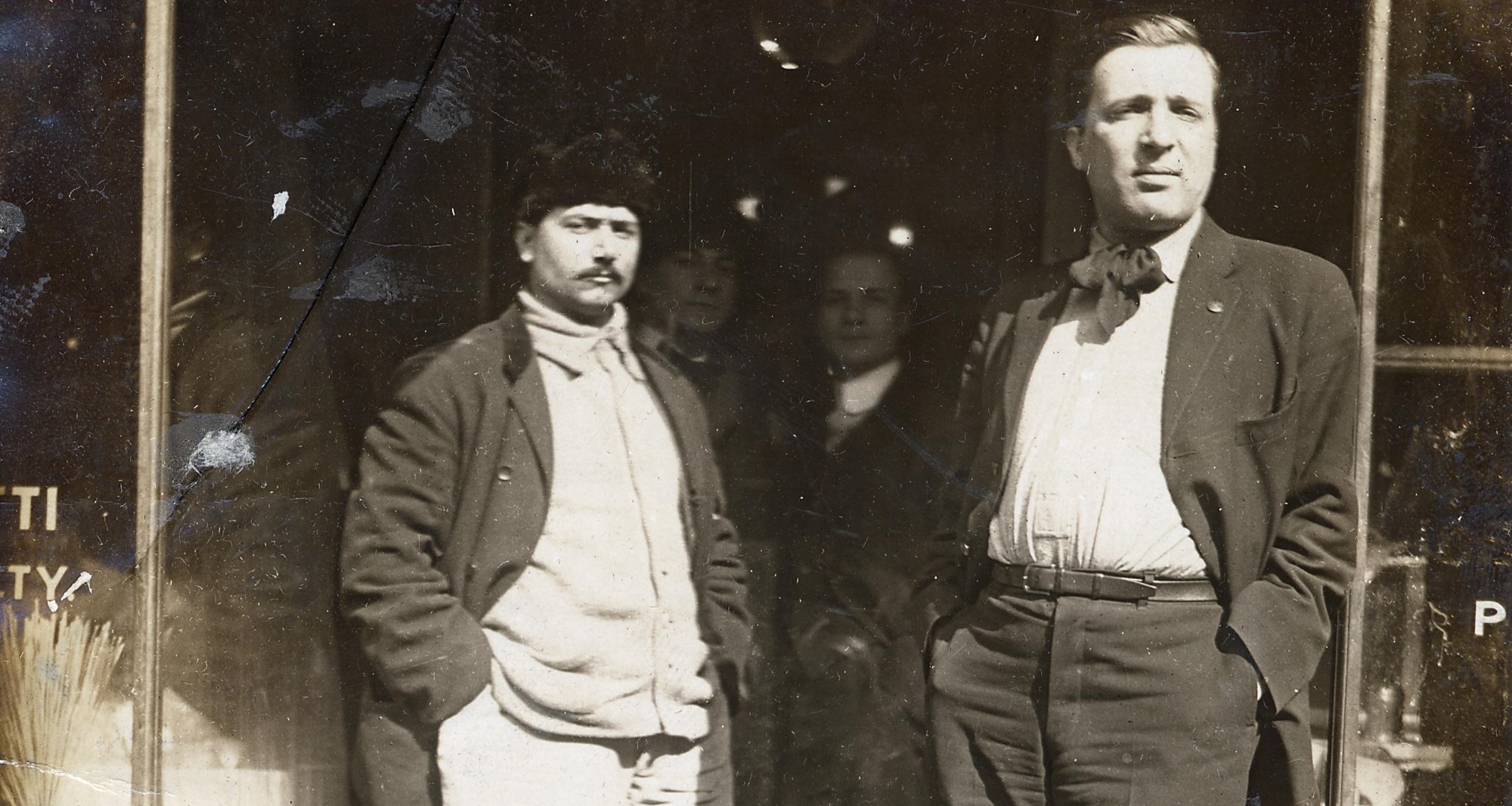
Joseph Freeman, editor of the New Masses and a leading figure of the ‘proletarian literature’ movement, looks back at his own tradition, the beginnings of working class writing in the U.S., and magazines like the Comrade, Masses, and Liberator–where he began his own career writing for the left press.
‘The Tradition of American Revolutionary Literature’ by Joseph Freeman from New Masses. Vol. 15 No. 6. May 7, 1935.
THE bourgeois revolution at the end of the eighteenth century transformed the life of the western world under the abstract slogan of liberty, equality, fraternity. These social goods became the monopoly of the bourgeoisie along with the factories, the machines, the banks, and the state. Literature reflected this profound change in society. The Christian myth was replaced by the myth of sacred ego as the central theme of nineteenth century bourgeois literature. We now know what the sacred ego really was. The freedom of the individual–from the Declaration of the Rights of Man and the Declaration of Independence down to recent plaints that Europe has really been a success and the promise of American life still a promise has meant in reality the freedom of the propertied classes to exploit those who have nothing to sell but their labor. This freedom for the privileged has been achieved through the enslavement of the millions. In ignoring those millions, in confining itself to the upper and middle-class individual, bourgeois literature has been a class literature.
At first it was frankly that. The class concept of literature antedates the organized movement of the proletariat. The ideologues of the bourgeois revolution demanded a new art and did not hesitate to name it by its right name. Diderot and Lessing called frankly for the bourgeois drama. Madame de Stael defended bourgeois against feudal literature, urged a complete break with the ideas of the old order, and called for a literature animated by specifically bourgeois values. Prosper de Barante argued that there was a necessary connection between literature and society, and concluded that society conditions literature. We know to what an extent American literature of the nineteenth century voiced the national-democratic aspirations of the then progressive bourgeoisie of our own country.
This has been called the great tradition. But there are really two great traditions in the modern literature of the west. Disappointment in the results of the French revolution ushered in the romantic movement of the last century. From the cult of the ego the romantics developed the myth of the primacy of art which led, until very recently, to the Ivory Tower. When art failed to satisfy the unbounded longings of the poet, overstimulated by the sublime phrases which concealed the bourgeois pursuit of profit, the poet fell back for solace into the arms of the church. But by this time, the church and the bourgeoisie, foes for centuries, had struck up an alliance against the proletariat, which took over rational materialistic thought where the bourgeoisie had left it. With a background of classical German philosophy, English political economy, French socialism. and revolutionary doctrine, Marx and Engels developed dialectic materialism, the ideology of the working-class, which became the revolutionary class of modern society. The new doctrine revealed more clearly than anything before it not merely the social but the class basis of ideas. The thinkers of the proletariat were able to perceive this profound truth because the proletariat is the first social class in history which fights for the abolition not only of class privileges, but of social classes altogether.
For the past century we have had a conscious, organized, purposeful struggle between the bourgeoisie and the proletariat. This has meant two conflicting traditions in economic life, in philosophy, in literature, in art–bourgeois and proletarian. In the forties the great German poet Ferdinand Freiligrath spoke of himself as a poet of the revolution and the proletariat. Subsequently Communist critics like Franz Mehring analysed literary classics from the proletarian viewpoint. In Russia a great school of critics developed–including men like Pisarev, Byelinsky and Tchernishevsky–who were not only able aestheticians, but leaders of thought, teachers of the people, revolutionaries who linked poetry with politics. From Marx and Engels to our own day, the organized movement of the working class has been vitally interested in art and literature, past and present; it has always been interested also in developing that art and literature which reflects the struggles and aspirations of the proletariat. Wherever the socialist movement developed, there grew up around it groups of socialist writers and artists. Where the class struggle was latent, the socialist movement was weak; where the movement was weak, the art it inspired was weak. Where the class struggle was sharp, the movement was strong; where the movement was strong, the art it inspired was rich and vital.
America has been no exception to this general law of development. For example: in 1901, when the American socialist movement began to grow, a group of New York socialists founded The Comrade, whose contributors included Edward Carpenter, Carpenter, Walter Crane, Richard Le Gallienne, Maxim Gorky, Jack London, Upton Sinclair, Edwin Markham, and Ryan Walker. This publication–precursor of The Masses–announced that its aim was to give its readers “such literary and artistic productions as reflect the soundness of the socialist philosophy…To mirror socialist thought as it finds expression in art and literature…and to develop the aesthetic impulse in the socialist movement.”
You will be convinced that this was no “Stalinist” plot to put American artists in uniform, when I remind you that this was in 1901 and that the editors of the magazine included John Spargo and Algernon Lee–at that time more or less Marxians.
The magazine, which ran for four years, employed the phrase proletarian poet to describe working-class writers of verse. No one considered the phrase odd. It was a logical corollary to the working-class outlook on life, the obvious poetic byproduct of proletarian politics. For all its utopian, sentimental fantasies, brought into the socialist movement of that period by middle-class intellectuals who were still bound to the class of their origin, The Comrade represented a literary movement in America out of which grew Upton Sinclair and Jack London. It brought more or less socialist standards to literary criticism. In its pages Edwin Markham predicted “a great revival of literature” in America and throughout the world, which, he said, would grow out of the movement to emancipate labor.
In America, as in Europe, every decade saw intellectuals join the socialist movement only to drop out later; yet each decade brought new contingents from the educated classes. Each contingent of writers started afresh. No continuity was maintained in socialist literary circles. The Masses group started directly from the socialist movement, yet, at the same time, burdened with the middle-class notions which had their roots in the romantic tradition. As persons, the writers and artists of the magazine were socialists or syndicalists or anarchists. The publication as such was a private venture, unaffiliated with any party, formally owing allegiance to no cause. As individual writers and artists, the Masses group championed two causes: socialism and a free art. Sometimes these two ideas were fused; at other times they clashed. When Floyd Dell in 1913 urged Dreiser to write the American novel of rebellion, he was employing the socialist standards of The Comrade; when he wondered at the Masses trial in 1918 what he was doing in court when he should be at home writing fiction, he was reverting to the romantic tradition of the free, unfettered artist above the battle. At odds with bourgeois America, the Masses-Liberator writers fought now as journalistic allies of the proletariat, now through the tour-de-force of creative art, which ranged, in letters, from the most saccharine sonnets to stirring revolutionary poetry. The best writing of this period was done by men actively engaged in socialist or I.W.W. organizations–men like Joe Hill, Ralph Chaplin, Arturo Giovanitti, Jack London, the early Upton Sinclair, and John Reed.
The October Revolution in Russia was a turning-point for the proletariat the world over, consequently for its literature. By 1919 Floyd Dell was talking of the proletarian novel in America, and applauding Soviet plans for the development of what was then called “proletariat socialist art,” What appealed to our American critic was not only the successful attempt to make literature old and new available to the millions, but the equally important attempt to stir the worker himself to create art. Dell at that time grasped the active element in proletarian art. The new stories, he said, should, above all, teach the worker courage and confidence in his destiny, teach him with their satire to scorn the ideals of capitalist society, deepen his sense of community with his fellow-workers in their world-wide struggle for freedom, and make him face the future with a clear and unshakable resolution, an indomitable will to victory and freedom. Later he urged that the literature of America was above everything else a literature of protest and rebellion. It is only a question of time, he said, which shall rule the world–which will be required by force of circumstances to suppress its enemies by force–the capitalist class or the working class; and for a brief period he demanded that writers take sides in this conflict not only as men but as writers.
For Floyd Dell proletarian literature was one kind of literature; for Michael Gold it was the only kind of literature worth creating. In an essay published in 1921 he called definitely for a proletarian art. The old ideals must die, he said. But let us not fear. Let us fling all we are into the cauldron of the Revolution; for out of our death shall arise new glories. His faith in proletarian culture came from his faith in the proletarian revolution. He was the American exponent of that literary tradition which the organized working class had initiated in every country—and which had already given our own country Hill, Chaplin, London, Sinclair, Giovanitti, Dell and Reed. But Gold was more alert about the issues and problems involved: he was molded by the World War and the Bolshevik Revolution.
Everywhere the best writers felt the impact of these two events. The old order was visibly changing and a number of intellectuals in various countries wanted to orient themselves in the chaos. In 1919 Romain Rolland organized a group of writers around a “declaration of intellectual independence,” signed, among others, by Jane Addams, Benedetto Croce, Stefan Zweig, Henri Barbusse, Bertrand Russell and Israel Zangwill. Thought was to be emancipated from serving the selfish interests of state, nation or class. The Masses-Liberator group refused to join because the document was not an open declaration for the proletariat. As was to be expected, Rolland’s international of thought collapsed. The left intellectuals learned their lesson. In 1919 Barbusse organized Clarté under Communist influence. The new group was outspoken in its support of the revolutionary working class. Its first pamphlet was an appeal to the proletariat of all countries to affiliate with the Third International; it called for a radical destruction of the capitalist system. At the same time it founded a publishing house and a magazine which printed revolutionary fiction, poetry, criticism and journalism. The Liberator was invited to join Clarté as its American branch. Max Eastman, then editor, declined. He argued that the Communist Party must be the only revolutionary organization guiding the revolutionary artist. Subsequently he changed his mind a little about this. But those of us who entered the revolutionary movement in the twenties came into a literary heritage based on these ideas:
1. Every social class has its own ideology and its own literature. The proletariat has its own ideology and its own literature.
2. The revolutionary writer not only creates novels, plays and poems which voice the aspirations and struggles of the workers, but himself participates actively in those struggles directly–in the organizations of the workers.
3. Capitalism retards the development of culture today. The proletariat is heir to the best of the old culture, and the initiator of the new. For the purpose of combatting capitalism and aiding the proletariat, for the purpose of developing the new culture, intellectuals organize in their own organizations.
4. It is not necessary for a writer to subscribe completely to the political program of the proletarian party in order to aid the workers; it is unnecessary for him to abandon poetry for organizational activity. If he is against capitalism and for the proletariat on fundamental questions, he can participate in a literary organization like Clarté and function in his own specific craft as an ally of the workers.
These ideas were prevalent in left-wing literary circles in this country in the early twenties. During the boom period, many intellectuals who had allied themselves with the workers under the impact of the war and the October Revolution, were absorbed into the then prosperous middle classes. A small group of left-wing writers, influenced by the Communist movement as their predecessors had been influenced by the socialist and syndicalist movements, agitated for a revolutionary art and literature in America. Conditions imposed upon them a task which was primarily propagandistic, educational, organizational. They wrote, lectured and organized with a view to circulating basic Marxian ideas in literature. They founded THE NEW MASSES, the Theatre Union, the New Theatre, Partisan Review, the John Reed Clubs, the Film and Foto League; they taught literature in the Workers School and wrote about it in The Daily Worker, partly to acquaint the workers with contemporary literature, partly to acquaint writers with the viewpoint of the workers and its significance for culture in general and literature in particular. They developed young poets, critics, journalists and novelists who subsequently did creative work of distinction. They published and encouraged revolutionary writers not only in New York, but also in the Middle West, the Coast, the South, among them talented Negro writers like Langston Hughes and Eugene Gordon. In doing so, they were not–as their enemies said–importing a Russian idea imposed upon them by the Kremlin. They were developing in their own country an international idea as old as the proletarian party–an idea that had its own specific American traditions.
They worked for a decade close to the labor movement, to its mass organizations, to the Communist Party–but they were more or less isolated–for various historical reasons from the majority of American writers. The economic crisis, the spread of fascism, the menace of a new war–the agony and travail of capitalist culture in decay–the barbarization of culture in the capitalist countries and the colossal triumph of the Soviet workers not only in industry and agriculture–but in science, art, literature, and the cinema opened the eyes of the best of America’s writers to the meaning of the class-struggle. In the choice which we must all make in this epoch they have chosen to side with the working-class. Actually, there is no choice. In its final stages of decomposition, capitalism means the doom of everything fine in human thought. The working-class alone, in emancipating itself, can emancipate the whole of mankind, and with it release undreamed-of forces for the conquest of knowledge, the creation of art.
You who represent all that is most promising in American literature have taken over the heritage of progressive and revolutionary thought. You have enriched it with your craftsmanship as it has enriched you with its insight. For the first time in the history of our country, the literary allies of the proletariat may be counted not by the dozen but by the hundreds. Moreover, you are the American contingent of that army of writers all over the world which is militantly fighting for the preservation of culture through the triumph of the working class. In that class lies our strength. A brief, inadequate note on the past has no value except as it teaches us something about the present. We ought to know that we have a revolutionary literary heritage behind us in order that we may transcend it. We also ought to know that we are at our best as writers when we are an integral part of the working-class movement, when our writing emerges out of active identification with it. I have mentioned the names of some who, physically alive, have been dead as creative writers since they broke with the proletariat. Consider what a poet like Arturo Giovanitti, silent today, could write about the October Revolution when he was an active proletarian fighter in 1920—
Victory, lightning-faced, flame-winged has come,
Just on the day it was told us by your prophets and seers,
The harbingers of your great day, the builders, of your highway,
The blazers of your world-trails.
Your teachers enlighten the people without any rest or stint,
And they give them one good rifle with every good book they print;
And the workers now own everything, even their right to be born;
And the peasants have taken in the full flax and the wheat and the corn;
And in Moscow it is high noon, and in Europe it is the morn
And the Soviets are everywhere.
The New Masses was the continuation of Workers Monthly which began publishing in 1924 as a merger of the ‘Liberator’, the Trade Union Educational League magazine ‘Labor Herald’, and Friends of Soviet Russia’s monthly ‘Soviet Russia Pictorial’ as an explicitly Communist Party publication, but drawing in a wide range of contributors and sympathizers. In 1927 Workers Monthly ceased and The New Masses began. A major left cultural magazine of the late 1920s and early 1940s, the early editors of The New Masses included Hugo Gellert, John F. Sloan, Max Eastman, Mike Gold, and Joseph Freeman. Writers included William Carlos Williams, Theodore Dreiser, John Dos Passos, Upton Sinclair, Richard Wright, Ralph Ellison, Dorothy Parker, Dorothy Day, John Breecher, Langston Hughes, Eugene O’Neill, Rex Stout and Ernest Hemingway. Artists included Hugo Gellert, Stuart Davis, Boardman Robinson, Wanda Gag, William Gropper and Otto Soglow. Over time, the New Masses became narrower politically and the articles more commentary than comment. However, particularly in it first years, New Masses was the epitome of the era’s finest revolutionary cultural and artistic traditions.
PDF of full issue: https://www.marxists.org/history/usa/pubs/new-masses/1935/v15n06-may-07-1935-NM.pdf
 Revolution's Newsstand