
In November, 1934 Celeste Strack, a student at U.C.L.A., member of the National Student League and Young Communist, was suspended along with four others for holding “communistic meetings” and attempting to “destroy the University.” Students mobilized with thousands joining a campus strike, winning their reinstatement the following month. Strack, who was just beginning her long life of political activism, gives the background to the suspension and the story of the struggle to reinstate.
‘Expulsions at U.C.L.A.’ by Celeste Strack from Student Review (N.S.L.). Vol. 4 No. 3. March, 1935.
At the University of California at Los Angeles there have occurred recently a series of administrative acts which, for their impressiveness as omens of a rising tendency, match the latest expulsions at City College. Taken together they show the trend in American college administration toward increased ruthlessness and severity in the suppression of student liberties when these encroach upon the settled order of things. Just as industrial strikes which promise to be successful are now broken by pitting troops against the strikers, and just as the prophetic Mr. Hearst has lately promised to bless an American fascist movement whenever one becomes necessary to check Communism, so do the Robinsons of New York and the Moores of Los Angeles defer to the swastika when the leftward swing of their students begins to discomfit the paymasters in control of their universities.
Like City College, UCLA has on the one hand a record of administrative reaction and, on the other, the reputation of incubating radical students. For ten years the major issue has been the question of ROTC and the students’ right of free speech in combating it. Each time the students attempted to bring liberal speakers to the college, the Better America Federation, the American Legion, the Daughters of the American Revolution and other reactionary groups came to Provost Moore’s office with sheaves of protests and threats to bring pressure on the legislature, so that appropriations (of the people’s money!) would be reduced.
These skirmishes helped the student body to get a clearer idea of just what it wanted in the way of student rights. The influence of the National Student League and of the newly elected liberal Student Council were beginning to make an impression. As a result, within the first five weeks of school, four clashes between the students and the administration occurred.
The first dissension took place over the proposal of the Navy League that UCLA sponsor an essay contest among southern California schools on the subject of “Our Navy.” With the administration’s acceptance, the Student Council pointed out to Dr. Moore that the motives of the League were somewhat odorous, since the organization is largely composed of munitions manufacturers. Dr. Moore professed to be “convinced,” and the offer was refused.
It had been customary, on Armistice Day, for UCLA and the American Legion to divide the proceeds of the football game. The Council decided to terminate this custom, voting to sever all cooperation with the Legion because of its function as an outlet for militarist propaganda. The Council further suggested that a pacifist speaker be sent to the Legion instead of the usual ROTC parade detachment. The Legion did not appreciate these suggestions.
Added to these incidents was the decision of the Council to investigate the finances of the Student Co-op. Profits, which were supposed to revert to the student body, were shown the books. The administration seemed unusually anxious to delay the investigation.
Super-Patriots and the NSL
By the time the question of a Student Forum had appeared, the administration had already been besieged by scores of superpatriots demanding that everybody within a rope’s-throw of the campus be prevented from engaging further in “unpatriotic” and “subversive” activities. Meanwhile, the recent successes of the students had served to bolster confidence in their ability to obtain common objectives. The National Student League was consolidating ranks for the struggle which threatened.
The breach between the students and the administration was widened perceptibly when the Council voted in favor of a student-controlled Forum, only to have Dr. Moore instruct John Burnside, student body president, to prohibit all further discussion of the Forum question. (That day a group of perhaps fifteen students who had gathered between classes on the quad to discuss the Forum, were amazed to see Dr. Moore scurry down the library steps, publicly accusing them of holding a “communistic” meeting.) On Wednesday, October 24, the Council met and in disregard of Dr. Moore’s orders discussed various plans for the Forum, postponing definite action until after November 6.
The next day a group of students met to consider support of the Forum. It was tentatively agreed to use the right of initiative provided in the student body constitution, which guaranteed the right to petition the Council to submit the Forum question to a student-wide vote. At this meeting, an “unofficial representative” of Dr. Moore threatened that if we attempted to use our right of initiative in connection with the forum, our constitutional rights would be taken from us! Not satisfied with this openly fascist pronouncement, he took further steps. When an enlarged group met on Friday to make a definite decision on the petitions, two policemen were present. They said they were there to break up a “communistic” meeting, and, if petitions appeared, would arrest everyone in the room. Several of us were quite aware that we were under constant police surveillance. The atmosphere was tense indeed that Friday afternoon.
Monday at noon, five of us were suspended without warning or hearing. Thomas Lambert, chairman of the men’s board, Mendel Leiberman, member of the Council, Sid Zagri, head of the forensics board, and John Burnside, student body president, were suspended on the charge of “using their student body offices to help the National Student League destroy the University.” I was charged with repeated violations (unnamed) of the University regulations, including the holding of “ccommunistic” meetings on the campus.
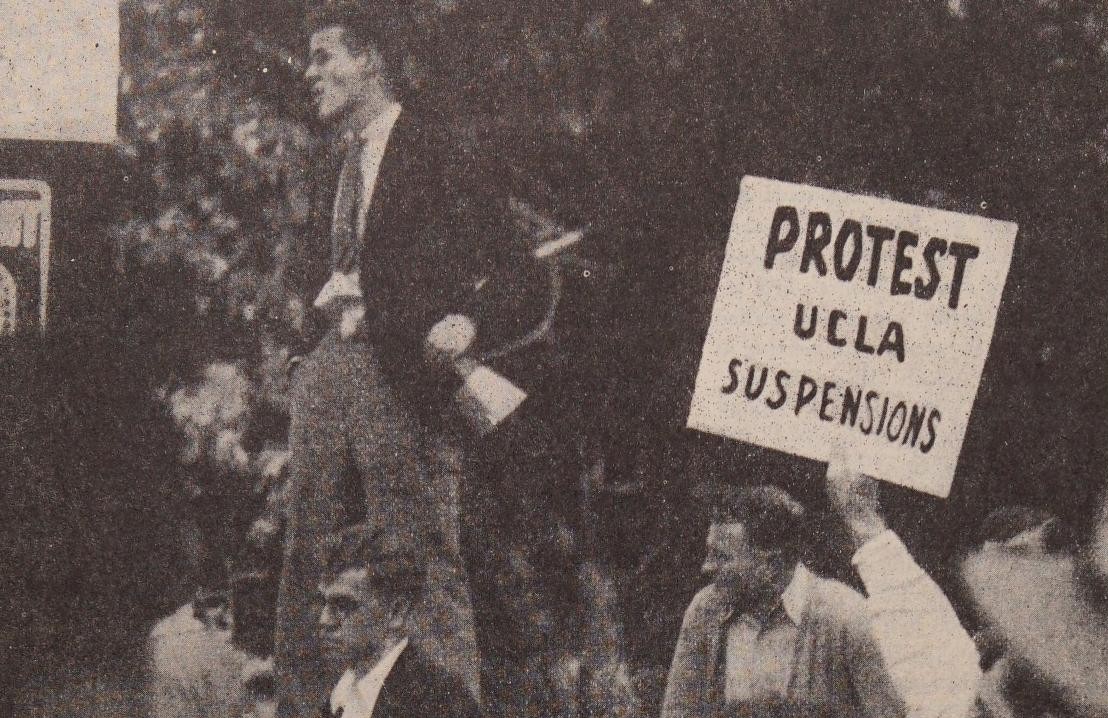
Within an hour, forty students had formed the General Student Committee for Reinstatement. Action—that was the demand. By midnight we had decided upon a mass demonstration for tomorrow at 10 A.M. Organization: defense committees, speakers, steering committee, building committees for publicity. I remember somebody saying, “Well, if fifty show up we’ll see it through.” As we worked we forgot our hesitance. Everything set; must have been about 3 A.M. Then: “Say, if we pass the word to meet on the Library steps, the cops will be there first; our speaker won’t have a chance.”
“I’ve got it. Call the meeting for the library, and then at the last minute switch it across the quad in front of Royce Hall. Right!”
Ten o’clock found the campus cops on the Library steps, carrying clubs. 10:02 found, not fifty, but hundreds of students assembled across the quad in front of Royce Hall.
“This is to be an orderly meeting! We are here to discuss the suspensions and demand free speech and a public hearing.” It was our first speaker, the NSL organizer. The cops had come and had broken through a weak spot in the defense squad. The speaker was knocked down. Another took his place; then another. Slowly, the cops were pressed out of the center. One of them got nasty. A flying tackle by one of the students landed him in the bushes.
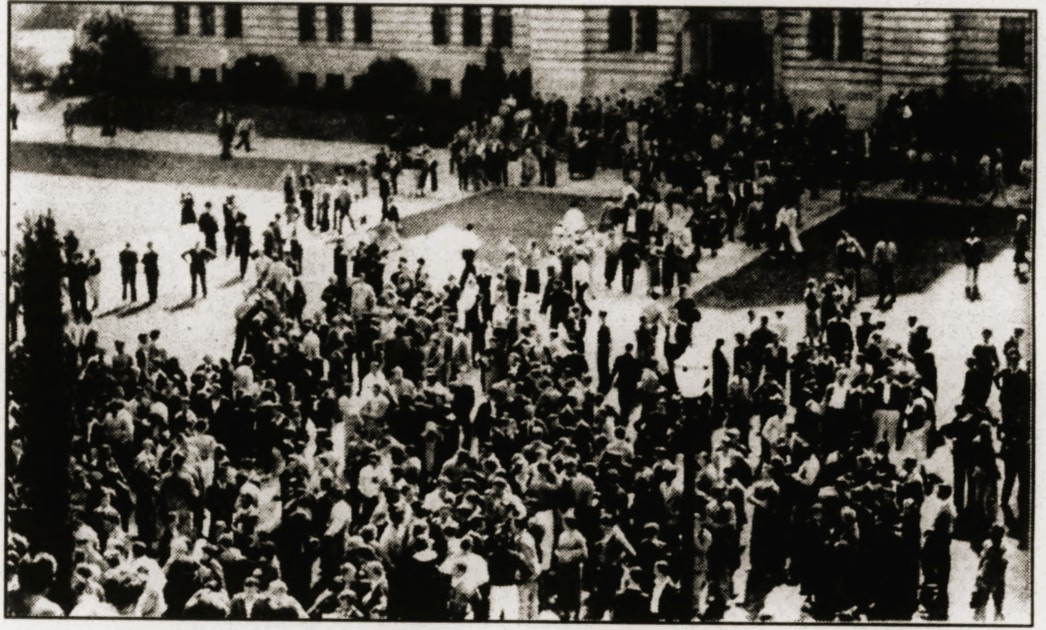
The meeting continued. Football players, summoned by an administrative official, elbowed through the crowd, trying to scatter the meeting. Then sirens drowned the speaker’s voice. The riot squad was here, fifty of them. It was the first time most of the 3,000 students had come face to face with the “law” under such circumstances. They were bewildered.
Hold That Line
The meeting was over as far as speakers were concerned, but the students remained. The crowd broke up into hundreds of small discussion groups. Every member of the Reinstatement Committee was the center of a group. The cops tried to wedge into the center, but the students only crowded in closer. Finally, the groups dispersed of their own accord. We had protested, and we had learned.
In the days that followed, the fight assumed many appearances. Dr. Moore hurled vituperative charges against the students, and against the National Student League in particular. The familiar red herring reached a point where it walked by itself, like Hamlet’s ghost. The newspapers carried daily scareheads: ‘“Ten More UCLA Suspensions Rumored.” The Student Committee for Reinstatement met daily and issued bulletins on the latest developments.
At Los Angeles Junior College, 675 students signed a petition demanding immediate reinstatement and recognition of student rights. Berkeley staged a protest meeting. Stanford protested editorially. Outside organizations began to respond. Nationwide protests swamped the Provost’s office.
Meanwhile, a vigilantes group had been organized. The athletes were at the bottom of it, of course: it has become an almost predictable development in college struggles that the athletes will be on the side of administration and reaction. Naming themselves the “UCLA Americans,” two hundred swore an oath pledging themselves to “drive radicalism off the campus, by force if necessary.” Now, Dr. Moore assured the press that the great mass of students (200) were supporting him, whereas only a small subversive element (3,000) sympathized with the radicals.
Once again, the reactionary forces which had lobbied for the suspensions renewed pressure upon Dr. Moore. The American Legion, the D.A.R., the Better America Federation, all gave the campus the appearance of a convention hall as they formed lines two miles long outside his office to congratulate him on his prompt action in saving the school from destruction. Dr. Moore preened, and issued daily statements to the press, of which the following is an especially pearly bit:
“The stage was set to deliver the University to the untender mercies of the National Student League.”
Look behind the apparent actors in the UCLA playlet. That shining young David, Dr. Moore, those double-barreled Better America Federationists, and the starspangled Daughters, are mannikins strung to the hands that direct all reactionary activities in California: the large shipping trusts, the banking interests, the industrial interests of the State.
On the Board of Regents itself the following groups are represented:
Southern California Edison Company, which helps to finance the Better America Federation, a radical-baiting organization; Security First National Bank, whose chairman was on the Morgan preferred list; Anglo-California National Bank, controlled by Standard Oil of California; Crown Zellerbach Paper and Power Company, whose holdings extend from California to Canada, New York and Honolulu; Pacific Steamship Company, noted for its brutal role in the West Coast maritime strike; Southern Pacific Railroad, with two and a half billions of assets; Metropolitan Life Insurance, the second largest corporation in America; of America.
As the implications of the suspensions became more apparent, the fight spread beyond the boundaries of the campus. The NSL went on the air—two radio broadcasts of fifteen minutes each. Liberal organizations, discussion groups, churches and clubs added their resolutions to the pile which was rapidly overshadowing the reactionary stack. Workers became aware of a striking resemblance between the treatment of the students and the treatment which they themselves have received at the hands of the large industrialists and their henchmen. Only a few months ago we had sent truckloads of students to picket at San Pedro. Now one of us would tear into the room yelling: “The carpenter’s local and the rubber workers are back of us!” Trade union papers carried.
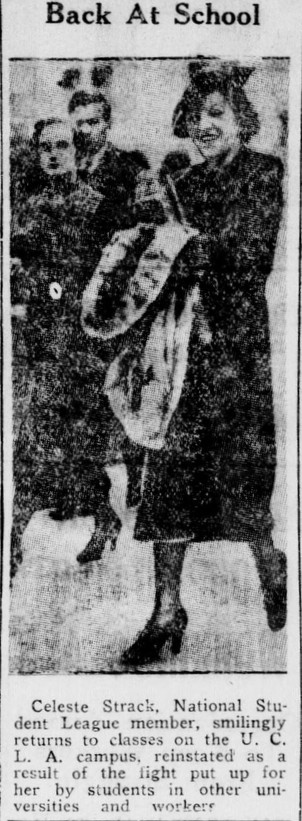
Pacific Gas and Electric; and The Bank; the story; we began to feel that we were really a part of an enormous fighting front that reached far beyond campus boundaries. In the third week of the suspensions, our first victory came. The four boys were unconditionally reinstated and restored to their student-body offices. Later in December, I, too, was permitted to return to school on a similar basis, and the emphasis now swung to the struggle for a student-controlled open. forum. The semester has just closed, and the local National Student League is preparing to open the new term with an increased drive for a student-controlled open forum.
The Fight Begins
Just as we achieved the reinstatement of the suspended students by mass action, so must we utilize the same tactics in this struggle for a student-controlled Open Forum. Our victories in the past do not necessarily betoken an end of administrative terrorism at UCLA. Dr. Moore’s capitulations in the matter of the suspensions simply mean that in that instance he was not prepared to back up his actions; it does not mean that similar actions will not occur again, and with greater severity. Student vigilantism is by no means laid under;—rather, its possibilities are just beginning to be realized by administrators of the Moore and Robinson type. The possibilities of an organized student fascist drive portends a danger which must be countered with organization among militant and class-conscious students, stronger, more thoroughgoing, better aware of what they are doing than ever before.
Emerging from the 1931 free speech struggle at City College of New York, the National Student League was founded in early 1932 during a rising student movement by Communist Party activists. The N.S.L. organized from High School on and would be the main C.P.-led student organization through the early 1930s. Publishing ‘Student Review’, the League grew to thousands of members and had a focus on anti-imperialism/anti-militarism, student welfare, workers’ organizing, and free speech. Eventually with the Popular Front the N.S.L. would merge with its main competitor, the Socialist Party’s Student League for Industrial Democracy in 1935 to form the American Student Union.
PDF of original issue: https://archive.org/download/student-review_1935-03_4_3/student-review_1935-03_4_3.pdf
 Revolution's Newsstand