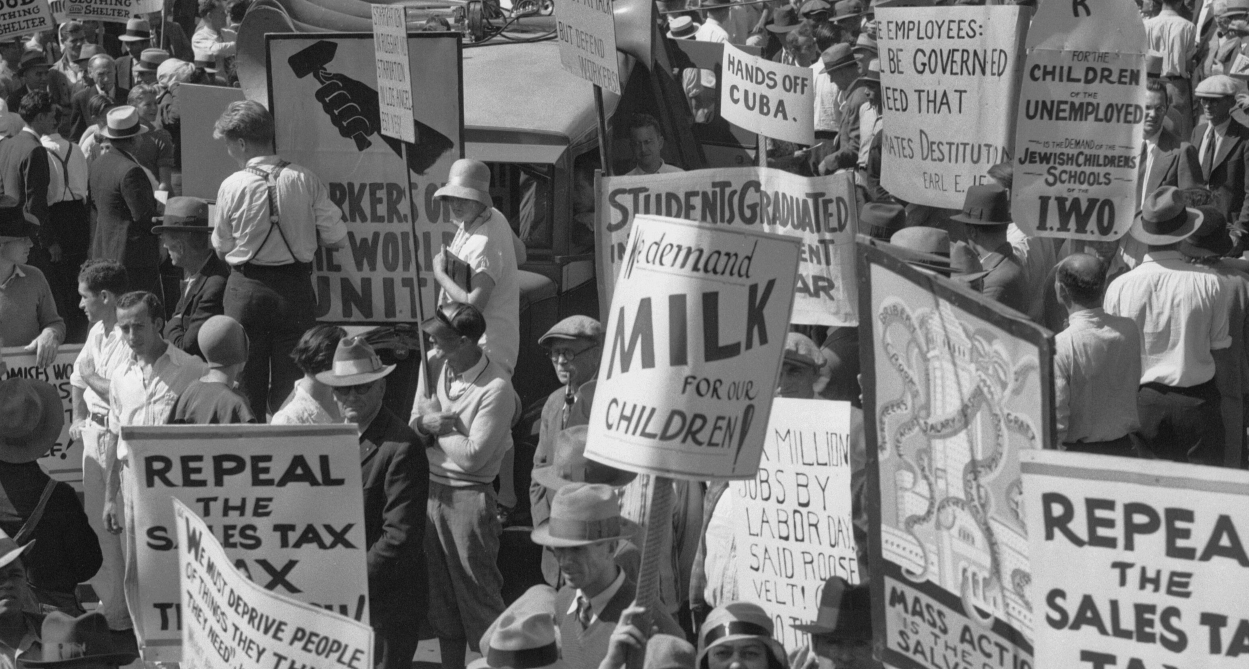
In terms of membership, 1930 was the low-ebb for the Communist Party in the years before World War Two. The 20s had been hard, with reaction and relative stability whittling away at the movement, followed by the splits and expulsions of 1928-9 where it lost a third of its members and a good portion of its leadership. With just over 6,000 members, generously, and facing the ‘Third Period’ in which the C.P.’s aimed for power, the main issue was recruitment. District 13 of the Party, then including all of California plus Arizona and Nevada, counted just 300 members in 1930. Below, the Los Angeles Section Organizer on the Party’s restructuring and attempts to rebuild.
‘Reorganization in the Los Angeles Party’ by C. Clark from the Daily Worker Vol. 6 No. 370. May 14, 1930.
(Organizer, Los Angeles Section.)
The last week in March, the Party units were reorganized in Los Angeles. Here it was not only a question of the absolute absence of any shop nuclei but also of an absolutely wrong organization of the street units. The re-organization brought to light many weaknesses existing in the organization and exposed to the light of day serious manifestations of right tendencies on the part of certain sections of the membership. The section committee has been aware of outright opportunist tendencies, ideology and activities existing in the fraction of the N.T.W.I.U., the cooperative, and a number of language fractions. It is not the purpose of this article to analyze the situation in these various parts of the organization. It is necessary only to point out that the comrades who participate in the activities mentioned and who commit right mistakes carry their ideology into the units and there leave a definite impression. The reorganization of the units, therefore, brought out and exposed these manifold weaknesses.
Old Form of Organization.
Prior to the reorganization there were nine street units, five of these met in the section of the city known as Boil Heights. All of these units met in the Cooperative Center. They met on the same night at the same place. The remaining four units all met at the headquarters of the Party located in the downtown section of the city. The independent political activity of the units was absolutely lacking. Even in a purely organizational sense all initiative was absent in the work of the units. In arranging for distribution under the old methods, two or three comrades would be stationed at the Cooperative Center and the same number at the Party headquarters. The membership of the five units meeting in the Cooperative Center would be told to report there, the members of the other units to report to the Party headquarters and there each comrade reporting would be assigned his factory or streets for the distribution of literature. The units, therefore, were deprived of the initiative in organizing their respective members for this work and developed no independent methods for the selection of territory, factories, etc. The membership as a whole was assigned to the various units absolutely without plan or selection of territory for the units. It was therefore, one of the main problems of reorganization to establish the units on a correct organizational basis.
The activities of the Party prior to reorganization were very largely confined to the Boil Heights section of the city and further to the Jewish section of the population. One of the immediate results of reorganization was the distribution of activities throughout the city. Units were organized on a basis of where comrades lived. The factories and perspectives of factory work as well as distribution of functionaries in the units were the important problems involved in reorganization. Thirteen street units and two shop units resulted from the reorganization.
Developing Political Initiative.
The reorganization laid the basis for beginning of solving of one of the main problems and that is developing of political initiative of the units. One of the first tests of independent initiative on the part of the units came with the arrangement of meetings for the defense of the Soviet Union organized throughout the city. All units were instructed to organize such meetings. The meetings were to be organized entirely on the initiative of the units themselves. The units were to prepare leaflets, to include in the leaflets not only the general purposes of the meeting but such issues as would appeal to the workers in the particular factories or neighborhood. The units were to arrange their own distribution, their own chairman of the meeting, their own defense, their own drive for new members, speakers, etc. In connection with the first attempt five meetings involving seven units materialized. The other six units failed to arrange such meetings. However, the meetings that took place indicate the tremendous possibilities and value of this work. The meetings mobilized a total of five hundred workers, took applicants to the Party and reached workers primarily that had never been reached before by the Party. A larger number of Mexican* workers came to these meetings than to any * one large indoor mass meeting ever arranged by the Party in this section. Encouraged by these results the Party proceeded to organize similar meetings on April 24th for the purpose of mobilizing for the 1st of May. The subject of these meetings was May 1st. This time eight meetings were arranged, altogether eleven units participating; a total of 19,000 leaflets were issued by the units for these meetings, 16,000 of these mimeographed, 3,000 printed. The leaflets were written and distributed by the units themselves. Three of the meetings were broken up by the police, one was not held due to poor distribution of leaflets. Four of the meetings, however, were highly successful. At one of the meetings fifty Mexican workers attended, fifteen of these joined the Party. At another meeting where Negro comrades spoke, two Negro workers and four others joined the Party. At third meeting twenty-five Mexican workers and over fifty others attended.
Expanding Activities Worry Police.
The extension of Party activities are of great concern to the local bourgeoisie and the police. Owners of halls are visited by the “Red Squad,” are appealed to and threatened into refusing halls to Communist organizations. The fact that Communist Party units have been definitely established and have held successful open meetings in the Negro neighborhood, the Mexican neighborhood and in other entirely new working class neighborhoods is of tremendous significance. This independent activity as begun by the units paves the way for serious factory work throughout the city.
Organization of New Units.
Outside of Los Angeles proper it is not a question of reorganization. There it is a question of building new units. The Party recruiting drive resulted in the organization of a Party nucleus in San Pedro composed of marine workers. Since then two nuclei have been established, one in San Bernardino and Colton, the other in the Imperial Valley. This is only a beginning which is by no means satisfactory as yet. The possibilities for the building of Communist Party units in many important cities and sections of this territory are very great. The section still has the task of seriously undertaking the building of the Party organization outside of the city of Los Angeles proper.
Manifestations of Right Danger.
The fact that only a section of the membership participated in all of the activities and a large number of Party members were passive and inactive was clearly brought out through the reorganization. The reorganization imposes great duties upon every member. The units themselves call upon the membership to participate in distribution, to carry out the various activities of the Party. It became more difficult for the passive elements to escape unnoticed. The reorganization therefore brought squarely to the passive members the question of their activity in the Party. Among the right elements there is grumbling and dissatisfaction with the new organization of the Party units. The elements that continually state that “they cannot participate in factory distribution,” that they are too “tired,” etc., also speak of the good old times when units were attended by as many as twenty-five comrades, five or ten of whom carried on the actual work. At the present time the size of the units is smaller, more comrades have to be drawn into work. The experiences of reorganization in Los Angeles brought out the correctness of the organizational letter of the C.I. which points out that many of the old cadres become tired and passive whereas fresh elements drawn into the Party work show revolutionary will and understanding for work much better than many of the so-called “1905” revolutionists. The passive opportunist elements will automatically eliminate through proper organization of work, check-up, etc., and when called upon to work capitulate before the difficulties of the new forms of activities necessitated by the sharpening class struggle. New revolutionary American elements and the best elements among the foreign born workers take their place and sink ever deeper roots into the masses.
The Daily Worker began in 1924 and was published in New York City by the Communist Party US and its predecessor organizations. Among the most long-lasting and important left publications in US history, it had a circulation of 35,000 at its peak. The Daily Worker came from The Ohio Socialist, published by the Left Wing-dominated Socialist Party of Ohio in Cleveland from 1917 to November 1919, when it became became The Toiler, paper of the Communist Labor Party. In December 1921 the above-ground Workers Party of America merged the Toiler with the paper Workers Council to found The Worker, which became The Daily Worker beginning January 13, 1924.
PDF of full issue: https://www.marxists.org/history/usa/pubs/dailyworker/1930/v06-n370-NY-may-14-1930-DW-LOC.pdf
 Revolution's Newsstand