A substantial report from Japan to the Sixth Comintern Congress in 1928 covering the economic situation, internal and colonial politics; bourgeois, reformist, and left wing political parties; trade union and strikes; and the Communist Party, its internal life and activities.
‘Report of the Japanese Communist Party’ from The Communist International Between the Fifth and the Sixth Congresses, 1924-28.
ECONOMIC SITUATION.
AFTER the great earthquake in 1923, Japanese capitalism concentrated its efforts upon the stabilisation and reconstruction of its economy. The government pursued the policy of financial retrenchment with a view to reducing the adverse balance of trade which has been a chronic feature of Japanese commerce for many years past. These efforts were largely successful. Considerable progress has been made in the concentration of important branches of industry and of banking.
In 1923, big companies with a capital of one million yen and over, representing 8 per cent. of the total number of joint stock companies in the country controlled 84 per cent. of the total capital in the country. Since then, the process of concentration has been accelerated. Cartels now exist in 20 branches of industry. Fifteen of these completely control more than 80 per cent. of the production in their respective industries. Six big companies practically dominate Japanese economy. Formerly, a syndicate of 22 banks predominated, but this has now been reduced to 5 banks which own 42 per cent. of the total banking deposits.
A notable feature of Japanese economy is the increasing extent to which state capital is being merged with that of the big private companies. Examples of this are the plan to amalgamate the government iron works with other private iron works into one big concern and the reorganisation of the Savings Deposits Branch of the Financial Department under the joint control of the big banking syndicates, etc.
Nevertheless, the inherent problems of Japanese capitalism are far from being solved, and in fact became even more acute as a result of the revolution in China. Business depression prevails and imports continue to be far in excess of exports. The weakness of the foundations of Japanese capitalism was revealed in the financial crisis which occurred in the spring of 1927, the third since the great war. The government was able to avert a complete financial collapse by granting a huge sum of money,—more than 800 million yen—to the banks and the big concerns. But it was unable to prevent the bankruptcy of numerous enterprises, including the firm of Suzuki, one of the largest commercial houses in the country.
Taken on the whole, Japanese capitalism is still on its rising curve: the output of cotton goods, pig iron, steel, copper, raw silk and other important products has increased from year to year. Nevertheless depression has prevailed in the last year or so and output has had to be restricted in a number of industries.

While industry on the whole is developing agriculture is declining. The inherent contradictions in the agricultural industries are becoming more acute and critical. The rural population, overburdened by higher rents, heavy taxes and militarism, is becoming completely pauperised. On the one hand, the ownership of laid is becoming more concentrated in the hands of the banks in the form of mortgages, while on the other hand the landowners are tending to become local bankers or industrialists. The poor peasant class, which constitutes about 75 per cent. of the rural population is growing continuously.
Japanese capitalism continues to look to China and Manchuria as a basis for its expansion and development and in the period under review the penetration of Japan, economically as well as politically has increased. Japan regards China as the chief source of its raw materials and as its principal market. It is significant that over 28 per cent. of the total exports of Japan go to China, and over 10 per cent. of Japan’s total imports come from China.
Japan is successfully competing with the western countries in China, particularly in cotton textile goods and has managed to secure a large proportion of the cotton trade formerly carried on in China by England. Moreover, Japan has large investments in loans and industrial undertakings in China and Manchuria estimated at about 2 billion yen.
While Tanan has taken advantage of Great Britain’s embarrassments in China to strengthen her own economic position there, nevertheless, the Chinese Revolution has also adversely affected her trade as is indicated by the decline in exports to China since 1925 by over 28 per cent.
POLITICAL SITUATION.
Foreign and Colonial Politics.
At the time of the Fifth Congress, the situation in international politics was marked by Anglo-American collaboration and antagonism between Japan and the United States. Since then the situation has changed. During the victorious advance of the national revolutionary movement in China, the Japanese imperialists united with the British and Americans for military intervention in China and for preparations for war against the Soviet Union. This united front, however, has not eliminated the antagonism between them. In fact, it has become more acute.
As the situation in China became more critical for imperialism, the Japanese imperialists became dissatisfied with the maneuvering policy of the Kenseikai government. The government was forced to resign and the Seiukai party formed a government with General Tanaka as Premier, and an open policy of military aggression in China was then introduced. Taking advantage of the state of confusion prevailing in China at the time, the Japanese imperialists occupied practically the whole region of Manchuria and inner Mongolia. The Japanese Consulates now exercise executive power and have their own police force in these territories. Plans for Japanese railway expansion in Manchuria have been vigorously pursued.
The investment of American capital in the South Manchurian Railway, the bloc between Chiang Kai-shek and Feng Yu-hsiang and other facts are symptoms of the rapprochement between Japan and the United States and the struggle in China is now clearly becoming a struggle between the United States and Japan on the one hand, and Great Britain on the other. This does not imply, however, that the profound antagonism between Japan and the United States has been eliminated; it represents merely temporary co-operation for the pursuit of immediate interests in China.
Japan’s co-operation with the United States and her maneuvering with the Chiang Kai-shek government in Nanking have led to strained relations with Chang Tso-lin which has found expression in the latter’s resistance to Japan’s scheme of railway expansion in Manchuria and in the threats of military action uttered by the Japanese government.
In the Japanese colonies, the old policy of forcible suppression by means of the police and the gendarmerie and the forcible expropriation of the rural population is being abandoned in favour of a policy of exploiting the population by means of industrial development with the aid of Japanese capital.
At the same time, however, ruthless measures are taken to suppress the national liberation movement of the colonial peoples and various methods are adopted to disrupt the labour and peasant movement in the colonies.
Internal Politics.
The internal political situation since 1924 has been characterised by the predominance obtained by the bourgeoisie over the landlords of the feudal elements, by the glaring evidence of corruption among the bourgeoisie and by the brutal attacks of the government on the labour and peasant movement. On the other hand, there has been a marked political awakening of the masses and the political struggle between the toilers and the ruling class has become more sharply defined and acute.
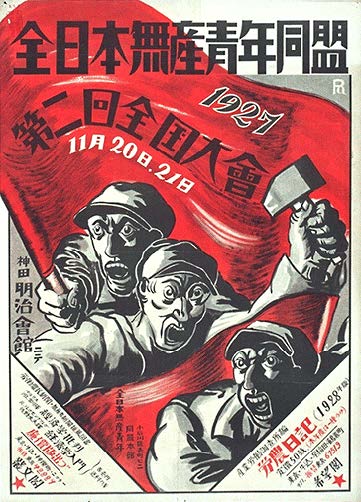
Federation’s second national congress in November, 1927.
The Kenseikai government which came into power with the slogan of “Defence of the Constitution” pursued a policy that was solely in the interests of the bourgeoisie. As a consequence of the demands of the workers and peasants it passed a Manhood Suffrage Act; but at the same time it passed the Peace Preservation Act, which was directed against the Communist and Left wing movement, as well as other anti-labour legislation. The Manhood Suffrage Act, however, served to stimulate the desire among the masses for a legal mass proletarian party. In 1925 the Peasants and Workers’ Party was formed but was suppressed by the government at its inaugural conference, but another party—the Workers’ and Peasants’ Party (Rodo Nominto) was formed in 1926.
The Seiukai government under Tanaka, which succeeded the Kenseikai, initiated an openly reactionary policy against the workers. It has refrained from carrying out its long promised measure of transferring the revenues from the land tax from the State Treasury to the municipal bodies, nor has it passed any measure of social reform. But it has intensified the oppression of the workers and the peasantry, dispersed mass meetings, carried out wholesale arrests of active workers and confiscated newspapers and journals. The government waged a savage campaign against the Left wing organisation during the local elections in September, 1927, and the campaign for the dissolution of the Diet, organised by the Rodo Nominto, was suppressed by the government.
The acute situation, nevertheless, led to the dissolution of the Diet, and to the General Election on the basis of the Manhood Suffrage Act in February, 1928. Never in the history of the Japanese labour movement has the political enthusiasm of the masses risen to the height it did in that election campaign. This served only to rouse the government to still more ferocious acts of oppression. Even in small constituencies, hundreds of militant peasants and workers were arrested.
Notwithstanding the government’s severe repression and the treacherous role played by the social reformists, the militant workers and peasants were able to put up a good fight against the reaction. The Rodo Nominto polled nearly 200,000 votes—a higher vote than that polled by any of the reformist parties—and obtained two seats in the Diet.
The vote of the two principal bourgeois parties was about equal and the Seiukai obtained only two seats more than the Minseito (formerly the Kenseikai) so that even with the support of some of the independent deputies, the government’s vote in the Chamber is a very unstable one. To counteract the bad impression created by the results of the elections (it was practically a defeat for the government) the latter has adopted a still more aggressive policy in China and has hurled its forces with still greater ferocity against the revolutionary movement and the Communist Party. In February and March last, the government suppressed the Rodo Nominto and the Hyogikai—the Left wing Labour Federation—and has carried out wholesale arrests all over the country on the pretext of having unearthed a Communist plot.
THE BOURGEOIS PARTIES.
In 1924 there were four bourgeois parties. In 1926 the Kakushin Club merged with the Seiukai and in 1927 the Seiuhonto joined with the Kenseikai so that now there are only two big bourgeois parties. Besides these there are several independent bourgeois groups like the Jitsugyo Doshikai (the party of the textile industrialists with four members in the Diet), the Kakushinto (a radical bourgeois group with four members in the Diet), and fourteen independent deputies. These small groups are mere appendages of the big bourgeois parties.
The thesis adopted by the E.C.C.I. last July describing the bourgeois parties in Japan still holds good. The thesis states:
“At the present time two main bourgeois parties—the Seiukai and the Kenseikai (now the Minseito), take their place in turn in the government. Not only are both these parties closely connected with big capital, but they represent also the direct and open political agencies of the two most powerful capitalist concerns in the country–Mitsui and Mitshubishi.”
However, whereas the Seiukai is more closely linked up with the nobility, the military and the court cliques, whose role in the government is a very great one, the Kenseikai acts as the representative of the quasi-liberal bourgeoisie which aims at the consolidation of the government machine of capitalist exploitation by more “liberal” methods. Thus, in 1925, the Kenseikai extended the franchise. Unlike the Seiukai, the Kenseikai also takes up a more moderate attitude towards the U.S.S.R.
There is no doubt, however, that on this point, as in the struggle against the revolutionary movement in the Japanese colonies and in Japan itself there is no essential difference between these two parties.
It must be observed that in order to quieten the demands of the peasantry, the Seiukai has planned a Stolypin type of agrarian reform the aim of which is to create a large class of small holding peasants by means of long term credits. It is also encouraging the development of auxiliary reactionary forces like the Ex-Soldiers’ Association, Young Men’s Association, etc.
REFORMIST PARTIES.
Workers’ and peasants’ parties came into being in Japan only in 1926. The reformists desired to establish a legal party like the British Labour Party, but the masses demanded a more radical organisation. Right from the very first, therefore, the reformists strove to isolate the Left wing movement.
In December, 1926, they formed the Shakai Minshuto (Social Democratic Party) with a reformist platform and programme. This party is based on the affiliation of Right wing trade unions, like the Rodo Sodomei (General Federation of Labour), the Kangyo Rodo Sodomei (the Federation of Government Employers’ Union), and other unions, having a membership of 100,000 in all, and in addition has an individual membership of 150,000. This Party is led by pure reformists like Suzuki, the chairman of the Rodo Sodomei, and by Professor Abe, the renegade Akamatsu, Nishyo, and Matsuoka, both the latter reactionary leaders of the Rodo Sodomei.
The Party is openly identified with the class collaboration schemes of the bourgeoisie. It supports Chiang Kai-shek in China, and strives to model itself upon the policy of MacDonald in England.

30-volume collection of Marxist
writings.
In the last local election it advocated a number of petty reforms, but obtained only an insignificant number of votes. It put up a number of candidates in industrial districts during the general election on a reformist platform, and won four seats. The leaders of the Party are already striving to come to an understanding with the Government, and have given their approval to the “timely measures” taken by the Government to suppress the Left wing organisations.
The Nihon Ronoto was formed by the treacherous “Left” opportunist leaders at the same time that the Social Democratic Party was formed. This Party is based on the affiliation of the trade unions, which broke away from the Rodo Sodomei on account of the class collaboration policy of the latter, and have a membership of 50,000. It also has the affiliation of peasant organisations, having a membership of 30,000, and an individual membership of 12,000. The theoretical basis of this Party is provided by a group of intellectuals gathered around the magazine “Social Ideas.” The Party leaders conceal their reformism by a screen of “Left phraseology,” calculated to prevent the masses from swinging into the revolutionary camp. They have rejected the united front with the Rodo Nominto, but under the pressure of the masses were compelled to participate for a time in joint campaigns like “Hands Off China,” “Dissolve the Diet,” etc., but broke away from them very soon. They attempted to run campaigns on their own in rivalry with the Rodo Nominto, but without success. In the General Election only one of the Party’s candidates was returned. Its press joined with the Social Democrat and Fascist press in exposing the illegal Communist Party to the Government.
The Nihon Nominto, which was formed in 1926 as a workers’ and peasants’ Party, is led by Right wing peasant leaders. Its membership is insignificant, and it is, in fact, united with the Nihon Ronoto.
LEFT WING PARTIES.
The Rodo Nominto has stood out as the most radical legal Party of the proletariat and the peasantry. It is based on affiliation of Left wing trade unions with a membership of 80,000, and of peasant organisations with a membership of 60,000. In addition it has 20,000 individual members. The party has pursued a radical policy sympathetic towards Communism. It opposed the Geneva International Labour Office and class collaboration and came out in support of the Soviet Union. In spite of its mistakes and shortcomings, it succeeded in rallying the masses of the workers and peasants around its banner against the ruling class.
In the summer of 1926 it commenced a mass campaign for the dissolution of the Diet. It also put up a strenuous fight against the government’s plan to transfer all the burdens of the financial crisis to the shoulders of the toilers. It revealed certain democratic illusions when, for example, it convened the so-called “People’s Conference,” which included representatives of the petty bourgeoisie, against the reactionary government. Among other campaigns conducted by the Party was that against intervention in China and for the recognition of the Wuhan Government and the campaign for the so-called “five laws” (8-hour day with minimum wage; free speech, free press, and right of assembly and strikes; non-contributory unemployment insurance and legal recognition of trade unions and tenant farmer unions).
The Party put up a number of candidates during the last local elections with good results. In the last General Election the Party was subjected to severe repression by the Government. Thousands of its members were arrested, its meetings were broken up by the police and its literature confiscated. Nevertheless, the Party obtained a good vote and two of its candidates were elected. Soon after the election over a thousand of its most active members were arrested in connection with the distribution of Communist leaflets and the party was suppressed.
At the end of 1927, the Rodo Nominto attempted to unite all the proletarian and peasant parties. Failing to understand the united front tactics properly, it proposed “an unconditional amalgamation” of all the existing proletarian and peasant parties including the Social Democratic Party and the Nihon Nominto. The Social democratic leaders, however, rejected the proposal. The centrist leaders in order to pacify the rank and file who desire unity with the Left wing workers, pretended to favour the proposals, but in reality inclined to the position of the Social Democratic Party.
THE TRADE UNION MOVEMENTS.
At the end of June, 1927, the number of organised workers in Japan was estimated at 316,900 out of a total of 4,576,666 industrial workers, or only 6.8 per cent. The best organised sections of the working class are the metal workers, the transport workers, the textile workers and the miners. The number women workers organised is 14,000.
The trade unions are split up into many small units. There are 337 unions of which 260 are federated in 29 organisations; the rest are independent.
The existing trade union organisations may be grouped into three sections: the Right wing, the centre, and the Left wing. The Right wing is represented by national] unions and federations like the Rodo Sodomei, the Kanyo Rodo Sodemei, the Japan Seamen’s Union, the Seamen’s Association, the Arsenal Workers’ Federation, the Jun Kodjokai, etc. The influential organisations at the centre are the Kumiai Domei (the Japanese Federation of Trade Unions), the So-Renga (the Japanese Federation of Trade Unions), the Ship Stewards’ Federation, and the Pottery Workers’ Federation. The Left wing is composed of revolutionary trade union organisations like the Hyogikai (the Trade Union Council of Japan), the Salaried Workers’ League, the Tokyo Municipal Workers Union, etc. Several of the national industrial federations like the Japan Transport Workers’ Federation, the Kansai Electrical Workers’ Union, etc., are near to the Left, or rather stand between the Left and the centre.
The Right wing unions stand for partial improvement of Jabour conditions to be obtained by means of class collaboration. Most of them support the Social Democratic Party. The centre identifies itself with the policy of the Nihon Ronoto, and talks about “realist” action. Its influence in the general labour movement, however, is small.
The Left wing stands for class struggle and for the emancipation of the proletariat by mass action. Influenced by the mistaken policy conducted at that time by the Communist Party, the Left wing trade unions in 1927 advocated the concentration of all forces on political action to the neglect of industrial action. However, at its third Congress held in May, the Hyogikai adopted a new policy, which properly recognised the functions of trade unions.
The outstanding activities of the Left wing trade unions were their efforts to form factory committees and factory delegate meetings, to organise support for strikes and to organise the unorganised. Early in 1927 several conferences of delegate meetings were called to demand the revision of the Health Insurance Act, and the movement of this spread to all industrial towns. The Left wing carried on agitation against the Geneva International Labour Office, carried on a successful campaign in favour of the Pan-Pacific Labour Conference, and officially elected its own delegates to it. The Trade Union Unity League, to which all Left wing trade unions are affiliated raised the slogan of: “Freedom of trade union members to belong to any party,” and is fighting for real class unity.

During 1927, three national organisations of working women were formed belonging to the Right, centre and Left respectively. The activities of women workers in 1927 was most marked. Out of a total of 631 disputes which occurred up to the end of September, 23 were conducted entirely under the leadership of women.
The total number of industrial disputes in 1927 was 1,012, involving 83,617 workers. Of these disputes, 45 per cent. were due to dismissals of trade unionists or other forms of victimization.
The number involved in any one strike have tended to grow as also has the duration of strikes. A large number of strikes have lasted for one and two months, and the big Noda strike lasted for over six months.
In regard to the peasant unions (tenant and tenant-owner unions), there were at the end of 1927, 4,320 organisations with an aggregate membership of 362,533, which marks a big increase since 1926. The representative organisations are: the Nihon Nomin Kumiai (Japan Peasant Union, 60,000 members, Left Wing); the All-Japan Peasant Union (membership 30,000 centre); the General Federation of Peasant Unions of Japan (membership 3,000, supports Social Democratic Party); the All-Japan Federation of Peasant Unions (membership 10,000, supports Right wing Peasant Party); the Middle Japan Peasants’ Union (membership 7,000), etc.
All these unions, and particularly the Nomin Kumiai fought actively against the injunctions prohibiting tenants from entering the land they cultivated. The number of disputes between tenants and landlords up to the end of November, 1927, was 1,034, involving 48,558 tenants. The disputes centred around demands for reduction of rents and against the payment of taxes. In these disputes the landowners and the government mobilised the police force and on numerous occasions sanguinary conflicts took place.
THE COMMUNIST PARTY.
Splits and Errors.
The period since the Fifth Congress has been a trying one for the Japanese Section. In 1924 a wave of liquidation tendencies swept over the Party and those who are in control turned renegades and filed to the enemy camp. A group of comrades who remained loyal to Communism set to work to rebuild the Party. The conference was convened in January, 1925, at which it was decided to form a Communist group. Although this group represented the most revolutionary section of the labour movement, it nevertheless bore a sectarian character. In essence, the theory and policy of the leading comrades was idealistic and as a consequence the group became involved in many serious errors. Its inherent weakness was completely exposed at the time when the antagonism between the Left and Right wings in the labour movement reached its climax. Not only did it reveal the old liquidatory, sectarian tendencies in a new form, but it committed other grave political mistakes which, in the more advanced state of the movement, were more profound than those committed previously. The gravest of these errors was the advocacy of the so-called “split and unity” tactics which aimed to split the trade unions and the political parties. This was the policy that prevailed at the Inaugural Convention of the Communist Party in December, 1926.
The year 1927 presented a good opportunity for the Party to make progress. The most advanced section of the workers realised the necessity for a Communist Party and eagerly looked forward for its establishment. On the outbreak of the financial crisis in the spring of 1927, the Japanese Communists realised the necessity of carrying on (as a Party, not as a group), the work among the masses and establishing the basis for its activities in the factories. Later on it began to form factory groups and the need was recognised for opening the Party’s ranks to wider circles of the militant workers and to public proclaim the existence of the Party to the masses.
The Comintern and the Japanese Question.
Meanwhile the E.C.C.I drafted theses and a resolution on the Japanese question containing an analysis of the international and internal situation in Japan and characterising the coming revolution as a bourgeois democratic revolution because the bourgeoisie is the driving force of that revolution and in the end determines the strategical lines of the Japanese Communists. The thesis emphasised the need for establishing an alliance between the proletariat and the peasantry, and for building up a mass Communist Party. It severely condemned the two main deviations in the Japanese Party, namely, liquidation and sectarianism—which were due primarily to the predominance of intellectuals in the Party, and laid down the tactics the Communists were to pursue in the trade unions and other mass organisations. In addition its clearly defined the immediate tasks and programme of action of the Japanese Party.
While the Party continuously condemned “ultra-Leftism,” which was the direct product of the policy of Kuroki (one of the leaders of the Party at that time), it was unable, however, to perceive the fundamental error of Kuroki’s theory and policy, but tried to attribute the mistakes committed to the “misinterpretation” of this theory, and to the “survivals” of the old leadership represented by Yamakawo in the Party and by this tried to quieten the discontent among the masses.
Finally, in the middle of 1927 the Kuroki theory emerged in the form of definite opportunism which may be described as—democratic illusion. Our comrades perceived the bourgeois democratic revolution as something totally separate from the social revolution and spoke only about “political liberty,” a “democratic parliament,” etc. On this basis they urged the Rodo Nominto, during the local elections to enter into a bloc with the Kokushinto—a small radical bourgeois group, while rejecting the united front with the Social Democratic Party and Centrist Party.
On the other hand, the Party set to work to establish factory nuclei, to publish factory newspapers, and distribute secret literature, but being hampered by this opportunist policy its efforts did not meet with the desired success.
At this stage the liquidation group (Yamakawa, Arahata, Inomata, Kitaura, etc.) who dropped out of the Party and formed an oppositional group seized upon a brief report of the decision of the E.C.C.I. on the Japanese question, which was published in “Pravda” in August, 1927, to commence a bitter attack upon the Party. It claimed that the E.C.C.I. decision was a justification of their liquidatory policy. Although the Left wing workers showed their strong resentment towards this scandalous attack upon the Party, the latter took no stand towards it, but remained silent.
Soon after, however, the Party recovered from its confusion and commenced activities on the basis of the E.C.C.I. decision. The publication of the complete text of the thesis of the E.C.C.I. in Japan was welcomed with great relief and sympathy by the militant workers. The Party also published its own political thesis accompanied with an appeal addressed “to the revolutionary workers of the country,” and distributed these among these masses. Work was undertaken to enlarge the Party and build it up on the basis of factory nuclei.
The Party and the Elections.
The Party took the occasion of the general election to publicly proclaim its existence. In the elections it displayed great activity and immediately became the rallying point of the revolutionary forces the Japanese proletariat. Large quantities of literature stating the platform and the programme of the Party were distributed. The Party also issued the slogan: “Workers’ and Peasants’ Government,” and as a result of its propaganda this slogan was taken up by the Rodo Nominto.
The activities of the Party and the success met with aroused the government to take still sterner action against the whole of the Communist and Left Wing movement. In the middle of March the government carried out wholesale arrests of Party members and active members of the Rodo Nominto and Left Wing trade unions, suppressed these organisations and has taken measures to prosecute these comrades on a charge of conspiracy.
General Activity and Campaigns.
Apart from the activities carried out by the Party in the industrial and political movements already mentioned in this report the Party initiated and carried out through the various organisations a number of other campaigns and activities. Among these are: the campaign in defence of the Chinese revolution; the campaign for the release of the arrested Korean Communists and the campaign for the establishment of workers’ defence corps against the Fascist organisations. In the trade union movement the Party succeeded in securing the representation of the Left Wing trade unions to the Pan-Pacific Trade Union Congress.
The Party actively led the Left Wing movement in the peasant organisations. It also successfully carried on activity in the Suiheisha (the organisation of the “Eta” outcasts) and succeeded in forming a League for the Support of the Rodo Nominto within that organisation.
Notwithstanding the persecution of the government the Party was able to devote considerable activity to publications, etc. The “Musansha Shimbun” (the Proletarian Paper), of 4 pages published six times a month, was founded in September 1925 and reached a circulation of 35,000. Last February the Party commenced the publication of an illegal organ, “The Red Flag.” In addition to this, a number of legal monthly magazines and papers were published; for example, “Marxism” (5,000 circulation), the “Workers’ and Peasants’ Movement,” “Political Criticism,” the “International,” etc. A number of factory newspapers have also been published.
A considerable quantity of Marxist-Leninist literature has been published. Of Lenin’s works ten volumes have appeared and arrangements have been made to secure the translation and publication of Lenin’s complete works. Arrangements have also been made for the publication of a Marx and Engels Library and the works of Bukharin and Stalin.
 Revolution's Newsstand