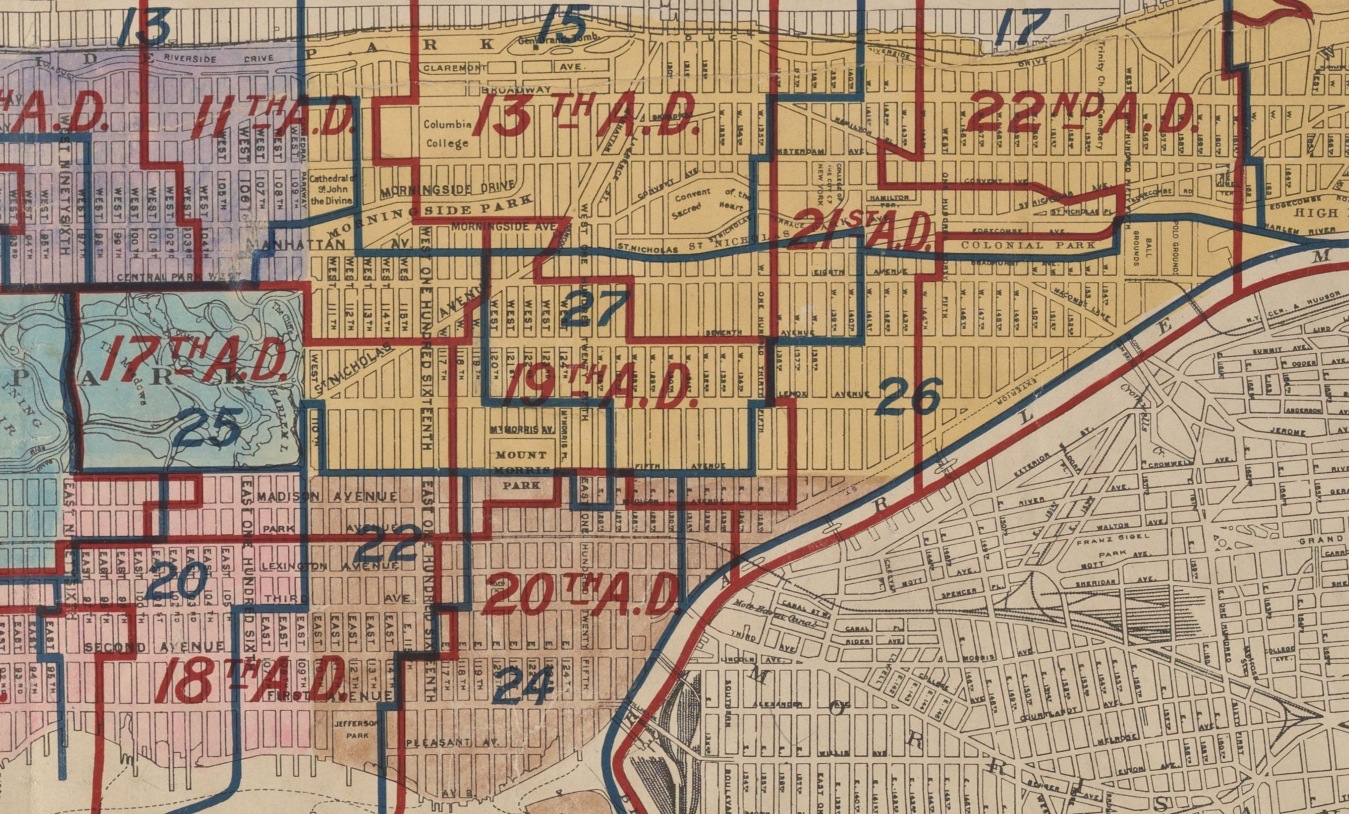
In this second week of an expose on Harlem housing by James S. Allen (Sol Auerbach), which in addition to its other merits is a fine work of social history, a look at the Black church as landlord, middle-class ‘model’ developments, rent parties and the underworld, and a survey of work and wages of Black New York It begins with Richard B. Moore, President of the Harlem Tenants League, urging an organized response. The next week will look at East Harlem, the center of Puerto Rican and Latin American communities.
‘Negro Workers Must Slave for Bosses and Landlords’ by Sol Auerbach (James S. Allen) and Richard B. Moore from The Daily Worker. Vol. 6 No. 39. April 20, 1929.
Tenants Urged to Organize Against Tenement System by Richard B. Moore. April 15, 1929.
President of Harlem Tenants League Says Only Mass Action Can Be Effective
(This is the seventh of a series of articles exposing the conditions under which the Negro workers are forced to live in Harlem, Previous articles dealt with the tenement conditions in various parts of Harlem. The present article, written by Richard B. Moore, president of the Harlem Tenants’ League, tells of what, the League is planning to do. Tomorrow the Daily Worker will continue its exposure of housing conditions in Harlem.)
THE flood of rent raises and dispossesses which the landlords are letting loose upon the exploited workers of this city is at its worst in Harlem. The capitalist caste system which segregates Negro workers into Jim-crow districts makes these doubly exploited black workers the special prey of the greedy rent-gougers. Black and white landlords and real estate agents take advantage of this segregation to squeeze the last nickel out of the Negro workers who are penned into “the black ghetto.”
Rents in Negro Harlem are already often double and sometimes treble those in other sections of the city. The landlords refuse to make repairs, causing the most vile and unsanitary conditions to exist. Overcrowding is rife and degrading social practices are forced upon these black toilers who are hammed in and ground down under this vicious system of capitalist landlordism.
Death and Degradation.
Vainly do these workers pinch and stint and contrive to meet these impossible rents which rise constantly ever higher and higher. The death-rate tells something of the terrible and ghastly story of this segregation and exploitation. Negro workers die more than twice as fact from consumption and certain other diseases; black babies perish at oven twice the rate of babies in other sections of the city. Still rents mount, higher and higher! Yet the wages of Negro workers are the lowest and their chance to get a job of any sort the j poorest. The last to be hired and the first to be fired, they are the greatest sufferers from the present widespread unemployment. They are heaviest hit, too, by the wage-cuts which the employers have been, constantly handing out to the workers as the reward for their “supreme sacrifice” in the last world war and as their present share for the coming world slaughter which the profit gougers are preparing for the workers of all races.
Wages and Rents.
Today the average wage of Negro workers in New York city is between $18.00 and $20.00 a week. Many women have to support families left fatherless by the war ‘”to make the world safe for democracy”—the democracy of the rent and profit-gougers. They have to leave their children on the street or with neighbors or in beastly day nurseries while they toil cooking, scrubbing, cleaning other peoples houses, and caring for the children of the oppressors, ten and twelve hours a day, seven days a week, for $10.00, $12.00, $15.00!
Out of these wages they have to meet the ruthless rent squeezers who demand $30.00 and $40.00 a month or 3 and 4 room flats without heat, often without hot water or baths, with ceilings coming down and walls falling apart, noisy dumps unfit for human habitation.
For the “better class” apartments, with steam heat and hot water now and then, the fat landlords, pillars of the church and respected citizens of capitalist society, demand $40.00 for 1 and 2 rooms, $46.00, $50,00, $60.00 for 3 and 4 rooms, $70.00, $80.00 and $100.00 for 4, 5 and 6 rooms, and so up the scale. A vicious and crushing circle of exploitation and oppression!
More Raises Soon.
LAST December, following the expiration of the rent laws, which were only introduced on mass pressure from the tenants, for apartments renting between SIO.OO and $15.00 per room per month, the landlords immediately set to work. Raises ranging from $5.00 to as high as $35.00, were handed out wholesale and dispossesses served upon thousands of families.
But this is nothing to what is coming when these laws expire for the poorest class and for all tenants at the end of next month. More rent raises and dispossesses will follow.
Mass Pressure Needed.
Only the united, organized, mass pressure of the tenants and workers, will avail in the least to stem this tide of rent profiteering. Only this power will avail to compel decent housing standards and to abolish vile slums in which black and white workers rot and burn to death.
THE Harlem Tenants League since its formation a year ago in January has led the struggles of workers and tenants of Harle against rent profiteering and vile housing conditions. Through the streets and houses of Harlem, thru mass meetings and demonstrations, through exposures in the press and before the legislature and officials at Albany and city hall, in the courts, in every possible way, the League has led a vigorous campaign for the protection of tenants and workers.
Other Organizations Join.
In the present rent and housing crisis, the Harlem Tenants’ League has again come to the fore with a program for the organization and active struggle of all the tenants and workers of Harlem to resist the menace they now face. This program reaches out to unite the organized tenants and workers of Harlem with the tenants and workers throughout the city and country.
Already several organizations have lined up for the fight. The New York Federation of Working Women, the United Council of Working Women, the American Negro Labor Congress and other organizations are already at work to call a broad rent and housing conference and to mobilize a powerful mass movement of tenants and workers to meet this rent and housing crisis.
Join Harlem Tenants’ League.
Lying promises and fake “fact finding commissions” as well as worthless bills and laws have been forthcoming from the capitalist politicians, but they have failed absolutely to stop rent gouging or to provide decent houses for the masses.
It is clear to all who follow their record that these politicians are for the landlords and the capitalists and against the workers. The fact is that only the Communist Party has brought forward a basic program and fights with the tenants and workers against the landlords and capitalists.
Tenants and workers of Harlem! Join the Harlem Tenants League! Organize to resist the profiteers! Tenants and Workers, black and white! Unite in a powerful mass struggle against the common enemy! Fight to abolish the system of landlordism and capitalism! Fight for a workers government which will give us a decent housing and social system!
The Church as Landlord—Owns “Rats and Cats Row” by Sol Auerbach. April 16, 1929.
St. Philips Church Exploits Negro Tenants in Entire Block on West 135th Street
(This is the eighth of a series of articles appearing exclusively in the Daily Worker, exposing the conditions under which workers are forced to live. The first six articles, which appeared last week, described the results of an investigation in the tenements of Harlem. Yesterday, Richard B. Moore, president of the Harlem Tenants League, told of its program. Today, the exposure of the conditions in Harlem is continued.)
WE have shown that landlords, supported by legislature and courts, rob the tenants to the extreme for lodgings which are not fit to live in, intimidate them and throw them out on the street. E.A. Johnson, the politician who claims to represent the Negroes of Harlem, robbed Negro workers in his block of tenements on Seventh Ave.
There are other landlords in Harlem besides white and Negro capitalists and politicians. The church is a large landlord in Harlem.
Money-Making Pulpit.
But read along and you will learn that the church, using its creed as a cloak to hide its serviency to landlord, legislature and court, takes no little hand in exploiting the Harlem tenants. The clergy and other “respectable citizens” of Harlem have just given their support to this same E.A. Johnson, the robber-landlord of Seventh Avenue, as the republican candidate to fill the seat in Congress left vacant by the death of Congressman Weller.
The pulpit is a good moneymaking proposition in more ways than one.
“Liberal” Tenements.
St. Philip’s Church, under the actual supervision of Shelton H. Bishop, who calls himself a “liberal,” owns the block of tenements on the odd side of West 135th Street, between Lenox and Seventh Avenues.
The Reverend Bishop lives in a roomy, well kept building, with concert hall and library. He has a cook, he has servants. The church, which also owns this property, keeps it in first class condition.
But come along to this row of six-story tenements, where workers live, some of whom listen to their landlord’s sermons on Sundays, and see if the church is a softer landlord than the capitalist and the politician.
Rats and Cats.
Rats, rats, rats, rats almost as big as cats, and cats bigger than usual cats, is the keynote of this block. Rats because the building is in a state of decay, because the walls are rotten from defective plumbing, because ceilings fall and plaster is loose, because there is no dumbwaiter service, because the floors are coming apart, because the apartments have not been renovated for years. Cats, big and bulky from much rat-meat, because traps don’t catch the rats fast enough and cats are more reliable. You can call this block belonging to St. Philip’s Church “Rats and Cats Row.”
A Disappointed Cat.
“Rats ran me out of here one night,” said A. Fuller, living on the fourth floor at 111, “so I went out and got myself a cat. It used to be so before I got my cat that when you would be sitting here in this room you could see the rats chasing across the hall out there.”
As he spoke, his fat black cat, suddenly dashed across the room and headed down the hall. The rat must have escaped for the cat looked disappointed when it came back.
“We once caught 30 rats at one time in a large cage in the hall,” said Mrs. Williams, living at 125. “The rats terrorize you here. I once opened that dumbwaiter door and saw a rat on the rope staring at me.”
Dumbwaiter Stench.
That is enough to give you an idea of the condition of this property owned by the church. The dumbwaiter has not worked for six years, the bells have been useless for even a longer time, garbage must be thrown down the dumbwaiter shaftway. When you open the door to the dumbwaiter in “Rats and Cats Row”, by all means keep your nose well covered. The garbage is piled as high as the second and third stories before it is removed. In the summer time it is almost unbearable.
More Money for Church.
St. Philip’s as landlord will not disappoint you. You will find everything to be expected from a landlord. No renovations have been made since 1925, and none will be made unless the tenants agree to pay a rent raise.
The rents for old tenants are from $32 to $35 for four rooms, which are poorly ventilated, dilapidated, gas-lighted, inadequately heated and swarming with rats. The tenants have been raised over the rent they originally paid and further raises are now being demanded.
St. Philip’s Church will no doubt be respectable and decorous enough to wait until May 31st when the Emergency Rent Laws expire, to pull over a wholesale rent raise. It also demands its rent on time. Fuller relates how when his rent was three days late the church’s lawyer was sent to collect it.
The Money-Box.
ST. PHILIP’S, like all other “churches of all other denominations, preaches “good-will among men” and “peace on earth.” It preaches this creed to workers who it exploits in its own tenements.
The pulpit from which the Rev’d Bishop and the older Bishop talks is nothing but a money box in which is collected the coins, sweated out: and lived out by the tenants on “Rats and Cats Row.”
The landlord, you see, can he a minister, as well as a legislature and a politician.
Tomorrow we will take you along to talk to Father Bishop himself and see what he has to say about the church as landlord. The Daily Worker has already received a number of letters from tenants in Harlem describing the conditions of their apartments and wholesale robbery. The letters are being published daily. Tenants are invited to write in freely to the Daily Worker.
Minister’s “Social Vision” Is the Vision of a Parasite. April 17, 1929.
Father of St. Philips Wants Good Return On Investment From His Tenants
(This is the eight of a series of articles exposing the conditions under which Negro workers are forced to live in Harlem. Yesterday, the Daily Worker described “Rats and Cats Row” a block of tenements on E. 135th Street, owned by the St. Philips Church. The present article acquaints you with one of the fathers of that church.)
AS you wait in the Parish House of St. Philip’s Church for Father Shelton H. Bishop to arrive you notice that the walls are in good condition, well painted and clean. No cats are needed here to chase the rats. Father Bishop, a brisk and well-preserved man who would pass for an efficient business man if it were not for his clerical collar, comes late and brushes in bubbling with excuses.
“Oh, it takes me so long to get over here. They keep me so busy until late night…”
A Clever Minister.
As you sit opposite the trim Father Bishop you think of carpeted floors, wide sunlit rooms, a butler, servants and a cook.
“Yes, conditions are bad in Harlem,” begins Father Bishop, after listening intently to our introduction and the purpose of our visit. (We have not told him that we know that his church owns a block of tenements.)
“Some of the landlords—not all of them—refuse to make repairs unless they get rent raises, Conditions are unsanitary, the people live in unventilated and diseasebreeding rooms. Not all the houses are bad, however. There are some good houses and some bad ones.”
“Where are some of the good ones located?” we ask, hoping that he will mention among the good ones the row of rat and vermin-breeding tenements owned by his church. But Father Bishop is a clever man.
The Good Ones.
“Well,” he says after some thought, “75 St. Nicholas Place, 853 St. Nicholas Ave…187 W. 135th Street—that is where I live and it is owned by the church.”
“Oh, the church owns property? Does it own more?”
“Yes, it owns the whole block on the north side of West 135th Street with the exception of the library and the YM.C.A.”
“Of course these houses are in as good condition as yours,” we throw in expectantly.
“Oh no,” says the clever Father Bishop. “They are pretty bad. They are kept in bad condition.”
A “Social Vision.”
“How is that? One would think that property owned by the church would be somewhat better.” We did not think so, but we said it only to draw the Father out more.
“Well, you see, I am not the rector of the church, my father is. And the vestry board actually runs the property. The trouble with the vestry board is that they are not accustomed to look at the problem with a social vision. They have to be educated up to it.” “What do you mean by a social vision, Father Bishop?”
A 5 Per Cent Investment.
“Well, looking at the problem from both sides. You will agree with me, won’t you, that anybody is entitled to 5 per cent on their investments? We try to give all we can for the money we get.”
We could not grasp the profundity of this “social vision” on the part of the minister of a church which tries to get all it can out of tenants living in its property, while refusing to spend a cent for repairs and renovations. About all the tenants get from their clerical landlord for their rent is good rat meat for their cats.
A Spiritual Return.
But let the minister himself enlarge upon this “social vision.”
“What we make in profits out of the property we own we return to the people in some form or other. Besides our spiritual help we have a home for the aged, a camp for children and a playroom for boys. If it were not for the apartments we would not be able to take care of the boys who come to play here, who also come from poor families. Nor could we distribute a few hundred Christmas baskets, as we did last Christmas.”
“But do you not feel it to be contradictory for a church to own a tenement block where conditions are at their worse and from the pulpit of that church preach the creed of ‘good will’”?
“Why so? We are just like the owner of a factory who returns to its employees, in some form or another, all its profits.”
Vision of a Parasite.
THAT is the “social vision” of a minister for a landlord church! His appearances are not so deceiving after all, for he is certainly a good business man. To him the suffering of tenants living on a block in Harlem is a matter of dollars and cents. If the church can get 5 per cent on its investment—the vestry board sees to it that it gets more—then the tenants can go without renovations and have all the rats they want. If necessary, the tenants must take rent raises and be served with dispossession notices. The Bishops, father and son, will continue preaching from their pulpit, assured that their income is certain and that the vestry board feels safe.
But the ministers play a more double-faced role than that. Out of the profits they grind from their tenants living in the rat cages on 135th Street, they take a small fraction and make up Christmas baskets. Then they go to the homes of the workers, smiling in Christmas fashion, with Christmas basket in hand, and say, “Now, see how good we are.”
Trick of Charity.
It is certainly a charitable institution! They grant asylum to a few old women whom members of the church and other exploiters in Harlem have worked to death at a starvation wage and diseased in tenements. How kind they must be to allow some thirty boys to play in a room in their parish—under the supervision of the Boy Scouts—while thousands of other children, victims of church exploitation, make the best playgrounds they can out of dirty streets and cubby-holes, sleeping two or three in a bed in some unventilated room.
That is the “social vision” of the church. It is a business vision, which means that it looks upon the great mass of Negro workers as so much material from which to make money and at whose expense clergymen and other “respectable citizens” can live in ease and luxury.
Segregated Segregation.
Not only do they believe in segregation for the Negroes—for it means that they have reserved a whole group of workers to themselves over whom they hold the privileged position of parasites—but they also believe in splitting the Negro workers among themselves so that they can exploit them all the better. It is in this church—St. Philips—that the ushers are instructed to reserve the first few rows for lighterskinned Negroes!
This is social vision for the parasites—both Negro and white—for the exploiters and the robbers of Negro workers.
Tomorrow the Daily Worker investigator will take you to a “model apartment” which has been heralded as a solution for the housing conditions. Come along, and we shall see. Tenants, write in to the Daily Worker, describing the conditions of your apartment and treatment at the hands of landlords.
“Gentlemen of Color” Only in Rockefeller “Model” House. April 18, 1929.
Gets Negro Bosses to Help Him Exploit Negro Workers In Harlem
(This is the tenth of a series of articles appearing every day in the Daily Worker, exposing the conditions under which workers are forced to live in Harlem. Previous articles described unsanitary, crowded conditions, the robbery of landlords whether politician, Negro or white capitalist, or minister and a fight against these conditions which the tenants are beginning to put up. The present article exposes a so-called “model apartment” scheme.)
JOHN D. ROCKKEFELLER, whose name is legion as brutal exploiter of labor of all races and in all parts of the world, has built apartments on the block between Seventh and Eighth Avenues, 149th and 150th Streets, for which he has stolen the name of Paul Laurence Dunbar.
This “experiment in cooperative housing” growing out of the charity of Rockefeller—for which he gets a five and one-half per cent return on his money—has been hailed by his own agents and papers like the New York Times as the action of a “public-spirited and charitable” man. In reality, it is a straight bluff.
It is meant for the upper class—segregated—of Negroes in Harlem. For the mass of Harlem tenants it is useless except for so much scenery to look upon, if they happen to be up that way.
Not for Us.
Housing schemes, such as proposed by the State Board of Regional Planning, such as are carried out by other “public spirited gentlemen” do not fool one single working class tenant anywhere.
If you live in an apartment where you pay $40 for four rooms in a dilapidated house and your imagination is struck by the description of the “model” Dunbar apartments, you will throw the advertisement down the dumbwaiter shaft as soon as you read that Dunbar apartments are available at $77.50 per month and $90 per month.
You will tear it up in fury when you read that a deposit of $50 per room must be paid before you move in towards the sale price of the apartment and that it will take you 22 years to “own” it. In this block of 511 apartments in which live about 2,000 people, the average monthly payment—call it rent or installments towards the buying of the apartment, it is about the same—is $14.50 per room per month. The apartments rent for from $60 to over $100. No lodgers are allowed. No rent parties.
“Charity” Not for Us.
This means that the mass Negro workers in Harlem are definitely excluded. The average earnings of the tenants living in this “model apartment” is from $40 to $50 per month. They are all of “good Christian character,” chosen from a long list of applicants, their lives well looked into.
The average earnings of the mass of workers living in Harlem is about $20 per week. Figure it out yourself. The mass of tenants cannot pay even $10 per room per month. We are definitely out of the circle of Rockefeller’s “charity.” But what is his idea, anyhow?
“Too Respectable.”
MR. and Mrs. Bruce, the managers of the apartments, are highly “respectable people.”
“You know, this development, is not tax-exempt,” said Mrs. Bruce. And then bristling like a society lady on show, “We are too respectable to ask for tax exemption. We feel that as citizens we should bear the duties of the state.”
In fact “respectability” bristles all over the place. The kind of respectability that Mr. Rockefeller likes to see respectability that means slavery to white masters. And these Negro bourgeoisie, who have sold themselves body and soul to the white master, take up his tune for the sake of getting a position of supremacy over Negro workers.
Police System.
Mr. Bruce himself—you must consider that a compliment—took us over the place. It is all well kept. Dumbwaiters are working and are fumigated every day. Special guards who have been made members of the police force, patrol the building and see to it that the house rules are kept. If you want to be a respectable Negro bourgeois under the wing of Mr. Rockefeller you must submit to a virtual prison system of restraints, and a spy system.
The Bruces, both trained in capitalist universities, are fine police captains. Going through the cellar—which is also well kept, we found Mr. Wood at his furnace.
“Now, Mr. Wood,” said Mr. Bruce, “will you please explain to this gentleman how the heating system works?”
Tutoring.
“This heating system supplies heat for this one apartment. It is built…” stammers Wood. He is stuck. He cannot remember his lines. Bruce saves him. “Thank you very-much, Mr. Wood. Now we will go on.”
That is just an example of how awful it must be to live in this model apartment—even if you are located in the upper class and can pay the price.
The “Real Thing.”
ROCKEFELLER does not allow any opportunity for making money to escape him. He started a bank, known as the Dunbar National Bank on the premises. The purpose of this bank as expressed in its official literature is also the purpose of the whole “model scheme.” It is meant for “the real thing—the middle class groups.”
“Gentlemen of Color”
It appeals to the “gentlemen of color,” in the name of a board of directors, only one or two of whom are Negroes hankers, but all of whom are big Wall Street financiers, to build a powerful middle class group in Harlem. It is meant for Negro store-keepers, builders, real estate men.
It is another institution created by Rockefeller for the exploitation of Negro workers with the aid of “respectable people” of their own race. In this way he buys over and helps the exploiters and the landlords to further rob the mass of Negro workers.
A Good Return.
THAT is a model scheme for you. Notice that while Rockefeller helps the Negro bourgeoisie along as puts them under a prison system, because they are Negroes. Notice also that this upper class in Harlem will submit to all sorts of insults for the sake of shaking hands with the agents of Rockefeller.
As far as we, the Negro and white workers are concerned, that “model scheme” in Harlem is not meant for us. It is, in fact, an enemy of ours, for it serves as a focusing point for the development of a group of Negro bosses and exploiters, taken under the wing of Wall Street, who are to get some returns on the exploitation of Negro workers, the greater benefit of which, however, is to go to Rockefeller himself.
Tomorrow follow the Daily Worker investigator further in the exposure of housing conditions in Harlem. Tenants are invited to write in freely to the Daily.
The Criminals of Harlem Do Not Live in the Tenements. April 19, 1929.
After Slaving for Meagre Wages, Tenants Must Scheme to Pay Robber-Landlord
(This is the eleventh of a series of articles giving the results of an investigation carried on by the Daily Worker into the conditions under which the Negro workers in Harlem are forced to live. The series started in the Daily Worker of April 8 and exposed unsanitary conditions, crowding, the robbery of landlords—politicians, Negro and white landlords and ministers—and described how some tenants arc organizing to fight the landlords. The present article deals with rent parties, buffet flats and “numbers.”)
THE official reports of government commissions on housing almost never fair to omit at least a reference to the slums “as breeding places of crime.” More than one report has pointed with alarm to the Draft Riots, of 1863, with the moral that crowded districts housing poor give birth to those “criminal elements” which are a constant danger to “public welfare” and “society.”
That is certainly a situation to alarm the patriots of that government of theirs. Just take a walk thru the Lower East Side or thru the tenements in Harlem and then take a walk along Riverside Drive and if you are at all class conscious you cannot help but ask yourself this question:
“How long will it be before we workers of the tenements will march and take possession of Riverside Drive?”
Police and Landlords.
That is a fear that always lurks in the minds of the masters. That is why Rockefeller builds a “model apartment” to at least win over a very small section of Negroes living in Harlem.
These investigators for the capitalist state urge more stringent methods in the fighting of crime in the working class districts. The capitalist state has its police and its courts to “root out” immoral practices in tenement districts. But the task of rooting out these practices will never be accomplished by these police and courts. They are an integral part of the landlord system.
The landlord system means that many workers living in a segregated district such as Harlem, where the mountain of rents knows no summit, will have to play “numbers,” must have “rent parties,” must practice prostitution in order to gratify the profit-stomachs of the landlords. The Real Criminals.
As long as workers are the subject of exploitation by boss and landlord, there will be “crime”, in working class districts. The state will use its courts and police against this result of capitalist exploitation. This very same state will help the landlords in the exploitation of the tenants.
It is this state and the class of landlords who are the real criminals. They perpetuate one of the greatest crimes in all of history.
Are not Riverside Drive and Fifth Avenue among the greatest criminal galleries in the world?
A “Forced Issue.”
TAKE the case of the building at Seventh Avenue. Eleven years ago this building was inhabited by white tenants. During and after the war period when Negro workers flocked into the cities to furnish cheap labor power for the exploiters, they were all, in the words of a member of the State Housing Commission, “dumped into Harlem.” The result was that the landlords began posting notices like these:
“We have endeavored for sometime to avoid turning over this house to colored tenants, but as a result of the rapid changes in conditions during the past month, the issue has been forced upon us”.
K.K.K. and Profits.
The landlords were not as displeased with the prospects as it might seem. They saw an opportunity for more profits. How strong their profit urge is can be seen from the fact that they ignored letters such as these:
“Dear Sir:
“We have been informed of your intention to rent your house at No…to Negro tenants. This is wholly un-American, and is totally against our principles.
“We ask in a gentlemanly way to rescind your order, or unpleasant things may happen.
“May your decision be the right one.
“(Signed) KKK.”
The Brass Band.
THE white tenants living in this building on Seventh Avenue paid $37 for six rooms. The first Negro tenant to move in paid $41 for the same apartment. Negro workers were welcomed to the brass-band tune of a rent-raise.
Today, the rent for the same six rooms is $95. The tenant we spoke to living at this address was a longshoreman and received an average of $25 a week in wages. He has to pay $95 for his apartment. How does he do it? He rents out most of his rooms to lodgers. He cannot be choicy about these lodgers.
They are hard to find and one must accept what one gets. This tenant is fortunate for he has been able to avoid an atmosphere of gambling, drinking and prostitution for his children.
Not So “Lucky.”
His fellow tenants have not been as lucky. The landlord raised the rent of one of them to $110. By taking the case to court the tenant succeeded in bringing it down to $100. The clever landlord–since it is “unfair” to have unequal rents paid for the same apartments–decided to equalize the rents and make it $95 throughout the building.
This meant that some of the tenants who were paying $70 and 75 were suddenly forced upward on the “social scale.”
How kind-hearted, this landlord. Constant robbery, forcing the workers not only to work for the landlord but also to get by any means possible more money with which to keep the landlord satisfied.
Rent Parties.
“MANY mornings when I get up at 5 in the morning to start my husband off to work,” said Mrs. X. “I hear a bunch of noise and hollering next door. That’s the rent party which continues on thru the night.”
The rent party is a common institution. It is a way of satisfying the landlord. Everyone is invited. You pay 25 cents at the door and inside you can buy drink, dance and love. Everyone comes. One or two rent parties a month can sometimes satisfy the landlord’s stomach.
“A raise, you say? That means another rent party.”
These same landlords will appeared shocked in public at what they call the “moral crimes” They will call upon the “respectable citizens” to save the honor of the community.
“Numbers.”
FOR the same reasons quite a number of workers in Harlem play “numbers.” Police will occasionally make raids on “number parties” and “house rent parties,” but no one has ever known them to have raided the homes of landlords and real estate offices for “profiteering parties.”
The landlord’s net is not complete, of course, without the wage-cuts and unemployment brought about by his brother capitalists.
So what is a longshoreman going to do, when after leaving his house at 5 a.m. every day, he can only find three or four days work a week? Or his daughter?
For Landlord’s Benefit.
Workers living in Harlem are forced to grasp at any passing support in order to keep their heads above water. If the rent is not produced out goes the tenant. No matter where he goes he will face the same situation. So for the benefit of the landlord he holds his “rent parties.”
In no other part of this city does this system work as viciously as in Harlem. It is an outgrowth of segregation which reserves a whole section of the working class for special exploitation.
Not only is the landlord fed his luxury and ease by the sweat of workers, by their diseases in the tenements, but also by the selling of their bodies. All to the glory of the landlords!
The real criminals in Harlem do not live in Harlem. They live on some such place as Riverside Drive and have their offices in Wall Street.
Tomorrow the Daily Worker investigator will take you along to a court in Harlem to hear a few dispossess cases. That will be the concluding article on conditions in Negro Harlem. Monday we will introduce you to Latin-American Harlem. Working class tenants, of all sections of the city and from other cities, send in your letters to the Daily Worker.
Negro Workers Must Slave for Bosses and Landlords. April 20, 1929.
Every Ounce of Labor Power In Family to Fill the Money Bags of Exploiters
(This is the twelfth of a series of articles appearing exclusively in the Daily Worker exposing the conditions under which workers are forced to live. Previous articles dealt with conditions in Harlan, exposing the extreme exploitation of the Negro workers by both white and Negro landlords. The present article sums up the results of the investigation in Negro Harlem. The exposure of housing conditions in lower Harlem, mostly inhabited by Latin American workers, will begin Monday.)
THE Negro population in greater New York City is estimated to be over 300,000. Of this population about 250,000 live in Harlem. These are mostly workers, of whom the greater part are unskilled, working at extremely low wages, subject to partial and complete unemployment.
Unskilled Workers.
The Negro workers are employed for the most part in manual labor of the most unskilled type. Out of a total of 1,762 cases reported by the Urban League, it was found that 589 were employed as porters, 403 as laborers, 202 as elevator operators, and the other groups, of which the largest is 60, are scattered thru various trades, more or less skilled. This survey was carried out in West Harlem, where the tenements are of a little better type than on the east side. If all of Harlem were taken into consideration, it is probable that the largest group would be laborers and longshoremen.
Among the workers reported by the Urban League, ranging from such low-paid categories as laborers to post office employees and clerks and including the large group of porters whose tips make up the greatest part of their wages, the average wage was found to be $24.32. Tho average wage is probably closer to $20 per week if the wide mass of Negro workers in Harlem are take into account.
This includes only those workers who work. Laborers do not find steady employment and are subject to the wiles weather and building booms. Longshoremen must rustle for a job every day. Although we do not know the number of unemployed workers in Harlem, we can safely say that the number is large, and that the percentage of unemployment is greater than in any other racial group.
These unskilled workers, who just as they are forced to live in segregated districts are segregated in the industrial field as well to the lower paid jobs, are the subject of the most pernicious profiteering scheme in the city. Segregated into a “dumping ground” which has been set aside for them, they are made to pay the highest rents.
“Lose Prejudice.”
There are worst tenement districts in New York City than Harlem. There are fire-traps in Harlem, unsanitary disease-breeding conditions, but by far the greatest burden thrust on the backs of the Negro workers is the mountain of rent.
Segregation, leading to overcrowding which reached its peak about 1923 with the great demand for apartments caused by the influx of Negro workers after the war, led many realtors to see the light. They suddenly became liberal, lost their racial prejudice, and made money.
Negro Exploiters.
In 1920, many of the buildings, which had been abandoned, were again put into use. Every available dwelling space was rented at enormous rates. In many cases rents rose 100 per cent in 1925 and 1926 over just a few years back. The rent raising is still going on. It is as much an institution in Harlem as are the tenements themselves.
Not only whitelands, but Negro businessmen say the golden opportunity. Today it is estimated that 75 per cent of the real estate in Harlem is under the control of Negro landlords. They are just as vicious as the white landlords. A businessman is a businessman, no matter what his color. His aim in life is to make money, and to make money he must be an exploiter.
A Bourgeois Mecca.
That is why there was so much talk after 1920 of the Negro Mecca. It was a Mecca for profiteers and speculators. It was a Mecca for the Negro bourgeois. But it was a hell for the Negro worker.
Even the State Board of Housing could not help but comment that it “cannot state too emphatically the fact, that any housing problem that exists in the white community, exists in exaggerated form in Harlem. The present problem is not the increase that the Negro like the white tenant is forced to pay, from year to year, but the enormous premium he has to pay in competition with white tenants.”
Workers Nightmares.
Not only are the Negro workers forced to live in segregated districts, especially designed for them by the ruling class, but they must pay for it in the form of high rents, which mean long hours of work, overcrowding in apartments not fit to live in. Rent raises and dispossession are the nightmares of a worker’s life in Harlem. In some cases we found that where there is only one worker in the family, he must work at two jobs. He may work at night as a porter. He gets a few hours sleep and in the morning goes rustling for a job on the waterfront. His life belongs to the landlord.
Every Ounce of Labor Power.
In most cases all the labor power in the family is used to meet the landlord’s demands. Sixty per cent of the women in Harlem, which I think to be a conservative estimate, are employed. In the group reported by the Urban League, 463 out of a total of 1225 women, are employed as domestic servants, and 420 as factory workers. This is indicative of the trend in industry for it shows that of this group more women are employed in factories than men. Unskilled women labor is even taking the place of unskilled man labor because it is cheaper.
In addition, nearly every family must take in lodgers to pay the rent. Even in the group examined by the Urban League, which was somewhat higher placed, there was found to be an average of one lodger to each family.
“Hit Reds.”
In some sections of Harlem, over-crowding is so bad, as a result of the high rents, that the “repeating” or “hot-bed system” is in vogue. The “Hot-bed system” keeps the bed always occupied. The same room is rented to a day worker and a night worker. One tumbles out to go to work as the other tumbles in from a day’s work.
We saw this overcrowding when we visited the Williams family on East 134th Street, where 10 people lived in 4 rooms. We saw the same thing on Seventh Avenue, where rents are much higher, and where every available bit of space is sub-rented to lodgers.
This case is reported by a social worker: “A recent migrant from South Carolina, his wife and nine children are living in 2 rooms with an elderly woman who is ill. The wife by looking after this old woman is given credit for half the rent. All of the children are under 12 years of age. Two beds were in the apartment. Seven of the children slept on pallets on the floor. It happened that one of the smaller children developed pneumonia which was quickly transmitted to other members of the family. The father was employed as a laborer, but was injured shortly after coming to New York. The rent was $34 per month.”
Wages and Rent.
SOCIAL workers for the capitalist state say that no more than 20 per cent of the wages should be spent for dwelling. That remains so only on paper. Among the 2,326 apartments reported by the Urban League it was found that 21 per cent of the tenants give away between 20 and 30 per cent of their total wages for rent; 26 per cent are forced to give between 30 and 40 per cent of their total wages, and 48 per cent give the landlord more than 40 per cent of their total earnings. These figures, although low because they do not include a totally representative group, illuminate the robbery of the landlord system on one hand, and the extreme slavery of Harlem tenants, on the other.
CROWDING, unsanitary houses, and the slavery of the workers to capitalists in the factories and landlords in the tenements, take their toll in the health of the workers. How much worse this condition is in the Negro Working class districts can be seen from a comparison of health statistics.
The Hospital Information Bureau of the United Hospital Fund publishes the following information: the death rate per 100,000 of population is 390 for the Negroes, while it is 67 for the whites in New York City. The New York City Health Department reports that the rate of illness among Negroes in New York City is 10 per cent higher than among whites.
Infant Mortality.
The infant mortality rate for the city as a whole is 76 per 1,000 births, while for Negro children it is 136 per 1,000 births.
The Health Bureau estimates that while deaths from consumption have declined in the last 10 years, the rate of decrease among Negroes is very low and the deaths from that cause still remain about three times as great as among whites.
This condition is due to the state of the houses in which Negro workers are forced to live, the fact that they have been made the special prey of boss and landlord.
Do It Ourselves.
WE have already told you how little is to be expected from capitalist sources in the relieving of this situation. Since 1842 there have been special state commissions, and the laws which have been passed were forced by mass pressure. Even the little that these laws prescribe in the way of fire-proof houses and sanitary conditions, have been entirely ignored by the state and the landlords.
In closing our series on Harlem, we can only repeat the solution that we have explained more than once. That is for tenants in all parts of the city to take matters into their own hands.
House Committees.
This can only be done by organization. Just as workers in the mills must organize, first shop committees, then union locals, before putting up a fight for better conditions that will be effective, so the tenants must organize their house committees, which will eventually be united into block committees and then into a large union of tenants.
The only way to avoid rent raises is to refuse to pay them. The only way to avoid evictions is to refuse to move. If a whole tenement, or a whole block, should go on rent strike, when any tenants, even one, are threatened with raises or evictions, then we will have the landlords in our power.
But organization is necessary for this. There should be a house committee for every tenement in New York City. Petitions to Albany will not help, nor will the lobbying politicians, who themselves own tenements.
When the landlord talks raise, make him talk it to the house committee. Then, instead of him dictating raises to us, we will be able to dictate rent-cuts to him.
On Monday, will appear the first article on housing conditions in Latin-American Harlem. To make this series a success, more subscribers must be gotten to the Daily Worker, more Daily Workers must appear on the newsstands, bundles of the Daily must be distributed in the sections described.
The Daily Worker began in 1924 and was published in New York City by the Communist Party US and its predecessor organizations. Among the most long-lasting and important left publications in US history, it had a circulation of 35,000 at its peak. The Daily Worker came from The Ohio Socialist, published by the Left Wing-dominated Socialist Party of Ohio in Cleveland from 1917 to November 1919, when it became became The Toiler, paper of the Communist Labor Party. In December 1921 the above-ground Workers Party of America merged the Toiler with the paper Workers Council to found The Worker, which became The Daily Worker beginning January 13, 1924.
 Revolution's Newsstand