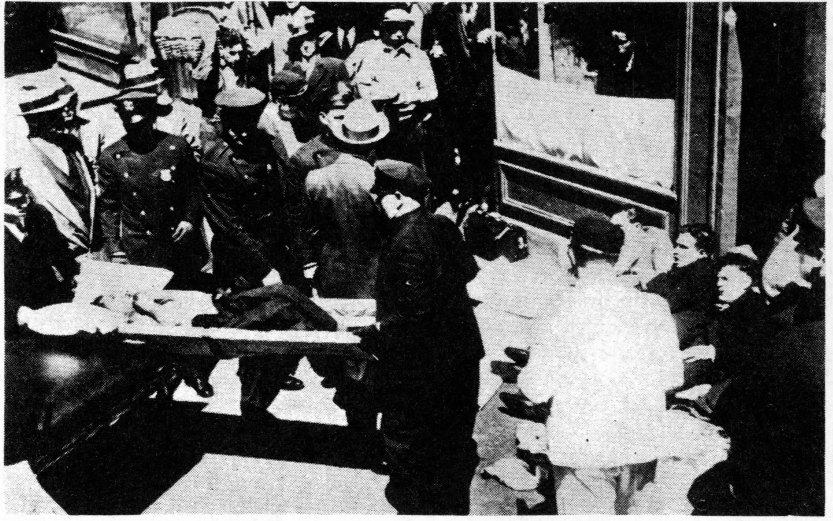
Militant unionist Morris Langer was murdered in a bomb explosion during a N.T.W.I.U. strike in Newark, New Jersey. A.F.L. gangster-bureaucrat Jack Schulman is arrested. The story behind the killing below.
‘Morris Langer—Murdered!’ by Philip Jaffe from Labor Defender. Vol. 9 No. 6. June, 1933.
MORRIS LANGER was murdered. Who murdered him and why? The answer to this question unfolds a dramatic struggle on the part of a genuine workers’ union, The Needle Tradesworkers Industrial Union, against low wages, long hours, and racketeer boss unions.
On March 22nd, a bomb explosion injured Morris Langer so severely that after four days he died. Jack Schulman was arrested and charged with Langer’s murder. Who is Langer and who is Schulman?
Morris Langer began working as a fur dresser in 1910 when he was twelve years old. He joined the Fur Dressers Union and was a militant participant on the side of the workers in all struggles and strikes.
In 1924, at the convention of the International Fur Workers Union, an affiliate of the American Federation of Labor, he raised his voice in protest against the cowardly and reactionary maneuvres of his union leaders, who at every important turn sold out the workers. Langer opposed the leadership of Moe Harris and his militant opposition was supported by the New York delegation headed by Ben Gold.
Moe Harris’ notorious and defeatist methods of fighting non-union shops was to make agreements for lower wages for union workers. This he believed would help the union shop bosses to undersell the non-union shop bosses, and so defeat them. Morris Langer fought that kind of leadership as he also fought graft practices within the union. It was in this year that Langer joined the Communist Party of which he remained a member until he died.
In 1925, Langer, leading the rank and file, defeated Moe Harris, and for his first victory, captured the Newark local. The American Federation of Labor, represented by Hilfers, together with the International, got an injunction against the Langer leadership. The workers, however, redoubled their struggle, broke the injunction, and continued their fight for uniform prices and workers’ control.
At last, in 1929, the last stronghold of the International, Moe Harris’ local 58 of Brooklyn capitulated. The Fur Dressers’ Union now joined the newly formed Needle Tradesworkers Industrial Union and launched a concerted fight which is unique in the history of trade unionism in America. It fought and won for the furriers a complete unification of every branch of the industry. No more can the workers of one branch of an industry fight the workers of another branch of the same industry. Because Morris Langer and other leaders organized completely the Dressers, Dyers, Trimmers, and Garment Workers, so that every bit of work done on a fur garment was done by union help from beginning to end.
They succeeded in obtaining wage raises of from 20% to 40%. They succeeded in establishing an unemployment fund of 3% contributed by the bosses, but controlled by the workers. They succeeded in lowering the work week to 44 hours. The average wage in the fur industry is now about the same as the minimum wage in 1926.
In contrast to this, needle trade workers controlled by American Federation of Labor unions have received wage cuts up to 60%.
The only three shops that the N.T.W.I.U. did not succeed in organizing are A.H. Hollander and Son, J. Hollander, and Philip Singer, all of Newark, N.J., and it is against these three shops that Morris Langer led a renewed and bitter struggle. In February of this year a strike was called against these three. To these non-union sweat shops, the militant workers were a thorn in their sides, and Morris Langer stood as a symbol for these workers, and the Hollanders and Singers had no other way left but to use gangster scabs to intimidate and kill.
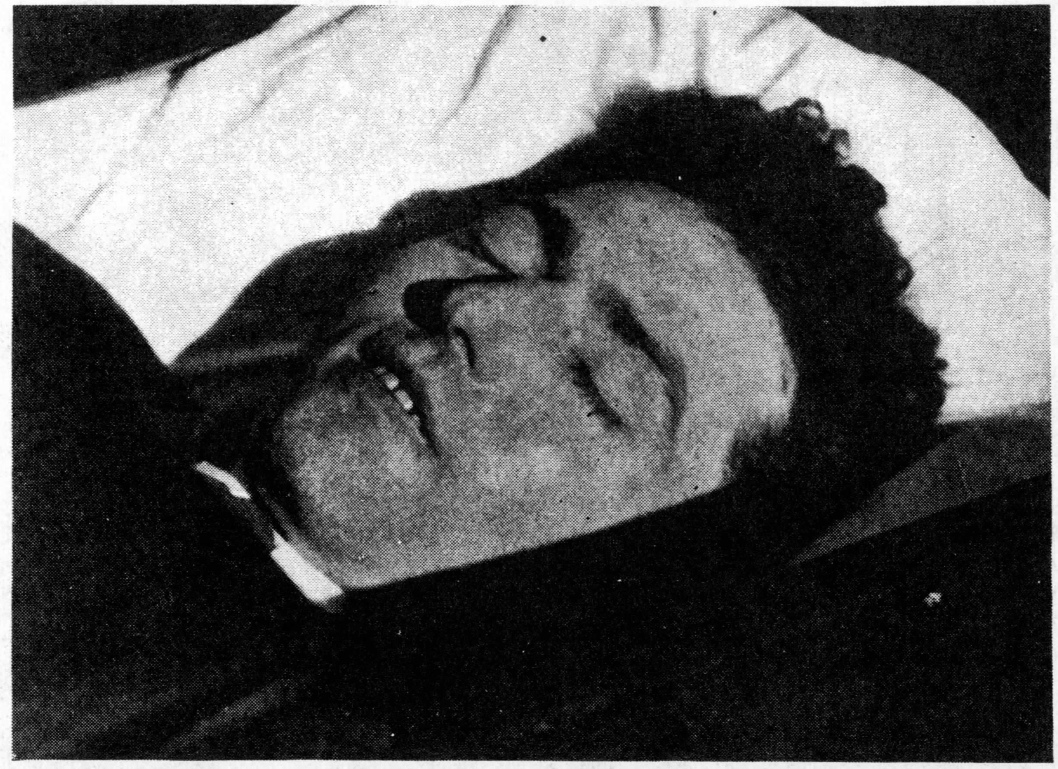
These three Newark shops are old hands at fighting workers with every weapon at their command: gangsters, racketeers, and murderers. As far back as 1915, the workers, Rubin and Novack, were shot in a strike against the inhuman exploitation of Hollander. A month before Langer was murdered, another young worker, Natale Balero, was shot by a Hollander underworld company scab. And on March 22nd, Morris Langer was mortally injured. Jack Schulman, arrested for his murder, is the well-known contact man between the Singer concern and Moe Harris of the defunct International of the A.F. of L.
On April 24th, following Langer’s murder, a mass of gangsters with guns and clubs attacked the union headquarters. A bitter fight followed. One gangster was killed, three are still in the hospital, and seven others were arrested. The workers held these seven captive and forced the police to arrest them.
The workers of the Needle Tradesworkers Industrial Union will not forget this vicious gangster murder of their fellow workers. They will repel every attack against them as they did on April 24th. They will continue to organize, strike, and win their demands. The N.T.W.I.U. stands as a model for all working class unions.
In honor of Morris Langer, his fellow workers are establishing a Morris Langer Library, organizing a Morris Langer International Workers’ Order Branch, and raising a fund of $5,000 for the support of his widow and two children.
The International Labor Defense has played a very important role in the fight of the Needle Tradesworkers’ Industrial Union. In the last report that Morris Langer wrote, there appeared the following:
“In the VanDye Way strike, and during the whole campaign, about 50 workers were arrested, practically all of them in the VanDye Way strike, on charges ranging from disorderly conduct to assault and battery. However, with the close cooperation of our Union and the I.L.D., all our workers have been freed to date.”
These victories of the I.L.D. must guide us to larger victories. Every arrested and persecuted worker should be a signal to us for greater efforts in mass demonstrations of protest and redoubled fighting in the courts of the bosses.
Labor Defender was published monthly from 1926 until 1937 by the International Labor Defense (ILD), a Workers Party of America, and later Communist Party-led, non-partisan defense organization founded by James Cannon and William Haywood while in Moscow, 1925 to support prisoners of the class war, victims of racism and imperialism, and the struggle against fascism. It included, poetry, letters from prisoners, and was heavily illustrated with photos, images, and cartoons. Labor Defender was the central organ of the Scottsboro and Sacco and Vanzetti defense campaigns. Not only were these among the most successful campaigns by Communists, they were among the most important of the period and the urgency and activity is duly reflected in its pages. Editors included T. J. O’ Flaherty, Max Shactman, Karl Reeve, J. Louis Engdahl, William L. Patterson, Sasha Small, and Sender Garlin.
PDF of original issue: https://www.marxists.org/history/usa/pubs/labordefender/1933/v09n06-jun-1933-lab-def.pdf
 Revolution's Newsstand