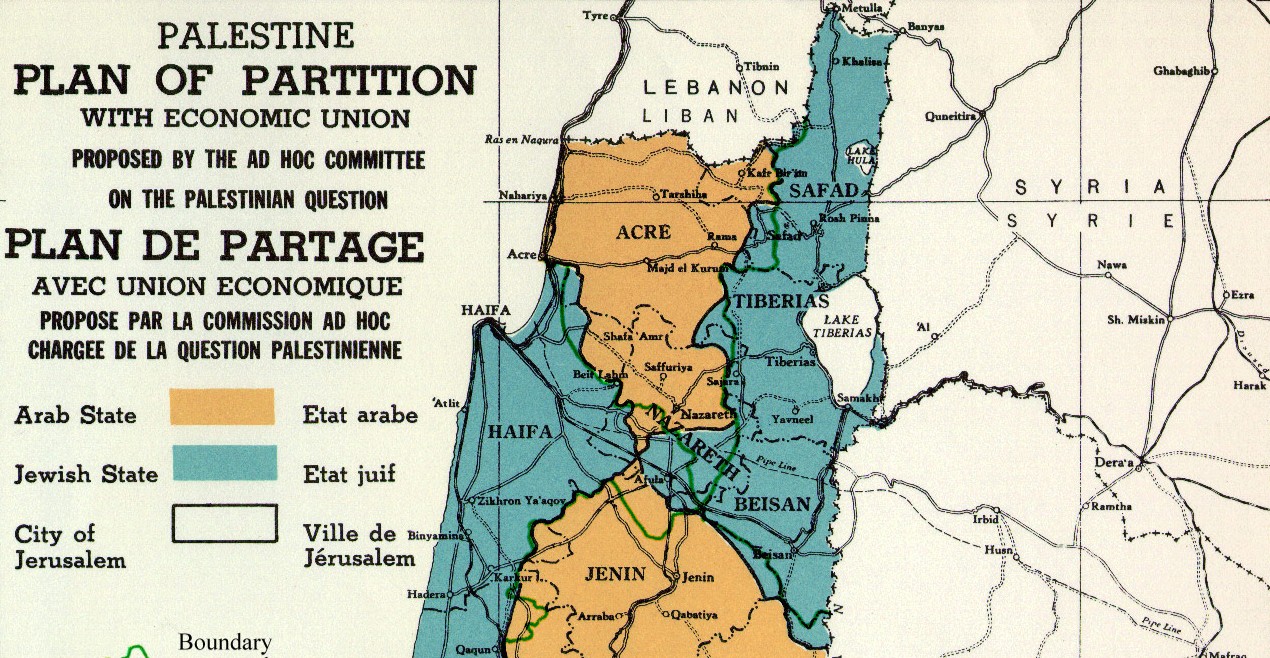
From its inception until the mid-1930s the revolutionary Left was nearly unanimous in rejecting Zionism and the colonization of Palestine, with Jewish Marxists leading that rejection. Things began to change in the mid-1930s. A variety of events came together; the victory of fascism in Germany, the refusal of asylum in the U.S. for fleeing Jews, increased immigration to Palestine, along with the Communist Party’s move to the ‘Popular Front’ which sought alliances with liberal forces, and lastly the British ‘White Paper’ of 1939 which sought to gain Arab support in the coming war by curtailing Jewish settlement. The official Communist Party first separated Palestine from the rest of the Arab Revolution, then dropped opposition to Jewish immigration, and finally supported the partition of Palestine and the formation of the State of Israel, which was championed by the Soviet Union at the UN in the later 1940s. The left at the time, of course, was also theorizing Jewish history and identity. In response Charles Crompton of the Socialist Workers Party, writing before the Second World War broke out, reiterates traditional opposition to Zionism, especially in light of the new circumstances.
‘Notes on the Jewish Question’ by Charles Crompton from The New International. Vol. 4 No. 4. April, 1939.
It is time to take a clearly defined position on the Jewish question. The purpose of the following theses is to open a discussion and to establish those points which are controversial and those which are not. A short, sketchy presentation of the entire problem appears to be a lesser evil than any danger which may arise from the misunderstanding of any particular points.
1. The Arab world which has been divided by the imperialist powers into colonies and puppet states and which is economically and socially still in the chains of pro-capitalist relationships, is in the process of awakening.
2. The national, bourgeois movement toward unification of the Arab world – from Morocco to India – is “historically legitimate”, to the extent that any such movement on the part of colonial peoples toward independence and unification is legitimate.
3. The position of the Fourth International on the Pan-Arabian national movement is made clear by a comparison with the position of the Left Opposition (Bolshevik-Leninists) on the national, Chinese revolution.
If the progressive force of the national revolution of the colonial peoples is not made to serve the world social revolution, then it will be utilized by the most reactionary fascist forces.
4. (a) The “Jewish Homeland” is an artificially created, alien body in the national organism of the awakening Arabian nation.
(b) This alien body has been systematically developed for about a decade.
(c) It arose as the result of the dirty deals of big capitalist, Jewish nationalists with the Turkish government, feudal landlords and imperialist powers. It has rested from the very beginning on a racist ideology, on mythically religious and even on historical claims.
(d) Even apart from its origin this “Homeland” must inevitably become a plaything of imperialist interests as long as imperialism exists, particularly as it lies at the intersection of most important imperialist interests. Its origin is the result of Great Britain’s interest.
(e) It is entirely impermissible in discussing the Jewish question to consider Palestine alone. This country is a part of the awakening Arab world in spite of arbitrary or “historical” boundaries.
5. The Jewish colonists in Palestine are different from the natives chiefly in that the former, as a distinct entity, are supplied with the capital which the Jewish petty and big bourgeoisie of the whole world has collected for them. This capital gives the Jews, aside from their purchases of land, a far greater supply of the means of production as well as a higher culture. Both result in a far greater productivity of labor of the Jews in Palestine and therefore in the economic and social decay of the Arabs who have little capital and are compelled to produce according to obsolete methods. It is of secondary importance whether this decay is absolute, i.e., an objective decline in real income or only relative. The latter is precisely the criterion of national oppression!
It remains to be established to what extent Jewish groups have no or only a small share in the fruits of this high productivity of labor as conditioned by capital. An attempt to establish this would have to proceed from a comparison of their standard of living with that of the Arabs !
The question of the Arab bourgeoisie which is developing slowly and in a struggle with the capitalist Jewish colonists remains undiscussed here.
6. Every genuine socialist movement will have to establish itself in the eyes of the Arabs by a program of dividing the land, machines and other advantages which result from the greater supply of capital of the Jews.
7. (a) Until very modern times the Jews were a caste entrusted by feudal and guild-regulated society with important social functions – trade, finance and handicraft outside of the guilds.
(b) They had all of the characteristics of a nation but one: they did not form a self-contained organism with class stratifications, but were parts of the societies of other peoples.
(c) They lost both the characteristics of a caste and their quasi-national characteristics to the extent that capitalist democracy conquered.
(d) For this reason they maintained these qualities in Eastern Europe, where the law of uneven development left to the socialist revolution the complete execution of the democratic revolution.
8. (a) The dissolution of the Jewish quasi-nation into the surrounding peoples which was begun by the democratic revolution, was a progressive process. It was not completed by bourgeois democracies and, like all democratic tasks not completed by the long overripe social revolution, it was reversed by Fascism.
(b) By means of the fascist anti-Semitic wave the big and petty bourgeoisie sacrifices part of itself to free the remainder from a certain amount of competition.
(c) The section sacrificed is distinguished in Central Europe from the remainder essentially by more or less insignificant residues of custom and religion and also by observable racial differences.
9. Jewish nationalism is just as reactionary as anti-Semitism: both attempt to turn the wheel of history backward and to create a new nation out of hardly discernible national residues. Both have the same racist ideology: the creation of “economically, socially and culturally unified nations according to the principle of community of blood. (The slogan “The Voice of Blood” is a creation of the Zionist Martin Buber, not of the Nazis.)
10. For the productive forces freed by the social revolution the historical nations will prove to be units economically and culturally too small. There will not be the slightest need for the preservation, much less the regeneration of such national or quasi-national units such as the Jews were.
In this sense the social revolution solves the Jewish question by the disappearance of the Jews through assimilation, of course, without the slightest compulsion.
11. Until that time there remains, beyond self-understood help for all victims of Fascism, nothing to be done but the ceaseless work of education of the Jews toward the understanding that only the social revolution can save them from physical annihilation by fascism. The effect of this propaganda will not be strengthened but only weakened by the failure to take a clear position on Jewish nationalism and an unambiguous attitude toward Pan-Arabism.
The New International began as the theoretical organ of the Communist League of America, formed in 1928 by supporters of The International Left Opposition in the Communist Party. The CLA merged with the American Workers Party led by AJ Muste to form the Workers Party of the U.S. in Dec 1935 before intervening in the Socialist Party, at which time this magazine was suspended. After leaving the SP, the main Trotskyist forces formed the Socialist Workers Party in 1938 and resumed publication. In the split of 1940, the State Capitalist/ Bureaucratic Collectivist faction left the Party and held on to the magazine; the SWP then produced ‘The Fourth International’ as their organ of theory.
PDF of full issue: https://www.marxists.org/history/etol/newspape/ni/vol05/no04/v05n04-apr-1939-new-int.pdf
 Revolution's Newsstand