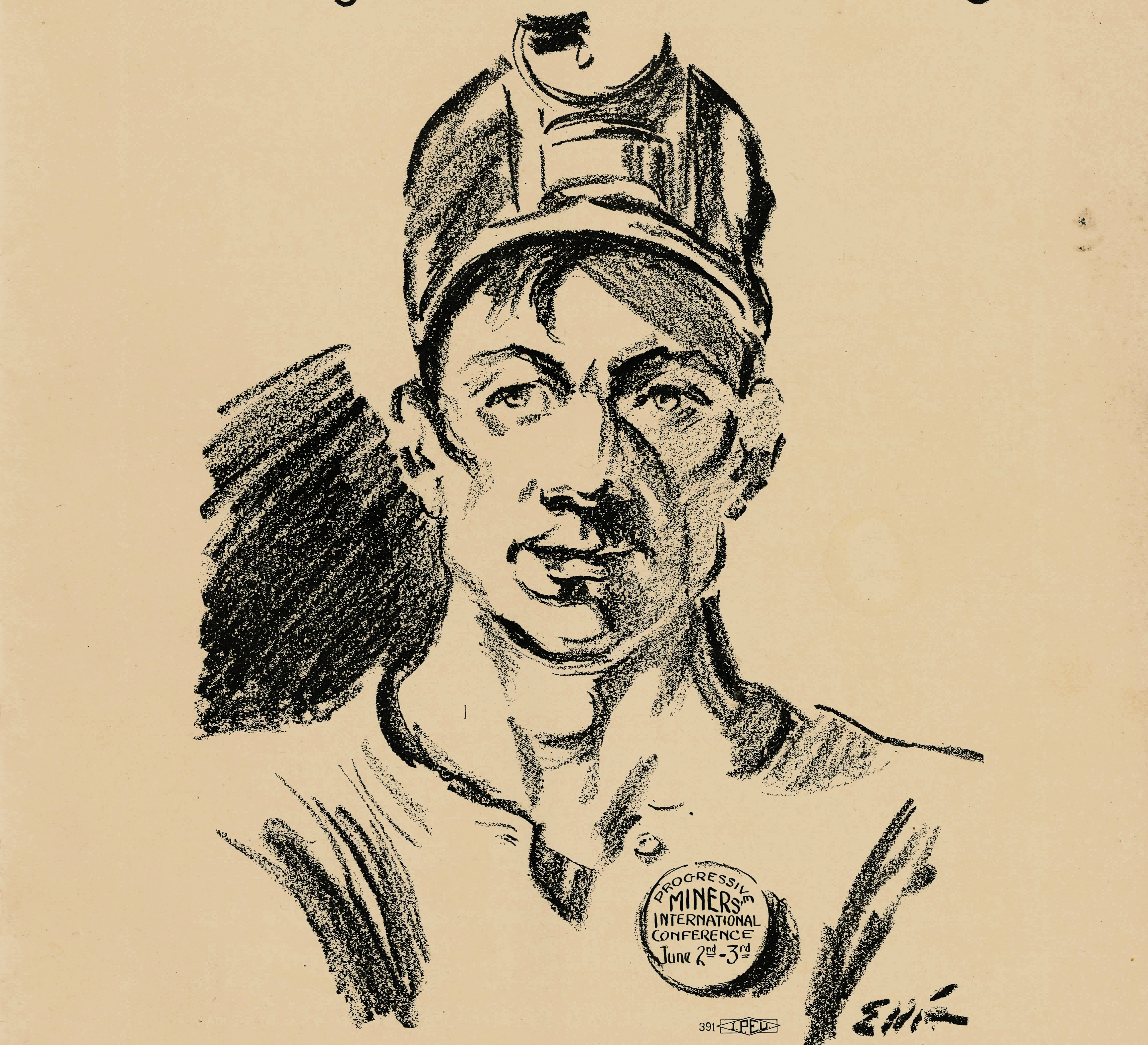
A look at an early T.U.E.L. opposition, the Progressive Miners’ Committee of the U.M.W.A. A severe crisis hit the coal industry in the economic contraction following the First World War. That crisis also hit the U.M.W.A. hard, greatly compounded by the bureaucratic insurgency of John L. Lewis. With well over 1000 members of the U.M.W.A. in the early 1920s, the Communist Party and the larger left wing wielded considerable influence. Below is an article by Foster announcing the reasons for formation and the upcoming founding conference, along with a draft program of the Committee. Of particular interest are the way ‘nationalization’ of mines is presented, as well as practical demands for union democracy.
‘Progressive International Committee of the United Mine Workers of America’ by John Dorsey (William Z. Foster) from Labor Herald. Vol. 2 Nos. 1 & 2. March & April, 1923.
TIRED of the pussyfooting and mismanagement in the administration of their union, the militant members of the coal miners’ organization are combining together to bring about progressive and aggressive policies in the U.M.W. of A. At a meeting in Pittsburgh, Pa., on February 10th, comprising a large number of delegates coming from many districts, they launched a body to be known as the Progressive International Committee of the United Mine Workers of America, with Thomas Myerscough of Local 4561, Lawrence, Pa., as secretary. This Committee will at once become active in lining up the militant elements throughout the mining districts in the anthracite as well as bituminous fields. Later on a national gathering may be held.
The Progressive International Committee adopted a program, among the chief planks of which are the following: Socialization of the coal mines, Aggressive campaign against dual unionism, Vigorous movement to organize the unorganized districts, Election of organizers by the rank and file instead of their appointment by the International office, Formation of a Labor Party, Remodeling of the constitution of the U.M.W. of A. so as to make fraudulent elections impossible. Affiliation with the militant trade unionists of other countries, Six-hour work day and five-day week, Complete endorsement of amalgamation, not only of craft into industrial organizations but also of the latter into gigantic class unions, Establishment of a national agreement to cover all coal miners, Reinstatement of the Kansas miners, Abolition of the “pay roll” vote at conventions, Immediate fighting alliance between the railroaders and miners, etc.
Mismanagement and Treason
Grave discontent exists among the masses comprising the rank and file of the United Mine Workers of America. For this there is ample reason. The past several years have been marked by the most cynical disregard of the coal diggers’ interests by the crowd now in power in Indianapolis.
The neglect to organize the unorganized miners of the country has become an open scandal in the union. The Union administration has found it politically profitable to allow the partially organized districts to drift along with only the faintest pretence of assistance, get them into a fight about election time, and then purchase their support with promises of financial assistance. This support never materializes in any effective way, so that the earnest and courageous miners who want to join the union, and wage vigorous battles for that privilege, are left to the mercies of the coal operators. In the meantime scores of “organizers” spend their time in the 100% organized fields building political fences for the administration. Lewis is reported to have said, in an unguarded moment, that it was best not to have West Virginia, Pennsylvania, Alabama, Tennessee, and Colorado organized fully, because such tremendous power in the hands of the union would cause the Government to suppress it. One of the crying needs of the miners is a great organizing campaign, put on by men who are in earnest about it.
Consider West Virginia, for example. A finer struggle was never made than that in District 17. But the International administration has done nothing but play politics with it. After the miners there have gone through two years of civil war, military suppression, wholesale arrests, trials for treason, murder, and the entire gamut of capitalist oppression, largely on their own slender resources, they are finding themselves sabotaged by the International office. What success they achieved was made possible by their own courage, and the councils they set up themselves to organize the finances of the battle. Now Lewis is outlawing these bodies.
Cynical Machine Ignores Convention
Time and again the miners have gone on record in convention for a certain policy, only to see their instructions totally disregarded by their officials. Such was the case with the issue of the Labor Party. Clearly and definitely the U.M.W. of A. has declared in convention that the Union should endeavor to create a party of Labor, opposed to the capitalist parties. But when at the Cleveland Conference in December they had an opportunity to see it put into effect, the delegates, hand-picked by Mr. Lewis, voted against the Labor Party.
For some time the Union has demanded nationalization of the coal mines as the only escape from their present intolerable condition. At the last convention this was made the subject of a special report, and a national committee was named, with John Brophy of District 2 as chairman, to study ways and means of bringing this about, and to report from time to time to the membership and educate them along these lines. When recently this committee made public its first report, with a carefully worked out proposal for nationalization, the mouthpiece of Lewis, Ellis Searles, denounced the document as “unauthorized” and went out of his way to insult the committee.
The infamous expulsion of Howat, and the disruption of the Kansas District by John L. Lewis, was another brazen disregard of the will of the Union. The miners of America believe in Howat, and in the last convention they showed that, by electing him a representative to help establish connections with the militant miners of Europe. Within a few weeks after this vote of confidence in Howat on the part of 1500 delegates from the local unions, Lewis had started his dirty work. Taking advantage of Howat’s imprisonment in the fight against the menacing Industrial Court Law of Kansas, a fight which rendered tremendous service to the entire labor movement of America, Lewis caused the expulsion of Howat and Dorchy, threw out the entire Kansas District, and reorganized it with a bunch of his faithful tools. A more shameful proceedings has not disgraced the American labor movement.
The Betrayal of Pennsylvania
The treachery of Lewis and his crowd in the matter of the Fayette and Somerset strikes in Pennsylvania, is of a piece with the entire record. When the great strike was called last April, a grave menace hung over the union in the fact of the unorganized fields. If these continued to produce to full capacity there was danger that the U.M.W. of A. might go down to defeat. A call was issued to the unorganized fields to come out on strike. Scores of thousands in Western Pennsylvania responded, depending upon the solidarity of the union in their great fight to bring them into the miners’ family circle and into the settlement. But they were deserted. Agreement after agreement was signed, but none for the strikers in Fayette and Somerset. Coal companies operating mines in those fields were obligingly furnished with miners in adjoining fields, by Lewis and his administration, while they continued to starve the Fayette miners. Without any financial assistance except that voluntarily furnished by nearby friends, these heroic miners stayed out through the summer and through the winter, until January this year, before a single cent came to them from the International office. A two-million dollar assessment was levied ostensibly for relief, but instead of using it to back up the strike the Fayette miners were told to go back to work, while the officials paid themselves all their back salaries which they had boasted was a contribution to the strike cause. In a protest meeting of delegates from 55 striking locals, January 27th, a resolution was unanimously adopted, condemning this betrayal, and calling “upon all other Districts of the U.M.W. of A. to join in a fight to right the grievances of the various districts and change the cowardly policy of the International Executive of the U.M.W. of A.”
More Bureaucratic Arrogance
A vicious and ignorant document, inspired by Lewis and adopted by the Executive Board at Indianapolis on January 11th, was directed at District 26, which comprises the Nova Scotia held in Canada. District 26, which has gone through terrific struggles within the past two years in which it found itself at the mercy of the oppression of the exploiters, allied with the Government and with British coal interests, has come to keenly feel the necessity for militant International organization, extending the solidarity of the miners throughout the world. In consequence it has taken steps looking toward affiliation to the Red International of Labor Unions, the fighting body of trade unionists of all countries. But the reactionary administration of Lewis will have nothing of international solidarity. The document in which the International Executive Board hands down its ruling is a confusion of ignorance and misstatement. But there is no doubt of the intent behind it. It is a direct threat to the miners of District 26, that unless they abandon their aspirations of international solidarity, the Lewis machine will expel them and smash their union. District 26, it is reported, putting the unity of the U.M.W. of A. above their District aspirations, has decided to obey the instructions of the Executive Board not to affiliate directly to the Red International, and is carrying the issue to the next International Convention of the U.M.W. of A
All of which is but a glimpse of the high spots in the record of the present administration of the miners’ union. The rank and file are sick to disgust with their arrogant and power-drunk bureaucracy, and in the organization of the Progressive International Committee they demonstrate that they are going to take a hand themselves in the conduct of the organization. In the past the administration has been able to win in all conflicts with the rank and file, because the militants have organized their fights purely upon a district basis. With the well-oiled national machine, backed by the national treasury, Lewis has been able to use the other sections to defeat the insurgent group. Confident of his power to continue this merry game, he gaily goes his way, without regard for decisions of conventions or the will of the organization. The Progressive International Committee of the miners is going out to unite the forces of militant progress to see that convention instructions and the will of the rank and file are carried into action.
Program of the Progressive International Committee of the United Mine Workers of America
As an aftermath of the war, coal is an over-developed industry, capable of 800,000,000 tons annually, while only 500,000,000 tons are actually needed. Gigantic subsidiaries of railroad and steel corporations, operating as great coal syndicates, are found side by side with hordes of petty operators equipped with only insignificant capital. This situation has produced an orgy of political corruption, judicial usurpation, strikes, riots, bloodshed and general disorder, which has become the scandal of industrial America. Such an insane condition in the most basic industry of the country must not continue.
Under the guise of reorganizing the industry, the large-scale operators see an opportunity to crush their weaker competitors on the one hand, and to wipe out the last vestige of unionism on the other, and thus, by trustification, create a great Feudalism of Coal. By this means they hope to render absolutely helpless both producers and consumers of coal.
Those who have lived in the shadow of the Feudalism of the U.S. Steel Corporation know what a nightmare such a system would mean for the miners. The crushing of the United Mine Workers of America, the only large industrial union in the United States, would be the greatest possible disaster to the workers of this country.
Nationalization of Coal Mines
To meet this situation of demoralization a radical change must be made in the coal industry. There is only one solution at this moment that is possible, and that is NATIONALIZATION OF COAL MINES. Against this plan will be marshalled all the forces and resources of plutocratic America. The capitalist press and its journalistic hirelings, together with an army of retainers composed of the intellectual and political prostitutes of Wall Street, are flooding the country with an avalanche of lies, slander and misrepresentation against NATIONALIZATION. Corrupt and reactionary labor leaders are also opposing the plan, and every honest trades unionist who espouses the cause is marked for persecution.
In advocating NATIONALIZATION OF COAL MINES, the Progressive Coal Miners mean the operation of the coal mines under the direction of competent union miners, and not under a commission composed of the usual lawyers, bankers and politicians. A political bureaucracy sitting at Washington as the directors of the coal industry would be a monstrosity worse even than the abortion known as the Railroad Labor Board and would never be tolerated by the rank and file of the United Mine Workers of America.
NATIONALIZATION OF COAL MINES, as a political program, will be a failure unless it includes genuine democratic management of the mines. Since the efficient operation of the coal mines is possible only by those who have had experience in digging coal, we demand that the program of NATIONALIZATION OF COAL MINES shall provide for the operation of the mines entirely under the direction of union miners, who alone are possessed of the technical, mechanical and manual skill necessary t the successful operation of the mines.
Need of a Labor Party
NATIONALIZATION OF COAL MINES can be accomplished only through political action. To suppose that such a change can be brought about by “friends of Labor” among the politicians of the Republican and Democrat parties is possible only to the mind of a Lewis. Such a possibility is too absurd for those who seriously consider the recent great events in the industrial and political life of the country.
Nor is it possible for the miners, as a group, to accomplish this great political change alone. The working class of America as a whole is the only group with sufficient interest, solidarity and numbers to make NATIONALIZATION a reality. Therefore the miners, in order to inaugurate NATIONALIZATION and to protect their political interests generally, will be compelled to join with the rest of the working class and launch a great Labor Party based upon the trades unions. Composed exclusively of workers and working farmers, and all working class parties without regard to political differences, such a political party would be able to fight the battles of Labor on the political field. The conduct of the Government in the recent strikes of the miners and railroad workers proves conclusively that the Government is under the complete domination of the plutocrats of Wall Street. A Labor Party worthy of the name will fight to put the Government in the hands of the workers, and thus end the exploitation of the producers by the parasites and profiteers.
Aggressive Organization Campaign
Plans must be laid immediately to bring into the organization the great army of non-union miners. Over one-third of the miners in the United States are outside of the union.
A comparison of the ratio of the producing capacity of non-union mines to the total consumption of coal in the United States reveals a startling and dangerous situation. In 1921 the total non-union mine capacity was 295,000,000 tons yearly, while the total consumption of coal in the United States in the same year was only 407,000,000 tons. The situation is now worse. Due to the disastrous Cleveland agreement, much territory formerly union has been lost to the organization. It can be conservatively stated that in case of a general strike of the union miners of the country the non-union mines can now produce over three-fourths of the coal needed in the United States.
This situation threatens the U.M.W. of A. with disaster unless remedied immediately. During the war every miner in the country could have been organized, had the administration of the International put forth the proper efforts. But the international officials found if profitable to keep many districts in a demoralized condition. The representatives of such districts at the national convention seek to curry favor and support for their weak unions by voting as they are told, without regard to the issues or principles involved. The Progressive Miners demand that an aggressive organization campaign be launched to the end that this condition be remedied and that an honest and sincere effort be put forth to enroll all non-union miners, under the banners of the U.M.W. of A.
Alliance Between Miners and Railroad Workers
There must be created a real fighting alliance between the men who dig coal and those who haul it. This must not be a weak affiliation such as exists at present, which produces merely an exchange of friendly telegrams of sympathy when either group are on strike. The miners and railroad workers must actually join forces for united action and fight side by side in times of strikes.
Reinstatement of Howat and Other Kansas Miners
Of all the crimes of the Lewis administration, none has been more flagrant and cowardly than the brutal expulsion of Alexander Howat and the fighting Kansas miners. While lying in jail battling against the Industrial Court slave law of Kansas, Howat and his fellow officers of District 14 were stabbed in the back by Lewis, who arbitrarily removed them from their official positions and expelled them for life from the organization. He neither preferred charges against them nor gave them a trial. The whole thing was in open violation of the International Constitution. Capitalism, at its worst, grants trials even to robbers and murderers. But Lewis, to the eternal shame of the labor movement, refuses to do as much for a man with the fighting record of Howat. We demand the immediate reinstatement of Howat and his fellow officers to their official positions, with all the rights and privileges they enjoyed prior to their expulsion. Every local union in the U.M.W. of A. should elect good, strong delegates to the next International Convention, with instructions to fight first, last and all the time for Howat and his co-workers who have been crucified by International President, John L. Lewis.
National Agreements Only
The Progressive Miners demand that the policy of National Agreements be established and adhered to. In the early days of the industry agreements were made between small individual operators and local unions, then by sub-districts, next by districts, later on by several districts together, and finally, as a result of the development of the industry and the appearance of great coal corporations operating in several states, national agreements were arrived at. This was accomplished only through years of suffering, privation and strikes, and is the priceless heritage of every union miner, bought with the blood and self-sacrifice of a great army of martyrs to Labor’s Cause. It was a steady progress onward and upward. Yet in the 1922 strike, with victory in our grasp, Lewis, by signing the Bituminous and Anthracite agreements, reversed this tendency, and by splitting the ranks of the miners, pushed the organization back to where it was years ago.
Direct Election of Organizers
A most necessary reform in the U.M.W. of A. is to bring about the election of organizers by the rank and file. At present the big staff of International organizers are appointed by the Administration, with the result that they are largely an electioneering machine to keep the present officialdom in power. They spend most of their time running around the organized districts playing politics and seeking to develop sentiment in support of the Administration. When the conventions assemble, they flock in and literally swamp them. The unorganized are entirely neglected. The only remedy for this state of affairs, which is extremely demoralizing to the union, is to amend the International Constitution to provide for the election, by the rank and file, of all organizers and traveling auditors. The “pay roll” vote must be abolished in the United Mine Workers of America.
Amalgamation
The Progressive Miners heartily endorse the movement to amalgamate all the craft unions of the country into a series of industrial unions. In its early days the coal mining industry was afflicted with craft unionism, but the miners saw fit to combine all their unions into one organization to cover the whole industry. In the great fights that have since occurred the industrial form of our union has stood us in good stead. Had we been so organized that one part of the working force remained at work while the rest were striking, we would have been defeated and our organization broken up long ago. Speaking from experience, we heartily recommend industrial unionism to the labor movement as a whole, and we pledge ourselves to do whatever we can to bring it about.
Six Hour Day and Five Day Week
The Progressive Miners demand the six hour day and the five day week. The sacrifice and devotion of the miners to their industry for the benefit of society has resulted in such rapid mechanical and organizational improvement that the average American miner produces 3 times as much coal in an equal space of time as his English brother. Out of a total possible 300 eight-hour working days in a year, or 2400 hours, the average miner spends only one-third or 800 hours, at remunerative labor and loses 1600 hours. The operators and their henchmen would make the miners pay for their great efficiency in production by closing down the mines and throwing many thousands of miners entirely into the army of unemployed, there to engage in a desperate struggle for work, against the employed miners, and to serve as a reserve force of the employers in time of strikes. Meanwhile these same operators, in many parts of the country, are fighting to aggravate the situation by establishing a longer work day and by increasing the task of their men. As against this brutal alleged solution, the Progressive Miners urge and demand the application of the practical common-sense remedy, a substantial shortening of the working time. We demand unequivocally the six hour day and the five day week.
Secession and Dual Unionism
The Progressive Miners heartily condemn all secession and dual union movements. As a result of the “rule or ruin” policy of the Lewis administration, carrying with it all sorts of fraudulent elections and general betrayal of the miners’ interests. intense bitterness and disillusionment has been caused among the rank and file of the organization. Under no circumstances should this discontent be allowed to break into secession movements. We must stay within the ranks of the United Mine Workers and settle our differences there in a practical and constructive manner. Experience teaches that secession leads inevitably to demoralization and defeat. It weakens the organization and, by withdrawing many good men, leaves the reactionaries in undisputed control. Efforts of reactionary officials, such as John L. Lewis, to force secession movements among men they cannot whip into line, must be vigorously resisted. A pattern to go by are the Kansas miners, who, notwithstanding the bitterest provocation, loyally refused to split the union. From the beginning Alexander Howat has stood like a rock against starting a dual movement. Any stories in the press to the contrary, are simply propaganda of the employers. Howat has stated time and again. that he will have absolutely nothing to do with secession movements. All Progressive Miners should take the same stand.
International Affiliation
Capitalism is international in scope, and the organization of the miners must be as wide as the world. In the great 1922 strike coal was shipped into the United States from various countries, which made our fight just that much harder. In the big British strike of 1921, the same experience was had, coal being sent in from many countries to break the strike. This proves conclusively the necessity for united action among the miners of all nations to prevent coal being shipped into countries where the miners are on strike. We demand the closest possible affiliation of The United Mine Workers of America with the organized miners of the world.
Lewis Violates Miners’ Policies
The solemn duty of every official of a labor organization is to loyally endeavor to put into effect the policies laid down by his union. Lewis has violated this duty, times without number. Nationalization of coal mines, a basic policy, was endorsed by the Cleveland, 1919, Convention, and later a committee, consisting of John Brophy, Chris. Golden, and William Mitch, was appointed to work out the proposition. Then, when the committee reported, Lewis repudiated the whole project and thus brought about the resignation of Brophy and Golden, two sincere advocates of nationalization. Ellis Searles, Editor of the United Mine Workers Journal, a henchman of Lewis, who is not now and never has been a member of the U.M.W. of A., refused to permit the publication of the nationalization report, or any part of it, in the official journal of the organization.
The United Mine Workers of America are clearly on record for the formation of a Labor Party, having endorsed the proposition at the Indianapolis, 1921, convention. Yet, at the recent Conference for Progressive Political Action, in Cleveland, the delegation from the U.M.W. of A., who claimed they were acting upon the instructions of Lewis, failed to vote in favor of independent working class political action when that proposition was before the conference. Likewise, the U.M.W. of A. has unqualifiedly endorsed industrial unionism many times. It was the solemn obligation of the Lewis administration to see to it that the miners’ delegates to the A.F. of L. 1922 convention, should fight for a definite program of industralizing the other unions represented in the A.F. of L. But when the Railway Clerks submitted a resolution to amalgamate all existing craft unions into industrial organizations the miners’ delegates did not vote for the proposition.
Despite the bitter fight in the U.M.W. of A. convention, over the six hour day, in which Lewis was decisively beaten, that official has never hesitated to belittle and neglect this demand of the miners. It is common talk in mining circles that it was not even mentioned in conference before the signing of the New York Agreement, January, 1923.
Corruption in Elections
The district and international elections at the present time in the U.M.W. of A. are a shame and disgrace to the cause of unionism. “Pay-roll” agents of the various administrations employ bribery with money and liquor and the most brutal forms of intimidation to accomplish their corruption of the ballot. They have so disgusted a large part of the membership that more and more the honest members are losing interest in the elections and fail to take part in them. It is the duty of all Progressives to arouse these members to a sense of their duty and to prove to them there is splendid opportunity right now to cleanse the organization of election frauds and to make it a union fit to lead the workers of America to victory and power.
Militant Leadership
The remedy for the disorganization existing in our union is, to replace our present timid and incompetent leaders with labor statesmen of broad vision; with men possessed of minds capable of thinking in terms as big as the mining industry of the entire world, and infused with courage which will enable them to stand in the front of the battle line and to fight for the interests of the miners against all enemies of union labor. There are many men in our own ranks capable of rendering this service, who have been tried in the fire of persecution and found worthy. Let us immediately organize to place this group in responsible control of the organization.
Plan of Action
In order that the foregoing plan of progressive action may become a reality, it is necessary that the Progressive Miners organize to carry on an aggressive campaign of education among the rank and file of the U.M.W. of A. It is only by spreading our literature and by waking up the rank and file to the necessity for organization, that real progress can be achieved in modernizing and strengthening our union. If you believe in this program, see to it that every member of your local is furnished with a copy of this leaflet. Then call together a district conference of the Progressive Miners and get in touch with the International Committee, so that all work can be carried on efficiently in the various districts at one time.
In the near future a National Progressive Conference of Miners will be called, at which a permanent Progressive movement will be launched in the U.M.W. of A. This will be the dawn of a new day for the oppressed miners of the American continent. For further information write to
Thomas Myerscough, Sec’y-Treas. Labor Lyceum, 35 Miller St., Pittsburgh, Pa.
National Conference of the Progressive Miners has been called for June 2 and 3, Pittsburgh, Pa.
The Labor Herald was the monthly publication of the Trade Union Educational League (TUEL), in immensely important link between the IWW of the 1910s and the CIO of the 1930s. It was begun by veteran labor organizer and Communist leader William Z. Foster in 1920 as an attempt to unite militants within various unions while continuing the industrial unionism tradition of the IWW, though it was opposed to “dual unionism” and favored the formation of a Labor Party. Although it would become financially supported by the Communist International and Communist Party of America, it remained autonomous, was a network and not a membership organization, and included many radicals outside the Communist Party. In 1924 Labor Herald was folded into Workers Monthly, an explicitly Party organ and in 1927 ‘Labor Unity’ became the organ of a now CP dominated TUEL. In 1929 and the turn towards Red Unions in the Third Period, TUEL was wound up and replaced by the Trade Union Unity League, a section of the Red International of Labor Unions (Profitern) and continued to publish Labor Unity until 1935. Labor Herald remains an important labor-orientated journal by revolutionaries in US left history and would be referenced by activists, along with TUEL, along after it’s heyday.
Link to PDF of full issue: https://www.marxists.org/history/usa/pubs/laborherald/v2n01-mar-1923.pdf
PDF of issue 2: https://www.marxists.org/history/usa/pubs/laborherald/v2n02-apr-1923.pdf
 Revolution's Newsstand