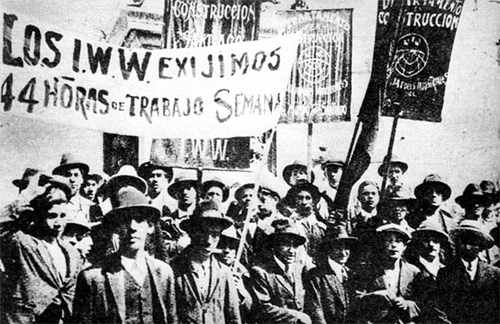
With many U.S. wobblies and radcials heading to Mexico to escape the draft and persecution during World War One, the Mexican I.W.W. saw factional disputes based in part on those personalities as different groups emerged and vied for the ‘endorsement’ of the the Chicago I.W.W. Along with many issues arising from the ongoing Revolution in Mexico, discussed below, the debate over Comintern affiliation also loomed large. The One Big Union printed appeals and analysis from the different groups, as this from Jose Refugio Rodriguez, editor of El Obrero Industrial associated with Linn E. Gale.
‘The Working Class Movement in Mexico’ by Jose Refugio Rodriguez from One Big Union Monthly. Vol. 2 No. 6. June, 1920.
Secretary of the Mexican I.W.W. (Translated from the Spanish)
While our eternal enemies, the exploiting classes, are utilizing every possible means to deceive and betray the workers of Mexico more shamelessly than ever, a little but growing group of Industrial Workers, banded together under the Mexican Administration of the I.W.W., is carrying on its almost unnoticed work that is bringing results.
It would only tire you, my fellow workers of the north, were I to relate in detail many of the things we are doing, for they consist of little details that mean much to those immediately concerned but are boresome to others. Suffice it to say that we organized last fall a provisional executive committee, which was to take charge of the work of unifying the labor movement of Mexico in a Mexican Administration of the I.W.W. Where existing unions could be induced to alter their constitutions and rules so as to conform with the fundamental principles of industrial unionism, we agreed to try to secure such alterations and to have these unions unite with us. Where existing unions insisted on listening to the treacherous appeals of Gompers, Morones and their ilk, we were to organize other unions along industrial lines. Slowly but patiently and earnestly, we have been proceeding in this manner, and in most cases we have found few Mexican workers who would defend Gompersism. The work of unification continues to be far from as fast as we wish, for the Mexican is apathetic to his own interests and it takes persevering work and much revolutionary fire to stir him into activity. However, we add a union every now and then, and gradually we see a few more working class organizations brought into our movement of unification.
We have, of course, adopted the I.W.W. preamble and most of the rules that are in force in the I.W.W. of the United States, making only such incidental modifications as local conditions required. We constantly seek to instruct the Mexican workers in the importance of the “strike on the job” and of general strikes. We endeavor to impress upon them that while we are always anxious to strike for more wages and shorter hours, wherever an opportunity appears, we regard such strikes. as mere practice preparatory to the final, supreme struggle in which we shall meet our enemies on the battle field of the general strike. If more wages are obtained, well; if shorter hours are gained, well also; but in neither case do we expect any great betterment in the condition of the unhappy, wretched toilers who produce today the riches that others may enjoy and utilize. We know that only in the final, permanent defeat of the vile, abominable system of capitalism, will we find lasting, enduring peace, freedom and happiness.
Unfortunately for our propaganda and work, the presidential election is due to come in the month of July, and in these moments there is spread throughout the country the usual treacherous, deceitful dissemination of lies and smooth stories designed to persuade the workers to vote for one candidate or another. True to the principles of industrial unionism, we have repudiated unconditionally all candidates and warned all workers to keep aloof from all elections. We also warned them to have no part in the revolution initiated in the state of Sonora by followers of Obregon, for we see no difference between the various candidates and we know that all of them—Obregon, Bonillas and Gonzales–have been seeking the support of the American and Mexican financial interests. It appears today that Wall street is financing the Sonora revolution and is, therefore, using Obregon as an instrument; but there is little difference between any of the candidates. We refuse to work or fight or sacrifice for any of them. We will utilize our energies in organizing industrial unions and in no other way.
In a recent issue of your esteemed magazine, you made a query as to the work of Villa, Zapata, etc. This query can be answered briefly and effectively. Villa is no more and no less than a despicable murderer who once served in the American army and there learned completely the science of killing his fellow human beings. He has always been an instrument in the blood-stained hands of the capitalists and financiers of Wall street. His history is well known on the frontier and can be corroborated with little effort. He has, it is true, made various promises to the workers of Mexico at various times, but none of those promises have the slightest basis of truth. Like the politicians who now want the votes of the Mexican workers, he has shamelessly lied to these workers to induce them to fight in his army of butchery and treason.
One of my brothers was a close friend of Zapata and helped draft the “Plan of Ayala,” which attracted attention throughout the world and was printed in English, Spanish, German, French and probably other languages. I know something of Zapata, therefore, from the most reliable sources. He was an honest man. He was an able man, considering that he had no education and that his ideas of communism and freedom came from the depths of an humble but unpurchasable heart. Yet the tales published in foreign periodicals about the wonders of “Zapataland” make us laugh and also make us shed bitter tears. We laugh because the tales were ridiculous and untrue. We shed bitter tears because we wish they were true. Probably Zapata’s lack of experience with men outside of his own little realm, and, probably, also, his lack of education, would have doomed his experiment to failure, in any event. But as a matter of stern reality, he never had an opportunity. His “Zapataland” only existed over a few hectares of land in the days of its greatest success. It was very crude, undeveloped, unorganized, and could not, therefore, last long. In the great land over which Lenin is the guiding figure and where industrial democracy has come to remain forever, there is much of science, order, skill, wisdom and shrewdness, to match that of the capitalist empires without. But there was none of this in “Zapataland”—only honest intentions, high ideals, bad organization, big blunders and inevitable failure. We honor Zapata and we shall always remember “Zapataland” with reverence. But we know it was far different from what the radical world generally believes.
As for Carranza, he was at best only a Liberal. He would probably have nationalized the petroleum and other industries if left alone by Wall Street. This would have displeased Wall street but done little good for the workers of Mexico, who could have been little better off than now. Generals and politicians would have been the beneficiaries. But even the good intentions that Carranza did have exaggerated as they were—were thwarted by threats of intervention. He would not have done much at best, I assure you, but he could not even accomplish the little that he desired. In the last few months he has made various concessions to Wall street in an endeavor to save his government from destruction, but his concessions have been pitifully useless. It was far too late and Wall street had already decided to support Obregon and to organize a new revolution.
In none of these men are we members of the Mexican I.W.W. interested. I only refer to them to reply to the query in the One Big Union Monthly for information about them. Our sole, only and permanent interest is in the organization of industrial unions in every part of this slavery cursed land of sunshine and shadow.
Permit me also, fellow workers, to say a word about the recent controversy that has raged in the columns of your magazine in regard to Mexican conditions. None of us know much about Irwin Granich [Michael Gold]. He says that he was a participant in the class struggle in Mexico, but if so, he participated so modestly and harmlessly that none of us knew it. I have seen him in a few meetings of the Mexican Socialists but nowhere else. I have nothing to say for him or against him personally, nor have most of us, for not many of us even know there had been such a person in Mexico until we saw his articles in a few American publications. I must say, however, with all emphasis and sincerity, that his attacks on Linn A.E. Gale were both shamelessly unjust and abominably ridiculous. Friends of Luis N. Morones, the Mexican agent of Samuel Gompers, have persistently tried to slander Gale, who has been merciless in his attacks on the Gompers machine, and the charges of Granich are but the repetition of these lies. We all know that they are false. Gale has made enemies unnecessarily by his fighting disposition and his bitterness toward his enemies, but they are not the kind of people that Industrial Workers would want for friends. His enemies are a credit to him and are a proof of his fearlessness. The Mexican radical movement owes much to Gale, and intelligent, sincere Mexican radicals resent attempts to blacken his reputation.
It is true, absolutely true, that Gale tried to induce the Carranza government to take revolutionary action and to ally itself with Soviet Russia. In this effort, he entered into intimate relations with certain persons in the government. But when he found that nothing revolutionary could be accomplished, and that the Carranza government only was willing to protect political fugitives here, but would go no further, he made no more efforts along that line. We were familiar with his efforts at the time and had no criticism to make. Being Mexican and knowing the Mexican politicians, we did not expect he would be successful, but we approved of the effort, believing that if it had been successful it would have been of great value to the revolutionary movement of the world.
But it is not with personalities that we are concerned. Our interest is in the powerful movement to which we have pledged ourselves and all that we now possess or may ever possess.
We are with you, fellow workers of the North, until the consummation of the dream that we cherish and the ideal that we support–until One Big Union covers Mexico from Sonora to Yucatan and industrial solidarity has stricken from our limbs each and every link of the chain of servitude that holds us in agony.
One Big Union Monthly was a magazine published in Chicago by the General Executive Board of the Industrial Workers of the World from 1919 until 1938, with a break from February, 1921 until September, 1926 when Industrial Pioneer was produced.
PDF of full issue: https://www.marxists.org/history/usa/pubs/one-big-union-monthly/v02n06-jun-1920_One%20Big%20Union.pdf
 Revolution's Newsstand