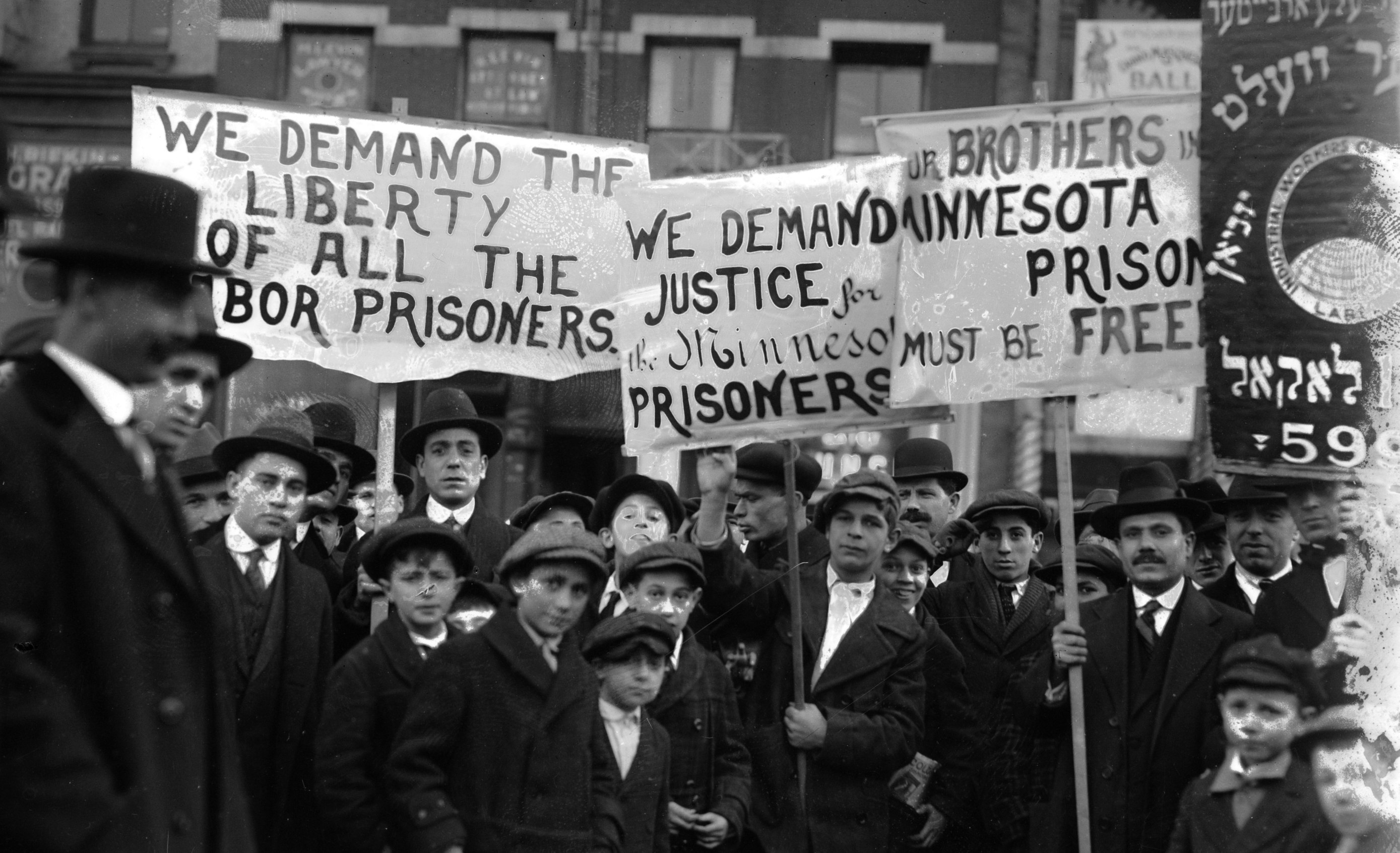
Arturo Giovannitti’s reputation as a fine writer, proletarian and partisan, was made by outstanding essays like the one below. He sees a coming storm from the woods of northern Minnesota where a strike by iron ore miners was shaking the foundations of a capitalist behemoth, U.S. Steel. Fantastic.
‘Fighting Steel’ by Arturo Giovannitti from The Masses. Vol. 8 No. 11. September, 1916.
The Steel Trust. Billions of dollars; half a million slaves; iron, fire, smoke, soot, fury, blackness and uproar; machines and sweat; machines and hunger; machines and greed; machines and civilization and glory and beauty and murder. The Steel Trust. America’s fore-hell of Europe’s torture pits; peace and good will emblazoned on an escutcheon of blood; picks, crowbars, dirks, automatics, cannon, armor plates, rails, chains, cat o’nine tails, straight jackets, bull pens, coupons, paychecks, overalls and silk hate, rags and velours, madness and frenzy, serenity and joy commingling and rotating in a fantastic swirl for the amusement of the great American people.
All-wise, all-seeing, all-powerful–nothing before it, not even the will of God; behind it only the dull and haggard face of the Fool who stirs the ashes of the dead and writes history for those who have not lived it and do not care. But who could write the history of the Steel Trust? Not even the recording archangel, not even the auditor of the ledgers of hell.
For the history of the Steel Trust is a history of peace–it is too one-sided, too uneventful to occupy anyone who takes a personal interest in the doings of life. Nobody ever dared to attack it; the St. Georges or Don Quixotes who tilt and spar with all the dragons and the windmills of the world rested their lances before the haunts of this debonair and philanthropic monster and rode away in search of more romantic adventures. Congress never investigated it with a real intention; political parties flattened their noses on the talisman of its slipper; labor unions and labor leaders shrunk tremblingly before the glare of its red eyes, and even private vengeance which the demons gave to man when the gods took their liberty away, never found a leaden bullet or a handful of saltpeter and rusty nails for this monster.
Nobody ever dared to rebel against it. Since the Homestead strike, thirty years ago, when a dream-drunken youth shouted the madness of his protest through the mouth of the pistol, rebellion was crushed and ground to pulp, and never even attempted to rise again. Since then the gory trinity of the Fates and the harpies: Carnegie, Schwab and Gary sit immovable and serene on a pyramid of white and gold: dollars and bones. Around it judges, senators, bankers, profiteers, soldiers, gunmen, murder-mongers, the guardians of the sepulchre and the turnkeys of the dungeon, dance a drunken and furious saraband of praise, grinning, chuckling, cavorting, swept away in a satyriasis of greed, vomiting the red clots of their ghoulish surfeit on the bruised face of the Republic.
Since then its domain has been sacred and impassable–nothing entered it, not even the printed word which has pried into all things impenetrable, not even the roar of the outside world travailing in the birth-throes of a renewed social consciousness. Around this world’s mightiest throne stood the barbed wire of an ultra human law, the redoubts of an unfathomable sacredness, a fence of bayonets, barbicans of beaten armor, ramparts of magic and steel, and frightful embroideries of red blood on a gray and black lacework of prison bars.
And at the gate, outside, counting the lost souls that went in, stood the President of the world’s greatest nation and the governors of seventeen states, in liveries of red and blue with stars on their lapels and coat tails, smiling, waiting, bowing and begging tips.
One power alone could raise its arm against the Steel Trust in these days when God and Demos are nursing their wounds in the field hospitals. Not the government, for the government is the head salesman and the toll collector of the Steel Trust. Not Public Opinion, for the trust has given it a permanent job as head eunuch in the harems of its favorite actresses and odalisques. Not the press, for America has no press, but only penny paper counterfeits of the people’s currency. Not the American Federation of Labor, for the helots of the Steel Trust are not laborers and cannot pay dues. No, not even the Church, even if it wanted to, for all those helots, half a million of them, are damned and belong forever to Him That Denies. Only one power could do it, for only one power was as godless, fearless and ruthless as the Steel Trust; as disrespectful of traditions, as disregardful of laws, as unafraid of gunfire and hellfire, as unappeasably hungry for power, as unslakably athirst with the passion of life–a power as dark and ominous, yet lighted by the distant gleam of the bonfire of men blazing on the hilltops of the jungle of beasts–the I.W.W.
It tried to slay the beast of Steel for ten years and failed. It is now trying again. It will try forever till it wins or dies. Let us help it win or let us help it die. It is everyman’s duty to do either one job or the other.
Look at these men in Minnesota. Here are the St. Michaels of the everlasting hereafter, battering down the closed gates of the new earth. Look at them.
Twenty thousand iron miners, unfed, half clad, uncultivated, rough, crude, dirty, ill-smelling, illiterate, savagely primitive in their needs and longings, without visions, without philosophies, chain bound to the belly and the galley, are now embattled against the Beast. Human worms, alive, gnawing at a giant that is carrion before it is corpse. Look at and study this struggle if you want to know about life. Close up all your books–they are worthless. Yesterday, today and tomorrow, what was and is and will be, is right here.
There is nothing unusual, nothing brilliant, nothing romantic; no human interest, no poetry, no sudden great inspiration, no art in this struggle. There is nothing but the silent and invisible omnipotence that made old worlds crumble to the dust, and new archies, new orders, new kinships of men rise and be. On one side gold, brains, culture, refinement, the invulnerability of righteousness, the bullets of the State and the fulminations of the Church, and around all this the silence of quailing little souls that see but bear no witness. On the other side hunger, ignorance, fatigue, stupidity, pestilence, dumb dread, inarticulate desires, aimlessness and the chilling silence of folded arms and eyes that stare.
The bank on one side, the jail on the other. There the Steel Trust with its two billion dollars and its hosts of mighty men riding in state through the aisle of a prostrate multitude of fools–here the I.W.W. with Carlo Tresca and Joe Schmitt staring through the prison bars into the alert eyes of a handful of living men. Who shall win?
There is no question as to who shall win. It is the weaker, for he alone who has no power has the will to acquire it. But how long must it take?
* * *
I don’t know who you are who read these lines. I don’t know what you do or can do–but I know that you can think. Think, then, and if you think straight, help these men win their battle, help them slay the Beast. Help them blow open the coffer where the blood-booty of the world war is stored, and feed with it a new generation of fighters. Help them batter down the jail walls, and release from the purgatory the beasts of toil that they may be transfigured into real men. Help them come out of the smoke and the furnace, the darkness and the depths. Help them return, Tresca and Schmitt and the seven other men accused of murder by those who have made murder synonymous with law and order, to open the places where men meet to know and love each other through strife and turmoil. Think, and give them what you can. Your voice first, if your heart is between your lungs; a shout of defiance if your teeth are used to bite on the knuckles of your enemies; a word of kindness if your lips have been sweetened too long with the mead of life.
Then your money. They need your money. Every cent that you don’t need out of this week’s income does not belong to you. Send it to them, through this magazine which belongs to them before it belongs to you. Invest your pennies in the struggle against the coupons and remember that bronze, in any form, is always mightier than gold.
But be quick. Don’t delay. This is the fore-thunder of the great storm, the vanwind of the coming gale. There is still hope for America and the world because of this. It is a sign of the times, a proof that the spirit of revolt is not dead, that the Revolution is still forging forward on the red tides of war. Ireland last spring–Spain yesterday–today America in the sweat shops of New York and the iron fields of Minnesota. The lines are being drawn, slowly but surely. Tomorrow is at the threshold of today. Red glares are in the skies. Red visions are in the eyes of all men, everywhere. If you want to be alive and live this hour in the fulness of its strength, see where you must go. Decide. Soldiers and militarism on one side, all over the world–on the other the first call of the Revolution and the slow mobilization of the Mob.
The Masses was among the most important, and best, radical journals of 20th century America. It was started in 1911 as an illustrated socialist monthly by Dutch immigrant Piet Vlag, who shortly left the magazine. It was then edited by Max Eastman who wrote in his first editorial: “A Free Magazine — This magazine is owned and published cooperatively by its editors. It has no dividends to pay, and nobody is trying to make money out of it. A revolutionary and not a reform magazine; a magazine with a sense of humour and no respect for the respectable; frank; arrogant; impertinent; searching for true causes; a magazine directed against rigidity and dogma wherever it is found; printing what is too naked or true for a money-making press; a magazine whose final policy is to do as it pleases and conciliate nobody, not even its readers — There is a field for this publication in America. Help us to find it.” The Masses successfully combined arts and politics and was the voice of urban, cosmopolitan, liberatory socialism. It became the leading anti-war voice in the run-up to World War One and helped to popularize industrial unions and support of workers strikes. It was sexually and culturally emancipatory, which placed it both politically and socially and odds the leadership of the Socialist Party, which also found support in its pages. The art, art criticism, and literature it featured was all imbued with its, increasing, radicalism. Floyd Dell was it literature editor and saw to the publication of important works and writers. Its radicalism and anti-war stance brought Federal charges against its editors for attempting to disrupt conscription during World War One which closed the paper in 1917. The editors returned in early 1918 with the adopted the name of William Lloyd Garrison’s The Liberator, which continued the interest in culture and the arts as well as the aesthetic of The Masses/ Contributors to this essential publication of the US left included: Sherwood Anderson, Cornelia Barns, George Bellows, Louise Bryant, Arthur B. Davies, Dorothy Day, Floyd Dell, Max Eastman, Wanda Gag, Jack London, Amy Lowell, Mabel Dodge Luhan, Inez Milholland, Robert Minor, John Reed, Boardman Robinson, Carl Sandburg, John French Sloan, Upton Sinclair, Louis Untermeyer, Mary Heaton Vorse, and Art Young.
PDF of full issue: https://www.marxists.org/history/usa/pubs/masses/issues/tamiment/t65-v08n11-m63-sep-1916.pdf
 Revolution's Newsstand