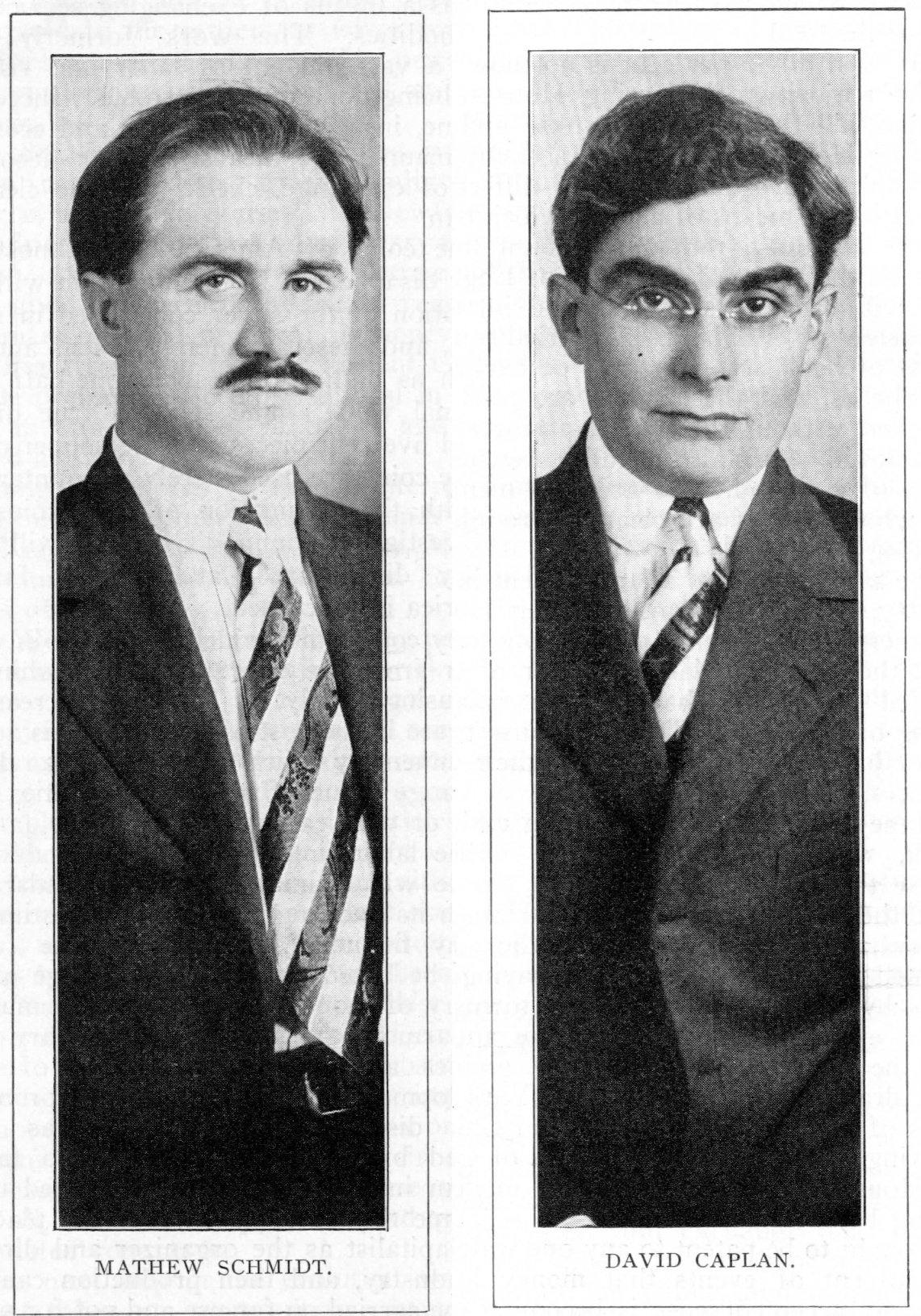
Class war voices from the past. Knowing, honest, unrepentant. Charged with conspiracy in the 1910 Los Angeles Times bombing, for which the McNamaras were found guilty, Matthew Schmidt and Dave Caplan eluded police for several years. Schmidt was arrested in September, 1914 and sentenced to life for providing the explosives, ‘Schmidtie’ was released after a long campaign in August, 1939 after twenty-five years at San Quentin. Caplan was arrested the following year and found guilty of involuntary manslaughter. Sentenced to ten years, he was released in 1923.
‘To Our Comrades’ by Matthew Schmidt and David Caplan from The International Socialist Review. Vol. 16 No. 2. August, 1915.
To Our Comrades and Friends, Everywhere:
Many of you know us, many more do not. We feel that personal word from us to you, comrades and friends, known and unknown, will help to clarify our position, bring us closer to each other, and result in a more intimate understanding.
We are in the midst of a great struggle—in the warfare of the disinherited against those who have dispossessed them of the earth and of the sunshine of life. It is a brave continuous struggle, and it is growing more and more intense every day, for labor is being forced to fight for its very life.
This struggle has many phases, and in some of them we have had our part. Thus we have become hostages of the enemy, prisoners of the great social war. But not we as individuals only; rather as two soldiers of the labor hosts whom the fortunes of war have happened to place in the front of the battle.
Of this we are firmly convinced, comrades: It is not our individual fight, but the fight of the oppressed and exploited against the masters of life. It has been our honor to be selected by the enemy as their, sacrificial offer to Mammon, in our persons to terrorize and still further to crush rebellious labor.
Not that they will ever succeed in breaking the revolutionary spirit of the masses or extinguishing the eternal yearning for greater liberty and well-being. Humanity will go on and on in its great battle against tyranny and exploitation till the last chain has been struck from the last wage slave.
But to accomplish this great purpose of the ages it is necessary continuously to rouse the people to the consciousness of their wrongs and to awaken them to the tremendous power of their united, solidaric action.
Our case, among many others, presents a most valuable opportunity for such activity. For our case is in reality and fundamentally but a phase of the great labor drama, and when we stand before the bar of capitalism in the forthcoming trial in the courts of Los Angeles, it will not be only we, Caplan and Schmidt, who will be called upon to defend our devotion to labor and our enmity to capital, but in our persons it will be militant labor on trial.
Every victory of capital against labor means the greater oppression, the weakening and the discouragement of the workers. Speaking not as defendants, but quite impersonally as revolutionists, we say to you, comrades and friends, that to permit such a victory as in the recent case of John Lawson, of Colorado, means to commit a crime against the revolutionary proletariat. Intrenched capital will have: but few such victories to boast of if the masses of militant labor will close ranks, forgetting their intellectual differences and personal disagreements, and thus present a united, invincible front to all the powers of darkness and oppression,
We therefore call upon you, comrades and friends, and upon all fellow-workers, in the great cause of labor’s emancipation, to raise your mighty voice throughout this land and to proclaim to the world in clear, clarion tones the liberating message of the determined solidarity of labor, AN INJURY TO ONE IS THE CONCERN OF ALL.
Not as Caplan and Schmidt do we sound this note. We speak as soldiers of the great social war, as members of the revolutionary international proletariat.
We beg no mercy from the enemy; we expect no justice from the exploiters of humanity. We demand to be restored to labor, that we may join the ranks of the workers fighting for the better day.
Fraternally, (Signed) Davin Caplan, Matthew SCHMIDT.
Los Angeles, Calif., County Jail, June 30, 1915.
HELP FREE THESE STEEL WORKERS
Fellow Workers:
Can you hear the voices of these men coming from the depths of their prison cells. They are appealing to you to awaken and unite your strength. They are not asking this in their own behalf, but for yourselves. They realize that their fight is your fight. They are demanding that you understand this principle of labor as they know it. That “an injury to one is an injury to all.”
The exploiters of Los Angeles, California, are the exploiters of the world. The struggle that is taking place there is a phase of the struggle that is going on everywhere.
In France, when Durand, the secretary of the Coal Heavers’ Union, was sentenced to the guillotine for a murder that was committed two months after he had made a certain speech, the workers arose and said: “You must release our brother or we will close down the industries of the nation.” Fearful of a general strike, the masters of bread opened wide the prison doors and Durand stepped forth a free man.
What has been done in France can be done in this country. It will require direct action. The kind of action that the workers best understand.
If the United Mine Workers of America would say to the coal barons, “Release John Lawson or we will close down the coal mines,” Lawson’s freedom would be assured. If the workers of the nation would make the same demand in the case of Rangel and Cline, Joe Hill, Ford and Suhr, Caplan and Schmidt, the jail doors would swing outward and these members of the working class would again step into the sunlight of freedom.
The condition of the working class of Los Angeles is so deplorable that for many years organized labor has made a continuous effort to bring it up to the level of other parts of the state. It is a city of thieves and slaves, principally real estate dealers who have laid their snares for the unwary, and slaves who make the city beautiful for a wage that means a mere subsistence.
Other employers of California threatened to reduce the standard of living to that of Los Angeles. The workers redoubled their energy that this should not be done.
The Los Angeles Times, the vilest sheet that was ever published, was the leader of the Merchants’ and Manufacturers’ Association of Los Angeles. It bitterly reviled and attacked the labor organizations. One night it was destroyed. The McNamaras pleaded guilty, but only under great duress, and they were sentenced to prison. It was then understood that there should be no further prosecutions in this particular affair. But Caplan and Schmidt had been arrested for complicity. The Golden Rule is not effective where profits are concerned. The men in jail are opposed to a condition of society where profits and dividends are the result of human toil.
They are demanding of you that you stand shoulder to shoulder with them, in the great battles of the working class, where industrial freedom is the goal.
Caplan and Schmidt have been offered a minimum sentence in exchange for a plea of guilty. To this they have replied, “No; not even to get off with a $10 fine.”
There is something that you can do for these men. Do it and leave these words behind to indicate the reason:
WE DEMAND THE RELEASE OF CAPLAN AND SCHMIDT!
Send all funds to Tom Barker, Room 201 Labor Temple, Los Angeles, Calif.
The International Socialist Review (ISR) was published monthly in Chicago from 1900 until 1918 by Charles H. Kerr and critically loyal to the Socialist Party of America. It is one of the essential publications in U.S. left history. During the editorship of A.M. Simons it was largely theoretical and moderate. In 1908, Charles H. Kerr took over as editor with strong influence from Mary E Marcy. The magazine became the foremost proponent of the SP’s left wing growing to tens of thousands of subscribers. It remained revolutionary in outlook and anti-militarist during World War One. It liberally used photographs and images, with news, theory, arts and organizing in its pages. It articles, reports and essays are an invaluable record of the U.S. class struggle and the development of Marxism in the decades before the Soviet experience. It was closed down in government repression in 1918.
PDF of full issue: https://www.marxists.org/history/usa/pubs/isr/v16n02-aug-1915-ISR-riaz-ocr.pdf
 Revolution's Newsstand