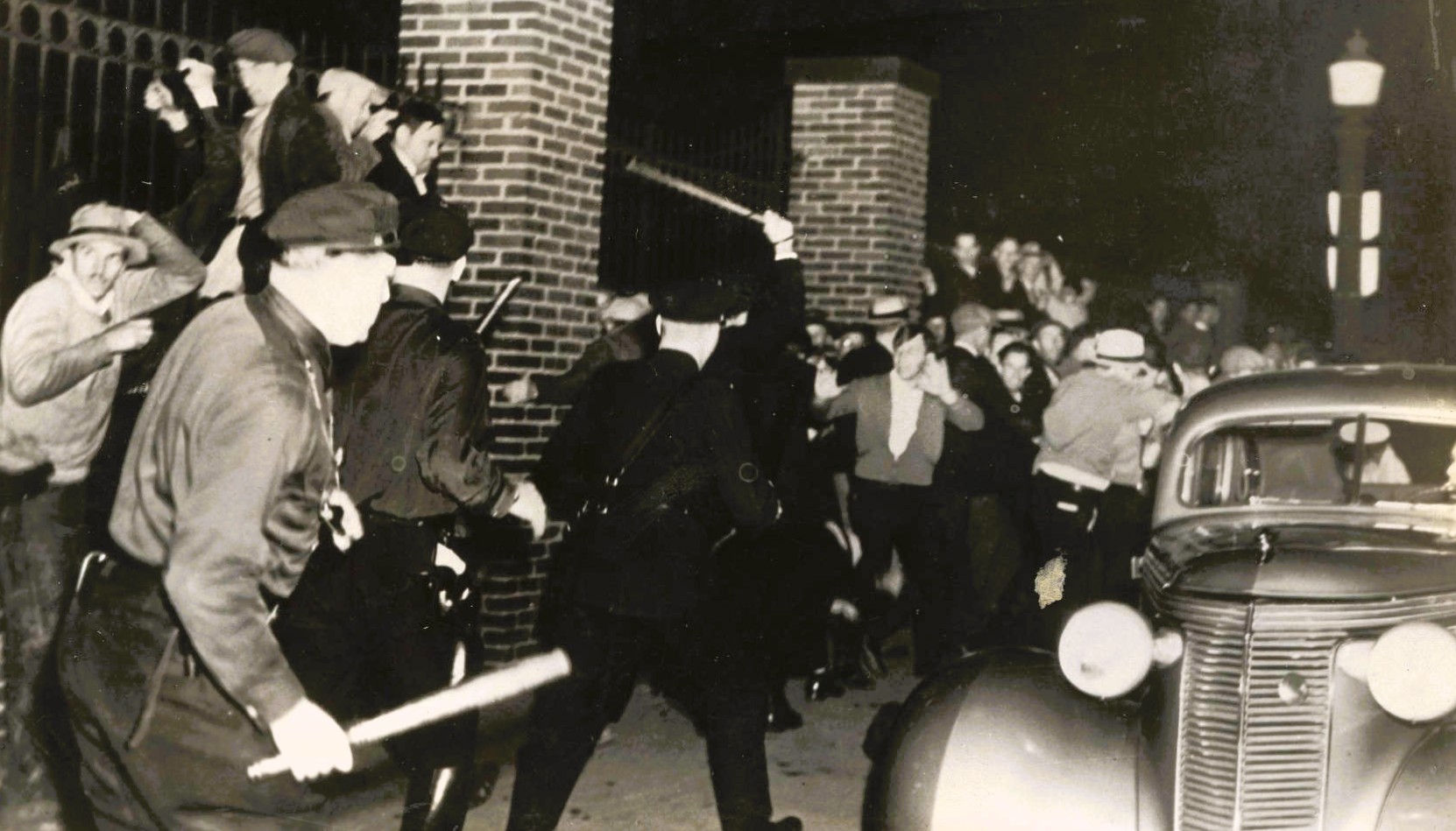
May 26, 1938 was a dramatic night during a rubber workers’ strike in the city of Akron; the kind of events that mature and steel a labor movement. Below are three articles: a background on the struggle, an eyewitness report from the front line by R. Ferguson, and analysis by B.J. Widick.
‘Striking Goodyear Workers Fight Police Terror, Score Gains’ from Socialist Appeal, Vol. 2 No. 23. June 4, 1938.
100 ARE HURT
Compromise Settlement Accepted; Showdown Is Postponed
AKRON, Ohio. The turbulent Goodyear strike ended last Tuesday when the workers accepted a company compromise proposal which granted some of the demands for which the strikers fought in the face of brutal violence by police and company guards.
The agreement left the door open for negotiation of a signed contract, although the company immediately hedged on this point.
Although many union progressives were dissatisfied with the accord because of its inferiority to the Firestone and Goodrich signed contracts, it was endorsed because it offered the union a breathing spell in which to build up its strength.
The real showdown was postponed and the workers have a chance to put themselves in a better position to prevent any repetition of the police brutality which sent more than 100 workers to the hospital and tear-gassed hundreds of others.
The Akron labor movement emerged more solidified than before thanks to the remarkable achievement of C.I.O, and A.F. of L. unity whereby Akron’s workers took a long stride forward.
Events of Strike
AKRON, Ohio. The Goodyear strike developed because of the failure of the company to settle major grievances. Sit-downs in the plants and picket lines at the main gates grew Thursday night when the union negotiating committee reported that Goodyear refused to negotiate satisfactorily.
Since the Goodrich strike had been won and it had been entirely peaceful–the cops made no attempts to prevent the union from establishing its picket lines–trouble at Goodyear was not expected. The labor movement was caught off guard.
Police Attack Suddenly
Over 4,000 Goodyear strikers and sympathizers were cheerfully picketing and razzing the cops when suddenly a police captain gave the order to “let them have it.” The all-night reign of brutality and terror, as described by another eye-witness in this issue of the Socialist Appeal, followed.
The situation in the labor movement on Friday morning was critical. The Thursday night defeat had to be turned into a victorious counter-offensive. Early that morning, Redmond Greer, secretary of the C.I.O. industrial council, spoke over the radio, analyzing the Thursday night events, excoriating the police, the mayor and Goodyear, and issued a call to all union leaders, both C.I.O. and A.F. of Labor, to meet that noon.
Unity In Defense
Over 75 A.F. of L. and C.I.O. union leaders responded. A United Labor Defense Committee of 14–seven from each section of the labor movement was established.
This truly remarkable exhibition of labor solidarity against the common enemy–Akron’s bosses–changed a critical defense into an offensive.
A sharp protest against the police brutality was made by the Defense Committee.
The A.F. of L. truck-drivers’ union, 2,300 strong, and the C.I.O. bus drivers and transportation workers union, threatened an immediate strike unless the police were removed from the scene at Goodyear by nightfall and picket lines permitted to function. A demand that Goodyear shut down completely also was made. Since the city administration and Goodyear had figured on utilizing the differences between the C.I.O. and the A.F. of L. to divide Akron’s workers and smash the Goodyear rubber workers union, the stand of the A.F. of L. unions blew their plans wide open.
The Tide Turns
It was this factor–the unity of the labor movement–that turned the tide. By nightfall, union officials and Goodyear worked out a compromise on the demands that satisfied organized labor, even though mass picketing was not yet re-established. What was decisive was the removal of the greatest proportion of the cops from the scene and the reopening of Goodyear Local hall, giving the unionists a chance to return on E. Market St.–the strategic entrance to Goodyear’s plants.
Meanwhile, the Akron newspapers carried many pictures of the bloody actions by the police, and the workers became more aroused. Also, a series of militant radio speeches began to whip up the old traditions of militancy in the Akron labor movement.
The resurgence of the labor movement reached a high point. last Saturday when a mass protest meeting of 7,000 was held.
Many of the C.I.O. and A.F. of L. leaders had been gassed along with the rank-and-file on Thursday night. They forgot their conservatism and a fiery meeting resulted.
Roosevelt Not Mentioned
Perhaps the most significant commentary on the entire meeting was the fact that although there were ten speakers, the name of Roosevelt was not mentioned once!
Speaker after speaker emphasized that the workers must depend on themselves alone.
Frank Grillo, secretary-treasurer of the United Rubber Workers, gave a marvelous picture of the Thursday night terror. He told the audience that the next time, “neither tear gas, clubs, machine guns or cannon will stop us from defending our rights.”
Sam Pollock, A.F. of L. butchers union organizer and one of the initiators of the United Defense Committee, said: “We may have our own quarrels and disagreements within the family of workers. But when any outsider starts to kick labor around, we forget our family quarrels and stick together.” He told the Akron workers how the Toledo workers had won a much tougher fight–the famous 1934 Auto-Lite strike.
Recalls 1936 Strike
Thomas F. Burns, vice-president of the U.R.W.A., returned to his days of militancy of a few years ago and gave a flaming address that set the crowd cheering over and over again. Recalling the 1936 Goodyear strike, Burns declared: “It was a different story then. Then you turned out in numbers–and you didn’t come empty handed either.” Shouts of “give them hell,” and “give us guns,” interrupted his speech frequently.
The entire emphasis of the speeches was on rallying thousands of workers for a well-prepared mass picket line for Tuesday morning when Goodyear threatened to reopen.
No doubt, negotiations were hastened by the militant tone of the mass meeting, which was followed by a demonstration and parade of the workers around city hall and the police station.
Arrests Announced
Feeling became even more tense at the close of the meeting when Greer announced that six unionists had been arrested for distributing leaflets protesting the cops’ activities and announcing the mass meeting. Greer reported on the threats made to the arrested men by the police who picked them up. Sunday afternoon, the Central Trade and Labor assembly held a special meeting and voted unanimously to support the United Labor Defense Committee and its actions.
Frequent reports of the mobilization of the National Guard and their entrance into Akron have aroused much resentment. There are no illusions about the Khaki-uniformed tin-hats since Governor Martin L. Davey revealed himself as a notorious strike-breaker in the “Little Steel” strike last summer.
Akron Militant Tells Of Big Picket Line Battle by R. Ferguson.
AKRON. At 10 minutes before midnight May 26 the workers in the front ranks of the huge crowd of unionists gathered before the main gate of Goodyear’s Plant No. 1 began to circulate about, forming a thin picket line. The line grew rapidly to hundreds of men, and just before the midnight change of shift moved across the street and towards the gate, bent on firmly establishing itself peacefully under the noses of scores of cops.
No sooner had we advanced a few yards along the sidewalk than hell seemed to have broken loose. A raving cop shouted, “They asked for it, goddamit, now let ’em have it,” and charged into the unarmed line, flailing his night stick and followed by dozens of savage blue-coated beasts.
Battle Is On
The line faltered, men raised their arms to ward off murderous blows, fought back with fists, and finally, feeling the full weight of the brutal assault, fell back. The line broke, terror- stricken, amidst the screams of the wounded and the curses of thousands of unionists and sympathizers still gathered across the street.
Running down the street, we heard a steady klop-klop-klop- nightsticks raining on the heads of men, women and children.
Then cries of further terror: company dicks dashed out of the plant pumping tear and nausea gas into the retreating throng. Gas shells plunged against ribs, sizzling and ricocheting off the streets and buildings.
We dragged along our wounded, or made hurried forays into the street to pull them out of the clouds of settling gas. We carried an unconscious worker, his head and clothing covered with blood, down a side street to a doctor. The cops had won the first engagement.
Workers Unprepared
Around the corner in Goodyear Boulevard the workers stopped their flight, pondering what to do. The unanimous mutter between clenched teeth was, “Oh, if we’d only been prepared for this.” And when word spread of the scores injured and gassed, the shooting of a woman, every- one agreed that the next time. the cops and company thugs would be met with their own weapons. But for the rest of the night, the workers’ ammunition consisted only of stones, bolts, and anything throwable.
Seeing that our position in Goodyear Boulevard would be immediately advanced upon by the Cossacks and that it could not be successfully defended for any length of time, I edged around into Market Street towards the union hall, followed by a bounding tear gas projectile. The hall stairs were jammed with workers coming and going and room was cleared to take the dozens of wounded away in waiting ambulances.
The cops proceeded down the the street towards the hall, breaking up the crowd before the hall with long range tear gas fire. We took refuge around the in Willard Street corner and prepared to defend the hall from assault. It was easier here because the wind blew the gas straight on down Market Street and two hundred workers, backed up by many more, successfully kept the cops at bay for two hours with stones and uprooted paving bricks. Our barrage drove them into the plant or out of range every time they paused to load their guns.
Police Fire Wildly
Workers began knocking out street lights to cover our hiding places. Aiming their gas shells wildly in the night, the police made a shambles of the fronts of buildings in the vicinity. One shell pierced an upstairs apartment window and exploded inside, calling forth the screams of a woman. Shells rose high in the air like sky-rockets, aimed at workers lodged on house and building tops. Jeers and taunts came from enraged workers in the nearby cemetery and Willard Street followed by showers of bricks. “Put down those guns and fight like men, you yellow bellies” and a thousand similar imprecations filled the air.
Word went round that the police chief had gone into the union hall to try to get our defensive battle called off. Shortly after, the police fired through the windows of the hall with tear and nausea gas, hitting the wounded and making the interior a reeking hell. A fire started, and a lull occurred in the fighting until it was put out. Unionists barricaded the doorways, staying in the hall, refusing admittance to the cops.
Form Defense Squad
The fighting continued until early morning, cops mopping up the whole area for a half mile from where their dirty work began. Every inch of retreat was contested by the workers in an inspiring display of courage and determination against overwhelming odds.
The sadistic attack of practically the entire force of 150 Akron police and 100 Goodyear thugs has infuriated the whole labor movement. The answer to them has already been grasped by every worker who experienced or knows of them. And that answer is: meet force with force; organize squads for labor’s defense.
Police Brutally Attack Goodyear Pickets With Gas Bombs; Workers Make Heroic Defense Against “Law and Order” Thugs
The Lessons of Akron–Organize Workers’ Defense! By B.J. Widick
AKRON. – The most inspiring and commendable example of labor solidarity in this period of C.I.O.-A.F. of L. warfare was developed here last week when every C.I.O. and A.F. of L. union rallied behind Goodyear strikers whose picket lines were temporarily crushed by a vicious police attack that sent over 100 people to the hospital and tear-gassed hundreds of others.
Not since the tensest moment of the famed five-week Goodyear strike in February 1936 was Akron labor confronted with a graver crisis. Chaos prevailed for the few hours following the night-long reign of terror planned and carried out by Goodyear through its thugs and city police.
Unity Achieved
In the face of this fundamental challenge to its very existence, Akron labor responded. The petty fights between C.I.O. and A.F. of L. unions here, as well as the deep cleavage between them, were forgotten in this hour of danger.
A United Labor Defense Committee backed by the entire labor movement was set up. Threats of an immediate transportation strike and a truck-drivers’ strike stopped the drive momentarily against the Goodyear workers. Talk of a general strike reached the ears of the labor-hating bosses and cooled off their violent passions.
Akron labor achieved unity in action against the boss class. The results speak for themselves. It is a lesson and an example for unionists throughout the country who want to defend their organizations in this time of crisis against the offensive of the employers.
The need for unity of the labor movement was never greater than at the present time. The example of Akron could be multiplied a thousand times. Labor must achieve solidarity in a common fight against its common enemy–the ruling class–if it is to survive.
The Second Lesson
There is a second great lesson to be learned from the Akron experience. In the historic five-week Goodyear strike of 1936 that established the C.I.O. as a mass movement, rubber workers did not suffer from brutal police attacks. Picket lines remained intact and the strike was won despite formation of vigilante movements, despite the hostility of the same mayor who holds office today, despite a march on the strikers by an army of deputies and police which collapsed before it reached the strikers.
Any Akron worker would tell you why the labor-haters failed in 1936. The picket lines were organized and well-prepared to defend themselves against any kind of attack. Labor relied on its own might and power then. It was successful.
Last Thursday night, Akron labor was empty-handed. It was unprepared, and Goodyear and the police department knew it. They took advantage of it. The reign of terror–a nice commentary on American “democracy”–followed.
Defense is Necessary
The contrast between 1936 and 1938 was evident and the lesson to be drawn was made clear by almost every union leader who spoke at the mass protest meeting a day later. Akron labor must always be ready to defend itself. It must always be on guard. Let other union centers learn this lesson without the cost that the Akron workers paid.
The United Labor Defense Committee created by the C.I.O. and the A.F. of L. unions here was a real stride forward in building an organization which can keep labor on its guard and which can prepare labor to defend itself against any attack.
This committee should be transformed into a permanent body whose duty must be to create groups of workers in each union subject to call day or night to defend the rights of labor. It should form workers’ defense committees in every union. It should be able to mobilize thousands of workers to face any possible threat to the union movement.
Such a workers’ defense committee today can prevent the smashing of picket lines. It can preserve free speech and assemblage to the unionists. And tomorrow it can be ready to meet Fascist hordes who today do their work in vigilante movements, as strike-breakers, as company thugs, and blue-coats parading as the “Law.”
There have been a number of periodicals named Socialist Appeal in our history, this Socialist Appeal was edited in New York City by the “Left Wing Branches of the Socialist Party”. After the Workers Party (International Left Opposition) entered the Socialist Party in 1936, the Trotskyists did not have an independent publication. However, Albert Goldman began publishing a monthly Socialist Appeal in Chicago in February 1935 before the bulk of Trotskyist entered the SP. When there, they began publishing Socialist Appeal in August 1937 as the weekly paper of the “Left Wing Branches of the Socialist Party” but in reality edited by Cannon and other leaders. Goldman’s Chicago Socialist Appeal would fold into the New York paper and this Socialist Appeal would replace New Militant as the main voice of Fourth Internationalist in the US. After the expulsion of the Trotskyists from the the Socialist Party, Socialist Appeal became the weekly organ of the newly constituted Socialist Workers Party in early 1938. Edited by James Cannon and Max Shachtman, Felix Morrow, and Albert Goldman. In 1941 Socialist Appeal became The Militant again.
PDF of full issue: https://www.marxists.org/history/etol/newspape/themilitant/socialist-appeal-1938/v2n23-jun-04-1938-SA.pdf
 Revolution's Newsstand