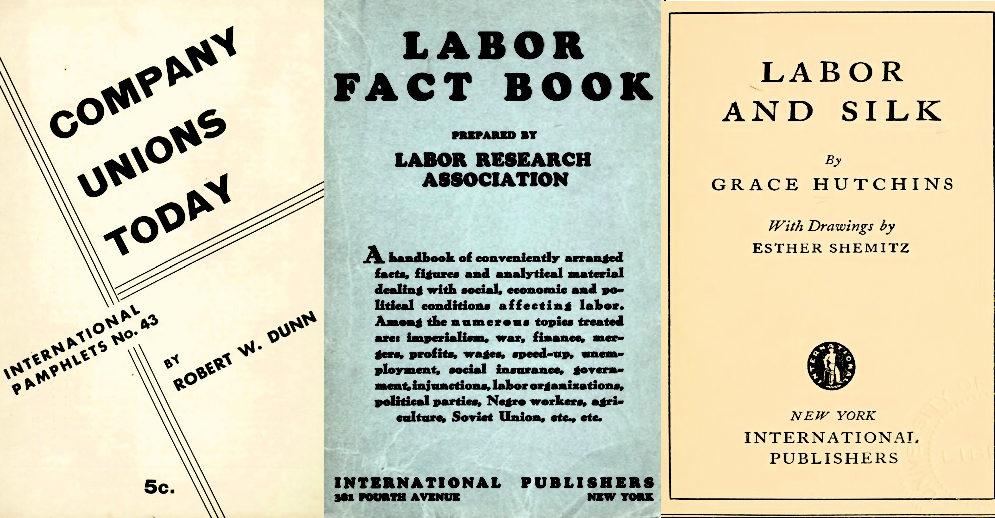
Researchers are unsung heroes of the labor movement. Robert W. Dunn, director of the Labor Research Association, introduces the organization.
‘The Job of a Labor Researcher’ by Robert W. Dunn from New Masses. Vol. 7 No. 3. August, 1931.
Many workers associated with the new Workers Cultural Federation seem to have heard of the Labor Research Assn, for the first time through its affiliation with the Federation and its participation in the recent conference of workers’ culture groups. In view of this fact a brief report on the activities of L.R.A. for New Masses readers may be in order.
The Association was established in December, 1927, its purpose being “to conduct research into economic, social, and political problems in the interest of the American labor movement and to publish its findings in articles, pamphlets and books.” In view of the dearth of books dealing with specific industries and written from the worker’s point of view, we set out to fill the gap. We agreed to prepare a series of books to be distributed by International Publishers. The books were each to deal with one industry, or a group of related industries. They were to be sold at a low price and written in a readable, non-technical style. At the same time they were to be primarily factual and based upon the most careful research.
This task has been partly performed. Five books on the following industries have been produced—automobiles, silk and rayon, coal mining, lumber, cotton and wool. The books are well printed and range in size from 192 to 256 pages, selling in boards for $1. Those to follow on such industries as iron and steel, food, clothing, railroads, and leather will be of the same style.
The data that has gone into the books already published has been used also for the benefit of unions, organizations and publications having to do with workers in these industries. Cumulate files of material are kept so that at any time additional up-to-date information will be readily available for those organizing workers in these fields.
Follow-up work on certain industries has also been carried on through the issuance of two regular monthly publications which go to organizers and active workers as well as to outside subscribers for 50 cents a year. They are the mimeographed Mining Notes and Textile Notes which digest and summarize material on these two industries.
In addition to the industrial series, the L.R.A. has prepared other books—the first being the Labor Fact Book, a handy manual of information on a thousand and one topics of interest to workers in their daily life and struggles. Although this is not a “year” book, it will doubtless be followed every few years with new editions containing later information. This book is a collective product of the L.R.A. staff. Other books in the offing are those on Labor in the South by Esther Lowell and Art Shields, on The Woman Worker by Grace Hutchins and on The Worker’s Struggle for Health and Safety by Grace Burnham.
Pamphleteering is another L.R.A. job that has been tackled seriously in the last year. International Pamphlets has published eleven manuscripts prepared under our auspices by individual writers, in addition to several which it has taken from the pen of John Reed Club artists and writers. These 32-page ten cent products have had a very wide sale and some of them have been used with good effect by such organizations as the Friends of the Soviet Union, the International Labor Defense and the Trade Union Unity League. We now have a half dozen more pamphlets in manuscript form, one of the most effective of which is Anna Rochester’s on Profits and Wages.
While working primarily on the intensive and long range research necessary for the preparation of these books and pamphlets we have gradually been drawn into all sorts of day-to-day research tasks. Requests have steadily mounted for articles, investigations, answers to questions, and data for the reports of leaders of unions and other groups.
Our service for more militant organizations has made us the brunt of repeated attacks by various professional patriotic associations, Red snipers, and certain A.F. of L. leaders who have warned their constituents about the insidious—convincing—nature of our studies. But we have gone ahead unperturbed by the Woll-Fishites. We have altogether over a hundred organizations, sending out our economic data through the Federated Press and labor papers, and placing our materials where they can be used to good effect in advancing the movement. The office is now the recognized research center for hundreds of individuals, unions, and other organizations.
L.R.A. is always able to make use of research workers. We would appreciate the names of students, sympathizers and workers who might want to tackle research under our direction. Such volunteers will help greatly in the general work of factfinding and fact-distributing that we are trying to carry on.
ROBERT W. DUNN.
Labor Research Assn.
80 East 11 St. New York City
The New Masses was the continuation of Workers Monthly which began publishing in 1924 as a merger of the ‘Liberator’, the Trade Union Educational League magazine ‘Labor Herald’, and Friends of Soviet Russia’s monthly ‘Soviet Russia Pictorial’ as an explicitly Communist Party publication, but drawing in a wide range of contributors and sympathizers. In 1927 Workers Monthly ceased and The New Masses began. A major left cultural magazine of the late 1920s and early 1940s, the early editors of The New Masses included Hugo Gellert, John F. Sloan, Max Eastman, Mike Gold, and Joseph Freeman. Writers included William Carlos Williams, Theodore Dreiser, John Dos Passos, Upton Sinclair, Richard Wright, Ralph Ellison, Dorothy Parker, Dorothy Day, John Breecher, Langston Hughes, Eugene O’Neill, Rex Stout and Ernest Hemingway. Artists included Hugo Gellert, Stuart Davis, Boardman Robinson, Wanda Gag, William Gropper and Otto Soglow. Over time, the New Masses became narrower politically and the articles more commentary than comment. However, particularly in it first years, New Masses was the epitome of the era’s finest revolutionary cultural and artistic traditions.
PDF of full issue: https://www.marxists.org/history/usa/pubs/new-masses/1931/v07n03-aug-1931-New-Masses.pdf
 Revolution's Newsstand