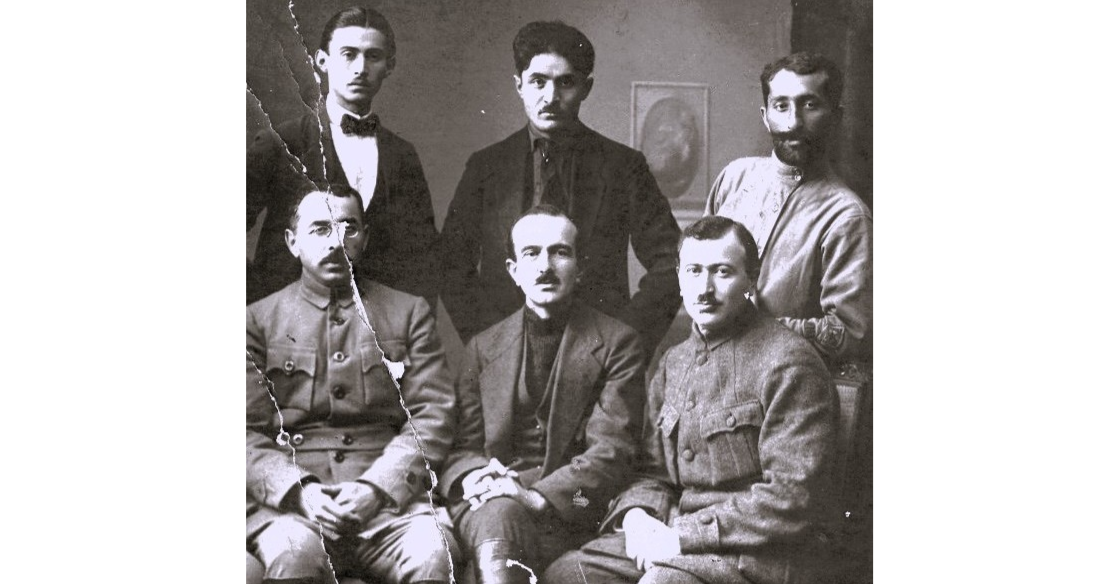
Historic leader of the Turkish Communist Party Bekar Ferdi, Mehmet Şefik Deymer, gives an overview of the history of Turkey’s workers’ movement.
‘The Labour Movement in Turkey’ by Bekar Ferdi from International Press Correspondence. Vol. 6 No. 64. September 30, 1926.
Historical.
The first attempt to create in Turkey a professional organisation on the lines with which we are at present familar dates back to the year 1893, when a group of workmen in the State Cannon Factory founded the “Mutual Aid Society of the Ottoman Mechanics”.
Such attempts were never long-lived, for Sultan Abdul Hamid, in his fear of organisations in general, had them Systematically dissolved, while their founders and leaders were exiled. When the old regime collapsed in 1908, there existed half a dozen industrial centres with from 60,000 to 80,000 workers of various categories, without counting the manual workers and the season workers. The severity of the despotic rule had prevented the toilers from creating the semblance of an organisation. Nevertheless, under the pressure of economic conditions, a certain class-consciousness without distinctive tendency had arisen.
Immediately after the proclamation of the constitution in 1908, when the whole of the Turkish public was with the greatest enthusiasm forming organisations, the workers also made haste to organise themselves. The tendency was to imitate the trade unions of western countries. On the railways and in the factories of the tobacco monopoly there were even strikes, which were then a novelty in the country. The Young Turks, in their role of representatives of Capitalism, were perturbed by this Labour movement and passed laws which prohibited trade unions and subjected strikes to a procedure so intricate as to make them impossible. This law is still in force.
The new workers organisations were tolerated in the form of workers associations in accordance with the provisions of the Societies Act. The majority of the trade unions of the various branches of production originated during this time. After the world war there came another wave of more modern and more active organisations. In the year 1919 the Communists came upon the scene. At the same time as the Communists appeared, the agents of the Second International offered themselves as leaders of the working class. With the assistance of the troops of occupation, the adventurers, who called themselves Socialists, were successful within a short period in gathering several thousand adherents. It was an artificial movement which made a good impression in the beginning though it lacked a sound basis.
The Workers Organisations.
At present the workers are organised in three kinds of trade unions:
1. The trade unions with a long past. Most of these were created in the popular enthusiasm of the years 1908/9. The characteristics of these trade unions are their passivity, their extraordinary caution and their short-sighted views concerning the organisation of workers. In their activity they never go beyond the limits of their purely professional demands. Their leaders in general are old, slavish or corrupt officials.
In the course of the last two years, the Communists have made it their task to introduce healthier conditions into these organisations. Unfortunately, the routine of the organisations is such that this aim is a very difficult one to attain. Nevertheless, several successes can be reported: the leadership of the Tobacco Workers’ Trade Union has passed into the hands of men in sympathy with our movement. In all the other trade unions an active minority keep the old leaders in a state of constant apprehension. The most important of the organisations are those of the printers, the Constantinople dockers, the workers of the tobacco monopoly, the ship workers, the tobacco workers of Smyrna, etc.
2. The trade unions founded or developed by the bourgeois parties. Among these are counted the workers of the steamship companies of Constantinople. The leaders are the confidents of the Unionists or of the Kemalists. Under pressure from the workers, however, they are often compelled to collaborate with the Communists.
To this category there belongs the General Workers Union, which was founded by the Communists with the aid of members of the Peoples Party in sympathy with them. During the past year, the Government arrested the secretary and several prominent members of this union and condemned them to hard labour on a charge of carrying on Communist propaganda. But at the congress held as a consequence of this incident several Communists, who were not generally known as such, were elected to the Executive and all the agents of the Kemalists were excluded. This trade union is now completely under the influence of the Communist Party.
3. The trade unions which were founded by the Communists and are completely under their influence. These organisations are mostly in the provinces. The revolutionaries have full control here. As far as the law of the land permits, they do their best to adapt themselves to the instructions of the Red International of Labour Unions. The munition workers of Angora, the railwaymen of Eki-Chechir, the miners of Balir, the chauffeurs, the mechanics and the railwaymen of Adrianople, the railwaymen, the metal workers and the weavers of Smyrna, etc., are organised in this fashion.
The old guilds must also be mentioned. In some of them the exploiter and the exploited are united in the same organisation. This is the case with the sadlers, a portion of the shoemakers, a portion of the bakers. The guilds are subject to the control of the municipalities and have certain rights in relation to the regulation of working conditions. There is a strong movement in favour of their abolition. In certain trades the workers are leaving the guilds in masses and founding trade unions (shoe-makers, bakers, etc.).
The Number of Workers.
Concerning the number of workers in Turkey, according to the rough estimate of the trade unions, there must be more than 250,000, of whom 40,000 to 60,000, a quarter, are industrial workers. Of this number only 25% are organised. The development of the working class and of their organisations has been irregular up to the present. This is a natural consequence of the instability of the economic position.
The agricultural labourers are not included in the above total. The peasant families who have no land and who sell their labour power are estimated to represent a total of 500.000. In the Songuldak district the workers who are engaged in the fields also work in the coal mines. The same thing is observable in Adana, where the workers go successively to the cotton plantations, then to the cotton-mills and then into the spinning-mills. Such conditions favour contact between the agricultural labourers and the town workers, where they facilitate the alliance of the two categories of workers.
Political Organisations.
The working class of Turkey is not yet politically organised. At the moment it is only the Communist Party of Turkey which is carrying on illegal political activity in its name. In the course of the last ten years there have been several attempts to create a legal labour party, but no encouraging result has so far been achieved. The Labour Party, the Socialist Party, the Independent Socialist Party, the Social-Democratic Party, the Party of the Workers and Peasants, have all been obliged successively to relinquish their activity on account of the indifference of the workers. The last-named party alone, several organisations of which founded the Communist Party of Turkey, played a significant role in the first year after the war and wielded considerable influence among the workers.
The Turkish workers are still deprived of the most elementary rights, which the workers of the West have possessed by force of law for several decades. The Turkish workers do not possess the eight-hour day; the working day often extends from sunrise to sunset, representing 15 to 17 hours per day at certain season of the year. They have not the right to create unions in the real sense of the word. There is no unemployment insurance, no health insurance, no employers’ liability and no old-age pensions. The labour of the women and children is exposed to the whim of the exploiters. There is not the slightest measure enacted with the object of securing hygienic conditions for the workers.
The Future of the Working Class.
Having regard to the situation of the bourgeoisie, the position of the workers is not so bad. For the national bourgeoisie has only found a free play for economic expansion in Turkey during a period in which Capitalism in the whole world is entering upon its decline, while the proletariat is approaching the stage at which class warfare is everywhere assuming great intensity.
The Turkish workers are opposing their bourgeoisie in the confidence that they have the support of the international proletariat. Furthermore, they have a solid skeleton formation of revolutionary Marxists and organisors. Their ideology is developing quicker than that of the Nationalists. It may, therefore, be hoped that the workers in town and country will organise, despite all difficulties, and enforce their immediate demands which can be summed up in the slogans: trade union rights, complete independence of the trade unions, and laws for the protection of labour. In these fights the Turkish workers will not forget that their chief historical task lies in the overthrow of Capitalism for the purpose of introducing the dictatorship of their own class in alliance with the peasantry.
International Press Correspondence, widely known as”Inprecorr” was published by the Executive Committee of the Communist International (ECCI) regularly in German and English, occasionally in many other languages, beginning in 1921 and lasting in English until 1938. Inprecorr’s role was to supply translated articles to the English-speaking press of the International from the Comintern’s different sections, as well as news and statements from the ECCI. Many ‘Daily Worker’ and ‘Communist’ articles originated in Inprecorr, and it also published articles by American comrades for use in other countries. It was published at least weekly, and often thrice weekly. Inprecorr is an invaluable English-language source on the history of the Communist International and its sections.
PDF of full issue: https://www.marxists.org/history/international/comintern/inprecor/1926/v06n64-sep-30-1926-inprecor.pdf
 Revolution's Newsstand