
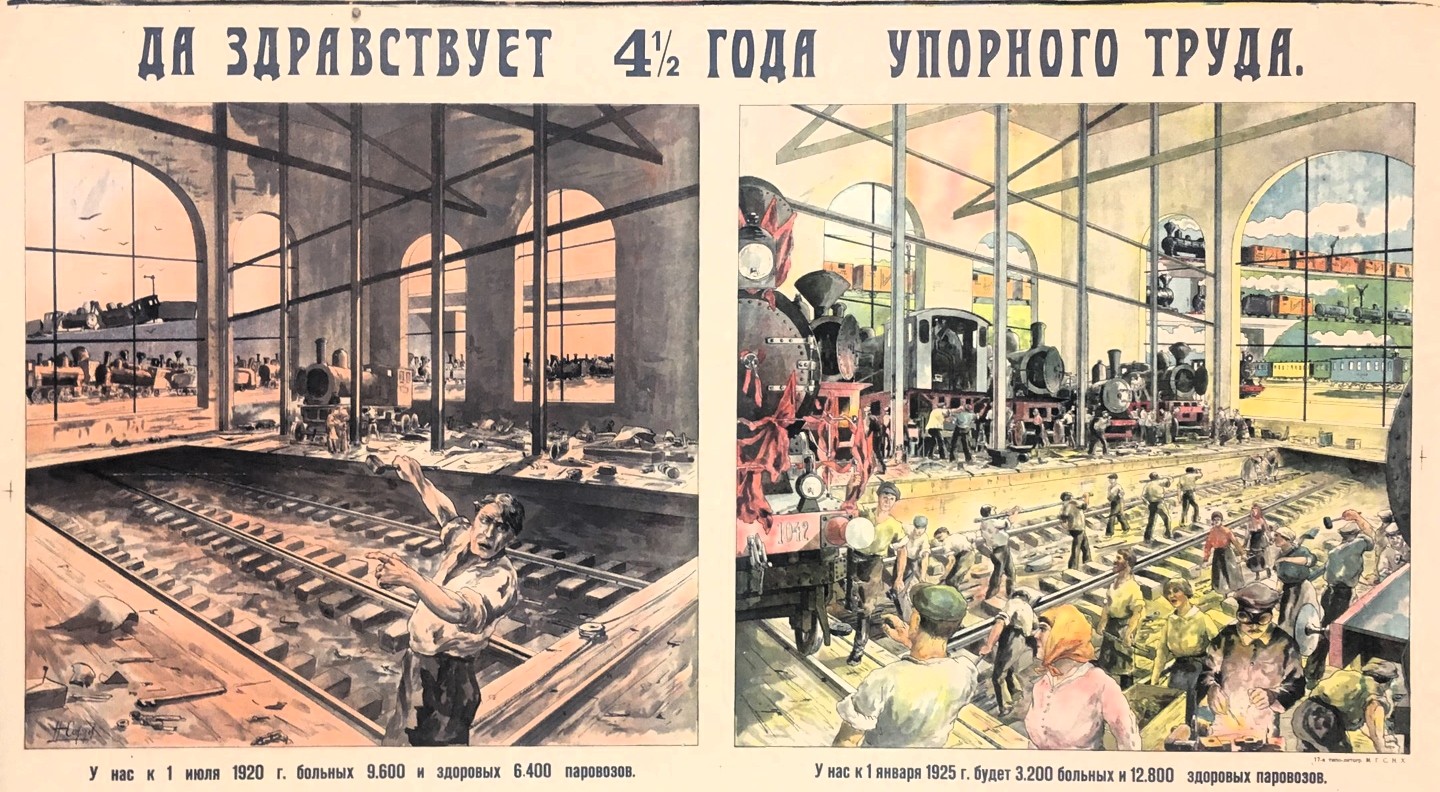
The Russian Revolution was made by train From dispensing Soviet power, to feeding its people, to winning the Civil War, everything was dependent on railroads. The First World War, Revolutions, blockade, imperialist intervention, and multiple civil wars crippled both the industry and the lines. Enormous effort was necessary to organize, rebuild, and expand the essential network. In response, as part of War Communism, the Bolsheviks militarized the railroads from factory workers to engine-stokers. Below is a look at the scale of the crisis and the implementation of the reorganization plan.
‘Combatting the Disorganization of Transport’ from Soviet Russia (New York). Vol. 3 No. 9. August 28, 1920.
1. MILITARIZATION OF RAILROAD MEN
The Council of Defence of the workers and peasants has decided to militarize, throughout Russia, the work of persons aged eighteen to fifty and employed or formerly employed within the past ten years, in the railway service, as mechanics, assistant mechanics and firemen of every class and category, as well as the workers repairing boilers, the superintendents, and laborers working in the railway shops.
Persons working in the above-mentioned occupations and filling responsible posts in the Red Army or working, according to their specialty, in the institutions of the War Commissariat or on the construction of railroads, as well as persons now occupied as railroad men and holding the positions enumerated above, are exempt from militarization. Persons liable to militarization and not presenting themselves within the time fixed, are tried before the revolutionary tribunal and punished by confinement for a maximum period of five years in a concentration camp.
2. MOBILIZATION OF COMMUNISTS
The Central Committee of the Russian Communist Party has addressed a circular to all the party organizations, announcing the mobilization of the Communists for the combatting of disorganization in transportation.
“The civil war which has been imposed upon us,” the circular reads, “and which has lasted more than two years, has brought our country to extreme ruin. Our industry cut off for long months from its sources of basic materials, deprived of fuel and releasing a large number of expert workers for the Red Army, finds itself paralyzed. Our transport suffered especially. The number of newly constructed locomotives and cars is altogether insignificant, compared with that of the period before the war and our actual needs. The damaged locomotives considerably exceed in number those which have been repaired. The number of cars and locomotives out of service is growing from day to day. In the localities which were invaded by the bands of Denikin and Kolchak almost all the railroad bridges have been blown up, a great number of works have been destroyed, the railroads damaged, telegraph poles torn up, etc.
“All these ravages, together, render the situation of the railroads extremely dangerous. The catastrophe of a complete cessation of the movement of trains threatens us, if by heroic efforts; we do not succeed within a short time in working a radical change. In view of this enormous and mortal danger, the Central Committee is utilizing a means which was tried with success during the years of the revolution.
“We appeal to the masses of the workers, to you especially, comrades, members of the Russian Communist Party. It is you who have led hundreds of thousands of Red soldiers in the great and sacred fight for the proletarian power, for Communism. You have done this by your heroic example, by your unlimited devotion to the cause of the workers. Whenever the situation on the front became threatening, our party ordered a mobilization of the Communists, and always this mobilization regenerated the front. The Red soldiers, who were even yesterday dispersed by the first attack of the enemy, are very different today, when a fresh force of Communist workers has entered their ranks. They have become heroes and accomplished great feats, competing among themselves in daring and courage.
“At the present time, comrades, we are on the eve of a new mobilization, but this time for an internal peace front. Cost what it may, we must regenerate our means of transport during the coming months. It is by this effort and only by this from the terrible suffering of famine and cold. This effort, if it succeeds, is the assurance of the regeneration of our whole industry and the definite consolidation of our victories against the national and world counter-revolution.
“To this end, the Central Committee announces a new mobilization of 5,000 members of the party, for the work of transport.
“Let each city and district aspire to be in the front ranks of the fight against the danger which is menacing the revolution, a danger which must be met.
“Let every mobilized member of the party report at the peace front with the same disposition to heroic acts, and the devotion of which tens of thousands of our party members have given proof on the fronts against Denikin and Kolchak.
“We must construct three new locomotives for one, and repair a hundred instead of ten.

“Forward, Comrades, to a new heroic battle on a new front. The victory which we shall win there will be a victory on the whole line, and, especially, a general battle won against famine and cold.
“We must win this victory, and we shall win it!”
3. THE PRODUCTION OF A WEEK OF INTENSIVE LABOR
The week devoted to transportation has produced very satisfactory results on the railroad lines Nicholas and Murmansk.
Railroad men and volunteer workers participated, working particularly on large and small repairs, in order to put into circulation, with the least possible delay, the maximum number of locomotives and cars. The workers dismembered a number of cars and locomotives which were irreparably damaged, employing the useful parts for other cars; they adapted numerous freight cars for passenger service; they collected fuel, loaded and unloaded trains, cleared the tracks of snow, and selected the exchange parts and useful material.
8,844 listed workers and 400 supplementary workers were employed in the Nicholas railroad shops on the repair of cars. They repaired 295 freight cars, twenty-six baggage cars and nine passenger cars. In the centred shops for the repair of locomotives 2,500 men worked during this week. They completed almost all the capital repairs on eight locomotives. Labor production increased on an average of seventy per cent. On the same Nicholas railway in the course of the week devoted to transport, the work was pursued not less energetically. They succeeded in repairing almost 900 trains and continued, moreover, the usual routine repairs on locomotives. They adapted more than 100 freight cars for passenger transportation. In short, the transport week has increased the quantity of rolling stock by nearly 1,000 units.
The transport week also produced very satisfying results on the Murmansk railroad. They were successful in repairing thirty locomotives, necessitating ordinary repairs, and a tender, and two locomotives were recovered. The parts of twenty-one passenger cars were inspected, 168 freight cars repaired, forty-three cars for the transport of wood converted, the boards of 448 train-platforms renailed, and 660 stove-pipes prepared. The increase in labor productivity on the Murmansk railway amounts on an average to sixty per cent.
4. THE RAILROADS OF UKRAINE
After Denikin’s retreat, the Soviet power found the railroads in the region of Kharkov in a deplorable state. The entire technical personnel had been removed and the drafts, designs, and tools carried off. The Whites burned everything they did not have time to remove. Typhus raged among the few employes who remained. In depriving the railroads of the technical personnel, they did not succeed, nevertheless, in doing it soon enough to catch up with the Red Army, which advanced rapidly, always liberating new sections of railroad. The situation of the railroad bridges was particularly critical. South and north of Kharkov, forty-seven bridges were destroyed. The workers of the railway service accomplished miracles, in order to rebuild them. A special information section was formed, to organize local reconstruction squads which were formed with the immediate help of the service section of the railroad. Reconstruction was much hindered by the lack of material and the absence of a transport operating regularly to bring material. It is thus for example that the demands for wood, addressed to Orel and Kursk were not met except at the end of two weeks. In view of this state of affairs the reconstruction section of the southern railway service began itself to exploit the forests. As a result twenty-nine bridges of the forty-seven destroyed by the enemy were repaired in June.
5. RESUMPTION OF INTERNATIONAL RAILWAY COMMUNICATION
The economic activity of the country becoming more intense upon the raising of the blockade and the conclusion of peace with Esthonia, a question of first importance arises, and one concerning the very near future, that of the railroads, as one of the principal economic factors.
In anticipation of this, the financial and economic section of the Commissariat of Ways of Communication elaborated a program of work relative to the questions of transport economy.
This program is occupied, principally, with the organization of new direct international transport of passengers and freight and the reestablishment of the old transports. Measures will have to be taken henceforth to establish these transports with the aid of the Esthonian railways.
The program next describes the financial situation of the railroads and enumerates the measures designed to improve it; it then discusses the comparative study of the situation and of the role of the economy of the railroads among the other branches of the national economy and occupies itself with a new distribution of the railways in accordance with the economic situation.
6. “ECONOMIC LIFE” ON THE QUESTION OF TRANSPORTATION
Economic Life, a daily appearing at Moscow, and serving as the organ of the Supreme Council of National Economy and the Commissariats of Finance, of Provisioning, and Foreign Commerce, devotes its Sunday issues exclusively to the question of the fight against the disorganization of transportation. In the number of March 7, the journal explains the purpose of these periodic articles.
“The worker having taken into his hands, following upon the October Revolution, the direction of the national economy, must understand and form a clear idea of the importance of the transport and its regular functioning. Every locomotive, every train, becomes, from this moment, a valuable thing for the working class. The difficult conditions in which we are forced to live render the question of transport very urgent for the working class, and it demands immediate solution. In effect, only the satisfactory solution of these questions will enable the worker to improve the present difficult situation and destroy all the chains which prevent him from constructing his new economic life.
“The fundamental task of our Sunday members is to inform the large working masses, the organizers of the national economy, of the state of our transport. We want, constantly, to attract the attention of the workers to every change in the transport situation for better or worse. We do this in order to keep the workers constantly alert, to call them to the fight against the disorganization of transport, for only victory over this public calamity will permit the strengthening of the proletarian power and consolidate the conquests of the October revolution.”
The same number contains interesting information on the situation with regard to rolling stock on the railroads of Soviet Russia.
“We must recognize,” writes the journal, “that only a very insignificant quantity—but a few hundred—remains to us of the number of locomotives which were in use in 1914.
“There were constructed in our factories and received from abroad nearly 4,000 locomotives in the period from 1914 to 1919, inclusive. That means nine locomotives for 100 versts of exploited railroad, considering the system which we possess at the present time (normally, there would be thirty locomotives for every 100 versts). This number of locomotives is four times less than that available in 1914, and two and a half times less than that available in 1916.
“We must logically deduce from this that it is not only necessary actively to repair the locomotives out of service, but that it is also indispensable to increase at all costs and in the shortest possible time the number of locomotives in use, by constructing new and very powerful engines. This second circumstance is even of more importance than the first.
“Such a critical situation with regard to our rolling stock naturally brings up the following question: are our factories for the construction of locomotives and trains in a position to furnish us the necessary quantity on the condition that they be supplied with metal, fuel, and other indispensable materials. On the condition, also, of their having at their disposal a sufficient number of workers provided with food and equipment? And then the question: how soon will our factories be able to achieve this task?
“Let us suppose that we have a system of 50,000 versts of railroad. For 100 versts in use, we must have an average of thirty locomotives, the proportion which obtained before the war. For 50,000 versts we must have 15,000 locomotives. The working conditions on our railway system makes thirty freights cars necessary for each locomotive. Thus, a minimum of 450,000 freight cars must be available. We now have about 10,000 locomotives and 250,000 cars. We need, therefore, 5,000 additional locomotives and 200,000 cars.
“In 1912 and 1913 the committee charged with the distribution of orders studied in detail our factories for the construction of locomotives and cars. It follows from this examination that the maximum annual production of all the factories could be estimated at:
Locomotives from 1,700 to 1,800.
Cars from 40,000 to 46,000.
“About 1,300 locomotives and 30,000 cars are annually put out of service. Thus the factories can, in the course of a year, increase the total quantity of rolling stock in use by the construction of
Locomotives 500 at most.
Cars 15,000 at most.
“To construct all the rolling stock that we lack would require: 5,000 locomotives at the rate of 500 a year =10 years, and for the cars (200,000 at 15,000 a year) =12 years and a half. But in reality we would have to triple, or at least double this figure, because, first, the machinery in most of our factories is worn out and must be replaced; second, to restore working conditions such as they were in the factories in 1912 and 1913—the period of the greatest production—a considerable length of time will be needed.”
Soviet Russia began in the summer of 1919, published by the Bureau of Information of Soviet Russia and replaced The Weekly Bulletin of the Bureau of Information of Soviet Russia. In lieu of an Embassy the Russian Soviet Government Bureau was the official voice of the Soviets in the US. Soviet Russia was published as the official organ of the RSGB until February 1922 when Soviet Russia became to the official organ of The Friends of Soviet Russia, becoming Soviet Russia Pictorial in 1923. There is no better US-published source for information on the Soviet state at this time, and includes official statements, articles by prominent Bolsheviks, data on the Soviet economy, weekly reports on the wars for survival the Soviets were engaged in, as well as efforts to in the US to lift the blockade and begin trade with the emerging Soviet Union.
PDF of full issue: https://www.marxists.org/history/usa/pubs/srp/v3n09-aug-28-1920-soviet-russia.pdf
 Revolution's Newsstand