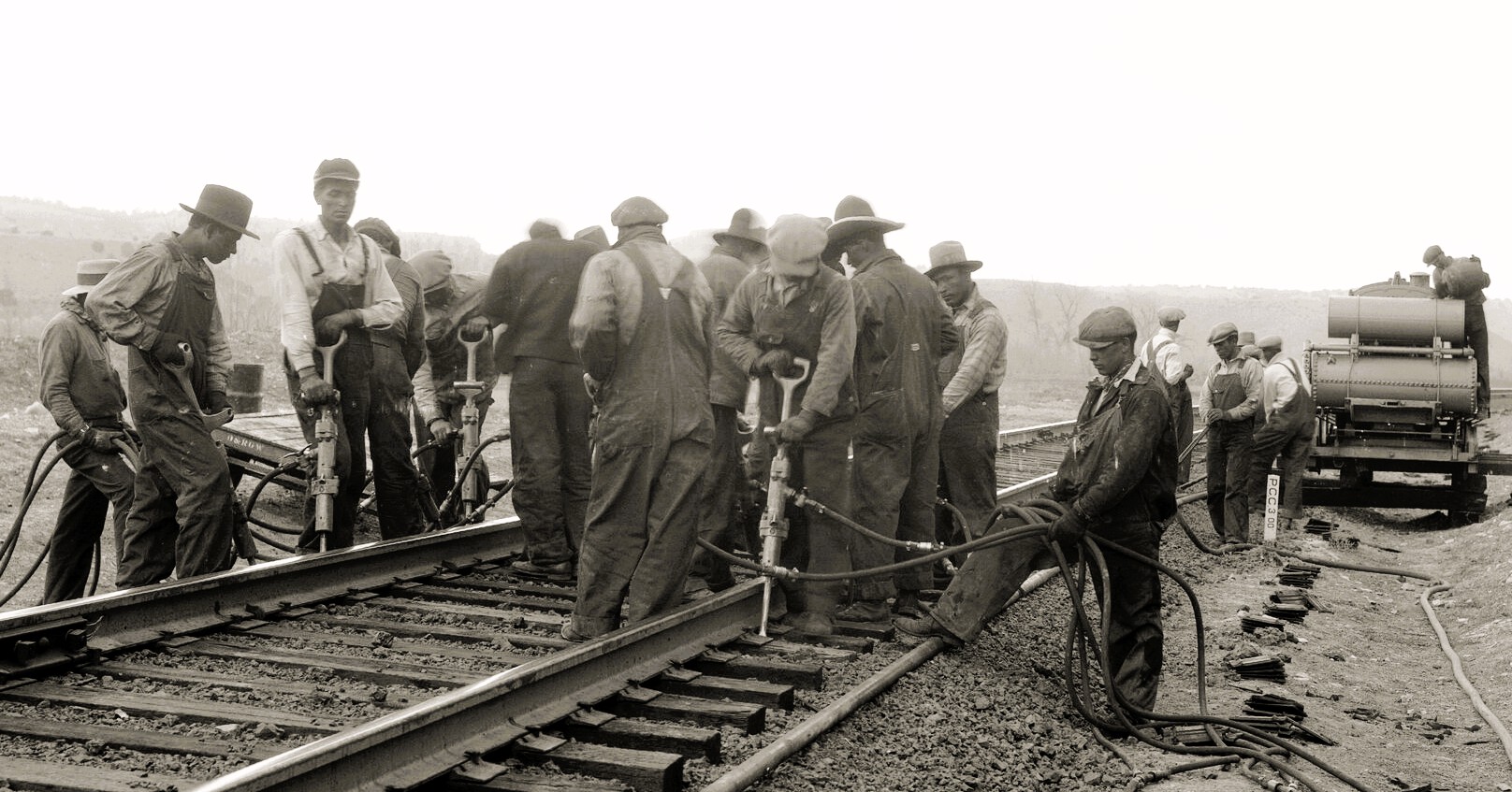
A valuable report of the third conference of the T.U.E.L.-sponsored International Railroad Amalgamation Movement looking at what the 1920s, with its economic ‘rationalization’ and political reaction, did to the industry and the unions. Millions of workers, most of them unorganized, labored for what were then the most powerful companies in the country, with the union movement deeply divided along craft lines into well over a dozen organizations.
‘Railroad Progressives Move Forward’ by H.E. Kaye from Labor Unity. Vol. 2 No. 6. September, 1928.
THE third conference of the International Railroad Amalgamation Movement, held in Chicago on June second and third, marks a turning point in the railroad industry. Six years have passed since the disastrous 1922 strike of the shopmen. These six years have witnessed the almost utter disintegration of the shop crafts. Due to the reactionary policy of the union officials in refusing to take effective action toward uniting the railroad unions into a powerful, aggressive industrial organisation of all railroad workers, many of the shop crafts are but mere skeletons of their former membership. Company unions have sprouted up on sixty-four railroads. Unemployment is taking its heavy toll. Approximately 250,000 railroad workers have been laid off since 1923, the result of the ever-increasing use of machine technique, speed-ups and so-called efficiency methods. The present leaders of the railroad unions, with a few rare exceptions, are absolutely incapable of coping with the situation, which is rapidly reducing the railroad unions to mere appendages of the railroad companies, little more effective in fighting for the interests of the rank and file than are the many company unions. The vast mass of railroad workers are still unorganised, but 750,000 out of the approximately 1,800,000 being in the present unions.
Class-collaboration agreements like the B. & O. Plan, instead of a fighting policy for increased wages and shorter hours; labor banking and insurance schemes instead of efficient organisation of the unorganised; dismal arbitration failures such as the C. & O. shopmen’s case and that of the workers on the K.C.M. & O., instead of a militant, smashing drive of the united railroad unions all along the line; are, as far as the present leadership of the railroad unions are concerned, the only methods they are able to offer the rank and file for withstanding the onslaughts of the railroad companies.
Crumbs Now And Then
Regardless of the few sops handed out to some of the unions under the operation of the Watson-Parker Law, such as the recent decision of the railroad companies in the Western Firemen’s and Trainmen’s case, not to carry their opposition to the United States Supreme Court, but to abide by the decision of the United States Circuit Court of appeals upholding the Western Wage Award, continued support of this act is hamstringing the railroad unions. By it the railroad unions are being drugged into a policy of almost absolute surrender to the railroad companies. The action of the Western Railroad Managers in abiding by this decision was a well-thought-out policy of instilling new life into the Railway Labor Act, a new injection of the deadly serum of “legalism” into the minds of the railroad rank and file.
The railroad workers on the job were getting sick of the long drawn-out negotiations, the numerous delays, the whittling down of their demands to the bare bone. Sentiment for a fighting policy of railroad unionism among the rank and file was increasing rapidly. Sensing all this, and exercising far greater foresight than the railroad union leadership, the Western railroads accepted the decision of the award and for the present headed off the growing militancy of the rank and file. They are not yet quite ready for a break with the railroad unions. But troublous times are ahead. The reactionary union officialdom do not see the growing clouds on the railroad horizon. But the railroad managers do. So also do increasing numbers of the rank and file. And the delegates attending the recent Chicago conference are among the advance guard of that rank and file.
A Rank And File Conference
The entire conference was one of action. Delegates came to the conference from such far points as Tacoma, Washington and Edmonton, Canada. With a few exceptions they were of the rank-and-file workers direct from the job. They smacked of the industry. There were no fat paunches there. Faces lined by toil, they determinedly set down a line for aggressive, fighting railroad unionism. And they did a good job. Taking full note of the present conditions in the industry, of the past years of bitter disillusionment and defeat, they hammered out a fighting program that will within a year or two result in the greatest mass movement of the railroad rank and file that the country has ever seen. And out of this mass movement will come the powerful industrial union of railroad workers that has been the dream of railroad militants for the past forty years.
The entire keynote of the conference was the problem for the effective organization of the one million railroad workers still unorganized. Point one of the Program, to “Organize The Unorganized,” is the basic task confronting the rank and file. Once get the 1,000,000 unorganized railroad workers back into the unions and it will have the most powerful effect in injecting new life, not only into the present railroad unions, but into the entire American labor movement. It will be a gigantic step forward and will result in the absolute defeat of company unionism. But this step forward cannot be undertaken through the corrupt leadership at present heading the unions. Point two of the Program, to “Oust The Reactionary Leaders,” lays down the basis for cleansing the railroad unions of their present mis-leaders. This dead timber must be cut out, root and branch. A fighting leadership is an absolute necessity.
For Real Struggle
In point three, “For An Aggressive Union Policy,” is laid the basis for a complete break with the no-fight policy of the reactionary leadership. Powerful mass action of the rank and file instead of cringing acceptance of the decisions of “neutral” arbitrators under the provisions of the Watson-Parker Law, must be the order of the day. Under such powerful mass action of the rank and file the entire poisonous mixture of never-ending arbitration, union-management co-operation, the proposed establishment of the flexible work-day, speed-ups and efficiency programs of the companies will wither away. Fighting unionism and no surrender must be the slogan for action.
One of the greatest menaces confronting the railroad workers today is the ever-increasing development of machine technique in the industry. Innumerable labor-saving devices and better machine methods in the shops, the use of auxiliary locomotives or train boosters resulting in the hauling of longer trains, roller-bearing equipment, heavier loading capacities through the use of the new “Dalman” trucks, automatic engine cab signaling and control, central dispatching control systems, car retarders in the classification yards, are but a few of the many improvements in railroad operation of the last few years. This has resulted in the displacement of 250,000 workers since 1923 and many more thousands are slated for layoffs in the near future as further machine methods are devised. It is utterly impossible within the scope of this article to adequately cover the hundreds of instances of such improved machine methods in the railroad industry. They are here to stay and will press down on the rank and file more heavily in the future with their threat of unemployment and starvation. They must be controlled. And the means for such control is laid down in point four of the Program, “For A Six Hour Day”. The Third Conference of the Railroad Amalgamation Movement demands the six hour day for all railroad workers with general wage increases and calls upon all railroad workers to support this demand. The establishment of the six-hour day will be a means of re-absorbing into the industry the hundreds of thousands of railroad workers now in the ranks of the unemployed who at present compete for the jobs of those employed which factor keeps wages down. The winning of the six-hour day with substantial increases in the wages of the poorer paid classes of railroad labor is the next great task to be accomplished.
But the accomplishment of these great tasks cannot be brought about by the present separation policy of the railroad union leadership. While we see on the one hand ever greater consolidations and mergers of the different railroad systems into gigantic combines, as witness the recent ten billion dollar merger of the New York Central, the Pennsylvania, the B. & O. and the Nickel-Plate-Erie, on the other the railroad unions are stagnating in the old system of craft-unionism which dates back to the competitive state of the railroad industry of over forty years ago.
Thinking only of their own “pie-cards” and of defending the interests of some of the more skilled trades at the expense of the great masses of unskilled or semi’ skilled, the reactionary leadership stubbornly oppose every effort to amalgamate the railroad unions. Amalgamation must be brought about in spite of them! In the great amalgamation drive following the 1922 strike the overwhelming majority of railroad workers were for one union in the railroad industry. Point five of the Program, “Amalgamate The Railroad Unions,” indicates the necessary steps to be taken for the building of one powerful union for the entire industry.
Amalgamation Grows In Favor
Already, in widely separated parts of the country spontaneous movements for the closer co-operation of the present railroad crafts have arisen. Witness the joint action of the unions on the Pere Marquette last year; the action of the Tri-State Union Meeting of the B. of L.F. & E. at El Paso, Texas, in April, 1927; the demand of the joint meeting of Engineers and Firemen at Altoona, Pa., last August to amalgamate those two Brotherhoods; the proposed Federation of all Railroad Trades as put forward by the St. Louis meeting of the Railroad Clerks; the recent joint action of the six brotherhoods on the Boston and Maine in fighting a ten per-cent reduction of the wages of the B. & M. clerks: all straws in the wind indicating the temper of the rank and file if given even half a chance. Giving due recognition to the admirable spirit of the railroad workers concerned in these widely separated instances, the Third Conference of the International Railroad Amalgamation Movement has advanced an effective plan of action for the organisation of Joint Railroad Councils in every railroad center the country over. What has already been done by the railroad workers on the Pere Marquette and the Boston & Maine can be extended to the farthest confines of the industry. The unions must be pulled together. The million unorganised railroad workers must be brought into them. New blood, new life, pulsating energy will be the result.
Due to space limitations, it is possible in this article to but briefly sketch the all-inclusive program of the International Railroad Amalgamation Movement. The outline of action drafted by the recent conference together with its implications could not be adequately covered in a hundred articles of this extent. From time to time will appear articles on the various phases of the movement as the occasion requires.
Every railroad worker who reads this article should immediately get in touch with O.H. Wangerin, Secretary-Treasurer of The International Railroad Amalgamation Committee, Room 8, 702 East 63rd St., Chicago, III, for further information regarding the organisation of the joint councils, or, still better, subscribe to the militant paper of the movement, “The Railroad Amalgamation advocate.” However, in closing this article, we can do no better than to quote from the last page of the Program:
PULL THE UNIONS TOGETHER
Organize Joint Railroad Councils In All R.R. Centers
In order to carry out the above program the Third Conference of the International Railroad Amalgamation Committee went on record calling upon its supporters throughout the railway industry to immediately initiate the formation of JOINT RAILROAD COUNCILS in all railroad centers.
The purpose of these Councils is to bring about closer co-operation of the railroad workers of the various trades, to organize the unorganized, to further the work of amalgamating the unions, eliminate company unionism, to resist wage cuts or lengthening of hours, and to generally consolidate and strengthen trade unionism on the railroads.
The JOINT RAILROAD COUNCILS shall be made up of representatives from local unions, also from shops, round-houses, yards, offices and other work places. Representatives shall also be drawn in from unorganized roads. Every effort must be made to build a mass support of the organized and unorganized railroad workers around these JOINT RAILROAD COUNCILS.
The Councils shall at once begin intensive campaigns for the organization of the unorganized in their respective localities on the basis of the above program. It will be the major task of these Councils to stimulate and direct these organization campaigns and to carry into effect the general program of re-organizing and building railroad unionism adopted by the Conference.
Railroad Militants! Have your local lodges take steps immediately to organize a Joint Council at your railroad point. Call a meeting of representatives of all trades, or as many as possible, to start the formation of your Council. Elect the necessary temporary officers and committees, set a regular meeting date, get delegates from all organizations and places of work in your district, and begin functioning on the basis of the above program.
Labor Unity was the monthly journal of the Trade Union Educational League (TUEL), which sought to radically transform existing unions, and from 1929, the Trade Union Unity League which sought to challenge them with new “red unions.” The Leagues were industrial union organizations of the Communist Party of the United States (CPUSA) and the American affiliate to the Red International of Labor Unions. The TUUL was wound up with the Third Period and the beginning of the Popular Front era in 1935.
PDF of full issue: https://www.marxists.org/history/usa/pubs/labor-unity/v2n08-w27-sep-1928-TUUL-labor-unity.pdf
 Revolution's Newsstand