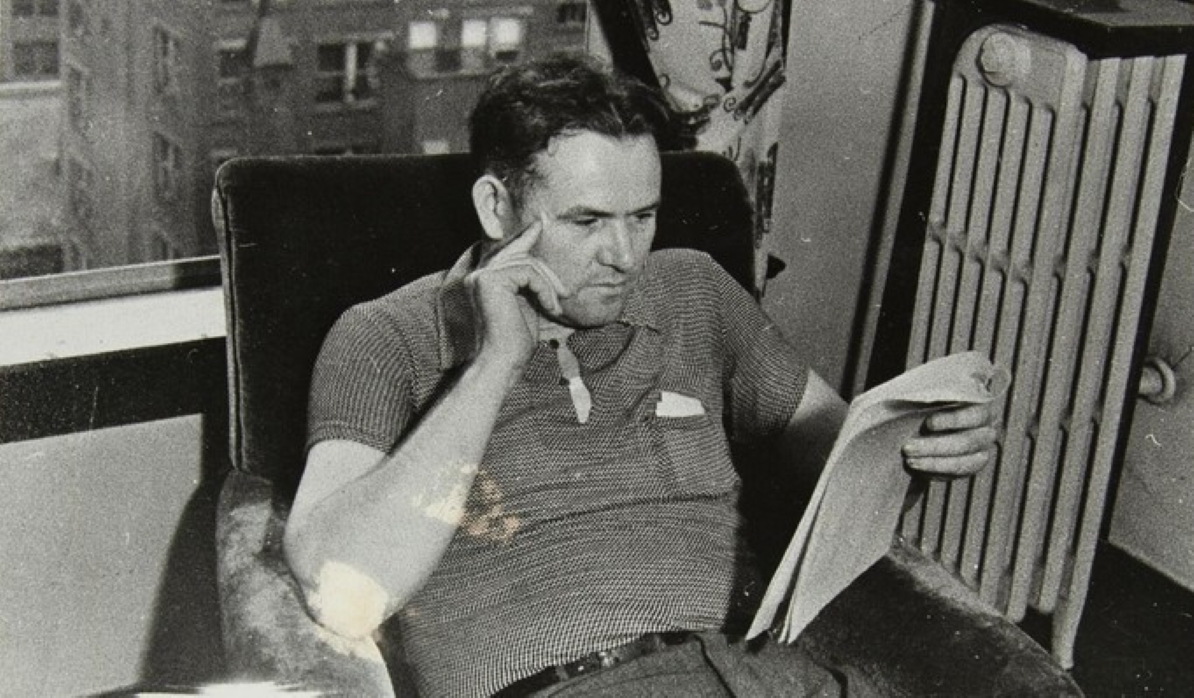
A name synonymous with the worker-writer, Jack Conroy announces ‘Unrest’, the yearly compilation form the proletarian poets collective Rebel Poets.
‘Rebel Poets’ by Jack Conroy from New Masses. Vol. 5 No. 11. April, 1930.
Rebel Poets. April, 1930.
Dear New Masses:
Our organization, Rebel Poets, an Internationale of Song, has been watching with keen interest the letters from the various Workers’ Art Groups in the New Masses. Since conservative and reactionary writers and artists have long been gathered into guilds of many varieties it is strange that working class authors, artists and poets—who certainly possess the requisite capability and energy—should not have subscribed to a program similar to that outlined in the recent issues of the magazine. It is invigorating and heartening to find that, to borrow a phrase from Mike Gold, the Revolution is a breaking like a wheat kernel through the stony soil of American art and letters.
Rebel Poets sprang from the group of poets who contributed to America Arraigned! edited by Ralph Cheyney and Lucia Trent, an anthology of protest against the murder of Sacco and Vanzetti. Ralph Cheyney was the founder and has been the president since the fellowship’s organization. During its two years of existence Rebel Poets has grown from a membership of less than a score to more than 300 members, distributed throughout the world. Unrest, the Rebel Poets Anthology for 1929, was the first of a proposed annual series of radical anthologies. It has been accorded an enthusiastic reception by the revolutionary press of the world. The 1930 volume is almost ready for the press, and will include the work of representative revolutionary poets of the world. Almost every New Masses poet will be represented.
Aside from the task of compiling this annual anthology, the organization aims to form local chapters in cities where even a few revolutionary poets, writers, or even proletarians who stand offensive and defensive for class propaganda and stressing of the class struggle in poetry and literature, may be found. These local chapters should serve as cultural oases where radicals may congregate for discussion of revolutionary art and other activities. In this way, the otherwise isolated proletarian should be made to feel that he is not fighting alone in his assaults against the citadels of capitalism.
We extend fraternal greetings to the John Reed Club, which has already performed such significant service in attracting and organizing the proletarian artists of New York, and to all the other groups which are springing to life or which have been operating for some time in various centers in the United States and abroad. We hope and believe that these forces may be amalgamated into a mighty working class cultural union of authors, poets, and artists which will present a United Front to the subversive influences which seek to wean young radical writers away from the class struggle and revolution in art and literature.
R.R. 4, Toledo, Ohio. Fraternally JACK CONROY. Secretary
Rebel Poets. June, 1931.
The poet has so long been regarded as a faery creature tripping lightly in the realms of fancy that radical proletarians are wont to treat him with contempt. “You call me poet as a term of shame!” cried rare Ben Johnson, and the same attitude largely prevails today. However, it is the task of Rebel Poets to demonstrate that poets can and will become an integral part of the revolutionary movement. The difficulties are incalculable. Poets are few to begin with, radical poets are doubly scarce. Every radical author who has tried to get an obviously propagandists prose work published has a story to tell about publishers’ hostility. And poetry, never selling well, is regarded with even more animosity. In spite of these obstacles, Rebel Poets has published its second anthology (1930) and is preparing the third. We are aware of the obvious defects of our compilations, and we are striving to remedy them. The third collection contains a section of translations from contemporary soviet poets (due to the co-operation of Ed Falkowski, now in Moscow), Negro songs from the New Masses, a collection of Sacco-Vanzetti poems commemorating the fifth anniversary of their death, and what we consider the best available material from American and foreign sources.
Our magazine The Rebel Poet has encountered the hostility of the Postal Department from the beginning. The February issue has been declared unmailable because of the poem “Rally to Battle”, and we have been denied second class mailing rates, freely granted conservative publications of any kind. Our April issue was held well over a month until Washington pooh-bahs should decide whether it would set the mail bags afire. Other publications are feeling the tightening censorship, and even the liberals are alarmed, as evidenced by an article in the Nation April, 8. Evidently the Postal Department is enforcing J. Ham Fish’s gag laws without waiting for the formality of their passage by Congress. Our printer is an idealist, his workshop is a barn which he shares with a melancholy cow, and he can exist for long periods without food or drink. Yet what doth it profit a magazine if it gain such an asset, and yet lose the right to mail the blamed thing?
Our Rebel Poets series of pamphlets, of which Red Renaissance, by H.H. Lewis, was the first, will be supplemented by other titles, possibly an anthology of contemporary Russian poetry soon. The Wolverhampton (England) Chronicle, says of Unrest, 1930 “Glimpses of true poetry occasionally but the claims of art are sacrificed for a vehement denunciation of the social order as it exists today.” What we need is art and denunciation blended if we can get it, but the denunciation anyhow, let the art fall where it may.
Jack Conroy, President. THE REBEL POETS Rural Route Four. Moberly, Missouri.
The New Masses was the continuation of Workers Monthly which began publishing in 1924 as a merger of the ‘Liberator’, the Trade Union Educational League magazine ‘Labor Herald’, and Friends of Soviet Russia’s monthly ‘Soviet Russia Pictorial’ as an explicitly Communist Party publication, but drawing in a wide range of contributors and sympathizers. In 1927 Workers Monthly ceased and The New Masses began. A major left cultural magazine of the late 1920s and early 1940s, the early editors of The New Masses included Hugo Gellert, John F. Sloan, Max Eastman, Mike Gold, and Joseph Freeman. Writers included William Carlos Williams, Theodore Dreiser, John Dos Passos, Upton Sinclair, Richard Wright, Ralph Ellison, Dorothy Parker, Dorothy Day, John Breecher, Langston Hughes, Eugene O’Neill, Rex Stout and Ernest Hemingway. Artists included Hugo Gellert, Stuart Davis, Boardman Robinson, Wanda Gag, William Gropper and Otto Soglow. Over time, the New Masses became narrower politically and the articles more commentary than comment. However, particularly in it first years, New Masses was the epitome of the era’s finest revolutionary cultural and artistic traditions.
PDF of full issue: https://www.marxists.org/history/usa/pubs/new-masses/1930/NM-1930-04-apr.pdf
 Revolution's Newsstand