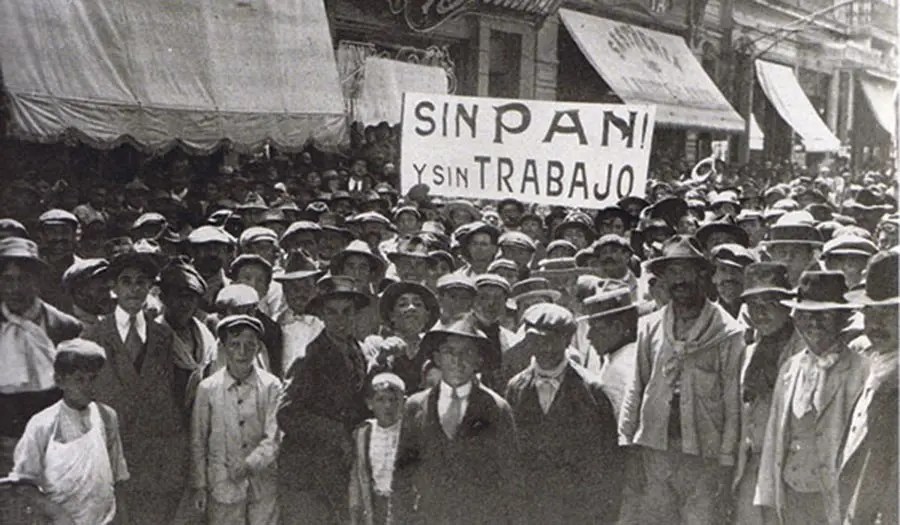
A wobbly from Galicia gives a full, if condensed, history of Spain’s workers’ movement from the 1840s through the revolutionary events of 1919.
‘The Labor Movement in Spain’ by Genaro Pazos from One Big Union Monthly. Vol. 2 No. 6. June, 1920.
“EL SINDICATO UNICO”—THE SPANISH O.B.U.
While I was preparing this article on “The Labor Movement in Spain,” some other fellow worker appeared ahead of me with parts of what I was intending to add in this article. I was very glad to see in Solidarity, issue of April 3, an article entitled “Liberating Class War Prisoners—How they Do It in Spain,” which is very important indeed. This was part of my work which I was reproducing from “La Voz del Obrero” (The Voice of the Worker), a bi-monthly paper published by the Local Syndicate of La Coruna. Also I notice that Delegate R-17 edifies the readers of Solidarity with the revolt in the Ninth Regiment of Artillery, and the Congress of the National Confederation of Labor, held in Madrid from December 10 to 17, 1919.
Many other cases are very interesting, but those two are the most important ones, first, because they show the demoralization in the ranks of soldiers, and, second, because they indicate the remarkable activities of Labor in Spain. I am informed that in many places the soldiers refused to obey orders from their officers when on duty, and when the army of Spain gets ready to revolt against their officials (and the facts below and above show it) then the revolution in Spain will soon take effect. It will be so, because the workers are ready to come out at any time, and when workers and soldiers, all members of the same family, act together, then—good-night, Autocracy!
Here are two facts to affirm my words: In La Linea, a town near Gibraltar, the bakers were on strike. A committee of soldiers appeared before the local federation, saying, “We were ordered to talk with you first; shall we go or not?” The reply was something similar—”Boys, you know our situation and conditions. You are soldiers in military uniform. Analyzing our conditions and your own situation, act according to your own judgment.” That was a reasonable answer, and the soldiers gave a no less reasonable reply: “All right, we won’t go and break the strike.” They refused to Obey orders that were not on their own rules.
In some of the Castilian provinces, I believe it was, stickerettes were stuck up on posts inside the barracks. They were anti-militaristic, of course. The general saw it, and called the entire regiment to the yard. There he made a speech, and when he was through, he commanded: “Those who brought those stickerettes in, step forward!” And how amazed he was when the entire number; as one man, stepped to the front. In other words, every one was in accord with that campaign against militarism. All these things are growing more and more every day, and the blow will come soon, no doubt. In Barcelona the bricklayers refused to work on the building of a jail, and although it is over a year the work is undone and there is no hope that it will be built.
Another act which is not less important is this: The captains and mates had a union, winning their demands through the transport workers’ solidarity. When the longshoremen were locked out in many ports by the bosses, those deck officials showed their solidarity also. A ship arrived in Malaga, and the yellow syndicate was trying to discharge the ship; a “Red” committee went on board to explain the situation to the captain. Rapidly the order was sent to the consignee asking that the cargo should not be taken out of the hold except by men carrying Confederation membership cards. As the consignee was opposed to this, the captain wired the company owners, and the reply was that if the consignee continued refusing to take “Reds” then its consignee commission could be taken away by the captain. Many ships went from one port to another, returning to the port of departure without being unloaded, in order to force the owners and consignees to employ workers from the Syndicate and not non-union men.
These are facts which: show the solidarity among the manual workers and technical officials.
As I said at the beginning, my intention was to make a condensed statement of the labor movement in Spain from the start; that is, ever since the first symptoms of organized labor appeared in Spain to this period. But, as Delegate R-17 intends to give information about the National Confederation Congress (which I recommend to every reader interested in labor developments) and also the facts of Zaragoza, I will limit myself to relate, with dates, the real facts of the revolutionary labor movement in that little parcel of land in the European continent, called “Spain.”
But before I go any further I congratulate R-17 on his first article—not because we look for “tips,” but for the simple reason that in North America the labor movement in Spain is either unknown or those who can get facts aren’t willing to publish them. I recalled this because magazines and papers called “liberal” and “radical” never show any inclination to present the true facts of revolutionary attempts inside that country. Even during the miserable action of the Manufacturers’ Association, with the so-called “lock-out” trying to force the workers to submission through hunger, they never succeeded in breaking the revolutionary spirit of class-conscious workers; but, even then, I said, nothing was printed. And allow me to say this: that the “lock-out” in Spain, especially in Barcelona, was the last weapon used by the capitalist class to destroy the “Sindicato Unico,” as the bosses state in a circular published in El Sol (The Sun), January 18, 1919, where they openly state that their aim was to destroy this union, which was a new. form of organization adopted first at the Congress of the Regional Confederation of Catalonia, held in Barcelona from June 28 to July 1, 1918.
A couple of words about this “Syndicato Unico.” It is similar to the Industrial Workers of the World, with its industrial unions, but with more local autonomy in general. As a matter of fact, as I will point out later, the doctrine of Spanish labor is not centralization to the point of control by one single body which commands all. That is, in my estimation, the only difference between the I.W.W. in America and the Syndicalists in Spain, under the new form of organization. Which is right or wrong time will show. In tactics they are the same.
Now to give an idea of the working class movement in Spain, and in order to obviate any idea that this revolt of today is merely a spontaneous uprising, it would be advisable to go as far back as before the International. By doing so we can analyze the feelings, teachings and so on of the leading movement, either economic or social.
I will start with the following question:
Does there really exist an economic movement in Spain, or does there not? If it does exist, is it of any importance? I quote a paragraph or two from a series of articles which appeared in the columns of an Italian revolutionary paper in Italy in regard to the revolutionary movement in Spain, written by an Austrian comrade, I believe. He said this: ‘In Spain the two revolutionary poles, Barcelona and Jerez, are situated northeast and southwest on the Peninsula, as in Europe the two revolutionary poles, Russia and Spain, are at the northeast and southwest of the continent. They are not nations of intellectual culture or compulsory education, but it is true that from these two illiterate countries will spread the flash which will cause the explosion which announces the social revolution.
And what characterizes Spain the most is that, although it may have contributed least to the labor movement in a theoretical and literary way, from a practical point of view it is the best leader of the movement…It is generally agreed that the Spanish workers were the first to put the general” strike into practice, as well as other forms of direct action within the economic struggle.
The labor movement in Spain first appeared in 1840, when the symptoms of revolutionary syndicalism began in industrial centers of the country. The right of association was denied and the syndicates (unions) declared illegal. They were driven underground. In 1847 the first revolutionary Socialist paper appeared in Madrid but was suppressed very soon. The teachings were the Proudhon theory. About this period the first strike was called by the secret organizations in Barcelona and other parts of Catalonia under the banner of “Union or Death.” This fight was for the right of assembly, the right to organize, like a few years ago in Seattle, when the free speech fight was on. The “legal” rights were granted but the persecutions went on. It was only a scheme to put the organizers in jail, because as long as they were forced to work secretly the authorities couldn’t find a single trace of the movement.
In November, 1847, acts of revolution started in Valencia and Saragoza. The workers at the latter city took control of it, expropriating food and other important necessities of life from the warehouses and ships anchored on the Ebro river. The soldiers were in sympathy with the workers, “infected” with socialistic propaganda. Almost in every Castilian city, mills, warehouses and factories were attacked with a view to “expropriation.”
The communistic idea was spreading all over Andalusia, with the theoretical expression of “commune Republic.” With this very idea, in June, 1863, over 5,000 men fought under the slogan, “Long live Communism,” but were defeated by government forces, who killed twenty revolutionists and deported more than two hundred.
Beside this economic movement, another revolutionary idea appeared. It was the “Federal Republic,” with Francisco Pi y Margall at its head. The economic and federal ideas of Proudhon greatly influenced Pi y Margall. To the federalist propaganda the Spanish proletariat owes its opposition to the centralization idea, politically as well as economically.
For the first time in 1868 came to Spain Giuseppe Fanelli, intimate friend of Bakunin. He organized the International in Madrid with Anselmo Lorenzo as one of the first members of that group. In 1873 the opponents to the new organization calculated the number of members to.be 60,000. In 1870 the First International Congress (Spanish section) was held in Barcelona, and there the program was “out of politics,” thus making the movement a purely economic affair.
The first paper, La Federacion (The Federation), defending the International principles, came out in 1869 with F. Pellicer as editor; in 1870 came another paper, La Solidaridad (Solidarity), and in 1871 the third one, La Emancipacion (Emancipation), with Pablo Iglesias and Anselmo Lorenzo, both anarchists of the Bakunin school at the time. The first issue came out with this motto: “In religious matters we are atheists, in politics anarchists, and in economics we are collectivists.”
Owing to this propaganda, and seeing that he was losing ground, Marx, in 1871, sent his son-in-law, Paul Lafargue, to see if he could stop the influence of the Bakunin idea. He attended the general meeting in Madrid, January 7, and, getting in touch with the La Emancipacion editors, succeeded in capturing Pablo Iglesias’ sympathy. Pablo Iglesias and others were excluded from the Madrid Federation because they were opposed to the International (Spanish section) principles.
At the annual congress, in Zaragoza, April, 1872, those excluded were admitted again but were expelled for good later, on account of insisting on carrying on propaganda against Bakunin’s principles. Lafargue, Iglesias and seven others organized a new branch of the International, the Madrid Federation, and, with a membership of nine, was recognized by Marx, Engels and the General Council in London, when the old branch with 60,800 was declared false. In the same year (1872) The Hague International Congress was held, approving Marx’s proposition to exclude Bakunin, Guillaume and others and recognize the new Madrid International Federation. At the same congress the participation in politics was adopted.
The Third International Congress (Spanish section) took place in Cordova, December, 1872, voting against the decision of The Hague Congress and in favor of the Saint-Simon Congress, which was against political action. The Marx followers were using their best efforts, but in vain. They were disappearing, while the Bakunin side was growing, with its seven radical papers in the field.
In 1874, when the Republic was overthrown, after only a few months’ existence, to make Alphonse XII the king of Spain, the persecutions forced the International to work secretly. But in spite of it papers were coming out here and there.
Four years later (1878) Pabio Iglesias organized in Madrid the first Social-Democratic group, keeping it secret till 1881. Iglesias himself affirmed a little later in a review, “Our Time” (Nuestro Tiempo), that “the working class movement from 1869 to 1885 was conducted by the anarchist element exclusively.”
In 1881 the reaction wasn’t so severe as before, and the movement came out openly, beginning the publication of The Social Review with 20,000 in circulation, which was very strange in a country where the majority didn’t know how to read. It looks different today, for, according to a statement by New York Congressman Siegel a few weeks ago in regard to Spanish immigrants, they are now found O.K. in their literary test.
From that time on the Federation was inspired with the modern Syndicalism principles. A year later, September, 1882, the second congress of the Regional Federation was held with 250 delegates, representing eight unions, 218 local federations and 663 sections, with 70,000 members.
Right here I wish to call attention to the fact that up to that time the anarchists were “collectivists” and the socialists “communists,” but from that date on, the anarchists became communists and the socialists collectivists (showing the hairfine distinction between these two expressions). In May, 1888, two organizations were formed: “Federation of Resistance against Capital,” under the control of Syndicalists and others, and the “Workers’ General Union,” handled by the Socialist-Democrats.
From 1878 to 1881 only a socialist group was in existence and it was secret; in 1881 there were four, and in 1885 five groups in different parts of the country. The first socialist weekly paper appeared in 1886, El Socialista, with Iglesias editor.
At the elections the Socialists polled 5,000 votes in 1891 and 25,400 in 1901. Barcelona only gave 400 votes for Socialist candidates. According to Iglesias’ figures the ‘‘General Union” was 3,500 strong in 1889 and 42,700 in 1902.
In 1888 a strike took place in Rio Tinto, where more than 12,000 miners took part. Over fifty-seven strikers were killed and 200 wounded. The first of May, 1890, every toiler stopped work for two days and the authorities didn’t make a move. March, 1891, a Federation Congress was held and decided to call a general strike for the eight-hour day. The very same day Pablo Iglesias and other Social Democrats paid a visit to Premier Sagasta to tell him that they had nothing in common with the strikers, and that they were heart and soul against the revolutionists.
From 1886 to 1888 there was published in Barcelona “Acracia,” a revolutionary paper, with Anselmo Lorenzo as editor; later on the “Productor”, also a review, “Social Science,” “Ideal Libre” (Free Ideal), “La Protesta” and “El Corsario,” in La Coruna,
In the spring of 1900 a congress was held in Madrid with 200 delegates representing 52,000 members. The Regional Federation was there organized with all the Syndicates in it. Their principles were the revolutionary general strike and “solidarity strike.” Before this time, 1898, the “White Review” (anarchist) was published in Madrid with a daily supplement for information about the every-day struggle, and in 1903 a daily paper, “Land and Liberty,” was established. In 1901 Anselmo Lorenzo published another paper, “The General Strike.” During this period strikes went on in Sevilla, Gijon, La Coruna, etc., etc., where the authorities were using their weapons against the workers.
In La Coruna, May, 1901, the civil guards, without cause, discharged their guns against a group of strikers, killing one and wounding a few others. Next day over six thousand workers attending the burial of the victim declared a protest general strike. When the workers returned from the cemetery martial law was proclaimed, and at the very same minute the guards opened fire without warning or mercy on the workers, leaving eight dead and fifty wounded. Nevertheless, somehow, the workers on strike won out, returning to work victorious, with revengeful feelings against the Socialists: for their cowardly denouncing of the rebel workers, while not a word was said against the action of the guards.
In February, 1902, the Metal and Machinery workers of Barcelona went on strike for the nine-hour day, and a general strike in sympathy was declared, including 80,000 toilers. Not a single vehicle was moved, and Barcelona was in the workers’ hands. A congressman said at the time: “If this movement spreads to every province of the country the government wouldn’t have enough machine guns to settle this revolution.”
The general strike idea has been propagated in Spain since the first International group was formed, and every new organization formed has adopted the same method. More than any pamphlet or theoretical program, the general strike idea was in the workers’ mind since the important movement in Barcelona, and from that time on the activities were for general strikes. As usual, the Socialists were against such strike. A committee from the Socialist party went to the military governor to assure him that Socialists have nothing to do with those “outlaw” “revolutionists.” They went further, saying that if such strike takes place they would go to the guards’ side in order to establish order. This was in 1902, and eight years later, some of them were the worst enemies of the workers during the tragical week of July, 1909, in Barcelona.
The strike over, Barcelona was kept for a year with the constitutional guarantees suspended and the military tribunal functioned often. Despite all restrictions, in 1903 a revolutionary daily paper came out, called “Land and Liberty.” There were three scientific and philosophical reviews and twenty weeklies published in a country of 18,000,000 inhabitants, with half of the population illiterate. P. Zancada published a book, “El Obrero Espanol” (The Spanish Worker), in which he stated that nearly 40,000 workers were either revolutionists or sympathizers. The most important centers of propaganda were Catalonia, Andalucia, La Coruna and Cartagena.
Another barbaric move was made by the Spanish government when Alphonse XIII was crowned. Premier Antonio Maure, one of the worst reactionaries in the country, was looking for “honors” and he found them in Alcala del Valle when the agricultural workers were on strike. Using the same old tactics, the guards shot down two peaceful workers merely to find some excuse to kill the movement. The people got so excited that they jumped on the civil guards and disarmed them, thus taking revenge for the victims. Soldiers were sent and more than a hundred young boys, women and old men were arrested and tortured. The methods of Montjuich Castle were put in practice with more vigor than ever. Oh, if the walls could speak. A woman in a state of pregnancy was beaten till she had a miscarriage. Others were condemned to hard labor for life.
A campaign protesting against such atrocities started in many countries of Europe. In Cette, France, March 12, 1904, the harbor workers refused to work on board Spanish ships until the Alcala prisoners were taken out of jail. The business men were forced to send a petition to the government asking to set the prisoners free, as otherwise Spanish commerce would suffer a great loss.
Then, after many minor troubles here and there, came the tragical week called in Spain “la semana sangrienta” (the bloody week), in July, 1909, when the Calatonian workers rebelled, protesting against the sending of more troops to Morocco, Africa. With the Spanish-American war vividly in mind, they were not willing to allow the departure from Barcelona of any more cannon food.
A revolution started in which all the radical and liberal elements took part. During a week the city was in the hands of the workers. Skirmishes were going on between the workers and soldiers without advantage to either side. It might have taken a different phase if the Republicans and Socialists had not deserted the rebel ranks, leaving the revolutionists at the mercy of the military forces then reconcentrated from everywhere in the country. This was the cause of failure, besides the fact that the other cities did not second the movement. In Alcira and Caregante the commune was declared, being defeated, of course, after Barcelona capitulated.
This tragical week lives in the mind of every worker in Spain. October 13,1909, is never forgotten—the day when Francisco Ferrer, Baro and three other comrades, one 18 years of age, were shot inside the historic walls of Montjuich castle, with many others tortured and exiled.
Year after year ever since wonderful movements were developing, consolidating more and more the workers in their efforts. General strikes were declared against the high cost of living. A special congress was called by the National Confederation and the General Union. A general strike took effect for twenty-four hours, and it would have been longer were it not for the parliamentarian Socialists who were and are handling the General Union.
Many more columns could be used to give in detail the economic and social struggle in Spain. There never was peace. There were always causes that forced them to act.
Of late years the labor papers have been frequently suppressed, but the workers often managed to get out their papers in spite of it. Thus “La Voz del Obrero” of La Coruna, organ of the local Syndicalists, was still published in July, 1919, four months after it had been prohibited. The workers have a way of keeping in touch with one another that the powers cannot break down.
On June 28, 29, 80 and July 1, 1918, the Regional Confederation of Catalonia held its congress in Barcelona. Despite the situation in Catalonia the Congress was a success. After three consecutive sessions and hard discussion the “Sindicato Unico” was adopted. This adoption and its putting in practice brought on eight weeks of “lock-out” by the owners’ federation against the newly adopted form of organization, as stated above. This congress was opened with the following declaration: “Taking into consideration the work done by our fellow workers of other countries, we want to prepare a superior form of organization to signalize the advent to power of the workers’ commonwealth, and we wish to do this, if possible, before the fight that will undoubtedly soon take place to dethrone the bourgeoisie from their omnipotence.”
At this congress more than, four hundred delegates were present, representing every phase of work and every corner of the country, even a delegate from the Confederacao Geral do Trabalho of Portugal was present, representing 100,000 members. The number of members represented at the above congress was near to one million. Three months after it the membership reached over the million mark.
Lots of facts are reaching us now, either in capitalist sheets or in the mail from fellow workers, which are very interesting for the workers on this side of the water.
One thing that we are sure of is this, that the rebel spirit is with the workers there; they were, and are growing up under persecution, but despite all they never break down.
News that recently reached us indicates that the workers are determined to stick to their principles. The Sindicato Unico is declared illegal, but, as the Syndicalists said in a document that I have at hand, they will go ahead even if they are forced to work secretly. The Catalonia governor and other authorities were in accord to prevent the delegates from collecting any dues, but no matter what they (the authorities) will try to do, the spirit will exist.
The Sindicato Unico may be said to be the Spanish I.W.W., inasmuch as its program is to unite the workers irrespective of crafts, to enable them to take over production and distribution. From one of their resolutions we quote:
“We are going toward what the money-mad bourgeoisie calls ‘Utopia.’ We are going toward the liberation of human beings, economically, politically and morally.”
One Big Union Monthly was a magazine published in Chicago by the General Executive Board of the Industrial Workers of the World from 1919 until 1938, with a break from February, 1921 until September, 1926 when Industrial Pioneer was produced. OBU was a large format, magazine publication with heavy use of images, cartoons and photos. OBU carried news, analysis, poetry, and art as well as I.W.W. local and national reports.
PDF of full issue: https://www.marxists.org/history/usa/pubs/one-big-union-monthly/v02n06-jun-1920_One%20Big%20Union.pdf
 Revolution's Newsstand