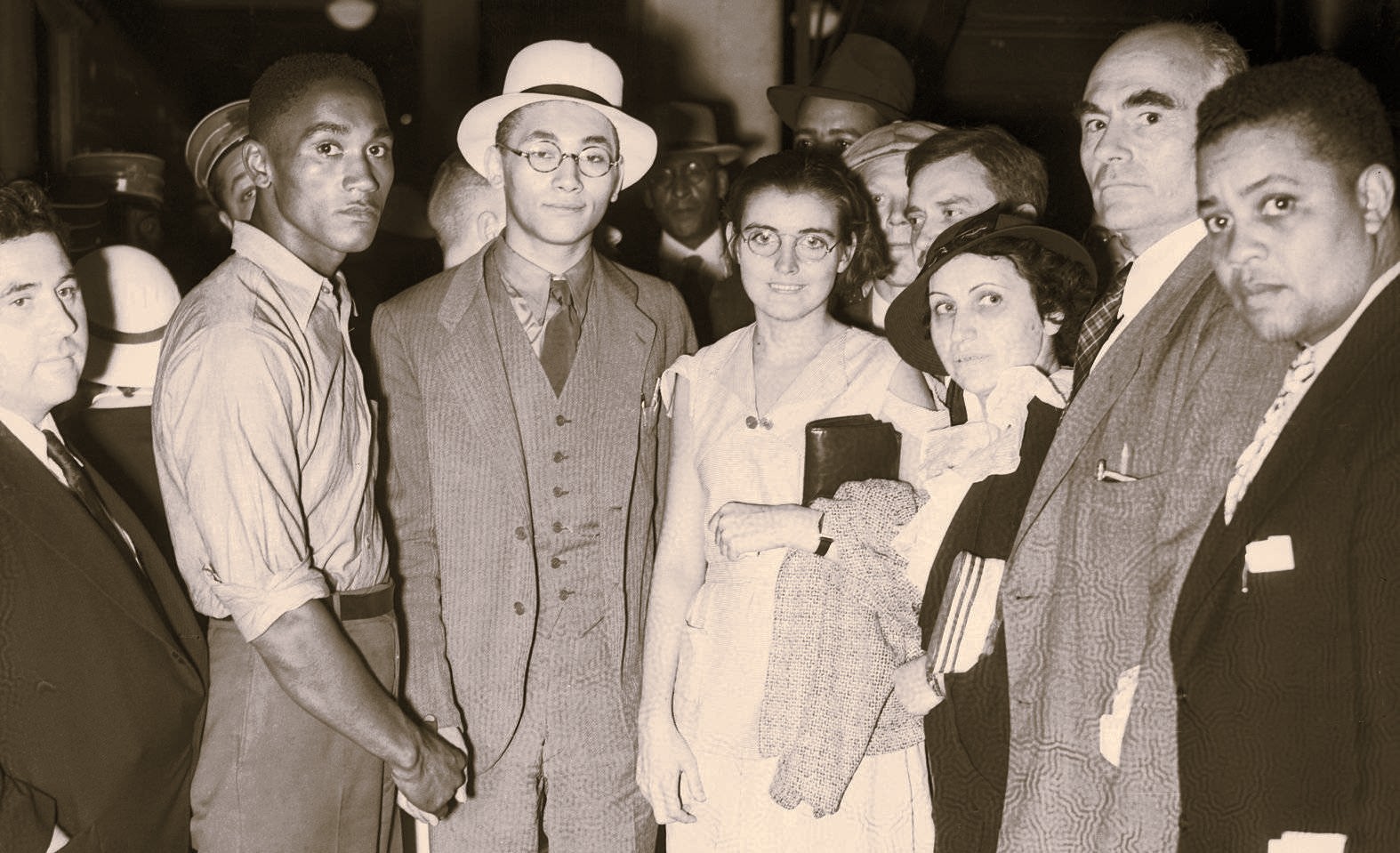
After a year and a half in prison, Angelo Herndon is freed on 15,000 bail while awaiting appeal for the charge of ‘inciting Negroes to insurrection’ and emotionally greeted by thousands of supporters on his arrival in New York City.
‘10,000 Cheering Negro and White Workers Take Over Terminal as Herndon Arrives’ by Edwin Rolfe from The Daily Worker. Vol. 11 No. 190. August 9, 1934.
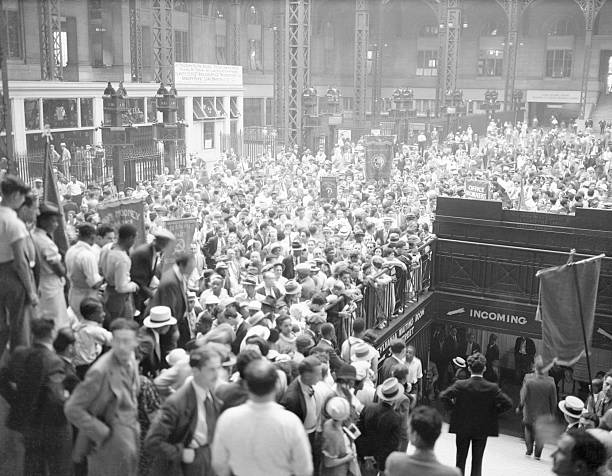
NEW YORK. For more than an hour on Tuesday evening the huge Pennsylvania Railroad Terminal belonged to the militant workers of New York City.
These were the workers—10,000 of them—who massed to greet Angelo Herndon, young Negro Communist leader, on his arrival from the Fulton Tower prison in Atlanta on the 6:46 train Tuesday evening. They accorded Herndon, out on $15,000 bail and facing a sentence on the Georgia chain-gang, a rousing joyful welcome such as has rarely been given to any working class leader.
A group of outstanding workers’ leaders was at the Pennsylvania Terminal to greet him when the train arrived—a delegation which included Earl Browder, general secretary of the Communist Party; C. A. Hathaway, editor of the Daily Worker; Charles Krumbein, district Communist Party organizer; Robert Minor and James W. Ford, of the Central Committee of the Communist Party; Richard B. Moore and Anna Damon, of the national office of the International Labor Defense; Benjamin J. Davis, Jr., I.L.D. lawyer in the Herndon case and now editor of the Negro Liberator; MacWeiss, of the Young Communist League; and Ben Gold, secretary of the Needle Trades Workers Industrial Union.
Masses With Banners
While this delegation waited on the platform, more than 500 others milled about the track entrances on the level above, and over 9,000 workers packed the south half of the main hall upstairs.
These workers had begun arriving singly and in groups, behind red banners and placards bearing the names of their organizations, long before “the I.LD. special’’ pulled into the station. They surged through the main hall, laughing and joyfully expectant, anxious to catch a glimpse of the heroic young Communist who had spent 19 months in the Atlanta jail—anxious to show their devotion to and solidarity with the young man who had defied the southern lynch bosses and courts in his efforts to save these Scottsboro boys.
As the train bearing Herndon and Joseph R. Brodsky, chief I.L.D. attorney, and Rev. J.A. Martin, Atlanta Negro minister, roared into the station, special guards and policemen shunted the crowd to an entrance away from the one where Herndon was to appear. But a Negro porter, who had read of Herndon’s fight in Georgia, spotted the deception and immediately rushed to Anna Damon’s side.
“Not this door,” he whispered. “That one, over there.”
Hoisted on Shoulders
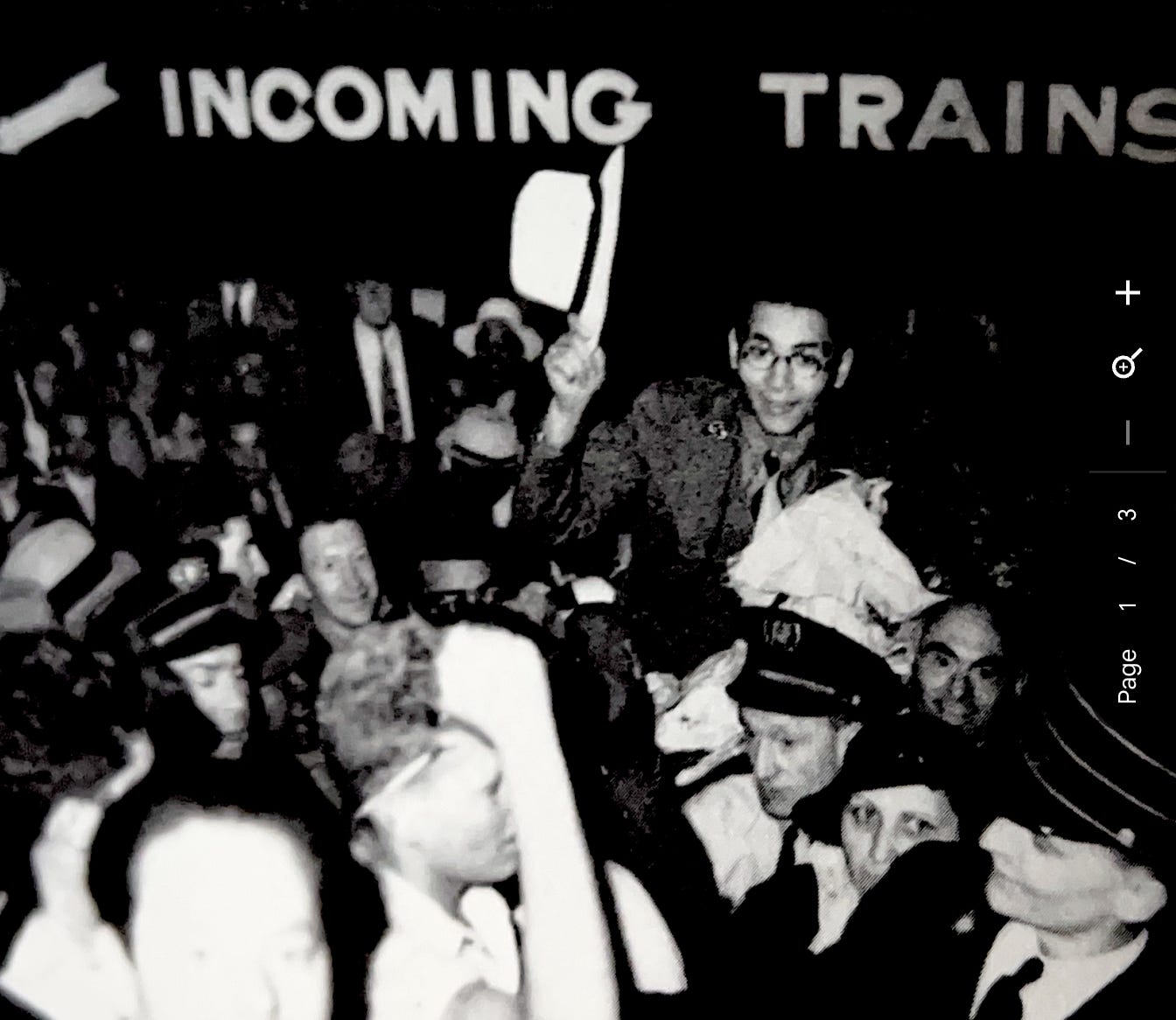
As Herndon appeared he was immediately hoisted upon the broad shoulders of Bob Minor, and his brother, Milton Herndon. A Negro worker appeared out of the crowd and joyfully pressed a large bouquet of fiery red roses into his hands.
Herndon, balanced above the mass of workers about him, took the flowers in one hand. With his other hand he waved to left and right his white Panama hat, the joy of the assembled workers reflected on his face as—his health, impaired by his long incarceration and tired after the long train journey smiled a happy answer to this welcome.
As he was carried up the marble stairway into the main hall of the terminal, black arms and white were held up, thousands of them, as cheers echoed through the station and the workers sang the International.
Rush to Shake Hands
The same workers who a few minutes before had applauded, Mike Walsh and F.D. Griffin, of the Harlem I.L.D., when they predicted how great the demonstration would be when the nine Scottsboro boys would arrive in New York, raised their voices now in deafening cheers, They rushed forward about him, eager to shake his hand, to hold their placards shouting “Welcome!” before his eyes.
But deep voices boomed “Discipline. comrades, discipline!” and the crowd fell back, opening a path through which he was carried out into 32nd St. The crowd surged close behind, closing the pathway as soon as he had passed.
A young worker, in his excitement, fell against two old matronly working-class women. Turning toward them to ask forgiveness, he saw they were crying. “I’m sorry,” he shouted to make himself heard, putting up his arm to shield them from the crowd. “Oh, it’s not you,” they cried, pointing to the frail figure on Minor’s shoulders. “It’s not you!” The tears caught the corners of their lips, upturned in broad smiles of joy.
Traffic Stopped
On the shoulders of outstanding Communists, Herndon was borne across the street to an empty parking ground. Here for fifteen minutes he waited, meeting members of the delegation, resting, waiting for the car which carry was to him to a comrade’s home, to rest. All of these leaders were known to him by name and by deed—but most of them he met personally in this little parking space for the first time. Outside the parking ground the massed workers captured the street, just as for an hour before his arrival, they had made the Penn Terminal theirs. Police, knowing how powerless they were to dispel this happy, determined throng, stopped traffic on 32nd St., between Seventh and Eighth Aves., while photographers clicked their cameras and Herndon, in the center of a human circle held intact by linked arms and hands, stood waiting for the auto which took him away to quiet, to the recuperation he needs before again facing the Southern courts in the I.L.D.’s appeal against his 18 to 20 years’ sentence to the Georgia chain gang.
Once Herndon was in the auto the workers fell back again, clearing a lane through which his car could pass. Again, as the auto moved on, the lane was closed, and the crowd followed behind down 32nd St., going spontaneously into disciplined march formation, in lines of four, as they reached Broadway, where they turned south.
“Scottsboro Boys Shall Not Die”
Singing and shouting “Free Angelo Herndon!” and “The Scottsboro Boys Shall Not Die!” they swept into Union Square just before dusk, immediately set up a speakers’ stand on the south end of the square near the Army recruiting station, and immediately opened a meeting.
Only once was a speaker interrupted. That was when the car carrying Herndon was recognized as it pulled up to watch the meeting on Fourth Ave., before Klein’s department store. The workers left the meeting, rushing across the wide avenue. For several minutes all traffic halted, before a mass of men and women more effective than any red traffic light. But again the cry of “Discipline, comrades,” turned them back to the meeting.
Several speakers kept the crowd listening tensely on the square until dark. The words of Bob Minor set the spirit of the meeting. Some of his words, sentences, remained with the workers when they boarded the subways for home.
“We assembled a short time ago at the Penn Station,” Minor said, “to meet a train coming from Atlanta, Georgia. On It was Angelo Herndon, whose name Is today known throughout the world.
“Herndon was 19 years old when he stood up in a Georgia court and proclaimed himself a revolutionist, a leader of the Young Communist League…Ten years ago there was no Angelo Herndon. There was no black leader of white workers. Today we have hundreds—they spell the unity of black and white workers throughout America!…If you honor this inspiring unity, you should honor the Communist Party, which is responsible for it! Herndon is only a boy in years, barely old enough to cast his first vote, yet he has already shaken the entire South!…Without the Communist Party, there could not have been an Angelo Herndon…Yes, comrades, fellow workers
“Four years ago a freight train stopped at Scottsboro. That train cut a deep gash through the South that will remain until we have a Soviet America!”
The Daily Worker began in 1924 and was published in New York City by the Communist Party US and its predecessor organizations. Among the most long-lasting and important left publications in US history, it had a circulation of 35,000 at its peak. The Daily Worker came from The Ohio Socialist, published by the Left Wing-dominated Socialist Party of Ohio in Cleveland from 1917 to November 1919, when it became became The Toiler, paper of the Communist Labor Party. In December 1921 the above-ground Workers Party of America merged the Toiler with the paper Workers Council to found The Worker, which became The Daily Worker beginning January 13, 1924. National and City (New York and environs) editions exist.
PDF of full issue: https://www.marxists.org/history/usa/pubs/dailyworker/1934/v11-n190-aug-09-1934-DW-LOC.pdf
 Revolution's Newsstand