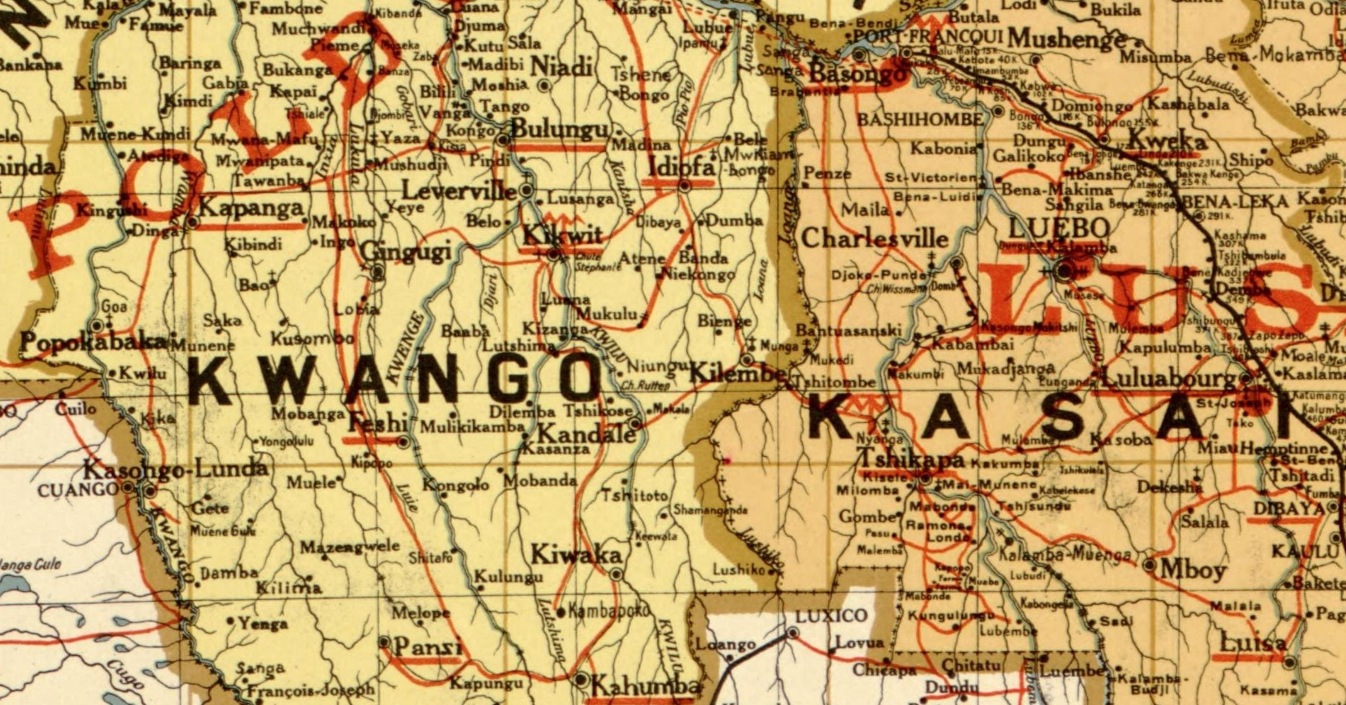
A report on the 1931 Pende rebellion of Congo’s Kwilu region against Belgian imperialist rule.
‘Bloody Suppression of Native Rising in the Belgian Congo’ by Mansy from Negro Worker. Vol. 1 No. 8. August, 1931.
The unbearable conditions of life of the Negro masses in Africa and particularly in the Belgian Congo, are driving the masses to a struggle against the colonisers. The Developing world economic crisis has also hit this slave colony of Belgian imperialism very hard. There have been many bankruptcies, and drop in production in many plants.
Negroes Terribly Exploited.
There has been a general slowing down of the industrial and commercial life of the whole of the Belgian Congo. As a result of this crisis, a great number of the toiling Negroes are out of work. Thousands of black working men and working women from Guiana and the Congo, work in the enterprises of the colonisers. Besides this, raw material and fruit is gotten and carried on in a great section of the areas. The large reserves of raw materials and great number of enterprises demand labour hands. The imperialists take all measures to force the native workers to work on their plantations and enterprises. In the majority of cases they use fire arms for this purpose. The black overseers, who are used by the exploiters, resort to force and fraud and compel the workers to work almost for nothing. The work at the enterprises is carried on under extremely hard conditions. On the average they work from 11 to 12 hours per day. In those enterprises where the equipment is old and out of date, the work is less intensive, but the length of the working day is 14 hours. The Negroes have to pay taxes in ready cash to the Belgian colonisers. This applies to those who work in the enterprises as well as those living in the villages and settlements.
The present of the Belgian Congo is like the past. The Belgian Congo was conquered by fire and sword. At the time of the rising in 1920-21, armed forces of Belgian imperialism levelled to the ground and destroyed thousands of settlements in the Busara area. This was done in order to suppress the rebels.
In 1928 the “mutiny” in North Rounda was drowned in blood and strangled by means of a wild orgy of massacres. The soldiers and gendarmeries burnt more than a thousand peasants huts.
British Soap Company Exploits Natives.
The rising extended to the Kuango area, on the border of Kuila, where the margarine and soap enterprises of Lord Leverhulme are concentrated.
These most frightful conditions and acts of the colonizers forced the Negro masses to loose their patience. They took up arms to fight for their emancipation. Armed with spears, arrows, stone and rifles, they rose against the punitive expeditions of Belgian imperialists who demanded from them payment of taxes in full. The rising spread over the whole area. Additional armed forces were sent against the rebels. The “mausers” began to speak. The streets of the mutinous villages and settlements were covered with killed and wounded blacks. The whites had only two wounded. But the violent onrush of the natives forced the soldiers of the colonizers to retreat.
Uprising Spread.
Military reinforcements were sent twice to the place of the rising. These expeditions suppressed with wild cruelty the rebels. But in spite of this, the rising was not suppressed. It spread further. The rebels set fire to the station points at Pikuzu and Kazengu. The soldiers who were at first compelled to retreat and return with considerable reinforcements. Bloody terror raged in the area of rising. Machine guns swept everything before them. On the borders of the areas of rising huge military forces were concentrated. Two objects were aimed at by the imperialists: In the first place to prevent new districts from joining the rising, and in the second to prevent the retreat of anyone in the mutinous area of Kuango.
Imperialists Plan Mass Murder.
The plan of the colonizers-hunters is to close up the rebels on a small area, to isolate them from other districts and to carry out a mass butchery and thereby put an end to the “mutiny.”
The attitude of the “motherland” to these bloody events is exceedingly characteristic. The question was raised in parliament by one of the senators, as to what was going on in the Belgian Congo and whether it would not be better if the government were to take up a more moderate policy in the suppression of the rebels in Kuango. The colonial Minister Crockett replied to this question as follows: Some times it is necessary…to avoid something worse.”
Role of so-called Socialists.
The declaration provoked not the slightest protest on the part of the senators of all shades, including also the social democrats, (so-called socialists) who gave this minister an almost enthusiastic reception.
The pretty words “it is sometimes necessary” mean that the government has decided to drown in blood the rising of Negroes, whom they systematically plunder, rob, exploit and kill. This in its turn means that the soldiers of the imperialists will, during all this time, suppress and reestablish imperialist order and that the blood of the Negro masses will flow still more, that hundreds and thousands, when they run away to the forests to save themselves from the bullets of the white colonizers, will be in danger of destruction from wild beasts, hunger and fever. That is what these words “it is sometimes necessary” calmly, pronounced, in parliament, by the Colonial Minister mean. It means rule by blood and iron. The members of the assembly have the same interests in this as the colonial banditism.
Only Communist Voice Protest.
It was only the Communist Party of Belgium, acting in cooperation with the workers, that came out openly in solidarity with their black comrades from the Congo. Special leaflets were issued explaining the events in Belgian Congo. A number of demonstrations and meetings were organized. The demonstration in Serenga was especially successful.
The communist deputy in parliament, Jacquematte protested in parliament in the name of the revolutionary proletariat against the Congo butchery. This speech had its effect, the bourgeoisie and especially the social-democratic press at first organized a conspiracy of silence in regards to the events which were taking place, but after the speech of Jacquematte small reports began to appear in the press about the character of the rising, also the number of killed etc. In the official press 160 Negroes were reported as killed, but in a foot note it is stated that the official number of killed are given as only 86. In reality the number of Negroes killed does not conform to the figure of 160 by far. This for instance, the “Soir” which printed a bulletin on the “Victory” describes a butchery in the neighborhood of a certain warehouse as a result of which more than 100 Negroes perished.
Hundreds of New Negro Rebels Rise.
The band of lying and slanderous Belgian colonizers does not wish to give a true account of the events in Belgian Congo. The history of the last years is one of the most bitter struggles against the colonizers on the part of the native masses in the settlements and towns.
The Belgian bourgeoisie is incapable of destroying the revolutionary movement. In the place of every rebel tortured to death, tens and hundreds of new ones arise. Many toiling Negroes know of the Soviet Union. They know also that in the Soviet Union the working class is the master of the means of production, that the working class overthrew the capitalists and the landlords and the national peoples inhabiting the Soviet Union have all attained tremendous achievements in the way of the growth of culture and economic development.
Only Way to Freedom— Fight to Destroy Imperialism.
The Belgian colonizers are trying to keep under their yoke the toiling Negro population of the colonies. But the sea of lies will not deceive the native masses. On the basis of their bitter experience they know very well what the imperialist beasts of prey are. They see with their own eyes the horrors of capitalist “civilization”, they feel the ever growing oppression of rotting capitalism, which before its inevitable end is trying to tie the noose still tighter around the neck of the oppressed people of Belgian Congo, and is trying by way of increased exploitation, to delay its fall.
Under the leadership and with the assistance of the revolutionary proletariat the Negro toilers will fight for the overthrow of the rule of Belgian imperialism, and will win.
First called The International Negro Workers’ Review and published in 1928, it was renamed The Negro Worker in 1931. Sponsored by the International Trade Union Committee of Negro Workers (ITUCNW), a part of the Red International of Labor Unions and of the Communist International, its first editor was American Communist James W. Ford and included writers from Africa, the Caribbean, North America, Europe, and South America. Later, Trinidadian George Padmore was editor until his expulsion from the Party in 1934. The Negro Worker ceased publication in 1938. The journal is an important record of Black and Pan-African thought and debate from the 1930s. American writers Claude McKay, Harry Haywood, Langston Hughes, and others contributed.
Link to full PDF of issue: https://www.marxists.org/history/international/comintern/negro-worker/files/1931-v1n8-aug.pdf
 Revolution's Newsstand