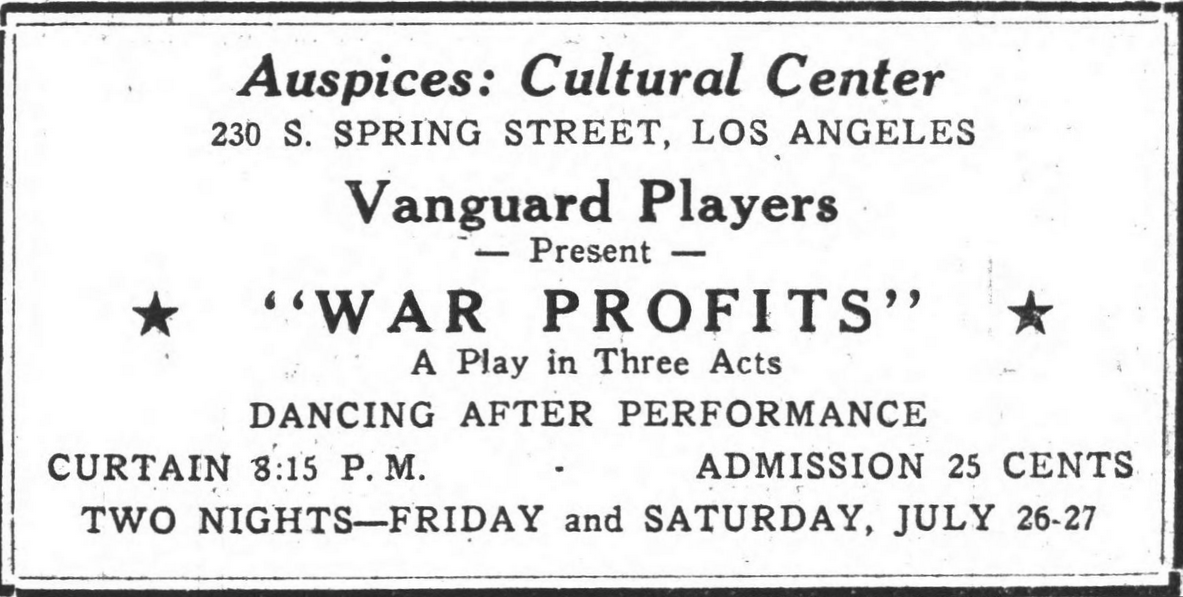
Radical performing arts groups Contemporary Theater, The Hollywood Players, and the Film and Photo League counter the ‘dream industry’ in Los Angeles.
‘A Theater of Meaning in Hollywood’ by Sidney Roger from Pacific Weekly (Carmel). Vol. 3 No. 1. July 8, 1935.
RIGHT in the midst of Hollywood, a revitalizing theater movement emerged at last in the form of the Contemporary Theater, The Hollywood Players, and the Film and Photo League. There are also other entertainment-propaganda groups that are equally effective on a smaller scale. These organization have recognized the potentialities of working class entertainment. Their purpose is primarily to combat the growing anti-labor or escapist theater and cinema, and replace them with the powerful artistry of class-conscious drama.
The decadence and helplessness of the bourgeois stage finds its antithesis in the Contemporary Theatre and Hollywood Players. The former group launched its career in conjunction with a Negro group in the production of Stevedore. This play by Paul Peters sensitively portrays the life and struggles of Negro dock workers in New Orleans. The startling picture of Negro workers, their fear of “stepping out of their places” even in the face of intense exploitation and outright cheating, their growing self-conscious strength, the domination and racial prejudice of white employers and the united front of white and black workers to final victory–came to life with dynamic intensity and sincerity. It was entertainment, and it was also an important object lesson. Although the acting was amateur and spontaneous and the direction a bit confused, the play drove its meaning home.
The next play of this group was Peace On Earth, by Sklar and Maltz. This play centers around a professor, whose anti-war sympathies cause him to join with students and longshoremen who are striking to prevent shipment of munitions to a belligerent nation. On the docks, the professor becomes actively involved in the strike when his friend is shot by hired thugs. He openly repudiates a trustee of the university who is a munitions manufacturer. His growing realization of the cause of war motivates his leading of a demonstration during which a policeman is shot. He is arrested, framed up and sentenced to die. In the last act the situation comes to a head. A war is actually provoked with a situation strikingly reminiscent of “the Maine”. The great jingoistic-propaganda machinery, in which the university pedagogs, the “timid profession”, play their part, comes into action. The liberals betray the professor and in spite of mass protest, the war-hysteria executes him. The performance of the experienced cast, under the expert direction of Jascha Frank, left little to be desired. The audience left with a clear understanding of the forces behind imperialist war and a practical method of combating these forces at their source.
The most recent play presented by this group, Sailors of Catarro, by Friederich Wolfe, dramatically records the incidents in the revolt of Austrian sailors in the Bay of Catarro. Their lack of revolutionary tactics, their confusion and inability to cope with better-trained forces, cause their downfall. This is an exceptional work of revolutionary self-criticism, but it seemed lost to any but the tutored. Yet it was exciting and dramatic enough to hold the audience in breathless suspense. The poor acting was successfully counterbalanced by the skilful direction of Rappaport, former assistant to Pabst, and an excellent set. The main criticism lies with the play itself and not the production. One fails to sense the seething mass of sailors below decks, and the essential working-class character of the uprising, in the personal revolution of a small group whose symbolism is never sufficiently apparent. Nevertheless, this production can be chalked up as another successful experiment in the building of a theater of meaning in Los Angeles.
The really glorious culmination of the revolutionary theater “season” (the workers’ theater can hardly afford to be limited by seasons) was the Hollywood Players’ production of Clifford Odets’ Till the Day I Die and Waiting for Lefty. Both plays were under the direction of Will Ghere, who was later brutally beaten by fascists for portraying the Hitler terror. The first play paints a picture of the underground anti-fascist movement in Germany–the tragedy of broken lives—torture, concentration camps–and the undying heroism of the working-class. There was an unnecessary amount of sentimentality, perhaps, to strike a “human-interest” note, and a very depressing ending, but it drove home its alert message. The production limped under the handicap of poor acting and too slow tempo.
Waiting for Lefty more than made up for the faults of Till the Day I Die in content, writing and masterful execution. We see a union at which labor fakers attempt to stall off the taxi-drivers from strike action. This is followed by a series of rapid, cinematic flash-backs into the lives of the drivers and the forces which lead them to strike. Climax follows climax to the final denunciation of the “union leader” by his own “bastard brother”. The speeches of the workers who have finally taken the floor, and the announcement that their leader, Lefty, has been murdered, lead to a concerted call for “Strike!” Even the blasé Hollywood audiences were stunned and rose on the final curtain with a roar of approval. The directness of appeal, the expressive dialogue and spirited, natural acting, make this the best revolutionary theater yet seen in Los Angeles.
Paralleling work done by the stage groups, the Film and Photo League of Los Angeles has started working on home ground to combat the opiatic propaganda of the “artistic” movie industry. (No more will the workers be forced to live vicariously in palaces of parasites and on “love that passeth all understanding, or to be scared out of all remembrance of their miseries by synthetic Draculas. No more will they become involved in the geometric gyrations of love triangles.) This new film group is bringing to the workers pictures portraying their own lives–pictures emphasizing the struggle for a better life. The healthy class-conscious character of the Film and Photo League is the most refreshing and important addition to the American cinema.
The history of this organization dates back three years, when a small group of film workers, realizing its necessity, tried unsuccessfully to form a workers’ cinema. After a long- dormant period, its importance in the workers’ life was again recognized, and it has re-started with new vitality.
A membership of studio workers, technicians and artists led to the acquisition of a large house, in which a small theater, projection room and laboratories were set up. The League owns its own 16mm camera, accessories and a sound projection machine. Already they have produced thirty-two reels of documentary, news-reel film depicting the strikes, struggles and victories of the California workers on various fronts. They have a fine stock of Russian films on hand, and are constantly kept busy by demands of unions and other working-class organizations. The League shows fine foreign films every Sunday night to the general public. So far they have shown Potemkin, Broken Shoes, Deserter and A Nous La Liberté.
The aim of the Film and Photo League is three-fold. First: to awaken interest in workers to the cinema as a medium of education. Second: to provide an understanding of the fine art of cinema. Finally: the integration of the above forces of art and propaganda for the production of American class-conscious cinema.
This phenomenal growth has taken place within the short period of nine months! Add to this that the locale maintains the reputation of being the largest bourgeois entertainment center of the world, and a reactionary stronghold for Chandler and Hearst. Then the record of the workers’ theater in Southern California takes on majestic proportions.
Pacific Weekly, based in Carmel, California was edited by William K. Bassett, Lincoln Steffans, and Ella Winter from late 1934. A Popular Front-era ‘fellow-traveler,’ magazine that became more of a Party press over its life. With a strong literary and arts focus, something of a West Coast ‘New Masses’, the weekly did not survive long after Steffans death in June, 1936. Though its run was short, Pacific Weekly is a rich record of left-wing 1930s writing with authors like publishing work in its pages.
PDF of full issue: https://archive.org/download/ccarm_008376/ccarm_008376_access.pdf
 Revolution's Newsstand